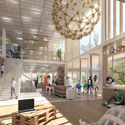
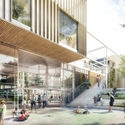
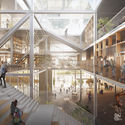
Herzog & de Meuron to Design the National Library of Israel

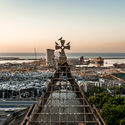
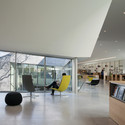
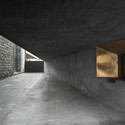
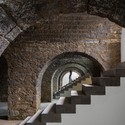
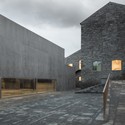
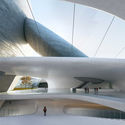
After carefully considering six international architecture firms – Ammar Curiel; Frank Gehry; Herzog & de Meuron; Kimmel Eshkolot, Kolker Kolker Epstein and Renzo Piano – an esteemed selection committee has chosen Herzog & de Meuron to design the new National Library of Israel in Jerusalem. The result comes after a controversial first attempt that ended in the dismissal of the initial competition winner for alleged copyright infringement.
More information after the break…
City Council Approves Redevelopment of NYC’s Historic Pier 57

New York’s City Council have unanimously backed a proposed plan to restore and redevelop the aging giant that is Pier 57. Built in 1952, the 300,000 square foot pier was hailed by Popular Mechanics as a ‘SuperPier’ for its vast size and unconventional construction, as most of the pier’s weight is supported by ‘floating’ air-filled concrete cassions. The pier was originally used as a bus depot by the New York City Transit Authority, however it has been lying vacant since 2003. The latest decision brings a concrete end to years of speculation as to what the fate of the pier would be.
Read more about the proposal after the break…
Russia’s Historic Mariinsky Theatre to Celebrate Grand Opening of Mariinsky II

On May 2, Russia’s preeminent Mariinsky Theatre will celebrate the grand opening of a new, 851,575 square foot addition on a neighboring site, just west of the company’s original 1860 theatre and 2006 concert hall, in the heart St. Petersburg. Designed by Toronto-based Diamond Schmitt Architects, Mariinsky II will be one of the largest theatre and concert venues in the world, providing a 2000-seat auditorium, state-of-the-art production facilities, and naturally lit rehearsal rooms, along with a rooftop amphitheatre and terrace.
Buckminster Fuller’s 50-Foot “Fly’s Eye” Dome to be Restored

Noted architectural historian and preservationist Robert Rubin has purchased the largest of Buckmister Fuller’s ”Fly’s Eye” domes and plans to reopen it to the public this summer for the first time in 30 years.
More on Fuller’s dome and its new owner after the break…
Changsha Meixihu International Culture & Art Centre / Zaha Hadid Architects

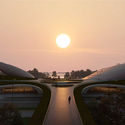
Zaha Hadid Architects (ZHA) have unveiled an ambitious cultural complex, which began to take shape in October after the project broke ground in the heart of Changsha, China. In true Hadid-fashion, the Changsha Meixihu International Culture & Arts Center defines itself by extreme sinuous curves that radiate from each of the three independent structures and links them to a pedestrianized landscape that offers a “strong urban experience”, forming what they hope to be a global destination for theater and art.
The architects’s description after the break…
Vieux Port Pavilion / Foster + Partners

Saturday in Marseille, France, pedestrians and city officials joined Foster + Partners to celebrate the completion of the Vieux Port Pavilion at the mouth of Marseille’s World Heritage-listed harbor. Minimal, yet effective, this “discreet” intervention provides a new sheltered events space on the eastern edge of the port. With six slender pillars supporting its razor-thin profile, the polished 46 by 22 meter stainless steel canopy amplifies and reflects the surrounding movement of the harbor, creating a spectacle that encourages pedestrians to linger.
More on Foster’s Vieux Port Pavilion after the break…
Grottammare Cultural Center / Bernard Tschumi Architects

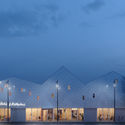
This dynamic cultural center in Grottammare, Italy, will be Bernard Tschumi Architects’ first commission in Italy. Inspired by the city’s small medieval center, the roughly 7,000 square meter structure will house a variety of exhibitions, conferences and workshops in an effort to “strengthen people’s ties to the territory with which they identify” by exchanging information about the existing city and envision its possibilities for the future.
The architect’s description after the break…
Diller Scofidio + Renfro Designs Telescopic ‘Culture Shed’ for New York

The expandable multi-use cultural venue dubbed ‘Culture Shed’ is one of the most radical proposals to come out of New York’s Hudson Yards Development Project. Designed by Diller Scofidio + Renfro - the New York-based interdisciplinary practice that played a major role in designing the High Line - in collaboration with the Rockwell Group, this 170,000 square foot cultural center will be located at the south end of the Hudson Yards, with the main entrance located near the conclusion of the High Line at West 30th Street.
More information on the Culture Shed after the break…
Renzo Piano Designs a Flat-Pack Auditorium for L’Aquila

In April 2009, the central Italian city of L’Aquila was devastated by a crippling earthquake, claiming lives and causing extensive damage to thousands of buildings, including the leveling of the city’s main auditorium venue. Nearing the fourth anniversary of this tragic disaster, the Italian city of Trento has donated a Renzo Piano-designed auditorium, which was inaugurated in October, in an effort to aid the reconstruction of this medieval city.
Creating an illusion of instability, the auditorium is formed by three interconnected cubes made entirely of wood (1.165 cubic meters in total) that ironically appears as they had “haphazardly tumbled down” and came to rest upon each other. The entire structure was prefabricated and then assembled onsite by Log Engineering, who pieced it together with 800,000 nails, 100,000 screws and 10,000 brackets.
Update: SFMOMA Expansion / Snøhetta

The San Francisco Museum of Modern Art (SFMOMA) has announced further details of its 235,000-square-foot building expansion that will support the museum’s increasing role in city life and the international art community. Designed by Norway-based practice Snøhetta, in collaboration with local firm EHDD, the 10-story concrete structure will compliment SFMOMA’s original, Mario Botta-designed, red-brick museum by offering more free-to-the-public space, expanded education programs and an abundance of flexible performance-based gallery space.
Construction will commence this Summer and is expected to reopen in early 2016.
More after the break…
Herzog & de Meuron’s Elbphilharmonie to be Completed by 2017

Sitting idle since November 2011, Herzog & de Meuron’s long-running Elbphilharmonie concert hall in Hamburg, Germany, has left residents wondering when will the music ever begin?
First envisioned back in 2003, the enormous crystalline glass structure stands nearly complete on top a historic warehouse on the edge of the River Elbe. Rising costs, delayed schedules and legal issues with the contractor, have plagued this magnificent concert hall with controversy. However, according a report in the German news magazine Der Spiegel, contractor Hochtief has initiated a new deal to ensure the completion of the building.
A revised contract, which is expect to adjust the architect’s fee’s to €94 million (€17 million over the original project cost), has projected Elbphilharmonie will be completed within the next four years. The news is bittersweet, as the architectural community and the residents of Hamburg have been waiting years for this highly anticipated concert hall to be complete, yet they cringe at the news of an overblown €575 million price tag.
Diller Scofidio + Renfro’s Aberdeen Garden City Proposal Nixed

After winning the Aberdeen City Garden competition in early 2012, Diller, Scofidio + Renfro‘s ‘Granite Web’ design was rejected over the summer in a 22-20 city council vote for being overly expensive. Despite public approval the proposal, which totaled a whopping £140m, was rejected in favor of a collection of more fiscally responsible city projects, such as refurbishing the Aberdeen Art Gallery and redeveloping the site of the St. Nicholas House.
Just recently, the City of Aberdeen announced a £300m city-wide plan of improving roads, schools and cultural buildings, with only £20m allotted for the city center, which will be pedestrianized but not much else. Thus, confirming the “final nail in the coffin“ for DS+R’s ambitious web of lush gardens and cultural landmarks.
Read more after the break…
In Progress: The Biomuseo / Gehry Partners

The Puente de Vida Museum, more commonly referred to as The Biomuseo, will be Frank Gehry’s first design in all of Latin America. It is located in Panama in the area called Amador, which sits only a few blocks from the country’s principal cruise port and is adjacent to Panama City. The mission of the Biomuseo is to “offer an impressing and educational experience about the biodiversity and emergence of the isthmus in Panama in order to motivate all Panamanians to get to know and to value this natural component of their identity, as well as to generate in all its visitors the need to protect the environment” (Biomuseo Website). The Biomuseo intends to explore the importance of Panama’s biological systems and its emergence as a geological link between North and South America, both of which have had global impacts many are unaware of.
With these goals in mind, it quickly became clear that the museum design needed to be something very special to attract the international attention its founders desired. They wanted the museum to be a never-before-seen kind of design and to serve as a new architectural icon for Panama, much like the Eiffel Tower does for France or the Tower of Pisa for Italy. With the participation of Gehry Partners as well as the world-renowned landscape architect Edwina von Gal & Company, the Biomuseo began to take form: an extremely unique, Gehry-esque structure surrounded by an open botanical park that complements the exhibits within.
More after the break…
Studio Gang Breaks Ground on Ecologically Diverse Urban Mecca

For the past several years the Chicago Park District and the City of Chicago have been working on appropriate uses for Northerly Island, a 91-acre man-made peninsula in Chicago, Illinois. The lakefront site branches off from Museum Campus, a section along Lake Michigan that is home to the Field Museum, Shedd Aquarium, and Adler Planetarium. Serving as an expansion to these cultural programs, Studio Gang Architects, in collaboration with SmithGroupJJR, have created an innovative design that integrates educational, cultural, social, and recreational activities into Northerly Island.
Read more about Northerly Island’s future after the break!
Steven Holl Architects to design Kennedy Center Expansion

Steven Holl Architects have been selected to design a new, 60,000 square foot addition to the prestigious John F. Kennedy Center for the Performing Arts in Washington D.C. The $100 million project, which will be lead by Steven Holl and senior partner Chris McVoy, is envisioned as three connected pavilions clad in translucent Okalux, glass, and Carrara marble, the material used on the original 1970s building designed by famed American architect Edward Durrell Stone.
Located mostly below grade on the south side of the existing facility, the protruding structures will be embedded within a lush landscape of public gardens. To the west, one pavilion will extend over the Potomac River, offering an outdoor stage at the water’s edge. The expansion will compliment the existing performance center with new classrooms, rehearsal and multipurpose rooms, along with lecture and office space. Both the new and the old will be directly connected underground and through the main plaza. A formal design will be refined and announced in the coming months.
More images and information on the Kennedy Center expansion after the break.
Miami: America’s Next Great Architectural City?

Miami, Florida is booming with new architectural projects by big names: everything from new condominums by BIG,to the new Miami Beach Convention Center. So why are so many big projects migrating to Miami Beach? The city is turning itself into an American cultural and civic center.
Join us after the break for more.
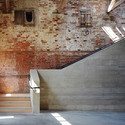
Are there TOO Many Cultural Centers?

Architects: Randall Stout Architects, Inc.; Associate Architects: Rodriguez Ripley Maddux Motley Architects.
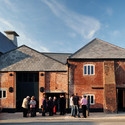
In a word, yes.
While the Cultural Policy Center of the University of Chicago would never put it that way, that is essentially the conclusion of their “Set in Stone” Report, released today.
The Report, a consolidation of 15 years of research involving over 800 building projects and 500 organizations, gathered hard evidence to find out: what influences a cultural building’s success or failure? The question is a relevant one: between 1994 and 2008 there has been a building boom of performing arts centers, museums, and theaters in the U.S., costing cities billions of dollars. And unfortunately, supply has outrun demand.
The biggest problem the Report identifies is that cities and towns, many of which have recently experienced improved education/income and enthusiastically undertake these projects, often overestimate the actual need for these centers in their communities. Thus, when they run into financial difficulties (most do: over 80% of the projects surveyed ran over-budget, some up to 200%), the centers become economic drains rather than cultural boons.
In other words: Just because you build it, it doesn’t mean they will come.
So what does make for a successful Cultural Center? More after the break…
Hanamidori Cultural Center / Atelier Bow-Wow
Architects: Atelier Bow-Wow / Yoshiharu Tsukamoto, Momoyo kaijima, Shun Takagi
Location: Tachikawa, Tokyo, Japan
Client: Showa Kinen Park Office
Commission year: 2002
Construction year: 2005
Function: Museum
Site Area: 6031 sqm
Constructed area: 5480 sqm
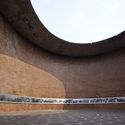
Poli House / Pezo von Ellrichshausen
Architects: Pezo von Ellrichshausen
Location: Coliumo peninsula, Chile
Client: Poli House Cultural Center
Area: 180sqm
Site Area: 10.000sqm
Construction start: 2004
Completion: 2005
Contractors: PvE
Structural Engineer: Cecilia Poblete
Materials: Concrete, Glass
Budget: 370 US$ / m2
Photos: Cristobal Palma