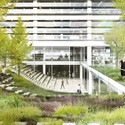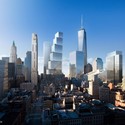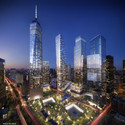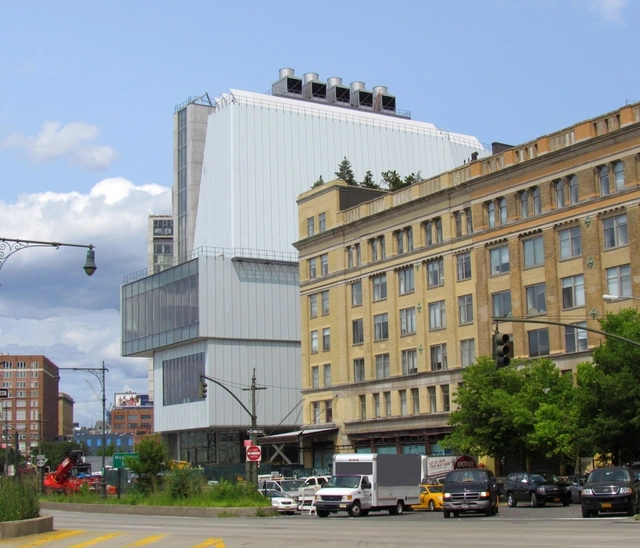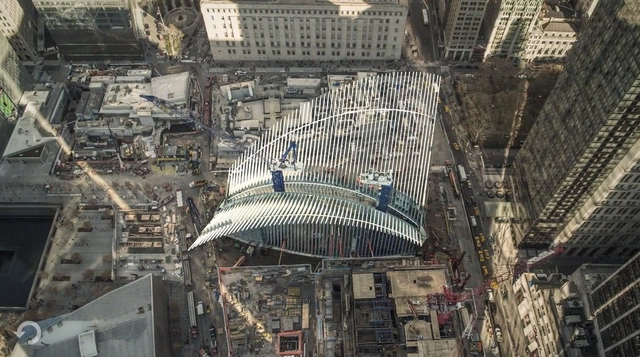
Last week, after a month of speculation, BIG unveiled their plans for New York's Two World Trade Center, replacing Foster + Partners' design which although started on site, was stalled due to the financial crash of 2008. With the building's high profile, in just one week BIG's design has been the subject of intense scrutiny. In this interview, originally published by New York YIMBY as "Interview: Bjarke Ingels On New Design For 200 Greenwich Street, Aka Two World Trade Center," Nikolai Fedak talks to Bjarke Ingels about the design of the tower and why it was necessary to replace the scheme by Foster + Partners.
YIMBY sat down with Bjarke Ingels to talk about his firm’s design for 200 Greenwich Street, aka Two World Trade Center. Despite public outcry following the change from the Norman Foster version of the tower, BIG’s innovative and forward-thinking building will truly respond to the human needs of its tenants, while also punctuating the Downtown skyline with a 1,340-foot take on a classic ziggurat. We’ve also obtained a few additional renderings of the soon-to-be icon’s impact on the cityscape.
"A living space should be a sanctuary. It has to be a place where you can reflect on your life." - Tadao Ando
NOWNESS has released a new video, this time interviewing the legendary Japanese architect Tadao Ando about his first New York building: Ichigoni 152. Planned to replace a parking garage on the corner of Kenmare and Elizabeth Street in Manhattan’s Nolita, the seven-story, seven-residence building aims to embody the energy of living in New York, while maintaining its role a "quite" and "sensitive" place of refuge for its inhabitants. "I would like to create something that only a Japanese person could do," says Ando. "It's about sensitivity."
Back in 2012, we found "Empire State of Pen," an amazing video of London-based artist and animator Patrick Vale’s drawing of Manhattan from the perspective of the Empire State Building. Now, Vale has taken a different perspective of the city, this time traveling a bit farther uptown to the Rockefeller Center area. Vale’s new drawing looks south, with the Empire State Building in the center, and the Freedom Tower in the background. To the east you can see the Chrysler Building, and to the west lies the Bank of America Tower in the Times Square area.
Vale started the drawing in December of 2014, when he spent an afternoon in -15 degree weather sketching and taking pictures, which he then took back to his studio to create the piece. The whole process took over a month to complete. Watch Vale's drawing come to life in the time-lapse video above, and view images of his illustration after the break.
Herzog & de Meuron's 56 Leonard is taking shape in New York. Due to top out this summer, the 60-story condominium has become known as the “Jenga tower” for its cantilevered glass facade. Upon its completion in 2016, the 821 foot-tall (250 meter) Tribeca building will be comprised of 145 residences and will feature a Anish Kapoor sculpture at its base. Check out the Rob Cleary time-lapse above to view the building's progress over the last year.
According to the New York Post, Renzo Piano has been commissioned by Michael Shvo and Bizzi & Partners to design his first US residential tower. Planned to rise in the southern Manhattan district of Soho at 100 Varick Street, the Piano-designed tower will include up to 280,000 square-feet of housing and reach nearly 300 feet. Featured amenities include a "gated private driveway" and "automated parking." Stay tuned for more details.
When the One World Trade Center opens its observatory elevators in May, visitors will embark on an unusual journey back in time with animated timelapse that recreates the evolution of Manhattan's skyline starting from the 1500s. In just 47 seconds, visitors will relive the city's architectural history, including the devastation of 9/11, while being lifted up 102 floors. Watch the video above, courtesy of The New York Times!
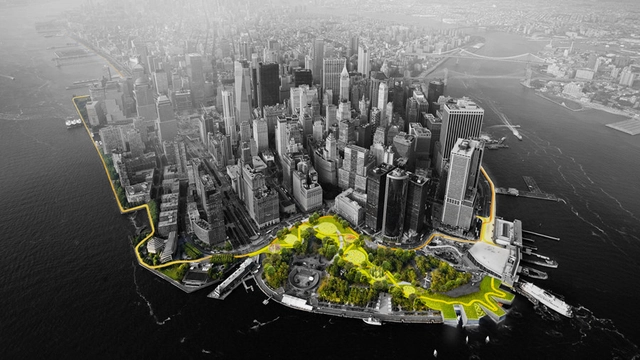
One of the six winners of the Rebuild by Design competition, Bjarke Ingels Group’s (BIG) “Dry Line” project aims to protect Manhattan from future storms like Hurricane Sandy by creating a protective barrier around lower Manhattan. The barrier will be formed by transforming underused waterfront areas into public parks and amenities. Now, you can learn more about the vision behind the project and how it was developed in a webinar led by Jeremy Alain Siegel, the director of the BIG Rebuild by Design team and head of the subsequent East Side Coastal Resiliency Project. The webinar will take place on Friday, June 12. Learn more and sign-up on Performance.Network.
David Chipperfield. Image Courtesy of David Chipperfield Architects
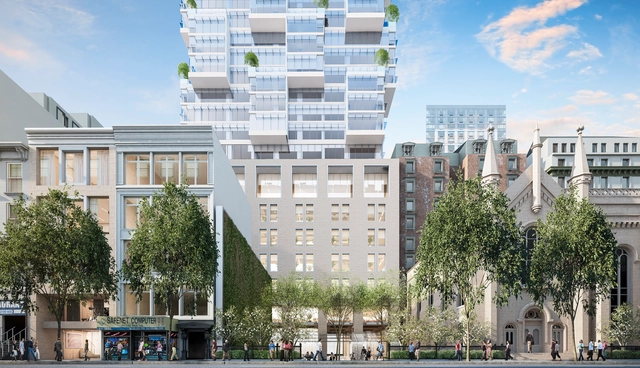
Manhattan based real-estate company HFZ Capital Group has announced "The Bryant," David Chipperfield Architects' first residential condominium project in New York City, located at 16 West 40th Street. The proposal for the 32-story building features a hotel on the lower levels, with 57 apartments ranging from one- to four-bedrooms, including two duplex penthouses, on floors 15 through 32 - offering residents "the rare opportunity to live in a new construction, residential development on the fully-restored Bryant Park," according to the developers.
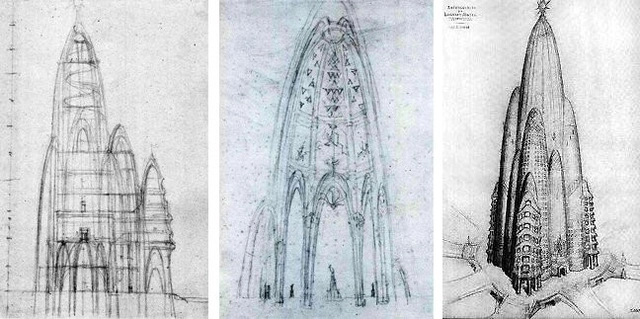
Sketches by Gaudí on the left, with Joan Matamala's drawing of the building on the right. Image Courtesy of 6sqft
Ever since its unprecedented skyward growth in the late 19th and early 20th centuries, Manhattan has been an icon of construction all over the world, with recent estimates concluding that the island contains some 47,000 buildings. However, as with all construction, completed projects are just the tip of the architectural iceberg; Manhattan is also the home of many thousands of unloved, incomplete, and downright impossible proposals that never made it big in the Big Apple.
Of course, the challenges of New York are indiscriminate, and even world-renowned architects often have difficulties building in the city. After the break, we take a look at just three of these proposals, by Antoni Gaudí, Frank Lloyd Wright and Frank Gehry, courtesy of 6sqft.
Conceptual plans of Perkins+Will’s East 37th Street Residential Tower in New York City have been unveiled. Debuted in Cannes, France, during MIPIM, where the high-rise received a “Future Projects Award,” the 700-foot-tall Manhattan tower boasts a “shimmering, angled curtain wall” organized by five clusters of shared amenities and open-air gardens.
More about the 65-story, 150,000-square-foot condominium tower, after the break.
But, unlike much of the press coverage that has greeted Calatrava in recent years, the New York Magazine article is much more forgiving, taking the time to investigate the twists and turns of the project's controversial 12-year history and offering the architect the opportunity to give his side of the story. Read on after the break for a breakdown of six takeaways from the article.
Despite his status, Le Corbusier never had the opportunity to build in New York - in fact he only had one chance to build in the United States at all, completing Harvard's Carpenter Center for the Visual Arts in Cambridge in 1963. But this doesn't mean his influence isn't visible all over the Big Apple. Originally published on 6sqft as "Towers in the Park: Le Corbusier's Influence in NYC," this article takes a look at three examples where Le Corbusier's "Radiant City" ideals were transplanted to New York.
Even before taking his first trip to New York in 1935, Le Corbusier described the city as “utterly devoid of harmony.” After seeing it in person, his feelings didn’t soften. He wasn’t impressed by the tall towers, rather stating that they were the product of an inferiority complex, and he thought the city’s leaders were too timid to hire him. He wrote an opinion piece in the New York Times saying that “American skyscrapers have not attained the rank of architecture; rather, they are merely small objects such as statuettes or knick-knacks, magnified to titanic proportions.” He thought the city would benefit from buildings that “don’t try to outdo each other but are all identical.”
A vision to protect post-SandyManhattan against future superstorms, Bjarke Ingels Group’s (BIG) “Dry Line” seeks to form a continuous storm barrier around lower Manhattan by transforming underutilized waterfront spaces into a “protective ribbon” of public parks and amenities. Though ambitious, the project is not impossible; it was one of six winners in the US’ Rebuild by Design competition that is envisioning ways New York can protect its edge.
Steven Holl and Vito Acconci’s Storefront for Art and Architecture has hosted its share of installations, but its newest intervention envisioned by SO-IL as part of the Blueprint exhibition is a whole new concept: covering the entire facade with shrink-wrap. The seamless outcome is deceptively simple, however, as the installation involved some careful calculations, a massive frame, and a dedicated team with an acute attention to detail. Read more about the project, see the finished product, and watch the process, here.
As uncovered by Curbed, construction workers at Rafael Viñoly's 1,396 foot (426 meter) tall 432 Park Avenue were served with a full stop work order last week by the New York City Department of Buildings, after an 8 foot (2.4 meter) long section of steel pipework was dropped from a construction hoist on the building's 81st floor.