Alexander Brodsky at Architekturzentrum Wien in 2011

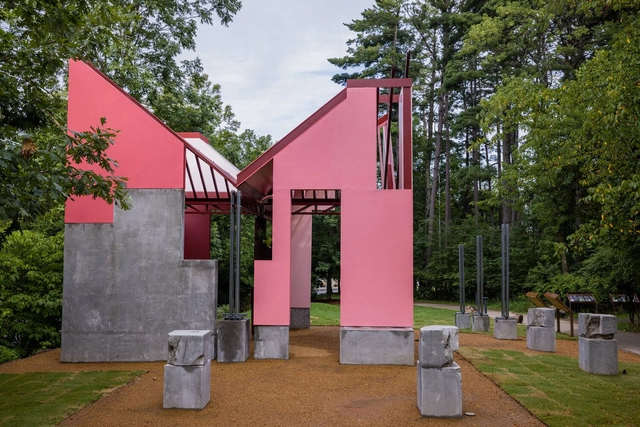
For this architect, there is an indiscernible line between installation and building.   studied architecture in Moscow, while working on art installations and drawings both independently and in collaborations with other artists. Brodsky admits that his career path was unconventional, that he felt unready to take on the responsibility of building.  Instead, Brodsky’s approach to architecture is through the lens of art: occupiable, room-sized installations that test spatial and sensory boundaries.

More after the break.

Milan Design Week 2013: Akihisa Hirata Designs ‘Amazing Flow’ for Lexus

Courtesy of Lexus

Under the guidance of , Japanese architect envisioned an  futuristic, experienced-based installation which sought to express “manifestations of flow as they relate to people and nature” to the spectators of the 2013 Milan Design Week. Titled “Amazing Flow”, the installation offered a “vision of the city of tomorrow” with a multi-sensory experience that embodied the “Lexus’ world vision” and a glimpse into how cars flow throughout built environment  The display consisted of a continuous, wooden structure that represented a moment in which “roads, humans, wind and water flow as a single entity.”

Compare the installation to the Lexus “Create Amazing” promotional video for the 2014 LF-LC Concept car and watch an interview with Hirata after the break…

Milan Design Week 2013: Energetic Energies for Panasonic / Akihisa Hirata

© Santi Caleca

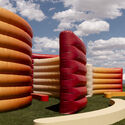
Envision a future where undulating “solar plants” transform the rectangular masses of our cities into a vibrant metropolis where technology aids in the coexistence of humans and nature. Represented in the conceptual installation “Energetic Energies” at the , this notion of redefining our relationship with the sky through photovoltaics is based on years of technological research and development by the Panasonic Corporation, who commissioned Japanese architect Akihisa Hirata to imagine the possibilities.

The exhibition features a 30 meter-long makeshift city, whose “hills” of photovoltaics overtake clusters of white, translucent buildings while shadows of clouds move in and out of the space.

A video interview with and more images after the break…

Steven Holl in Milan

©

On April 9, Steven Holl Architects is preparing to open the INVERSION, presented as part of Interni’s Hybrid Architecture exhibition event organized on occasion of the FuoriSalone 2013, during Design Week in Milan.

Christo Unveils Inflatable, Light-Infused Installation in Germany

© Wolfgang Volz, 2013 Christo

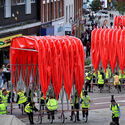
The internationally – and often controversial - acclaimed artist Christo has unveiled the “largest indoor sculpture ever made”. Prepared to debut in a public exhibition starting March 16, the inflated “Big Air Package” has been designed to occupy a 117-meter-tall former gas tank known as Gasometer Oberhausen in . The 90-meter-high, 50-meter-wide sculpture is made from 20,350 square meters of semitransparent polyester fabric and 4,500 meters of rope, with a total weight of 5.3 tons and a volume of 177,000 cubic meters. 

The seemingly endless, inflatable was conceived in 2010 and is Christo’s first major work after the passing of his wife and artistic partner Jeanne-Claude in 2009.

More on Christo’s “Big Air Package” after the break…

Situ Studio’s ‘Heartwalk’ Opens in Times Square

© Ka-Man Tse, Times Square Alliance

Just in time for Valentine’s Day, Situ Studio has unveiled the fifth edition of Times Square’s annual Heartwalk installation – a heart-shaped “room within the city” made of salvaged Sandy debris. Inspired by the “collective experience of Hurricane Sandy and the love that binds people together during trying times,” Heartwalk begins as two weathered ribbons of wooden planks that gradually lift to form an illuminated heart enclosure in the middle of Duffy Square.

People are already falling in love, as you can see Instagram’s #heartwalktsq is filling up with images of elated New Yorkers standing within the “heart of City”.

More images after the break…

SO? Wins YAP Istanbul Modern 2013

Courtesy of MoMA

SO? Architecture and IdeasSky Spotting Stop has been announced as winner of the 2013 Young Architects Program (YAP) Istanbul Modern in . Similar to its counterparts - CODA’s skateboard scrap Party Wall in New York and bam!’s buoyant installation He at MAXXI – the shady escape will be constructed in late June in the Istanbul Modern’s courtyard, offering refuge from the busy streets of Istanbul while overlooking the mouth of the Bosphorus.

More on ‘Sky Spotting Stop’ after the break…

bam! Wins YAP MAXXI 2013

Courtesy of

With an intention to attract and impress viewers with his massive scale, He has been selected as winner of the 2013 Young Architects Program (YAP) MAXXI in Rome, an annual competition that promotes and supports young and emerging architects in collaboration with MAXXI Architettura, MoMA/MoMA PS1 of , Constructo of Santiago and, for the first time, Istanbul Modern, Turkey.

Turin-based studio bam! bottega di architettura sostenibile, designed He as a grandiose and buoyant installation that transforms the concrete MAXXI facade and expansive piazza into a visual spectacular, while offering a shady escape from the Summer heat.

Video: Chris Burden / Metropolis II

YouTube Preview Image

Chris Burden’s massive kinetic sculpture, , will debut at at LACMA this fall. The project took Burden and his chief engineer Zak Cook four years to complete.

Burden, a performance artist known for crucifying himself on a Volkswagen and once hiring a friend to shoot him in the arm, doesn’t have any particular interest in transportation or urban planning, he says, although he has used toys in his artworks since the 1970s. “Toys are interesting as objects — they’re the tools you use to inculcate children into adults,” he told Fastco Design. “They’re a reflection of society.” His mini-city is “modeling something that’s on the twilight of extinction: the era of the ‘free car,’” Burden says, referring to the idea of jumping into one’s car anytime and going wherever one pleases. “Those days are numbered, but think it’s a good thing. The upside is that cars can be faster and safer, and you don’t have to worry about drunk drivers. Think about it: The cars in Metropolis II are going a scale speed of 230mph. That’d be great to do for real in L.A.”


Life Will Kill You / Sports

© . Photographed by Justin Harris

Check out this temporary , entitled “Life Will Kill You”, for the Revolve Clothing showroom in West Hollywood. For the , Molly Hunker and Gregory Corso of Sports used the standard zip tie to create a floating volume nestled below an existing soffit. The simplicity of the system highly contrasts the high fashion boutique clothing, which will be displayed in the space, as a way to show how the two extremes can compliment one another. “The design is intended to explore the edge between aggression and elegance through material sensibility, overall form, and visual effect,” explained the designers.

More images and more about the installation after the break.

Alexandria / Anonymous Studio

©

“Alexandria”, a new digitally fabricated installation by Jonathan Henry +  Arseni Zaitev from Anonymous Studio, will be placed in the Architecture Gallery of the Southern Polytechnic State University to open its biannual of young professional work.  As part of the “Summer Salon 2010,” the architecture/art/sculptural installation seeks to raise conversation across the various design communities through its contemporary approach to creating space.
More images and more about the installation after the break.

Habitable Sculpture / Miguel Arruda

© FG+SG – Fernando Guerra, Sergio Guerra

Architect: Miguel Arruda
Location: Olives Garden, CCB, , Portugal
Collaborator: Pedro Pereira
Structure: Afaconsult
Lighting: Donker by LGT
Project Year: 2010
Photographs: FG+SG – Fernando Guerra, Sergio Guerra

Jardin de la Connaissance / 100Landschaftsarchitektur

© Thilo Folkerts

Architects: 100Landschaftsarchitektur
Location: Quebec,
Directors in Charge: Thilo Folkerts, Rodney LaTourelle
Collaborators: Laura Strandt, Maike Jungvogel
Realization on site: Johanna Ballhaus, Elisabeth and Jessica Charbonneau, Sandrine Perrault
Project Area: 250 sqm
Project Year: 2010
Photographs: Rodney LaTourelle, Thilo Folkerts

Icup II_Synthetic Landscape / APHIDoIDEA

© APHIDoIDEA

Using 4,000 paper cups and 15,000 staples, APHIoIDEA’s newest is gracefully suspended from the ceiling, creating a new spatial experience in previously un-utilized storefronts.  The architectural is part of PHANTOM GALLERIES, an organization that places temporary installations in vacant storefront windows throughout LA to instantly form a new public gallery.

A video, more images/diagrams and more about the installation after the break.

Half Real / Point Supreme Architects

© Yannis Drakoulidis + Point Supreme Architects

If you quickly glance at this first image of Point Supreme Architects’ newest , you may being wondering what that blue volume is or even wondering what could happen in that small space. But, if you’re wondering what it is made of, well, that question yields the most interesting answer. The architects teamed with two visual artists, a musician and a performance artist/choreographer to design this and performance piece made 100% from blue foam insulation panels!

More information about this installation and more images of the amazing foam work after the break.

Mobîlot / COMCECI

We just found this short video by French architects, COMCECI.  The video provides a snapshot of their project “Mobîlot,” an installation set in the public streets of the city that is comprised of “mobile terraces” on a dis-mountable metal structure the size of a parking space.  Closed, the structure provides a quick resting place for passersby, and open, the wooden inner furnishings are the perfect place to enjoy a bite to eat with others.  Enjoy!
Field Rupture / VeeV Design

Photograph © Reid Yalom

A sculptural installation by VeeV Design, entitled Field Rupture, rests upon the courtyard of a 1950s modern house in Berkeley Hills, .  Since the installation is applied over the topological surface, the shifting ground conceptually pushes the surface vertically, and, as the name implies, this action causes the surface to “rupture.” Using a laser cutter to produce the digital fabrication, the sheet metal formation seems to burst from the ground as a “figure of two planes pushing against one another.”

More images of the installation after the break.

Path Room / Hata Lo + Arvo Tsai

Our reader Hata Lo shared with us this small landscape-, in an exhibition room, with Taiwanese artists . You can read a little brief after the break, along with more photos of their work.

Anti VJ facade installation at Songdo

An impressive visual performance by label Anti VJ , over the of a recent building in the new Songdo city, .

Watch in HD at Vimeo.

Built to Wear / Ball Nogues Studio

© Bai Xiaoci
© Bai Xiaoci

A new installation by Ball Nogues Studio for the 2009 Shenzhen Biennale of Urbanism, in collaboration with American Apparel.

Curator: Beatrice Galilee

Temporary spatial installations within urban cultures are a rapidly evolving phenomenon. Unlike “permanent” buildings, these structures nimbly respond to the accelerated temporality of on the move like Shenzhen and Hong Kong. Increasingly they provide the urban spectacles that “signature” buildings aim to deliver. Like never before, are adorned with provisional environments and architecturally scaled events. This situation has been further emboldened by the financial meltdown in 2008 as investors look to spend money on big urban spectacles without the financial commitment of making buildings. Within this economic outlook, the disposable plates of architecture are better investments than a collection of fine tableware. However, an important question looms when cleaning up after the meal: can the plate be composted or should it be colored with crayon and reused as a party decoration?
© Bai Xiaoci © Benjamin Ball © Benjamin Ball © Benjamin Ball

The Bamboo Lantern / Atelier FCJZ

1252942203-bl9

The designed for the Gwamgju Design Biennale in Korea  by Atelier FCJZ (a prominent chinese firm who is also designing the Shanghai Corporate pavilion for the Expo 2010) appears to be a solid heavy mass.  Yet, as visitors separate its two halves and occupy its interior, the mere cubic form turns into something else completely.  The lantern is a “ dialogue between opposites” , as its plan is comprised of a circle nested within a square.  The circle and square illustrate strong symbolism from the Ancient Chinese tradition, with the former representing the heavens, and the later, the earth.  These two shapes are inherently different and yet, when combined, they work together to organize the exterior space and provide a new sense for the interior.  “The directionality in the square is used to organize the surrounding exterior viewing space while the stillness of the circular shape that defines the interior intimately collects the rest space,” explained the architects.
More about the lantern after the break.