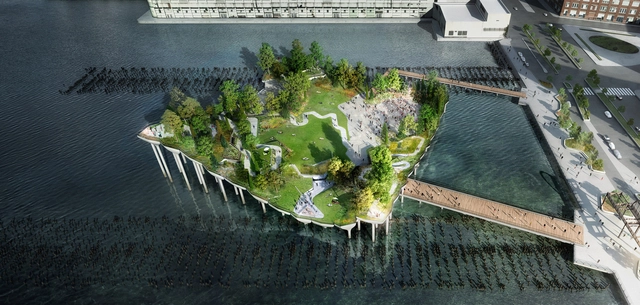
Pier 55, the floating park designed by Heatherwick Studio and landscape architecture firm, Signe Nielsen, received a green-light from the New York Supreme Court this past Friday, April 8, according to a report bythe Architect’s Newspaper. Floating above the Hudson River on the Lower West Side of Manhattan, the park is anchored by an aggregation of enormous petal-like stilts that are submerged in the water below. The park is being funded by the philanthropy of Diane von Furstenberg and her husband Barry Diller.
Pier 55’s legal troubles began last spring when the non-profit, City Club of New York filed a lawsuit against Pier55 Inc. and Hudson River Park Trust (HRPT) to stop the project.
Perhaps the most detested midtown skyscraper by the public, this huge tower has, nevertheless, always been a popular building with tenants for its prime location over Grand Central Terminal and its many views up and down Park Avenue. It is also one of the world’s finest examples of the Brutalist architecture, commendable for its robust form and excellent public spaces, as well as its excellent integration into the elevated arterial roads around it.
However, it is also immensely bulky and its height monstrous. As shown in the photograph ahead, the building completely dominates and overshadows the former New York Central Building immediately to the north, which had been designed by Warren & Wetmore as part of the “Terminal City” complex. The New York Central Building, now known as the Helmsley Building, straddled the avenue with remarkable grace and its distinguished pyramid. As one of the city’s very rare, “drive-through” buildings, it was the great centerpiece of Park Avenue. But by shrouding such a masterpiece in its shadows, quite literally, the Pan Am Building (today the MetLife building) desecrated a major icon of the city that will unfortunately will never recover from this contemptible slight on such a prominent site.
https://www.archdaily.com/783927/how-the-metlife-building-redefined-midtown-manhattanCarter B. Horsley
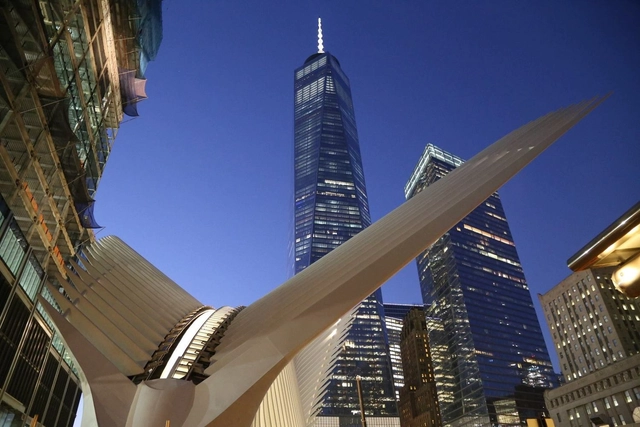
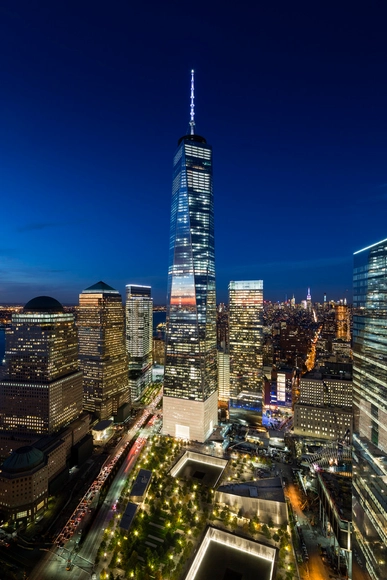
After 12 long years and a series of construction headaches, Santiago Calatrava’s $4 billion World Trade CenterTransportation Hub has finally opened to the public. Once widely regarded as a symbol of hope for post-9/11 New York, the project’s ballooning budget and security-related revisions gradually soured the opinions of the public and top design minds including Michael Graves and Peter Eisenman, and provoked a multitude of mocking nicknames ranging from “Calatrasaurus” to “squat hedgehog” to “kitsch dinosaur.” All the while, Calatrava urged critics to reserve their opinion until the project’s opening. Now that day has arrived - did Calatrava receive the vindication he was insistent would come? Read on for the critics’ takes.
Skidmore, Owings & Merrill (SOM) has released the plans for Manhattan West, a new office and residential development spanning five million square feet over the 2.6-acre platform that covers the active rail tracks connecting Penn Station to New Jersey and Upstate New York.
Courtesy of Noe & Associates and The Boundary; Via The Architects' Newspaper
An image of Álvaro Siza's first US building has been released. The luxury New York tower, planned for the corner of West 56th Street and Eleventh Avenue in Midtown, will rise up to 120 meters (just over 400 feet) and offer 80 units, a private roof garden, sun deck, spa and fitness center, and more.
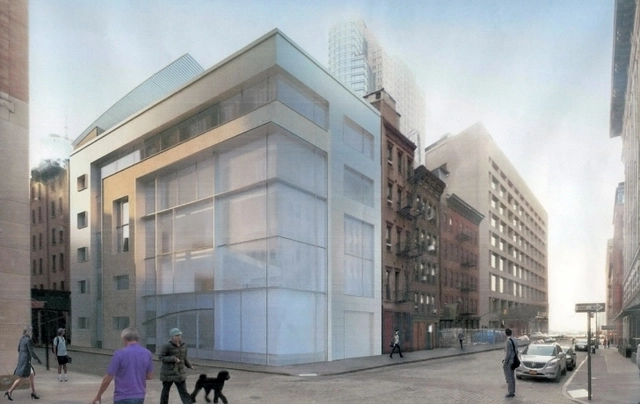
Maya Lin has been commissioned to design a 20,000-square-feet urban mansion in New York's Tribeca neighborhood. The five-story proposal, seen first on Tribeca Trib, aims to replace a 1980s mixed-use building on 11 Hubert Street. If approved, the of metal, glass and limestone building would rise 70-feet and house five bedrooms, 11 bathrooms, a dog room, wine closet, screening room, landscaped courtyard, 5,000-square-foot fitness center, basement, garage and more.
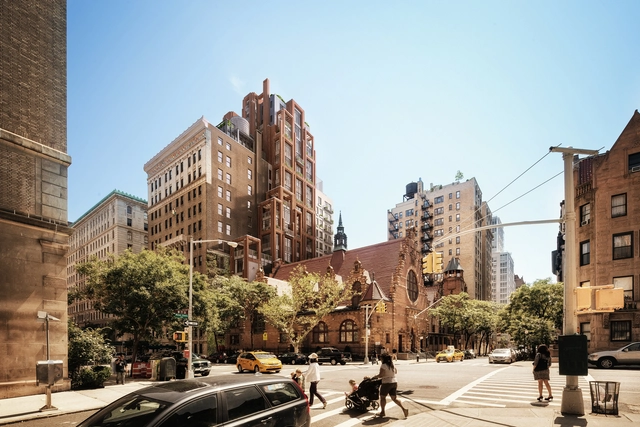
The New York City Landmarks Preservation Commission has approved COOKFOX Architect's plans for a mid-rise, 66-unit condominium building in Manhattan. Planned for two parcels of land in the West End Collegiate Historic District, next to one of the Churches' five ministries, the project aims to "fit harmoniously with the distinct streetscape" while "interweaving the rich historic details of the Upper West Side with subtle contemporary and sustainable design."
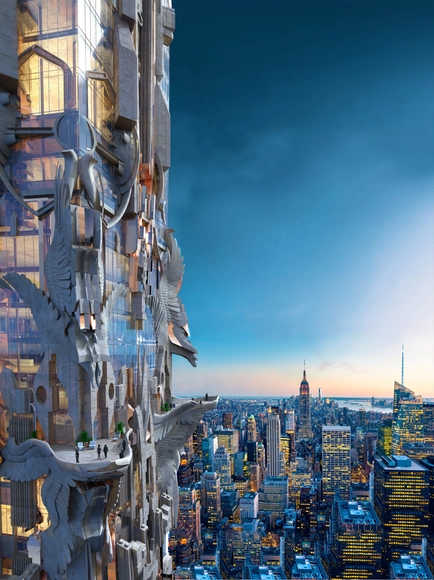
This isn't your typical New York skyscraper; Mark Foster Gage has been commissioned to design a 1492-foot-tall luxury tower in Manhattan - 41 West 57th Street. Described by Skyscraper City as the "missing link between Beaux Arts, Art Deco, Expressionism, Gaudi-Modernisme and Contemporary architecture," the outlandish design boasts a uniquely carved facade cloaked in balconies custom tailored for each of its 91 residential units.
"I think that many of the supertall buildings being built in New York City are virtually free of architectural design - they are just tall boxes covered in a selected glass curtain wall products. That is not design," said Gage.
"Throughout the architectural selection process, REX presented us with an inspired vision. Joshua [Prince-Ramus] totally blew us away with his innovative ideas about how to present cutting-edge culture, but also about how to make the PAC relate to everyone who comes to the WTC site," said PACWTC director and president Maggie Boepple.
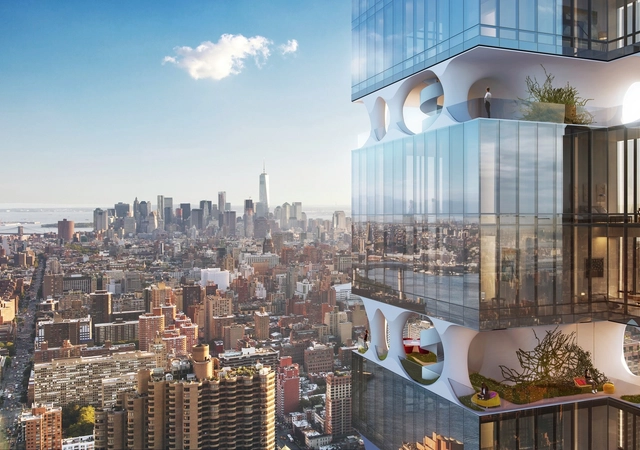
Inspired by the recent trend for super-skinny, super-tall skyscrapers currently dominating the Manhattan luxury residential market, ODA New York has developed a design for 303 East 44th Street which they describe as "a new urban reality" for the city. By taking a prototypical, modestly-sized tower building and stretching it skyward, the firm has inserted sculptural skygardens in the voids opened up between the floors to create a tower that combines the advantages of urban living with the spatial benefits of the suburban home.
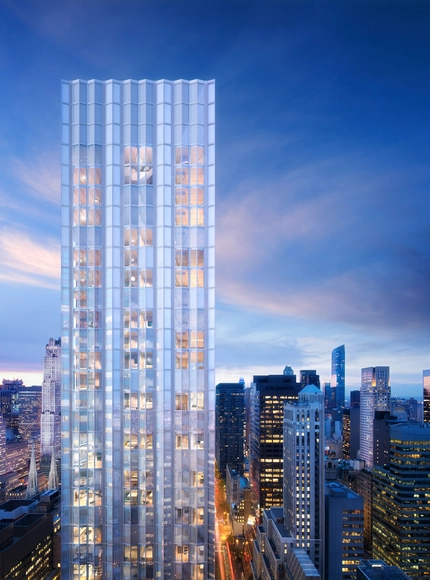
RFR and Foster + Partners have released new images of One Hundred East 53rd Street, a 63-story luxury residential tower in New York next to Mies van der Rohe's famed Seagram Building. The skyscraper, which was announced last year, will contain 94 residences, a swimming pool, wellness facility, spa, library and sitting rooms, and its trademark Foster minimalism is intended to "provide a counterpoint to the Seagram’s bronze edifice," according to the developers RFR.
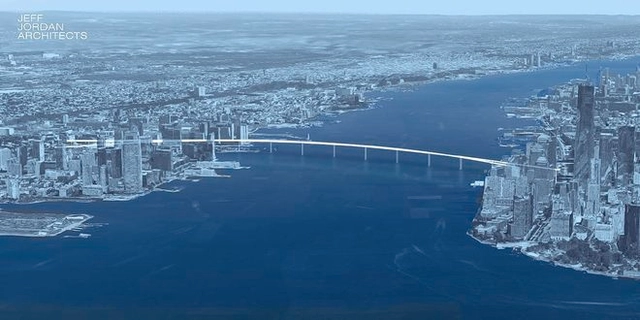
Courtesy of Jeff Jordan Architects, via http://libertybridgeorg.wix.com/libertybridge
Despite being separated by only a few miles, Manhattan and Jersey City seem much further apart; the Hudson River forces commuters to take long, roundabout routes or rely on the over-worked PATH system. Inspired by a need for connectivity between the two cities, Kevin Shane began conceptualizing a new pedestrian bridge, dubbed Liberty Bridge, which would connect Jersey City to Battery Park. Read more about this conceptual proposal after the break.
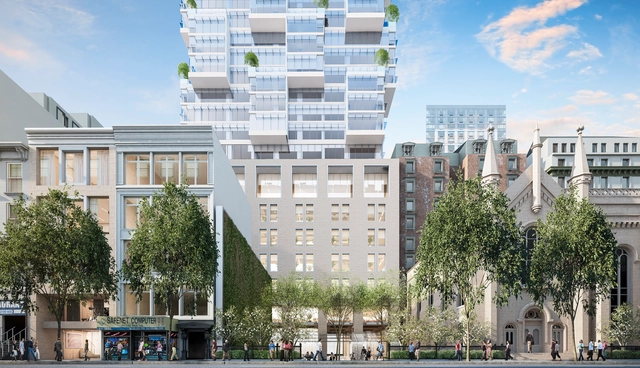
Images of Moshe Safdie's first New York project has been released. Planned to rise on a Manhattan site at West 30th Street, between Broadway and 5th Avenue, the 64-story mixed-use tower will feature a limestone base that compliments and serves its historic neighbor: the Marble Collegiate Church, one of the Collegiate Churches’ five ministries.
The building "will be distinguished by its vertical massing, which breaks down the scale of the tower into a series of three-story-high, offset projections," says Safdie Architects. "The offset projections also provide energy efficiency by self-shading the tower’s facade, further enhanced by additional sun shading at the south facade."
ArchDaily is continuing our partnership with The Architectural Review, bringing you short introductions to the themes of the magazine’s monthly editions. In this introduction to the August 2015 issue, AR editor Christine Murray takes on the disheartening architectural scene in North American cities from New York to Toronto, arguing that "NYC is not where we found a new American architecture" and asking: "Why not give the young guns a tower or a Whitney, let them stretch their legs?"
The latest New York towers are more billboard than building. Like celebrity-endorsed perfume - fancy box, smelly water - the architecture matters less than the artist and his (yes, they are all men) pen’s effluent black-ink concept scrawl.
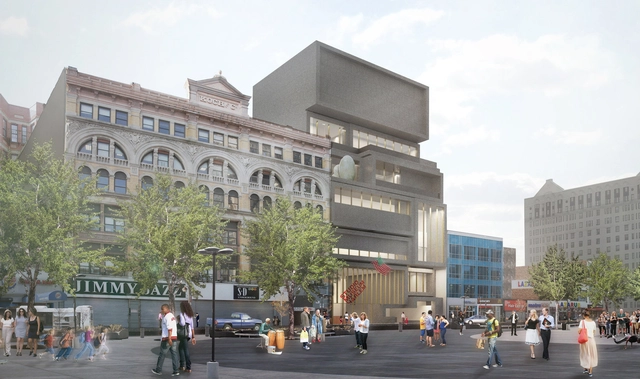
British architect David Adjaye is set to submit plans for new Studio Museum in Harlem. Designed to replace the 47-year-old museum's existing facility on Manhattan's West 125th Street, the new $122 million proposal will more than double the museum's space, allowing it to become a premier center for contemporary artists of African descent.
According to the New York Times, Adjaye was chosen to design the museum due to his sensitivity regarding the artists and surrounding neighborhood, which in turn inspired the project; the project's main space will feature a four-story, multi-use core marked by an "inverted stoop" that will act as an inviting "living room" and host for public programs.
“I wanted to honor this idea of public rooms, which are soaring, celebratory and edifying — uplifting,” he told the New York Times. “Between the residential and the civic, we learned the lessons of public realms and tried to bring those two together.”
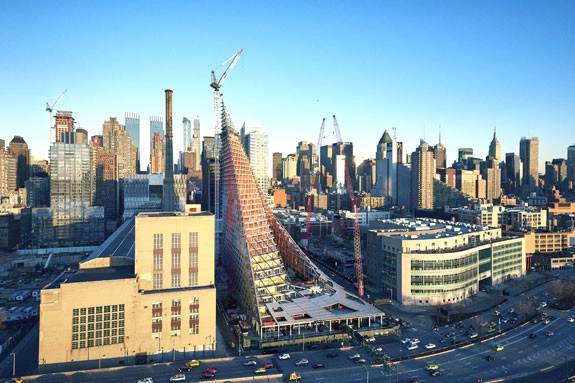
Join the CTBUHNew York City Chapter for a discussion on the VIA 57 West building. Guest speakers Bjarke Ingels (BIG), Aine Brazil (Thornton Tomasetti), and Jeff Crompton (Hunter Roberts) will discuss the architecture, engineering and the construction process behind this unique structure. VIA stands tall at 467 feet and is one of the most architecturally distinctive buildings constructed in New York City. The building provides a dramatic visual gateway to Manhattan’s skyline along the Hudson River. VIA is a hybrid between the European perimeter block and a traditional Manhattan high-rise development. The building’s unique shape combines the advantages of both: the compactness and efficiency of a courtyard building providing density, a sense of intimacy, and expansive views. The form of the building shifts depending on the viewer’s vantage point. While appearing like a pyramid from the West Side Highway, it turns into a dramatic glass spire when seen from West 58th Street.
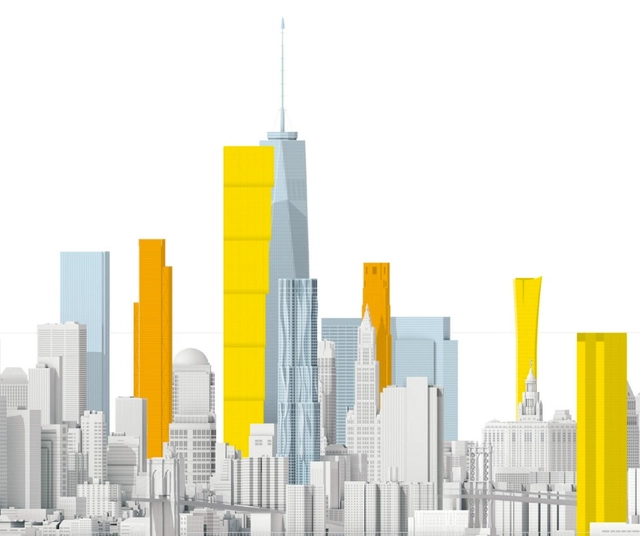
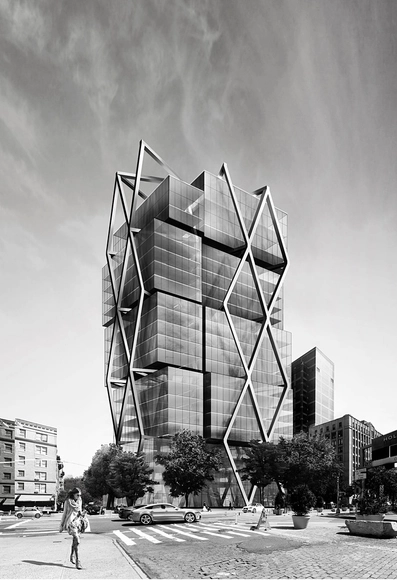
New York-based studio Dror has unveiled design concepts for three new residential buildings in New York City. The imagined buildings, spread throughout lower Manhattan, are based on the studio’s idea to “disrupt conventional building design by rethinking structure, where beauty and efficiency result from an imaginative, clever framework.”
Learn more about each of the plans, after the break.