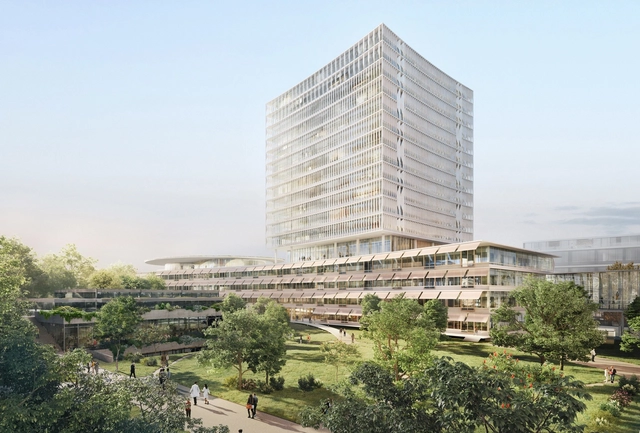
Herzog & de Meuron have released images of their proposed University Hospital Basel, Perimeter B in Switzerland. The 68-meter-tall building, with a footprint of over 5000 square meters, exhibits the firm's familiar clean, crisp aesthetic while paying respect to the surrounding historic context. Designed in collaboration with Rapp Architekten, the 12-story scheme will facilitate the hospital’s outpatient and nephrology centers.
https://www.archdaily.com/916930/herzog-and-de-meuron-design-crisp-university-hospital-for-baselNiall Patrick Walsh
Led by Jacques Herzog (born 19 April 1950) and Pierre de Meuron (born 8 May 1950), most descriptions of Herzog & de Meuron projects are almost paradoxical: in one paragraph they will be praised for their dedication to tradition and vernacular forms, in the next for their thoroughly modern innovation. However, in the hands of Herzog & de Meuron this is no paradox, as the internationally renowned architectural duo combine tradition and innovation in such a way that the two elements actually enhance each other.
Over 40 years of practice, Herzog + de Meuron have established themselves as one of the most celebrated practices in architecture. Their works span scale and site but are united by a sensitivity to material and detail that, today, often seems to fall by the wayside. The inner workings of the practice are notoriously private, but those interested in the process behind the project may soon have reason to celebrate.
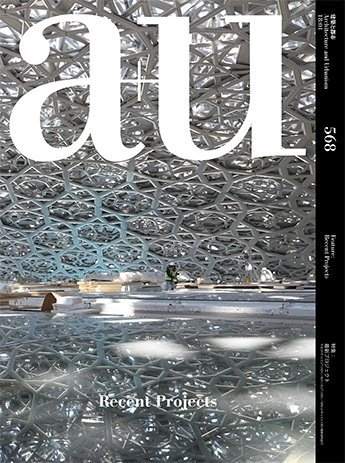
This edition of a+u introduces the 23 recent works of architecture and technology that emerged from their relationship with the urban structure or the development history. In this issue, we focus our attention on the process of conceiving and realizing the projects driven by various motivations and tactics. We invite readers to look beyond the confinement of a single building and examine the works on their possibilities to be in use for a long time.
The sale has not been without controversy, with opposition from the Arts Council’s reviewing committee on the export of works of art and objects of cultural interest. The committee had sought a delay in the sale until a buyer was found who would keep the collection in the UK.
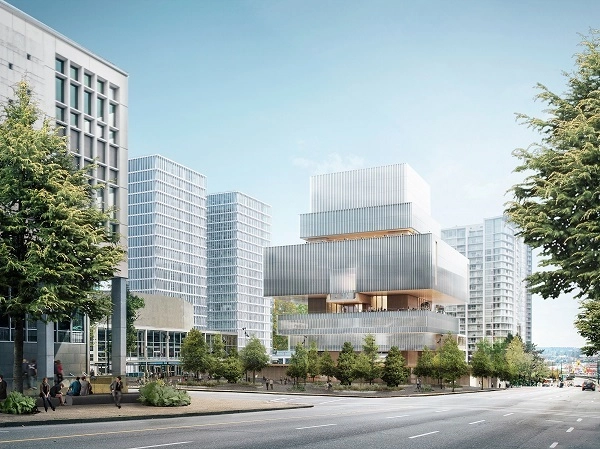
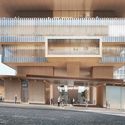
The Vancouver Art Gallery has unveiled the final design for its 300,000-square-foot building designed by Herzog & de Meuron. Designed to serve the Gallery’s ever-expanding collection of art and educational programs, the scheme will offer “a global platform for Vancouver’s and Canada’s thriving arts scene and play a vital role in establishing this city as one of the world’s most foremost cities for arts and culture.”
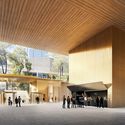
The scheme has been designed as a sculptural, symmetrical, upright building infusing opaque and transparent surfaces. The stacked scheme sees a minimal mass at the bottom contrast with larger volumes concentrated at the top, allowing light and air to filter down to an active, open-air courtyard below.
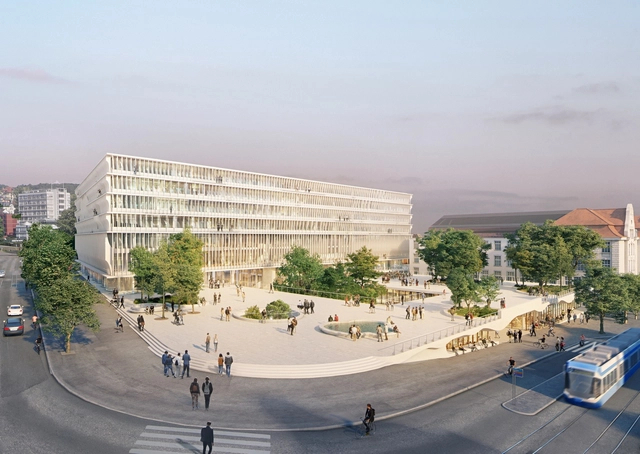
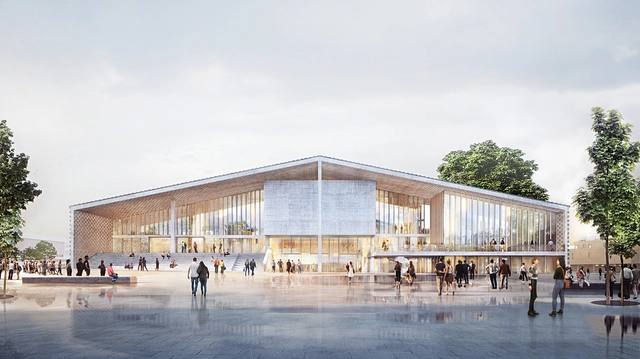
Herzog & de Meuron has released details of their proposed Forum UZH, creating a new center for education and research on the city campus of the University of Zurich. The new building is a seen as a crucial element for ensuring the future viability of Zurich as a higher education hub, upgrading and consolidating an existing aging, dispersed campus.
Due to be completed in 2027, the Forum UZH will occupy a prominent corner site, combining expansive public space with the firm’s recognizable clean, contemporary language. Situated in the old city’s university quarter, dominated by stand-alone buildings set back from the street on below-ground plinths and terraces, the Forum UZH forms the 21st-century embodiment of the stately urban campus.
Videos
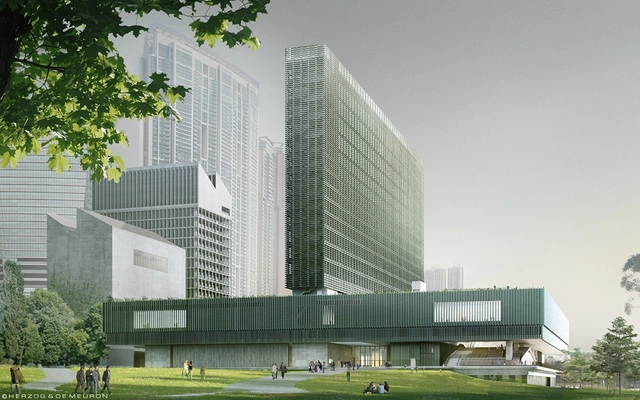
M+ Museum. Image Courtesy of Herzog & de Meuron
Herzog & de Meuron's M+ Museum of visual culture has topped out in Hong Kong ahead of its scheduled opening in 2020. Focusing on 20th and 21st century art, design, architecture and moving image, M+ will be the centerpiece of the West Kowloon Cultural District, and a key venue in creating interdisciplinary exchange between the visual arts and the performing arts in Asia.
Editor's Note: This article was originally published on 30 June, 2016. While the debate surrounding the terms of the UK's exit from the European Union continues to rage, the Tate remains a steady icon for London and the UK. But the building has also become a symbol in a new fight: one between the capital's elites and the general public. As the political sands in Britain continue to shift, it may be interesting to see how - and with whom - the building aligns in the future. - Katherine Allen, Managing Editor
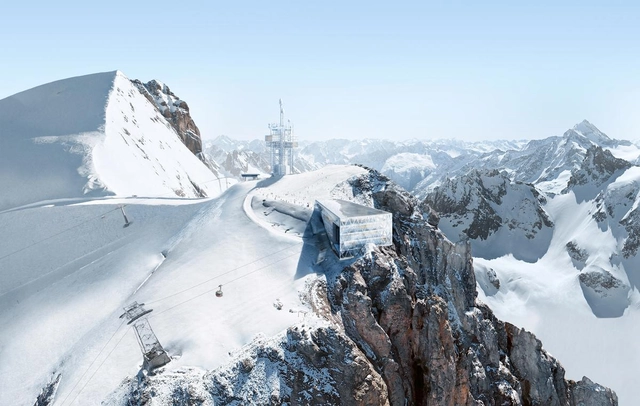
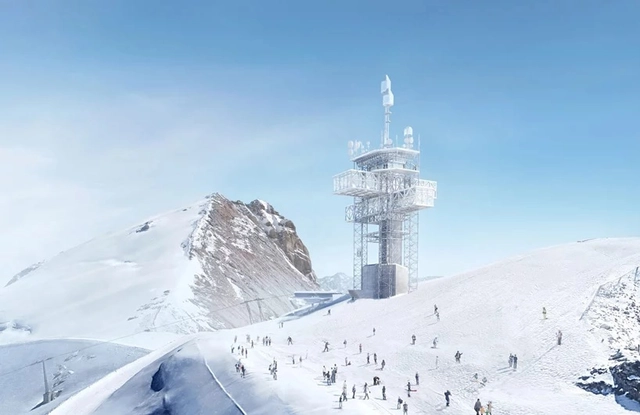
Herzog & de Meuron have unveiled their proposal for a mountain outpost in the Swiss Alps. “TITLIS 3020” is situated on one of Switzerland’s most renowned tourist attractions, the 3000-meter-high Mount Titlis.
The design forms part of a master plan for the area developed by Herzog & de Meuron, which includes the construction of the outpost, the redevelopment of an old beam antenna tower, and redevelopment of an underground tunnel.
https://www.archdaily.com/905586/herzog-and-de-meurons-mountain-outpost-brings-architectural-ambition-to-the-swiss-alpsNiall Patrick Walsh
During the second half of the twentieth century, architects all over the world, specifically from Europe, produced a legacy of renowned, modern works in Brazil. Following the principles of masters such as Le Corbusier, names like Lina Bo Bardi, Hans Broos, and Franz Heep held an undeniable influence on Brazilian architecture.
In recent years, the country has been welcoming a variety of buildings designed by foreign architects. Below, we have compiled 10 iconic works by international architects.
Titlis Summit Station. Image Courtesy of Herzog & de Meuron
Herzog & de Meuron have revealed their plan for a new summit station atop the Swiss mountain Titlis. The Alpine masterplan entails the new construction of the summit station, the redevelopment and extension of an old beam antenna tower, and an upgrade of the Titlis underground tunnel. The design aims to breath new life in one of Switzerland’s most renowned international tourist attractions.
Gasklockan tower. Image Courtesy of Herzog & de Meuron
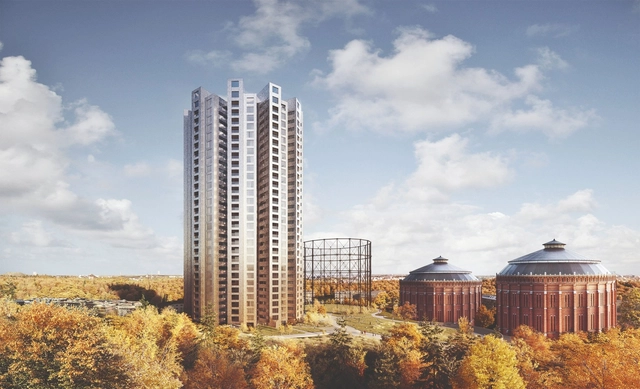
Herzog & de Meuron have released more images of their Gasklockan tower project in Stockholm. First announced late last year, the design will replace a 1930s gasholder with a 90 meter tower. As the firm's first project in Sweden, Gasklockan tower is being created with developer Oscar Properties. The latest images showcase the interior of the project and details of the facade. Designed with over 300 apartments, the circular tower was inspired by the original gasholder on site.
If the surest sign of summer in London is the appearance of a new pavilion in front of the Serpentine Gallery, then it’s perhaps fair to say that summer is over once the pavilion is taken down. The installations have gained prominence since its inaugural edition in 2000, acting as a kind of exclusive honor and indication of talent for those chosen to present; celebrated names from the past names include Zaha Hadid, Rem Koolhaas, and Olafur Eliasson.
Swiss practice Herzog & de Meuron have released revised plans for the Museum of the 20th Century project in Berlin's Cultural Forum. Designed to house the extensive National Gallery on 20th century art collection, the project was made in partnership with the Berlin State Museums and the Prussian Cultural Heritage Foundation. Herzog & de Meuron originally won the competition to design the museum building in 2016, and the revised design features new plans and a facade that opens the building to the outside.
A collection of stones piled one on top of the other, dry stone is an iconic building method found just nearly everywhere in the world. Relying solely on an age-old craft to create sturdy, reliable structures and characterised by its rustic, interlocking shapes, the technique has deep roots that stretch back even before the invention of the wheel. Its principles are simple: stack the stones to create a unified, load-bearing wall. But the efficient, long-lasting results, coupled with the technique’s cultural significance, have lead to continued use and updated interpretations all the way to contemporary architecture today.
The proposed expansion will include the integration of a new space into the School’s existing structure, with the goal of creating a facility which “will embody the School’s visionary and cross-disciplinary work at the intersection of design, pedagogy, research, and practice."
https://www.archdaily.com/898971/herzog-and-de-meuron-and-beyer-blinder-belle-selected-by-harvard-gsd-for-gund-hall-transformative-expansionNiall Patrick Walsh
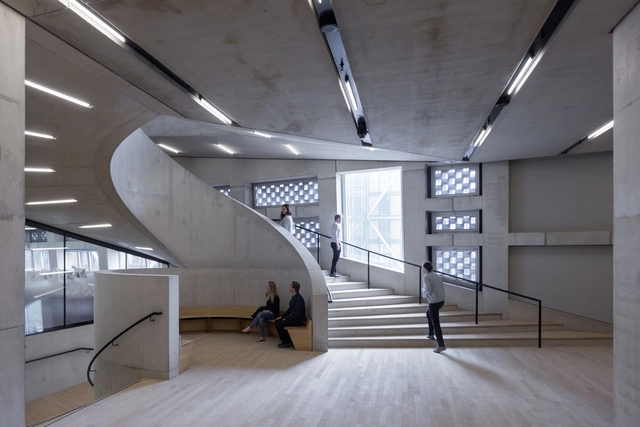
Stairs aren't only a means of vertical circulation. Through their might and scale, this building element can easily become the protagonist of a space. From afar one can observe the movement of people; from within the staircase the viewer is treated to new angles and perspectives of the building.
The prominence of staircases in the work of 2001 Pritzker Prize winners Herzog and de Meuron underscore the belief that risers and treads are never solely an element of circulation—they are generators of dynamism and rhythm that influence the essence of their projects.

















.jpg?1467325496&format=webp&width=640&height=580)




.jpg?1539856634&format=webp&width=640&height=580)


.jpg?1539856634)


.jpg?1532615893&format=webp&width=640&height=580)

.jpg?1532615939 "The Trays at Gund Hall. Image Courtesy of Harvard GSD")


.jpg?1532615893)