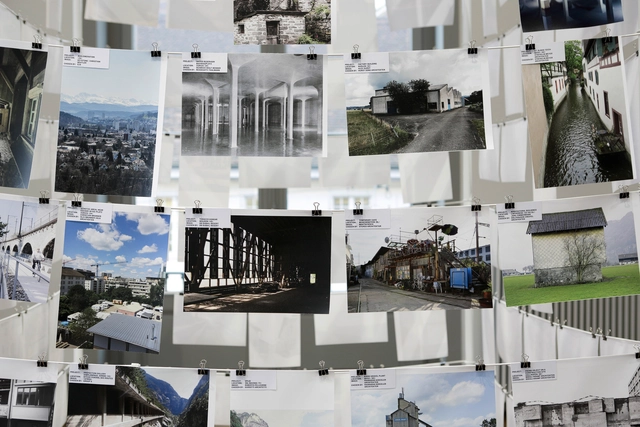
In one of his 1922 travel essays for the Toronto Star Ernest Hemingway wrote, in a typically thewy tone, of “a small, steep country, much more up and down than sideways and all stuck over with large brown hotels built [in] the cuckoo style of architecture.” This was his Switzerland: a country cornered in the heartland of Europe and yet distant from so much of its history. A nation which, for better or worse and particularly over the course of the 20th Century, has cultivated and become subject to a singularly one-dimensional reputation when it comes to architectural culture and the built environment.
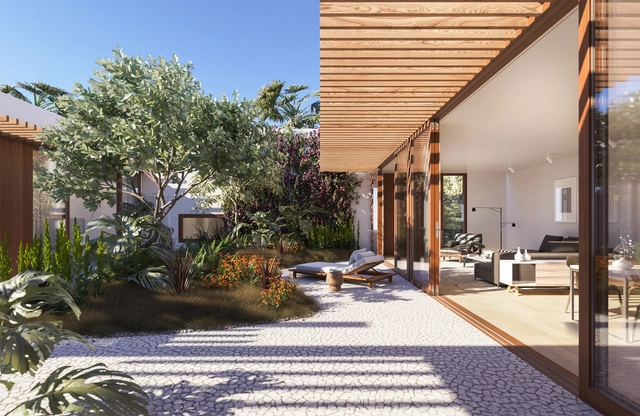
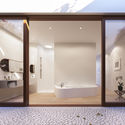
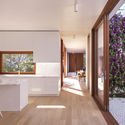
Renderings have been revealed for Herzog and de Meuron’s new luxury loft residences in Miami, designed in collaboration with local developer Robert Wennett. In contrast to the firm’s acclaimed parking garage located nearby, which capitalized on Miami’s surrounding views, 1111 Lincoln Residences will be a far more inwardly-focused endeavor, with the 2,115-square-foot lofts opening onto a series of rooftop courtyards.
Located near the city’s bustling intersection of Alton and Lincoln, the complex accommodates a multi-level parking garage, over 100,000 square feet of interior office space, dedicated event space on the seventh floor, as well as 11 selected retailers on the ground floor. Notable tenants include Alchemist, Jo Malone, Rosetta Bakery, and Chotto Matte, in addition to the various restaurants available to residents along Lincoln Road.
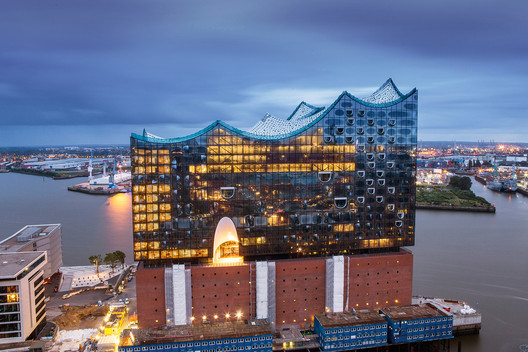
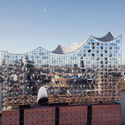
So much has already been written about Hamburg’s undeniably excellent Elbphilharmonie, which formally opened in January but has been publicly accessible, in part, since November. The chatter has mostly revolved around the same two talking points—the building’s on-the-tip-of-your-tongue shape and its fantastic price tag. In addressing the former, critics have called attention to the hall’s resemblance to an iceberg, an outcrop, a ship, circus tents, or the Sydney Opera House. And as for the costs, totaling $900 million, they point out how the project hemorrhaged cash, even if they have inadvertently exaggerated the figures. Having momentarily lost control of the narrative, the city felt compelled to set the record straight in time for the inaugural performance: The building cost just three—not ten!—times the initial budget.
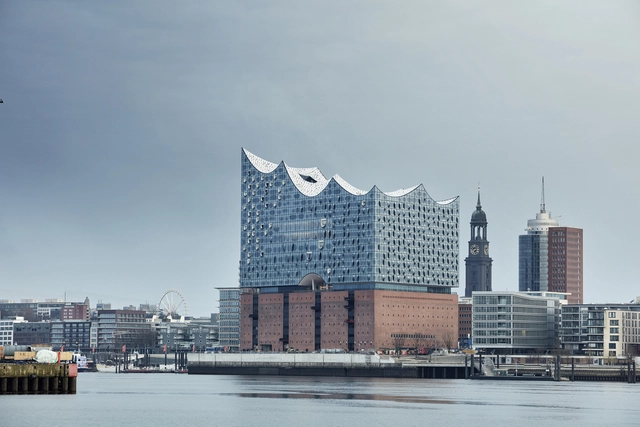
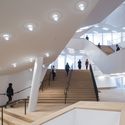
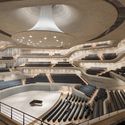
Photographer Laurian Ghinitoiuhas visited Herzog & de Meuron's Elbphilharmonie Hamburg, Germany – a 2017 winner of the ArchDaily Building of the Year award. The striking silhouette of this cultural centre and concert hall, which is identical in ground plan to the brick block of the older building upon which it sits, is often photographed as an isolated object. In this photo-essay, the context of the port around the project is often foregrounded – and unusual views offer new perspectives onto its iconic design.
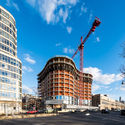
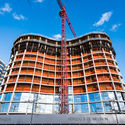
Construction on Herzog & de Meuron’s 160 Leroy condominium tower in New York’s West Village has nearly topped out, with 12 of its planned 15 floors now complete. The design, inspired by the great Brazilian architect Oscar Niemeyer, features a curved concrete and glass facade and contains 57 luxury condos ranging in price from $3.1 to $48.5 million.
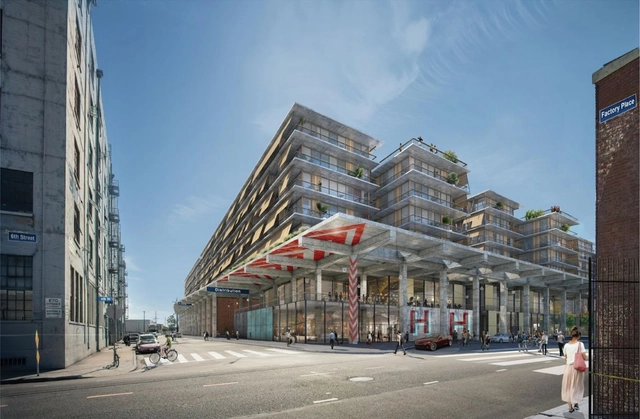
View from the street. Image Courtesy of Los Angeles Department of City Planning
The Los Angeles Department of City planning has released a new study surrounding Herzog & de Meuron’s 6AM mixed-use development planned for LA’s Arts District. Originally revealed last fall, the estimated $2 billion complex would constitute the Swiss firm’s first project in the Southern California city, and could play a major role in the revitalization of the downtown area.
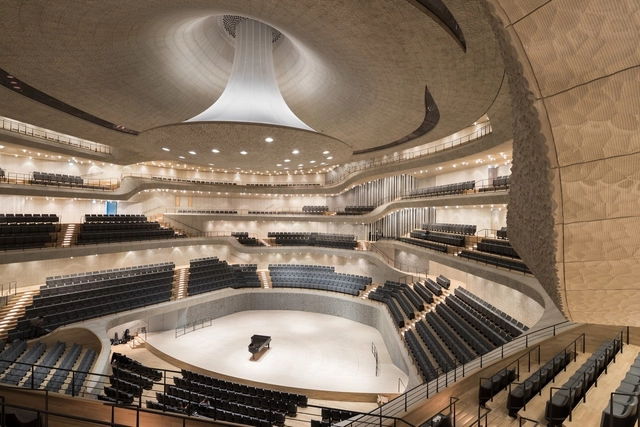
Of all its bells and whistles, the focal point of Herzog and de Meuron’s latest successful endeavor, the Hamburg Elbphilharmonie, is arguably the central auditorium, as explored in this new article by WIRED. An incredible example of the possibilities of parametric design, the hall is comprised of 10,000 individual acoustic panels that line the walls, ceilings, railings and balconies. Each of the panels consists of one million “cells” of varying dimensions, created to help define the sound within the space.
https://www.archdaily.com/805567/the-parametric-process-behind-the-hamburg-elbphilharmonies-auditoriumOsman Bari
After two weeks of nominations and voting, last week we announced the 16 winners of the 2017 Building of the Year Awards. In addition to providing inspiration, information, and tools for architecture lovers from around the world, ArchDaily seeks to offer a platform for the many diverse and global voices in the architecture community. In this year's Building of the Year Awards that range of voices was once again on display, with 75,000 voters from around the world offering their selections to ultimately select 16 winners from over 3,000 published projects.
Behind each of those projects are years of research, design, and labor. In the spirit of the world's most democratic architecture award, we share the stories behind the 16 buildings that won over our global readership with their urban interventions, humanitarianism, playfulness, and grandeur.
In the latest video from architecture vlogging favorites#donotsettle, the infectiously energetic duo of Wahyu Pratomo and Kris Provoost team up to take us inside Herzog & de Meuron's newly-completed Elphilharmonie in Hamburg. Filmed during the music venue's "family day," part of its three-week-long opening festival, #donotsettle gives us an engaging look into the building's many spaces—cleverly accompanied by an annotated cross-section of the building which allows us to track their progress through the project's labyrinthine interior.
With two weeks of nominations and voting now complete, we are happy to present the winners of the 2017 ArchDaily Building of the Year Awards. As a peer-based, crowdsourced architecture award, these winners were chosen by the collective intelligence of over 75,000 votes from ArchDaily readers around the world, filtering over 3,000 projects down to the 16 best works featured on ArchDaily in 2016.
In being published on ArchDaily, these 16 exemplary buildings have helped us to continue our mission, bringing inspiration, knowledge, and tools to architects around the world. This award wouldn't be possible without the hundreds of firms that choose to publish their projects with ArchDaily every year, or without those who take part in the voting process to become part of our thousands-strong awards jury. To everyone who took part—either by submitting a project in the past year, or by nominating and voting for candidates in the past weeks—thank you for giving strength to this award. And of course, congratulations to all the winners!
Read on to see the full list of winning projects.
https://www.archdaily.com/804859/winners-of-the-2017-building-of-the-year-awardsAD Editorial Team
Flagship stores excite both fashion shoppers and designers alike due to their role as visionary laboratories for the latest trends and stimulating retail experiences. Architects have developed various ways to dress haute couture stores, from distinctive icons in the day to seductive night-time images. The images accompanying this article, created by the Portuguese architect and illustrator André Chiote, help to explore the graphic potential of famous brands like Dior, Prada and Tod's. The illustrations clearly reveal the various techniques of playing with diaphanous layers, intimate views inside or the contrast of light and shadow.
In preparation for their grand opening on January 11/12, the Elbphilharmonie Hamburg has released an interactive drone video that lets you experience the Herzog & de Meuron-designed building at two different speeds: adagio and presto (slow or fast). Using the spacebar to switch between speeds, the footage takes you on a tour up the curving escalator, on to the elevated terrace, around the building and finally into the main concert hall, where the drones meet back up in a dramatic finish.
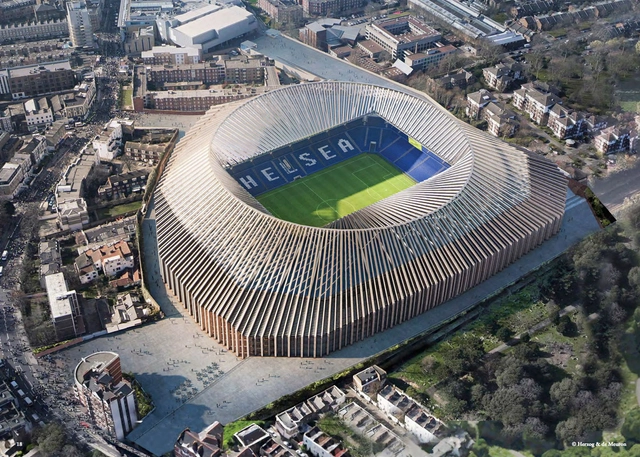
Herzog & de Meuron’s Chelsea Football Club stadium has been given approval by Hammersmith and Fulham council’s planning committee, reports BBC. The new £500 million stadium, which is estimated to be completed by 2020, will replace the existing stadium at Stamford Bridge, increasing the capacity of the space by almost 20,000 spectators to 60,000 seats.
The design of the new stadium is inspired by Gothic architecture, as well as nearby Victorian-era brick terraces, which will wrap around the entirety of the building.
Committee decision to approve the stadium plans does not mean that work can begin on site; various other permissions will be necessary before the final decision will be made by London Mayor Sadiq Khan.
Digital Designer and Creative Director Joel Filipe has unveiled Geometry of Madrid Architecture, a series of photographs depicting the bold architecture of Madrid. Through the project, Filipe reveals varying “geometries within minimalist clichés that underline the lines of the buildings.”
Herzog & de Meuron’sElbphilharmonie concert hall in Hamburg, Germany has opened after 16 years of planning and construction, which was held back by financial and legal issues. The grand opening of the concert hall, taking place on January 11 and 12, 2017, features inaugural concerts and a light display on the façade of the building.
As Hamburg’s newest cultural destination, the building was inaugurated by German Federal President Joachim Gauck, Mayor of Hamburg Olaf Scholz, architect Jacques Herzog from Herzog & de Meuron, and General and Artistic Director Christoph Lieben-Seutter.
More than 4,500 guests from Germany and abroad will take part in the opening concerts in the Grand Hall and Recital Hall today and tomorrow, including Federal Chancellor Angela Merkel, various high-ranking political and cultural leaders from around the world, and 1,000 visitors who won tickets to the event, out of 220,000 entrants from 73 countries.
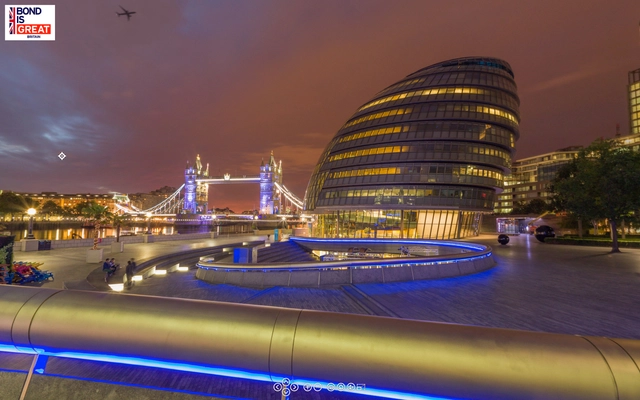
Architectural photographer Rod Edwards specializes in 360º virtual reality imagery and virtual tours of iconic buildings. Having spent the last decade producing this type of media, Edwards was recently commissioned by Visit Britain to shoot his “More London” project as part of the global campaign for the 2015 James Bond film “Spectre.”
Read on to see “More London” and more projects by Edwards.
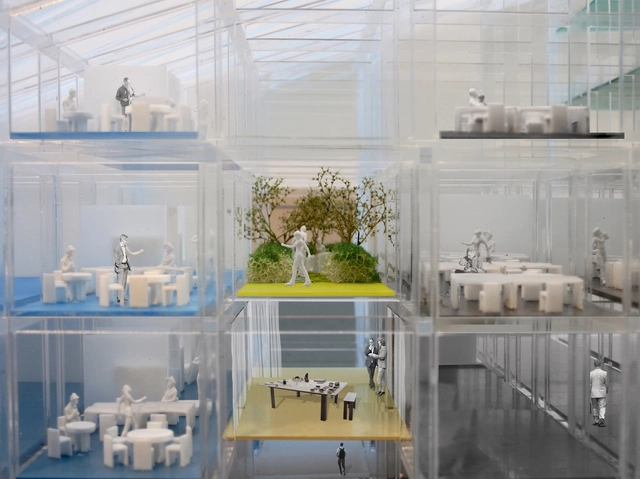
The Royal College of Art (RCA) has announced that Herzog & de Meuron has been selected as the winner of a competition to design a strategic approach for the center at its new £108m Battersea South campus.
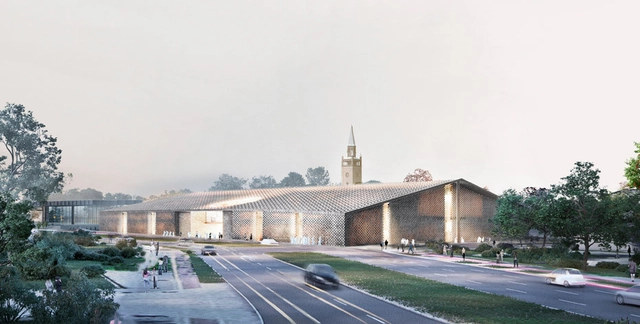
Three winning firms have been selected in the competition for the Museum of the 20th Century to be located in the heart of the Berlin Cultural Forum in Berlin, Germany. The 200 million euro building and site plan will serve as the new home of multiple internationally significant art collections, including the National Gallery’s Marx and Pietzsch collections, sections of the Marzona collection, and a collection of works from the Kupferstichkabinett (Museum of Prints and Drawings).
In 2015, the competition was launched, aimed at finding a design scheme that would encompass the site layout, architecture and landscaping around the museum.
Facing stiff competition from a list of 42 renowned finalists, Herzog & de Meuron together with Vogt Landscape Architects has emerged victorious for their brick, warehouse-inspired design. Runner up prizes were given to Lundgaard & Tranberg Architects with SCHØNHERR A / S, and Bruno Fioretti Marquez with Capatti Staubach Landscape Architects, while four jury recognitions were awarded to proposals from OMA, SANAA, Staab Architekten, and Aires Mateus e Associados.












.jpg?1488821716&format=webp&width=640&height=580)
.jpg?1488821999 "© Laurian Ghinitoiu")
.jpg?1488822128 "© Laurian Ghinitoiu")
.jpg?1488821802 "© Laurian Ghinitoiu")
.jpg?1488821732 "© Laurian Ghinitoiu")
.jpg?1488821716)