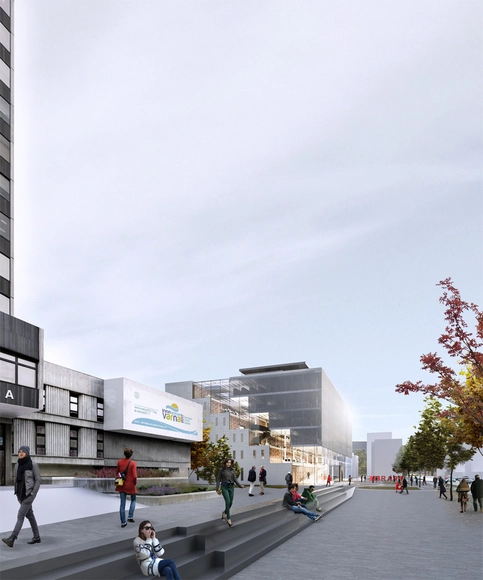
Architects for Urbanity has been awarded first prize in a competition for a new regional library in Varna, Bulgaria. What will be known as the "Pencho Slaveykov," the proposed 17,500-square-meter building was lauded by the jury for its ability to fit into the context "unobtrusively." It's design features a transparent "open space of knowledge" that divides the building's mass into two volumes and encourages the public to enter.
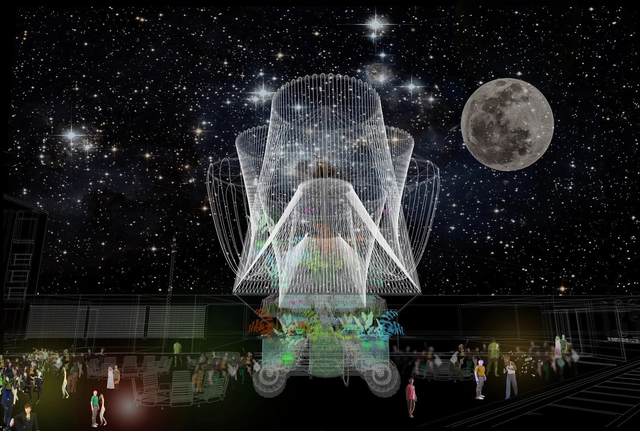
MoMA P.S.1 has announced five finalists to compete in the 2016 Young Architects Program (YAP). Now in it’s 16th edition, the competition will challenge a group of emerging architects to design a temporary installation within the walls of the P.S.1 courtyard for MoMA’s annual summer “Warm-Up” series.
All over the world, projects are being built. From pavilions to skyscrapers, the range of scales is tremendous, and even among the multitude, some projects stand head and shoulders above the rest in terms of sheer size, cost, and ambition. The following infographic collects eight of the largest projects that are currently in construction all over the world. With countries like Egypt, the United Kingdom, China, and The United Arab Emirates represented, they showcase a definite diversity while supporting the trend of extreme growth throughout Asia and the Middle-East that has been prevalent in the past decade - the UAE alone hosting three of the eight projects.
Some projects comprise multiple buildings – the Yas Island Complex in Abu Dhabi already features landmarks like the Yas Island Yacht Club and the Yas Hotel - while others are a single, massive piece of infrastructure like the Great Man-Made River Project in Libya. See them all after the break.
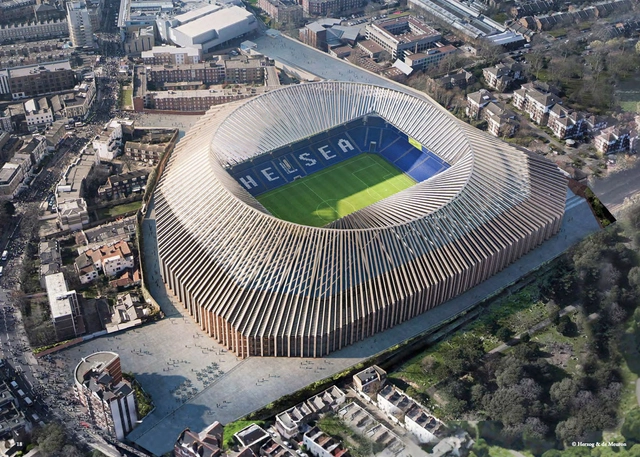
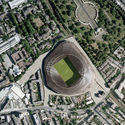
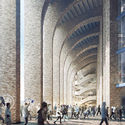
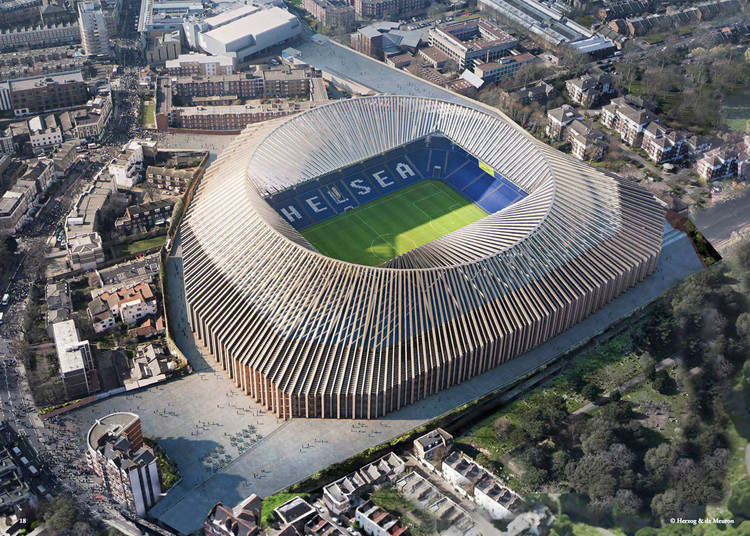
Following the announcement earlier this year that Herzog & de Meuron were developing designs for a new £500million stadium for Chelsea Football Club, the Swiss practice have released a series of official images which narrate the project's design intentions and contextual implications. The new stadium, which will be built in place of the football club's existing stadium at Stamford Bridge, will contain a "three-tier, four-stand, bowl with a capacity of 60,000 supporters" (compared to the current 41,837 capacity) and have around 60,000sqm of facilities housed within its ribbed shell.
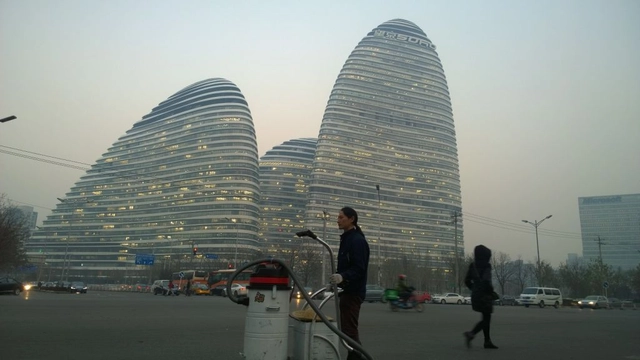
Day 98. Image via Quartz / Supplied by Nut Brother
From the Bird’s Nest to the CCTV headquarters, for the past 100 days Chinese performance artist "Nut Brother" has been wandering the streets of Beijing collecting smog with an industrial vacuum so that he can eventually turn it into bricks. He has now began to form his bricks by mixing a combination of the collected "dust and smog" with clay. As he told Quartz, the project is meant to be a symbol. Read the whole story here.
The Museum of Modern Art (MoMA) has appointed Sean Anderson as the new Associate Curator in the Department of Architecture and Design. Under the direction of Chief Curator Martino Stierli, Anderson will be responsible for "overseeing MoMA's Issues in Contemporary Architecture exhibition series, assisting in curatorial supervision of the Young Architects Program (YAP) both at MoMA PS1 and with international partners, and serving as the primary liaison to architecture communities both locally in New York as well as globally." His appointment is now effective.
Architecture is in some ways a paradoxical profession. On one hand, it projects a popular image of the lone, creative genius, taking control over all aspects of a building project and forming them to their creative ideals. But in reality, most projects take a huge team of people, all working together to produce a building which usually represents the creative input of not only many different people, but many professions too.
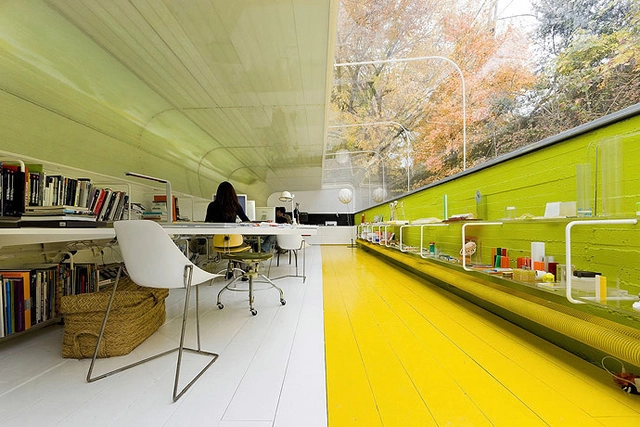
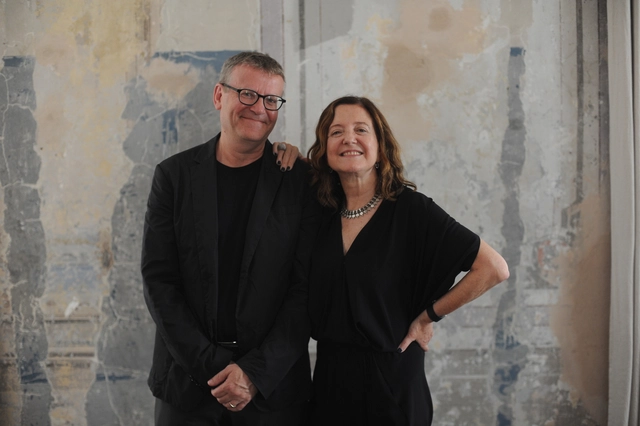
One way to find a balance between these two extremes is to take more creative control over the decisions of the group - in other words, to start your own practice, guided by your creative input alone. But is that goal worth the difficulty it might take to get there? This was the question we had in mind when we asked our readers to let us know the pros and cons of starting your own firm last month. Interestingly, not a single commenter left any response about the joys of working for someone else, and the consensus was firmly that running your own practice is preferable - provided you can deal with the significant problems of doing so. Read on to find out what they had to say.
At a media meeting this morning at the Istanbul Archaeological Museums Library, the curators of the 3rd Istanbul Design Biennial Beatriz Colomina and Mark Wigley announced the theme of next year's event, titled “ARE WE HUMAN?: The Design of the Species: 2 seconds, 2 days, 2 years, 200 years, 200,000 years.” The event, which will be held from October 22nd to December 4th next year, is intended to combine elements of both media documentary and archaeological project and according to the curators "will explore the intimate relationship between the concepts of 'design' and 'human.'"
Now in its second year, DesignCurial has revealed the results of their annual “Top 10 Public Toilets” award, recognizing outstanding lavatory design across the world. The top 10 emerged as exemplars among over 1,000 public toilet designs, evaluated on “design, innovation and the relationship with surroundings”. “The aim of the list was to bring international design to the fore, especially unique architecture that may be overlooked due to the structure’s mundane stereotype,” said Katherine Houston, web editor at DesignCurial. “This list is well geographically spread, with distinctive designs emerging from Japan, Australia and the UK to name a few.” See the world’s best public toilets for 2015 after the break.
In an article for theFinancial Times, Edwin Heathcote responds to the recent news that OMA, based in Rotterdam, have won the competition to design the British city of Manchester's new "ultra-flexible" arts venue. The Factory, so-named because of city's rich musical heritage, will be one of the largest cultural projects of its kind. Having gained and maintained financial support from Westminster, the building—which must be able to transform from a 2,200-seat theatre into an open 5,000-capacity space—is a flagship project for the British government.
The Louisiana Channel recently made a trip to the hometown of Peter Zumthor for an extensive and rare video interview on the Swiss architect's life journey, passion for learning, and how "different kinds of silence" help him reach his potential.
Without a doubt, it’s among the most famous houses in Los Angeles. The house is easy to describe: a steel framed L-plan, divided into bedrooms and the communal living spaces, all wrapped around a turquoise pool seemingly impossibly poised above the city. But words don’t do it justice. Julius Shulman’s 1960 photograph of Pierre Koenig’s Case Study House 22, perhaps better known as Stahl House, changed the fantasies of a generation.
https://www.archdaily.com/778021/a-virtual-look-into-pierre-koenigs-case-study-house-number-22-the-stahl-houseMadlaina Kalunder and David Tran, Archilogic
In the early days of the architectural profession, teaching and practice were neatly aligned: the elements of the various styles could be taught and put into practice in the field. However in the 20th century, while the business of construction was becoming increasingly technocratic, architectural theory became equally pluralistic and esoteric. Ever since, the dichotomy between architectural education and practice has been a controversial subject. Many in the business say that education fails to prepare students for the real world, while some academics equally contend that architecture schools have given up too much ground to technical considerations, and no longer teach enough important theory.
In the 21st century, that dichotomy is increasingly being bridged by the internet, offering a convenient alternative to universities and practices where architects can teach themselves. With that in mind, we wanted to open a discussion up to our readers: what are the things you wish you learned in school but never had the chance? Was there an element of history and theory that is vital to your understanding of architecture that you only learned after graduation? Or perhaps a technical consideration that you had to learn the hard way?
In November, SCI-Arc Director Hernan Diaz Alonso announced the launch of SCI-Arc EDGE, Center for Advanced Studies in Architecture. Beginning in fall 2016, the new center is intended to serve as a platform for multiple postgraduate programs. Diaz Alonso sat down to talk about SCI-Arc EDGE, the philosophy behind it, and the fields of study it will offer.
https://www.archdaily.com/778022/sci-arc-edge-center-for-advanced-studies-in-architectureSponsored Post
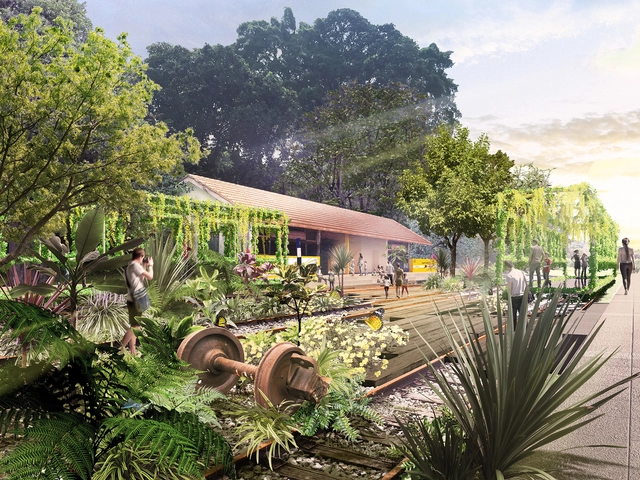
A design team led by Nikken Sekkei, in collaboration with Tierra Design and Arup Singapore, has won a competition to Master Plan a 24-kilometer long former railway corridor that spans the entirety of Singapore with their proposal entitled “Lines of Life.” The proposal, chosen by a panel from Singapore’s Urban Redevelopment Authority incorporates green areas, footpaths, bicycle paths, and surrounding developments that are flexibly implementable over many years, so that the former train line can be best integrated into its surroundings.
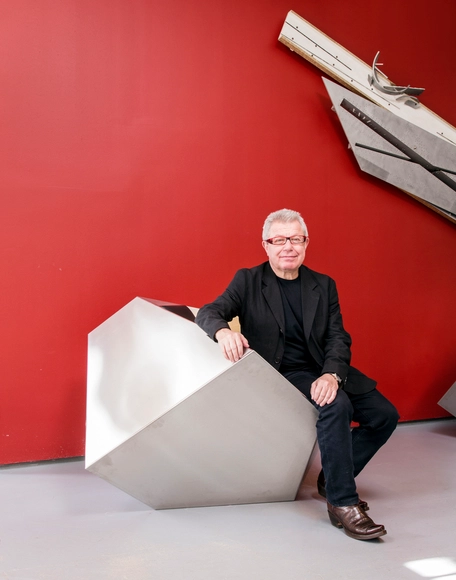
In an exclusive interview with Daniel Libeskind, who is based in New York City ("a microcosm of the world") and describes himself as having been "an immigrant several times," discusses his origins, his family, his early influences and the 'state of the world', touching upon a great theme in his built works: that of memorialising and remembrance in the built environment. Having grown up under "terrible oppression" in post-war Poland and moved between countries eighteen times, he describes himself as a citizen of the world with a great deal of retrospective advice for prospective architects.
Candles shaped like icebergs that melt to increase awareness for global warming. Reconstructions of Brutalist playgrounds. Geometric overalls with patterns representing the taste buds. These are just a few of the projects tackled by the young minds selected by Metropolis Magazine as their “7 Designers to Watch.” The list includes architects RAAF, LAB.PRO.FAB and Assemble Studio, alongside furniture designers, industrial designers and a design strategist.
Los Angeles, as we know it today, was made possible by massive infrastructure projects that provide reliable sources of water to the otherwise semi-arid region. The mastermind behind many of these infrastructure projects in the early twentieth century was William Mulholland, the self-taught engineer who rose through the ranks to become the Chief Engineer and General Manager of the Bureau of Water Works and Supply (the precursor to today’s Los Angeles Department of Water and Power). Mulholland is most commonly remembered for the construction of the Los Angeles Aqueduct, which piped water to the city from the Owens Valley, over 200 miles away. But Owens Lake was drying up faster than expected, and the aqueduct was threatened by both earthquakes and sabotage from angry landowners and farmers in the Owens Valley who orchestrated dynamite attacks on the waterway, in what became known as the California Water Wars.
Mulholland needed a backup plan, so he turned to building reservoirs, most of which still function to this day. Tom Scott’s video above tells the story of how one of those reservoirs, and the failure of the dam that held it back, shaped the development of Los Angeles itself. When the St. Francis Dam collapsed in 1928 the ensuing rush of water killed at least 450 people (though some estimate the total is closer to 600), destroyed 1,200 homes, forever altered the reputations of Mulholland and the city’s water infrastructure, and ultimately cemented the boundaries of the city and its neighbors.
This past February, BIG and Heatherwick Studiounveiled their designs for Google’s new Mountain View Headquarters in California. The project, which will be built by robots, faced sizeable critique, as well as site complications—that have since been resolved—over the past year. Now, as a part of Esquire’s 2015 Breakouts, Bjarke Ingels—founder of BIG—is speaking out about how the firm won the Google bid, and why the headquarters could create a new mold for Silicon Valley urbanism. Ingels goes on to discuss other major BIG projects, like 2 World Trade Center, and an upcoming NFL stadium. Read the full Esquire interview, here.
The past two weeks have seen a number of high-profile designs unveiled, including OMA in Manchester, SANAA in Budapest, Libeskind in Vilnius, Foster + Partners in Chicago and two projects involving BIG in Pittsburgh and New York. As ever with such renowned practices scooping up work, opinions flew and in some cases also produced reasoned debate over the new projects. Read on to find out what people had to say about them.
Istanbul-based architecture studio Salon, in collaboration with Praxis Landscape, has unveiled the designs for its Beylikdüzü Life Valley Bridges and Routes Master Plan for Istanbul's Beylikdüzü district. Guided by the idea of “Keeping the Valley Alive," the project has created a new design for the area to thrive, maintaining the valley “livable, accessible, sustainable, feasible, and alive.”
UPDATE: The Deadline has been extended to Wednesday, December 3rd at 9:00 AM EST. ArchDaily is looking for motivated architecture geeks to join our team of interns for Spring 2016! An ArchDaily internship is a great opportunity to learn about our site and get exposed to some of the latest and most interesting ideas shaping architecture today. Read on to find out what it takes to work for the world’s most visited architecture website!
Interested? Then check out the requirements below.
https://www.archdaily.com/777074/call-for-archdaily-interns-spring-2016AD Editorial Team





.jpg?1448848409&format=webp&width=640&height=580)
.jpg?1448848741 "Trail Restroom. Image via DesignCurial")
.jpg?1448848696 "Wembley WCs. Image via DesignCurial")
.jpg?1448848785 "Tokinokura Lavatories Shimodate. Image via DesignCurial")
.jpg?1448848535 "L'Uritonnoir. Image via DesignCurial")
.jpg?1448848409)





.jpg?1448657238&format=webp&width=640&height=580)



.jpg?1448602861&format=webp&width=640&height=580)
.jpg?1448602977 "© Salon")
.jpg?1448602967 "© Salon")
_1.jpg?1448602882 "© Salon")
.jpg?1448602850 "© Salon")
.jpg?1448602861)