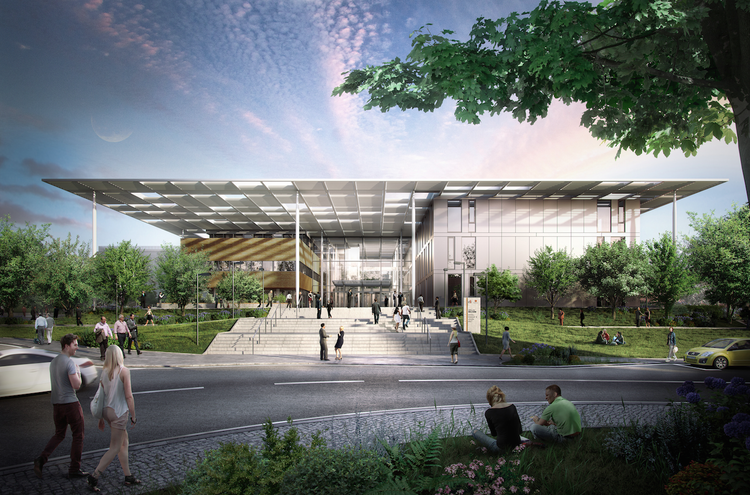
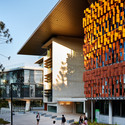
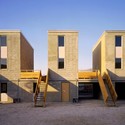
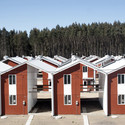
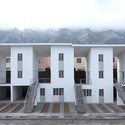
Tengbom is preparing to break ground on their competition-winning proposal “Kotten” (The Pinecone) in the Fontin area of Kungälv municipality. Following the destruction of the old trail centre in a fire in 2013, Kungälv municipality arranged an architectural competition for a new, modern trail centre in the Fontin area.
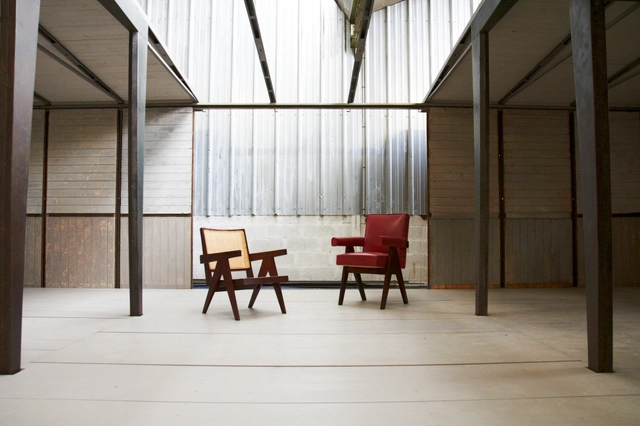
Prouve House with Easy Armchair Chair and Committee Chair by Jeanneret. Image Courtesy of Forward
Marking the second edition of Design Shanghai, this year’s exhibition will take place March 2015 and will include over 300 exhibitors across three halls; Contemporary Design, Classic Design, and Collectible Design. Featured among the confirmed installations is Jean Prouvé’s Demountable House, a rare early example of prefabricated housing.
French architect Jean Prouvé is regarded as one of the twentieth century’s most influential designers, and is known for combining bold elegance with economy of means in a socially conscious manner. He is also recognized for his manufacturing firm, Les Ateliers Jean Prouvé, where he designed and produced lightweight metal furniture in collaboration with some of the most well known designers of the time. One such designer was Pierre Jeanneret, a Swiss architect and furniture designer who often worked with his more famous cousin, Le Corbusier.
Read on after the break to learn more about this year’s featured exhibition.
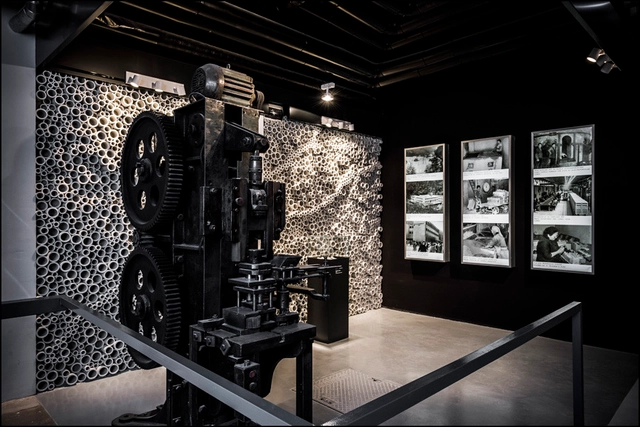
Winner of a 2014 National Design Award for Best Interior of the Year, this showroom design by RIBA ARHITEKTI (Janja Brodar and Goran Rupnik), transforms an otherwise drab factory corridor into a surprisingly engaging space through the innovative re-use of materials. Tasked with converting part of an unused hallway into a showroom, the client’s expectations were initially quite modest and called for re-painting and designing presentation posters. However, while inspecting the production units in the factory, the architects began to imagine using the freely available materials in the building to create a more engaging visual narrative about the company itself.
BSA Space, home to the Boston Society of Architects and the BSA Foundation, is currently accepting proposals from all designers interested in becoming a guest curator. The selected curator would be responsible for conceiving, fabricating, executing, and installing all aspects of a major exhibit within the BSA's 5,000 square foot gallery space. Proposals should take into consideration a diverse audience and seek to capture the imagination of the public by conveying the power of design as an instrument of change within Boston. All major exhibitions will run four to six months and guest curators will receive a budget of $30-70K. The deadline for submissions is Friday, November 14 at 4:00PM. More details can be found, here.
AIA Los Angeles (AIA|LA) has announced the recipients of the 2014 Design Awards. Twenty-one Los Angeles firms and 14 presidential honorees have been honored for excellence in both built (Design Awards) and unbuilt works (Next LA Awards).
What makes a city successful? Miami-based Knight Foundation aims to answer this question with their latest contest, the Knight Cities Challenge. Innovators across all disciplines are invited to propose their idea to improve one of 26 Knight communities, cities across the United States with an established network of support for the foundation's initiatives. Proposals should focus on three key levers of city success: attracting and retaining talent, expanding economic opportunity, and creating a culture of robust civic engagement in the chosen community. “No project is too small — so long as your idea is big,” says Carol Coletta, Vice-President of community and national initiatives for Knight Foundation.
Terreform ONE has named “The Lucent Cube” and “Self Growing Lab” as joint winners of ONE Prize 2014: Smart Dock, an open ideas competition for a ONE Lab educational facility at the Brooklyn Navy Yard. The challenge captured the attention of 99 teams from more than 22 countries. Ultimately, two winners, a third prize and an honorable mention were honored.
More details and the winning projects, after the break.
The Boston Harbor Association, City of Boston, Boston Redevelopment Authority, and Boston Society of Architects have teamed up to launch Boston Living with Water, “an international call for design solutions envisioning a more resilient, more sustainable, and more beautiful Boston adapted for end-of-the-century climate conditions and rising sea levels.” The two-phase competition, open to all leading planners, designers and thinkers, will award the best overall proposal $20,000; the second and third best will each receive $10,000. Submissions for the first phase are due December 2, 2014. Learn more, here.
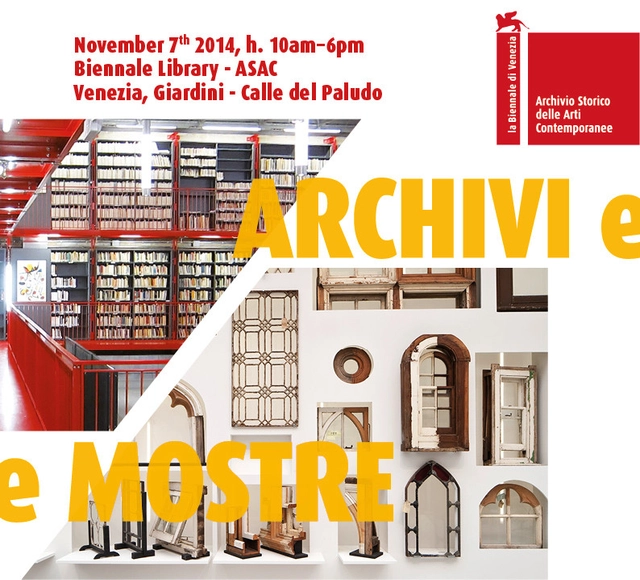
With just over two weeks left in the 14th Venice Biennale of Architecture, Paolo Baratta, President of La Biennale, is hosting a one day conference on the intersection between archives, exhibitions and digital integration. Focusing on the themes of the "dissipation of memory" and the "vulnerability of digital data" in an age of ever-changing technological platforms, the conference is the third in a series of archive-themed events hosted at the Giardini in the Biennale Library, and will feature a screening of Digital Amnesia, a documentary on the lifespan of archival technology, along with a round table discussion with leading archivists and curators from around the world. Panelists include the Mirko Zardini, Director and Chief Curator from the Canadian Centre for Architecture, archive superintendents from three Italian provinces, professors from three Italian universities, and Debora Rossi, the chief archivist for the Venice Biennale.
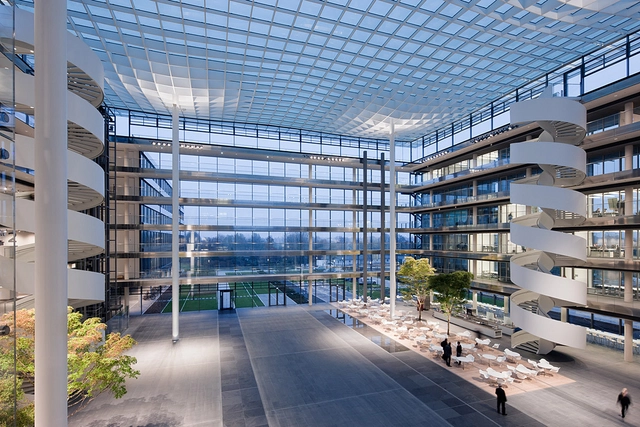
Deutsche Post Towers in Bonn Germany has received the 10 Year Award from the Council on Tall Buildings and Urban Habitat (CTBUH). Completed in 2002 and designed by Murphy/Jahn, Post Tower was a leader in introducing high performance design elements to create a more efficient and pleasant office environment, and has now been recognized by this unique award which rewards proven value and performance in a tall building over a period of 10 years since its completion, and offers a valuable look at the life of buildings long after the initial designs are realized. Read on after the break to learn more about the winning building.
Tom Bridgen: 'The Protected Vista' - Commendation - RIBA President’s Award for the Outstanding PhD Thesis. Image Courtesy of RIBA
The RIBA President's Awards for Research, established to "promote and champion high-quality research and encourage its dissemination to the profession," have announced the 2014 laureates. Spanning four categories - Master's, PhD, University, and Practice-Located Research - the winning theses and projects highlight the need for research across the profession to nurture innovation and strategic thinking. Ruth Morrow, chair of the jury and Professor at Queen's University Belfast, commented on the judging panel's "disappointment" at the lack of entries submitted from outside London.
The disparity between the six London based schools and those in the rest of the UK (of which there are more than forty high-calibre institutions) continually makes itself manifest in RIBA student awards. In spite of this, half of the awards and commendations given this year are for students studying at schools outside the capital; the remaining half were awarded to students of The Bartlett (UCL). Morrow hopes that "next year, in the 10th anniversary year of the awards, that more universities and practices from across the nations and regions will submit entries."
See this year's winning and commended projects after the break.
The Wall Street Journal has named Sou Fujimoto the “Architecture Innovator of the Year.” The 43-year-old Japanese architect, who first gained international acclaim in 2008 with the completion of the Hokkaido Children’s Center for Psychiatric Rehabilitation, has been lauded by the magazine for his “future primitive” structures that are, as Fujimoto’s believes, creating opportunities to explore “more possibilities” for daily life.
“Fujimoto’s goal isn’t just to make spaces—the basic function of architecture—but to make people relate to spaces in new ways,” stated WSJ author Fred Bernstein.
In response to Fujimoto’s selection, WSJ has published a comprehensive article about Fujimoto’s life and work. You can read the article, here.
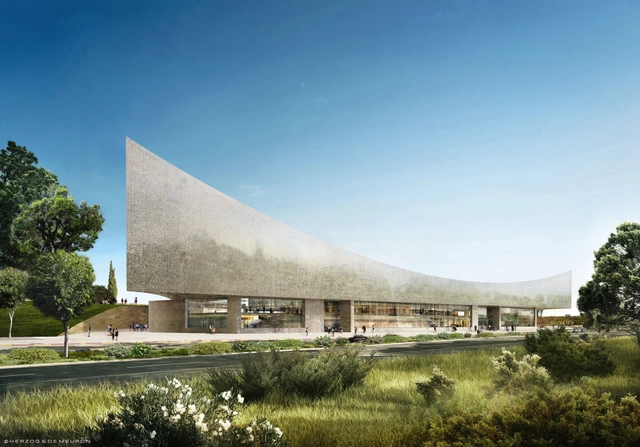
The Israeli National Library has released images of Herzog & de Meuron’s design for the library’s new home in Jerusalem. The six-story building, awarded to the Swiss practice over five others following an extensive interview process conducted last year, will be built by 2019 on a prominent site at the base of the Knesset building and adjacent to the Israel Museum, Science Museum and Hebrew University.
More image and information about the new library, after the break.
The Westminster City Council has granted planning permission to Sheppard Robson for a “dramatic” rooftop extension to London’s Aldwych House. The £15m project - situated within the Westminster Conservation Area - will add 8,500 square feet of high-quality office and reception space by installing a series of geometrical-folded forms on top of the landmark Midtown office building.
Bogle Architects has won the 2014 Czech Architect Week "Architectural Project of the Year” award for their ELI (Extreme Light Infrastructure) Beamlines project in Prague, Czech Republic. The campus, designed as four separate structures connected within a landscaped setting, will be the first laser research and technology facility to involve scientists from the global research community for high-powered laser experimentation.
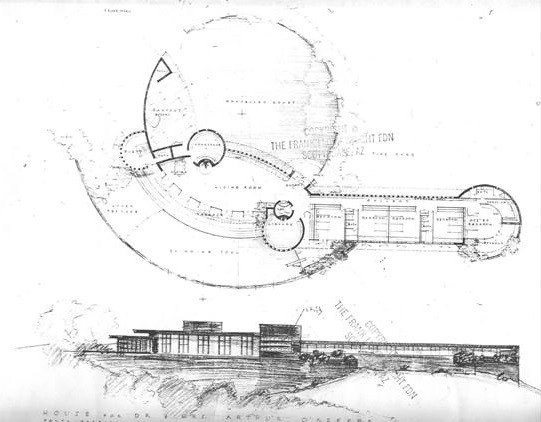
A plan by Stephen Brooks Architects to build the first Frank Lloyd Wright-designed home in the UK has been blocked at the appeal stage by a planning inspector, reports the Architects' Journal. Based on a 1947 design by Wright for the O'Keefe family in California, the project was the brainchild of Dr Hugh Petter, a Frank Lloyd Wright enthusiast who negotiated for eight years with the Frank Lloyd Wright Foundation before gaining permission to build the unrealised design in Tyntesfield Springs near Bristol, thousands of miles from its intended location.
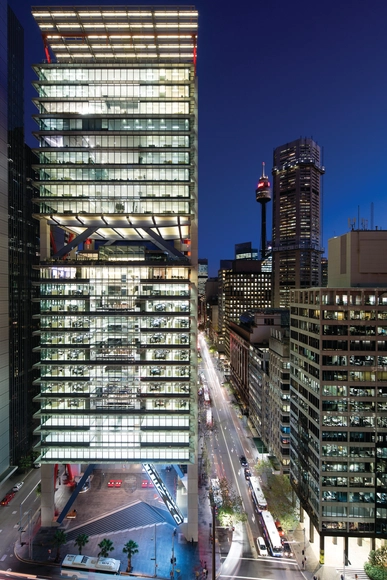
Chifley Square. Image Courtesy of Australian Institute of Architects
The Australian Institute of Architects has announced the winners of the 2014 National Architecture Awards. A total of 43 awards and commendations were given to 36 projects across the 12 national categories. "Projects honored include a housing project with an emphasis on communal spaces, a mental health facility with a welcoming domestic feel, a primary school that provides a sanctuary for the culturally diverse local population and a pro bono surf club that celebrates the coastal features and protects an adjacent fairy penguin habitat." View them all, after the break.
CEMEX has announced both the international and national winners of the XXIII Building Awards, which aim to recognize the best architecture and construction both internationally and within Mexico. All projects were reviewed by a panel of judges comprised of some of the most important and prestigious representatives of the industry at an international level.
The international awards recognizing housing, institutional/industrial and large-scale infrastructure projects that were built during 2013 and stand out for their constructive solutions, aesthetics and innovative techniques. Finalist projects ranged from Frank Gehry’s Biomuseo in Panama to Plan B Arquitectos’ Click Clack Hotel in Bogotá, Colombia, covering a range of countries and architectural styles.
The CEMEX Building Award is itself a unique piece of art created by Mexican sculptor Miguel Angel Gonzalez and made out of black marble and concrete.
Read on after the break for both the international and national winners…
Aravena also emphasized the importance of community participation in his projects, saying: “We won’t ever solve the problem unless we use people’s own capacity to build.” Watch Aravena’s full talk above and take a peek at some of his key projects below.
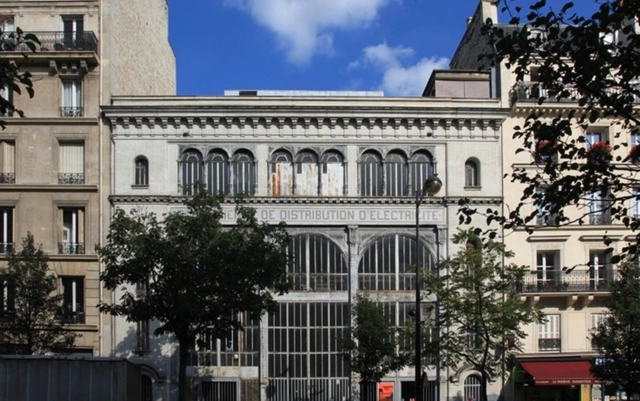
Site: Sous-station Voltaire (11e). Image Courtesy of Reinventer Paris
The City of Paris has called upon the architects of the world to propose "innovative urban projects" to reimagine the city's urban future. As the first competition of its kind in the world, Mayor Anne Hidalgo and her Deputy, Jean-Louis Missika, will "select and implement the new forms of buildings that will shape the future of Paris," putting innovation at the top of the criteria. Offering 23 sites, located in the centre of Paris and on the peripheries, the City is convinced that "the challenges faced by the world can be addressed through local answers." According to the Mayor, "from today, world creators are given carte blanche to reinvent the ways of living, working and trading in Paris." "Surprise us!"
Yesterday, during the opening of a new photography gallery, Centre Pompidou president Alain Seban announced the contemporary art museum will soon open a new design and architecture gallery inside the famed Renzo Piano- and Richard Rogers-designed building. “Eventually, there should be almost no offices in the building, and we'll keep only the technical facilities that are strictly indispensable," said Seban. “When allocating the spaces, the works and the visitors have to take precedence."
An international jury behind Budapest’s new National Gallery has launched a second and invited competition for a select few of the industry’s best after the first, open competition lead to “disappointing” results. Jean Nouvel, David Chipperfield, Mecanoo, Nieto Sobejano, Renzo Piano, SANAA and Snøhetta have been asked to submit proposals for a 5-building museum complex on the edge of Városliget, one of the city’s main parks. It will house the new National Gallery, the Ludwig Museum, an ethnography museum, architecture museum and photography museum.
The competition, known as the Liget Project, is being directed by jury members Wim Pijbes, the director of the Rijksmuseum, and Henri Loyrette, former director of the Louvre in Paris.
Sustainable lighting design offers various well-being and environmental benefits in addition to economic advantages for clients and users. Although daylight provides a free lighting source, for most spaces the amount and time of daylight is not sufficient and electrical lighting is necessary. A focus on sustainability becomes essential for minimizing energy consumption and improving the quality of life. Even though efficiency has significantly increased with LED technology, electrical lighting is still more widely used. Often the ambition for renovations or new applications goes along with a higher quantity of lighting instead of finding a better lighting quality with an adequate amount of energy.
Read on after the break for Light Matters’ 7 fundamental steps to achieve sustainable lighting.
A team of graduates from the Bartlett School of Architecture at University College London have developed a new hybrid building material designed for use in uniquely challenging construction environments. "Augmented Skin" combines a regimented structural core with a flexible opaque skin, which is coated in PVA to serve as casting formwork for concrete. Inspired by biological skeletal frameworks, the material can be assembled quickly at a minimal cost with maximum flexibility. The project was designed by architecture graduate students Kazushi Miyamoto, Youngseok Doo, and Theodora Maria Moudatsou, and was exhibited at The Bartlett's 2014 graduation exhibition B-Pro.
Read more about the flexibility of Augmented Skin after the break












RainerViertlboeck.jpg?1415267623&format=webp&width=640&height=580)


.jpg?1415393405&format=webp&width=640&height=580)