Have you seen our interviews in High Definition?

Quinta Monroy / Elemental

By Nico Saieh — Filed under: Housing , Selected , , , , ,
 

Architects: Elemental – Alejandro Aravena, Alfonso Montero, Tomás Cortese, Emilio de la Cerda
Location: Iquique, Chile.
Client: Gobierno regional de Tarapacá / Programa Chile-Barrio del Gobierno de Chile.
Engineering: Juan Carlos de la Llera & José Gajardo.
Contractor and Services: Proingel, Abraham Guerra, Constructora Loga S.A.
Budget: US $204 /sqm
Project Year: 2003
Construction Year: 2004
Execution time: 9 months
Materials: Concrete & Cement bricks
Site Area: 5000 sqm
Constructed Area: 3500 sqm
Photographs: ElementalCristóbal Palma – Tadeuz Jalocha


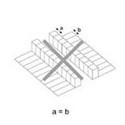
The Chilean Government asked us to resolve the following equation:

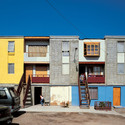
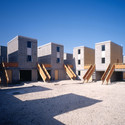
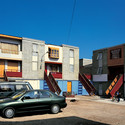
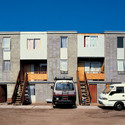
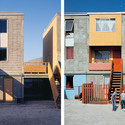
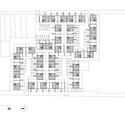
To settle the 100 families of the Quinta Monroy, in the same 5,000 sqm site that they have illegally occupied for the last 30 years which is located in the very center of Iquique, a city in the Chilean desert.

We had to work within the framework of the current Housing Policy, using a US$ 7,500 subsidy with which we had to pay for the land, the infrastructure and the architecture. Considering the current values in the Chilean building industry, US$ 7,500 allows for just around 30 sqm of built space.

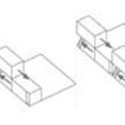
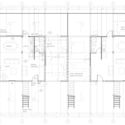
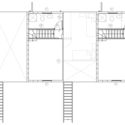
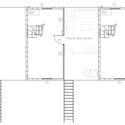
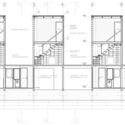
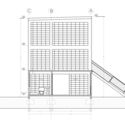
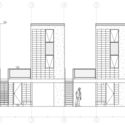
restrictions scheme

proposal scheme

And despite the site’s price (3 times more than what social housing can normally afford) the aim was to settle the families in the same site, instead of displacing them to the periphery.

If to answer the question, one starts assuming 1 house = 1 family = 1 lot, we were able to host just 30 families in the site. The problem with isolated houses, is that they are very inefficient in terms of land use. That is why social housing tends to look for land that costs as little as possible. That land, is normally far away from the opportunities of work, education, transportation and health that cities offer. This way of operating has tended to localize social housing in an impoverished urban sprawl, creating belts of resentment, social conflict and inequity.

If to try to make a more efficient use of the land, we worked with row houses, even if we reduced the width of the lot until making it coincident with the width of the house, and furthermore, with the width of a room, we were able to host just 66 families. The problem with this type is that whenever a family wants to add a new room, it blocks access to light and ventilation of previous rooms. Moreover it compromises privacy because circulation has to be done through other rooms. What we get then, instead of efficiency, is overcrowding and promiscuity.

Finally, we could have gone for the high-rise building, which is very efficient in terms of land use, but this type blocks expansions and here we needed that every house could at least double the initial built space.

SO, WHAT TO DO?

Our first task was to find a new way of looking at the problem, shifting our mindset from the scale of the best possible US$ 7,500 object to be multiplied a 100 times, to the scale of the best possible US$ 750,000 building capable of accommodating 100 families and their expansions.

But we saw that a building blocks expansions; that is true, except on the ground and the top floor. So, we worked in a building that had just the ground and top floor.

WHAT IS OUR POINT?

We think that social housing should be seen as an investment and not as an expense. So we had to make that the initial subsidy can add value over time. All of us, when buying a house expect it to increase its value. But social housing, in an unacceptable proportion, is more similar to buy a car than to buy a house; every day, its value decreases.

It is very important to correct this, because Chile will spend 10 billion dollars in the next 20 years to overcome the housing deficit. But also at the small family scale, the housing subsidy received from the State will be, by far, the biggest aid ever. So, if that subsidy can add value over time, it could mean the key turning point to leave poverty.

We in Elemental have identified a set of design conditions through which a housing unit can increase its value over time; this without having to increase the amount of money of the current subsidy.

In first place, we had to achieve enough density, (but without overcrowding), in order to be able to pay for the site, which because of its location was very expensive. To keep the site, meant to maintain the network of opportunities that the city offered and therefore to strengthen the family economy; on the other hand, good location is the key to increase a property value.

Second, the provision a physical space for the “extensive family” to develop, has proved to be a key issue in the economical take off of a poor family. In between the private and public space, we introduced the collective space, conformed by around 20 families. The collective space (a common property with restricted access) is an intermediate level of association that allows surviving fragile social conditions.

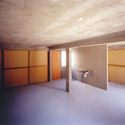
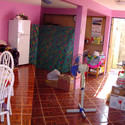
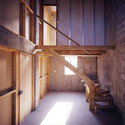
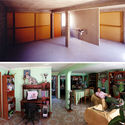
Third, due to the fact that 50% of each unit’s volume, will eventually be self-built, the building had to be porous enough to allow each unit to expand within its structure. The initial building must therefore provide a supporting, (rather than a constraining) framework in order to avoid any negative effects of self-construction on the urban environment over time, but also to facilitate the expansion process.

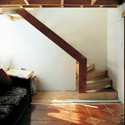
Finally, instead a designing a small house (in 30 sqm everything is small), we provided a middle-income house, out of which we were giving just a small part now. This meant a change in the standard: kitchens, bathrooms, stairs, partition walls and all the difficult parts of the house had to be designed for final scenario of a 72 sqm house.

In the end, when the given money is enough for just half of the house, the key question is, which half do we do. We choose to make the half that a family individually will never be able to achieve on its own, no matter how much money, energy or time they spend. That is how we expect to contribute using architectural tools, to non-architectural questions, in this case, how to overcome poverty.


24 comments »

roadkill says:

Still one of the most resourceful and best affordable housing projects ever… Well done – let’s have some more drawings please!

 
# December 31, 2008 at 16:32

I agree, this looks great. Homes anyone could be proud of.

http://www.contemporaryartdaily.com

 
# December 31, 2008 at 17:39
archizoo says:

Delightful innovation! Check out this (http://designthinking.ideo.com/?p=198#comment-361.

 
# December 31, 2008 at 19:38

archizoo,

Interesting link. Thanks!

 
# December 31, 2008 at 21:40

“That is how we expect to contribute using architectural tools, to non-architectural questions, in this case, how to overcome poverty.”

That´s why Aravena made it to the Monocle Magazine 20 heroes list.

 
# December 31, 2008 at 21:41
raúl says:

I find interesting to see what happen with the houses. it makes me think that it is an experiment, more than a smart solution

 
# December 31, 2008 at 22:39
cam says:

all smart solutions were at one point in time an experiment raúl.

 
# December 31, 2008 at 23:23
Lucas says:

I think that the intention is correct. However, I consider that on the one hand there is an excessive “design” and on the other and “elemental” interpretation of the demand. Just like their name, Elemental, but in a negative sense. Also, there are interpretations that have nothing to do with local conditions. The projects are an immediate response that tries to configure a popular environment with aesthetic quality. The fact that concerns me the most is the way some units that are able to evolve over time apparently allow the users’ participation. In these projects this is the weakest aspect.The effort in the design is good and always valid, but it is not well connected with the users’ intervention. The images in is this post do not show accurately what the interventions by the users are. There is a gap there that is unresolved, that obviously, needs to be re-thought.

 
# January 1, 2009 at 17:07
DTarcho says:

Congratulations! this project has a good architectural thinking behind! well done!

 
# January 1, 2009 at 20:11
Tom in London says:

There are far too many luxurious private homes on this site, most of them built for the privileged classes in some of the poorest countries in the world (Chile, Brazil, etc.) so it’s a great pleasure to see this interesting project. More of this, please ! And fewer sybaritic luxury homes in poor countries !

 
# January 2, 2009 at 06:23
Amelie says:

Tom, you are right, I follow you BUT do you think we could renegociate ”architecture without architects” with technological apparatuses… Or do you think we just have to come back (as this project is pretending) to a ”do what you want” with screws and dismiss ?

 
# January 2, 2009 at 07:13
Big A says:

If only this kind of approach was considered more often, instead of housing projects being over developed! Let the community add to it and also add its character. If only Gehry could take this approach in the Atlantic yards project in Brooklyn, New York, which has already displaced many of the borough’s inhabitants. The framework is all you need. Obviously, something that fits the New York vernacular but not with any less complexity than what Elemental has proposed and constructed. I recognize that 16 high-rise buildings in NYC represents a different scale of complexity, but it was the Brownstone building built as worker housing that has given Brooklyn much of its character. Perhaps there is an opportunity being missed to create a framework that guides the community to partake in the affairs of its own city streets, its own public life. Organic projects, such as this one by Elemental, have always established a counter to the brute force machine of the developer. Bravo.

 
# January 3, 2009 at 07:36
t0mash says:

superproject, architectural, social, e/nviron/mental

 
# January 29, 2009 at 07:44
Lu says:

Buen intento, no niego lo social, y todo el estudio realizado, poer a mi consideracion falto algo de control al entregarlo a los habitantes, ahora es un proyecto horrible, super mal tenido y con poca cultura, si la idea era que cada habitante se apropiara y creara su espacio como deseara, eso lo han hecho de la peor manera y es algo de lo que la pequeña ciudad de Iquique no esta orgulloso, es un sitio lleno de ladrones y poco facil de acceder, nunca la cultura ciudadana se dio y siguen siendo lo mismo de lo mismo.

 
# May 13, 2009 at 16:06
Lucas says:

Lu, totalmente de acuerdo. Creo que la intencion es buena, pero no asi los resultados.

 
# May 13, 2009 at 19:29
Lu says:

Si…. cuando estaba en la universidad, Cali, Colombia, tome como referencia Elemental y todos los proyectos alrededor de este, los estudie y pude lograr mi proyecto de grado del cual estoy muy orgullosa y me fue muy bien, estaba muy ilusionada con conocer estos proyectos bases del mio, por cosas de la vida, llegue a Iquique por un trabajo y moria por conocer Quinta Monroy… me da pena decirlo, pero fue una gran desilucion…

 
# May 13, 2009 at 19:34
wival says:

CONCEPTUALIZACION INTERESANTE, EJECUCION NO APLICABLE,EN MI CUESTIONAMIENTO NO ES MAS QUE OTRA MUTACION DE LA CULTURA PRESENTE EN TODOS LOS PROYECTOS SOCIALES,QUE PARECIERAN REGIRSE POR LA FORMULA ” SOCIAL = HACINAMIENTO + POBREZA “,
TODO SE CONVIERTE EN UNA CARENCIA TOTAL DE ESPACIOS, EN UN ABULTAMIENTO DE MAL GUSTO, Y UNA AUSENCIA DE INTERES HACIA LOS INDIVIDUOS , QUE SON TOMADOS COMO OBJETOS ” CERILLOS ” QUE HAY QUE ACOMODAR EN UNA PEQUEÑA CAJA.

 
# June 4, 2009 at 23:06

Links to this article »

Leave a Reply »

Want to have your own avatar? Get yours at Gravatar.

Latest Comments »

Haven’t a clue. I was unable to force myself to care enough to finish his novella....[+]
It is good– better than jurgen meyer: simpler...[+]
A pretentious, egotistical blowhard, and in the field of architecture? How utterly...[+]
I fully understand that it is not just about the building. I fully understand the idea,...[+]
I like the stair and the external view I can’t imagine the spaces...[+]
The building is beautiful. But it’s not about the building only… its about...[+]
Stourley Kracklite on 4 Houses / On Office:
I like purism as well as the next guy, so I am very interested in how the...[+]
I like the overall design of it, but in combination with the abandoned dessert location...[+]
I like the yurt argument… yes, it is clearly a client-wooing...[+]
Don’t ask… you’ll just get some lengthy BS answer.[+]
Yes, this is clearly a yourt inspiration :rollseyes:[+]
I like this building … but the pretentious,kitchy heart? …why?[+]

Browse by category »

Our partners »

Browse by date »

Friends »

Proudly hosted at »