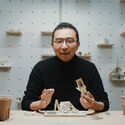
Video: Sou Fujimoto at IE Master in Architectural Design
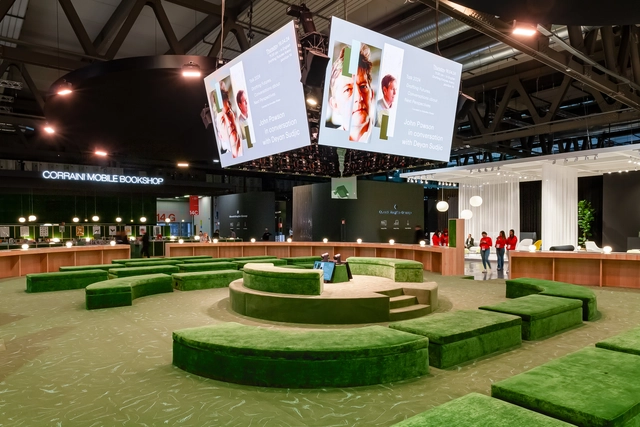
IE Master in Architectural Design opens its 2013 lecture series program, at the Círculo of Bellas Artes in Madrid, with the Japanese architect Sou Fujimoto.
Sou Fujimoto’s lecture, “Evolving Ideas: Primitive Future”, served as a forum for students to participate in open discussions between scholars, critics, independent professionals, entrepreneurs, curators and cultural activists.
What is the meaning of Architecture? How does it relate to nature? These are the two questions that Sou Fujimoto continues to ponder on. His projects are a pure reflection of his continuous research of the relationship between: City and architecture, architecture and landscape, inside and outside, and nature and architecture.
Enjoy the interview with Sou Fujimoto and summary of the event.
The Fujimoto Experiment: Five Students, Five Days, One Model

Last week an online call was put out by Rome’s MAXXI museum promising the first five architecture students to respond a chance to travel to Rome and build a model of Sou Fujimoto’s latest project. The five selected entrants started on their work at MAXXI on Monday and their experience is being broadcast over the course of this week in a series of photos and videos detailing the ups, downs, opinions and thoughts of the students as they work.
Read more about the model and exhibition after the break…
Sou Fujimoto to design the 2013 Serpentine Gallery Pavilion

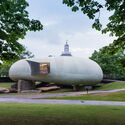
Today, the Serpentine Gallery announced the architect that will design the 13th edition of the Serpentine Gallery Pavilion. Every year the gallery invites a renowned international architects who have not built yet in the UK, to design a temporary pavilion that hosts public activities in at the Gallery’s lawn, in London’s Hyde Park between June and October. The list of architects for the past editions includes several Pritzker laureates. More info of this program at our Serpentine Gallery Pavilion infographic.
The Japanese architect based in Tokyo established his firm Sou Fujimoto Architects back in 2000. He graduated from the Department of Architecture at the University of Tokyo in 1994, and has been a lecturer at Kyoto University since 2007. With a solid trajectory in residential and cultural projects, the firm has consistently shown a unique and innovative approach to the spatial qualities within his buildings, exploring new ways of housing design, space and materials. Sou was also part of the team that won the Golden Lion at the 13th Venice Biennale, with “Architecture, possible here? Home-for-All”, the Japan pavilion.

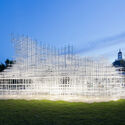
About the design of the pavilion Sou stated: “For the 2013 Pavilion I propose an architectural landscape: a transparent terrain that encourages people to interact with and explore the site in diverse ways. Within the pastoral context of KensingtonGardens, I envisage the vivid greenery of the surrounding plant life woven together with a constructed geometry. A new form of environment will be created, where the natural and the man-made merge; not solely architectural nor solely natural, but a unique meeting of the two.
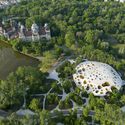
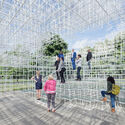
The Pavilion will be a delicate, three-dimensional structure, each unit of which will be composed of fine steel bars. It will form a semi-transparent, irregular ring, simultaneously protecting visitors from the elements while allowing them to remain part of the landscape. The overall footprint will be 350 square-metres and the Pavilion will have two entrances. A series of stepped terraces will provide seating areas that will allow the Pavilion to be used as a flexible, multi-purpose social space.
The delicate quality of the structure, enhanced by its semi-transparency, will create a geometric, cloud-like form, as if it were mist rising from the undulations of the park. From certain vantage points, the Pavilion will appear to merge with the classical structure of the Serpentine Gallery, with visitors suspended in space.”
We are big fans of Sou’s work, and we are very excited to see this project being built at Hyde Park. As usual, expect a complete coverage of this project. You can watch our interview with Sou after the break:
Sou Fujimoto: Sketchbook

The works of Sou Fujimoto resist any form of conventional categorization. This young Japanese architect stands for unconventional buildings that cannot be described by standard criteria and definitions such as inside/outside or public/private. Clear divisions such as between floor levels and rooms are shattered by his complex ground plans and interlocking structures which—in a reference to the idea of the cave—he describes as “Primitive Future.” With this approach he creates forms that are committed to a playful interaction between user and space. Alongside private residences, such as the well-known N House, his library for Musashino Art University has achieved particular recognition. In addition he was represented at the 2010 Venice Biennale with a design for a house.
Beton Hala Waterfront Center / Sou Fujimoto Architects

Sou Fujimoto Architects have shared with us their first place proposal for the Beton Hala Waterfront Centre in Belgrade, Serbia. Contrasting the medieval fabric of the capital city, Sou Fujimoto’s “floating cloud” intertwines an array of social and transportation programs into an organized tangle of suspended ramps that emerge from the static platform of the Beton Hala. It was lauded by the jury to be a “brave proposal” that holds the “highest emblematic potential among all of Beton Hala entries”.
Learn more after the break.
Venice Biennale 2012: “Lars Müller Publishers – Book Fever”

Join the authors and editors of Lars Müller Publishers for a rare book signing opportunity with architects Wang Shu, Sou Fujimoto, and Steven Holl on August 28th at the 2012 Venice Architecture Biennale! This event will kick off the exhibition Lars Müller Publishers – Book Fever, which will feature sixty publications – new releases, bestsellers, milestones from the past, and rare treasures – for the public to explore.
Founded thirty years ago, Lars Müller Publishers’ carefully edited and designed publications on architecture, design, and contemporary art has lead them to become a renowned international publisher. One milestone you may remember was their release of Peter Zumthor’s Works (1998), which was the first survey of the oeuvre of the architect now known worldwide that set new standards for the monograph as a book genre.
Continue after the break for more details on the book signing and exhibition.
House NA / Sou Fujimoto Architects

You may remember Sou Fujimoto Architects radical House NA from this video we shared with you last November. Designed for a young couple in a quiet Tokyo neighborhood, the 914 square-foot transparent house contrasts the typical concrete block walls seen in most of Japan’s dense residential areas. Associated with the concept of living within a tree, the spacious interior is comprised of 21 individual floor plates, all situated at various heights, that satisfy the clients desire to live as nomads within their own home.
Continue after the break for more images and information on House NA.
Video: Interview with Sou Fujimoto
Studio Banana TV had the opportunity to sit down with Tokyo-based architect Sou Fujimoto. He discussed the current inner-workings of his office and highlights his involvement with teaching in other countries, describing it as a “precious experience”. The importance of learning from other cultures and different students has positively impacted his ever-expanding involvement with a variety of international projects. He describes architecture as a “patient process” and believes architectural education should teach students how exciting the profession is.
Would you like to see more? View ArchDaily’s interview with Sou Fujimoto and some of his featured projects here.
Taiwan Tower First Prize Winning Proposal / Sou Fujimoto Architects

Tokyo-based architect Sou Fujimoto has been selected as the first prize winner for the Taiwan Tower International Competition. The winning proposal’s design reflects Sou Fujimoto’s philosophy of Primitive Future, as the “21st Century Oasis” aspires to be a model of green architecture for the future generations.
Continue reading for more project information and images.
Video: House NA / Sou Fujimoto Architects
Shinkenchiku brings you an exclusive inside tour of the contemporary House NA, designed by Sou Fujimoto Architects. Thin, steel poles delicately support the transparent “pile of boxes” at varying heights. In an interview conducted by F.W. Monocle, Sou Fujimoto explains, “In one way the house is like a single space, but each room is also a tiny space of its own. The clients said they wanted to live like nomads within the house – they didn’t have specific plans for each room. The house looks radical but for the clients it seemed quite natural.”
House N / Sou Fujimoto

Architects: Sou Fujimoto Architects
Location: Oita, Japan
Project Team: Yumiko Nogiri
Structural Consultant: Jun Sato Structural Engineers
Design Year: 2006-2007
Construction Year: 2007-2008
Site Area: 236,57 sqm
Constructed Area: 150,57 sqm
Photographer: Iwan Baan

AD Interviews: Sou Fujimoto
A while ago I had the chance to meet one of the architects whose work I highly admire: Sou Fujimoto.
This Japanese architect based in Tokyo, Japan, established his firm Sou Fujimoto Architects back in 2000. He graduated from the Department of Architecture at the University of Tokyo in 1994, and has been a lecturer at Kyoto University since 2007. With a solid history in residential and cultural projects this firm has consistently shown a unique and innovative play of spatial qualities within its building designs, pushing the limits of housing and space conventions.
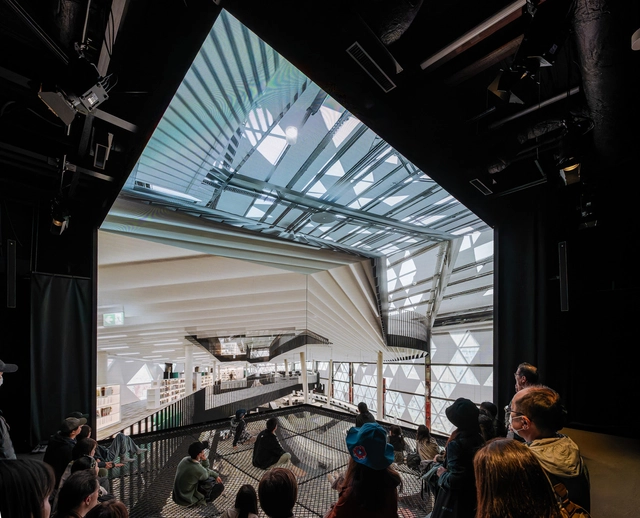
He defines his architecture under the concept of Primitive Future (as seen on his book), better described by himself as “a sort of primitive situation that relates to the human cave habitation but at the same time creating something new for the future”. This explains very well his works, specially in his recently completed library and museum for the Mushashino Art University. On our article you can watch a video of Sou explaining the challenges of designing a library on the information age.
You can check other works by Sou Fujimoto recently featured on ArchDaily:
- House N
- Group Home in Noboribetsu
- T House
- House of ORDOS 100
- Children’s Center for Psychiatric Rehab
- Final Wooden House
- Dalarna Library (in progress, with ADEPT Architects)
Musashino Art University Museum & Library / Sou Fujimoto

Architects: Sou Fujimoto
Location: Tokyo, Japan
Client: Musashino Art University
Project Year: 2010
Project Area: 2,883.18 sqm
Photographs: Daici Ano
One of the most interesting projects I’ve seen in a while, the Musashino Art University Museum & Library proposes a new relation between the user and the books, surrounded and sheltered by them. We had the chance to ask Sou Fujimoto about the challenge of designing this program in the information age, as you can see on the above video.
More info after the break:
ADEPT wins Dalarna Library competition

Danish architects ADEPT Architects, together with an impressive group of collaborators, have been awarded with the 1st prize on the competition for the Dalarna Library in Sweden. The team includes Sou Fujimoto (Japan, see all his projects previously featured on AD), Topotek1 (Germany), Rambøll A/S (Denmark) and Bosch & Fjord (Denmark).
The new library, placed centrally at the Dalarna university campus, is organized as a ”spiral of knowledge” (see diagram below). The sloping terrain continues in a ramp through the building. Wrapping itself the ramp creates a spiral-shaped space – the heart of the building for information seeking and easy orientation. This organization of program creates a various learning environment where students can take part in the vibrant life of the library as well as retreat into various study niches. The different sound levels and activities create a diverse and eventful library.
Group Home in Noboribetsu / Sou Fujimoto

Architects: Sou Fujimoto Architects
Location: Hokkaido, Japan
Principal Use: Group home for elderly with dementia
Project Year: 2006
Structure material: Wood
Site Area: 1,637 sqm
Constructed Area: 745 sqm
Photographer: Daici Ano
International firms invited by MAD to design “Huaxi City Centre” in China
MAD recently organized a collaborative masterplanning project in South West China. Ten young international architects were invited to take part in an urban experiment, to design a new city centre on a scenic natural site close to the city of Guiyang. The participating architects were: Atelier Manferdini (USA), BIG (DENMARK), Dieguez Fridman (ARGENTINA), EMERGENT/Tom Wiscombe (USA), HouLiang Architecture (CHINA), JDS (DENMARK/BELGIUM), MAD (CHINA), Mass Studies (KOREA), Rojkind Arquitectos (MEXICO), Serie (UK/INDIA), Sou Fujimoto Architects (JAPAN).
Seen on designboom.
Images after the break.
ORDOS 100 #9: Sou Fujimoto

This villa is located in plot #70 of the ORDOS project.
Architects: Sou Fujimoto Architects
Location: Ordos, Inner Mongolia, China
Design year: 2008
Construction year: 2009
Curator: Ai Weiwei, Beijing, China
Client: Jiang Yuan Water Engineering Ltd, Inner Mongolia, China
Constructed Area: 1,000 sqm aprox
T house / Sou Fujimoto

Architects: Sou Fujimoto Architects
Location: Gunma, Japan
Principal Use: Residence
Project Year: 2005
Structure material: Wood
Site Area: 144.47 sqm
Constructed Area: 90.82 sqm
Photographer: Daici Ano & Sou Fujimoto
Children’s Center for Psychiatric Rehabilitation / Sou Fujimoto

Architects: Sou Fujimoto Architects
Location: Hokkaido, Japan
Project Team: Hiroshi Kato
Project Year: 2006
Site Area: 14,590 sqm
Constructed Area: 2,536 sqm
Photographer: Daici Ano & Sou Fujimoto
Final Wooden House / Sou Fujimoto

Architects: Sou Fujimoto Architects
Location: Kumamoto, Japan
Project Team: Hiroshi Kato
Structural Consultant: Jun Sato Structural Engineers
Lighting: Hirohito Totsune
Contractor: Tanakagumi Construction
Design Year: 2005-2006
Construction Year: 2007-2008
Site Area: 89,3 sqm
Constructed Area: 15,13 sqm
Photographer: Iwan Baan