Monterrey Housing / ELEMENTAL

Uploaded by — Filed under: Housing ,Selected , , ,
 

© Ramiro Ramirez

Architects: ELEMENTAL
Location: Monterrey,
Client: Instituto de la Vivienda de Nuevo León (IVNL)
Engineering: Area of projects and technological innovation, IVNL
Urbanization & Specialization: Area of projects and technological innovation, IVNL
Site Area: 6,591 sqm
Initial House Area: 40 sqm
Expanded House Area: 58.75 sqm
Initial Duplex Area: 40 sqm
Expanded Duplex Area: 76.60 sqm
Project Year: 2010
Photographs: Ramiro Ramirez

Restrictions

Santa Catarina is a city of 230,000 inhabitants, located in the state of Nuevo León, in the northwest of Mexico. This project is ’s first outside of Chile.

site plan

The Government of Nuevo León, México, commissioned us to design a group of 70 homes on a site of .6 hectars in a middle class neighborhood in Santa Catarina. The required density suggested the application of the typology we developed for Iquique. However, the climate in Santa Catarina is very different from the northern dessert climate of Chile. The 600 mm of annual rainfall required us to adapt our proposal to this new question.

© Ramiro Ramirez

The commission to develop this middle class neighborhood with the financing of US$20,000 per dwelling (almost double the funds we had for the housing projects built by Elemental in Chile). However, the construction standards and building codes significantly raise the construction costs. In this case, it was pertinent to use the strategy of investing state resources to build “the difficult half” of the home, especially given the capacity do-it-yourself building observed in Mexico, ensuring a promising future for the expansions.

The Project

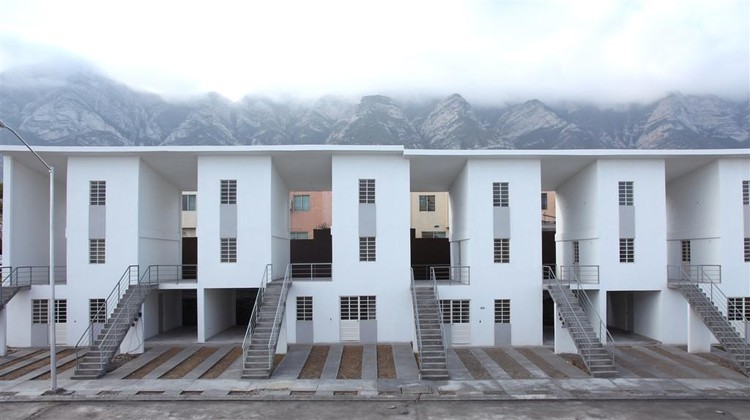
ELEMENTAL Monterrey consists of a three-story continuous building that in section superimposes a home (first floor) with a two-story apartment above (2nd and 3rd story). Both units are designed to technically and economically facilitate the final middle class standard of which we will hand over the “first half” (40 m2). In this sense, the difficult parts of the house (bathrooms, kitchen, stairs, and dividing walls) are designed for the expanded scenario, that is, for a home of more than 58 m2 approx. and an apartment of approximately 76 m2.

© Ramiro Ramirez

Secondly, given that almost 50% of the m2 of the complex will be self-built, this building is porous so that the growth can occur within the structure. On one hand we want to frame and give rhythm (more than control) to the spontaneous construction so as to avoid deterioration of the urban environment over time, and also make the process of expansions for each family easier. The proposed continuous roof above the volumes and voids protects the expansion zones from rain and ensures a definitive profile of the building toward the public space.

section

© Ramiro Ramirez

Third, experience tells us that in lower class neighborhoods the green spaces tend to be “earth spaces,” due to the scarcity of maintenance and the distance that exists between green space and the home that makes it difficult for neighbors to take care of. What we did in this case was to surround the green space with building, reducing the distance between communal space and the home to a minimum. This permitted us to define a collective space with secure Access that gives space to the social network and generates favorable conditions for maintenance and care.

All the apartments have direct Access from the public space and parking, a condition especially relevant in a country where every family can have access to an automobile.

* Location to be used only as a reference. It could indicate city/country but not exact address.
 
 
Thumb up Thumb down 0
mark says:

ohhh my!!! what is that? this is not architecture, please help us and free us for this kind of architecture, obiously is for latinamerican countries… so bad!!

 
# March 9, 2010 at 13:03
    Thumb up Thumb down 0
    Balkan says:

    @Mark if u would use your brain a little instead of ur eyes and read u would know the real value of this project.

     
    # March 9, 2010 at 13:50
    Thumb up Thumb down 0
    adrian says:

    pobre mark. anyway…..
    Look for this proyect under “quinta Monroy” Iquique, Chile by Alejandro Aravena.
    total rip off.

     
    # March 9, 2010 at 22:04
      Thumb up Thumb down 0
      taller.componente says:

      @adrian
      Please visit http://www.elementalchile.cl/

       
      # March 10, 2010 at 12:24
      Thumb up Thumb down 0
      palau says:

      this is a project by Aravena it ain’t a rip off….

       
      # July 31, 2010 at 17:54
      Thumb up Thumb down 0
      barto says:

      Elemental is Aravenas team, this project was also made by Aravena, you should read a little bit more

       
      # November 26, 2011 at 12:46
    Thumb up Thumb down 0
    j says:

    poor idiot. its functional and i could even feel a real special atmosphere winding through the park and buildings

     
    # March 10, 2010 at 06:31
    Thumb up Thumb down 0
    Mario Prz says:

    mark, do you even know what architecture is about? That is, in its most elemental purpose, to serve the need for a shelter.
    If you could understand that the need of a house/apartment in that (this) city, is increasing exponentially, AND that this team´s propposal is absolutely efficient in terms of space optimization and flexibility, for a low-cost housing project, you would be ashamed of your post. Not to mention they are also Latin. capital L like the one on your forehead.

    Please help us and free us of your pathetic, dispectful comments, and STOP discriminating.

     
    # August 25, 2010 at 23:28
Thumb up Thumb down 0
josecarlos says:

love this project, hope all of the social housing around latin america could be as good as this ones

 
# March 9, 2010 at 14:28
Thumb up Thumb down 0
jorge says:

Are you kidding???? this is a total rip off from Alejandro Aravena’s work in Chile, for social housing, is exactly the same without the roof and difference in materials.

 
# March 9, 2010 at 14:53
    Thumb up Thumb down 0
    kaji45 says:

    LOL I hope that is irony…. you do know who is excecutive director of elemental? Anyways.. this is another great example that architecture can exist in the humblest of structures.

     
    # March 9, 2010 at 15:22
      Thumb up Thumb down 0
      Tony says:

      Thank you kaji45! That’s the best reply I’ve seen.

       
      # March 9, 2010 at 16:10
    Thumb up Thumb down 0

    Aravena is the mind behind elemental…. hope u were kidding

     
    # March 9, 2010 at 16:59
    Thumb up Thumb down 0
    taller.componente says:

    @jorge
    please visit http://www.elementalchile.cl/

     
    # March 10, 2010 at 12:20
    Thumb up Thumb down 0
    Mario Prz says:

    Alejandro aravena is part of ELEMENTAL´s design team, I wouldn’t call it a ripoff…
    Its more like a repeated formula of space organization for horizontal condominiums.
    Only time will tell if its appliable to different surroundings.
    -it worked perfectly in Chile.

     
    # August 25, 2010 at 23:35
Thumb up Thumb down 0
Dustin says:

The execution is OK. I don’t believe the intention is very good though. Why do you want a big monotonous building? I know, it happens a lot in Mexico where people add on to their basic home and the result is less than desirable (horrible details, ugly decorations, disproportionate forms, etc…), but I believe that is what gives houses in Mexico character, Mexicans are full of character and traditions, their homes should reflect that even though we as architects cant find the immediate beauty.
Basically what the architects did was create a monotonous form, and made sure that the building would ALWAYS be monotonous, they seem to believe every family has the same needs, customs and desires. How wrong.
I do like the idea of the inner courtyard, although it could also become a dangerous place because it is enclosed and out of view from the authorities eye. (think vandalism, violence, drugs, etc..).

 
# March 9, 2010 at 16:28
    Thumb up Thumb down 0
    taller.componente says:

    @dustin…
    I just don´t understand how do you believe that the intention of giving houses to the people that don´t have any access to loans, credits, or to buy by any chance a house, because they make less than $100 us dlls a week, it is NOT good… and you say that you know that what happens a lot in Mexico? horrible details, ugly decorations, disproportionate forms? well is their fault, they missed the most important classes when they were in architecture school right? I think i disagree with you when you say that the building would be ALWAYS monotonous, and i agree when you say that every family has different needs, that is why, the building NEVER would be monotonous, every one would add their own character to the complex. And just so you know, even when every family has different needs, customs and desires, they share the same principal need, the need of having a house to live in, can you imagine how many people could we help making each house according to each user? (obviously in terms of social housing). I know it would be hard to understand because the level of your standards, and the kind of houses that we´ve (you and me) lived on, but when you see how this people live, the cost of this houses compared to what would cost this wherever you live, against what this people make, you´ll understand that this is a very good first step for them to keep moving fordward, and chasing their dreams. I´m sorry if i sound rude, is not my intention, but i wanted you to know a little bit more about this project, before you speak your mind again, about our city and our culture. I know this project, and i´ve been there, and belive me is not as bad as you think it is. Have a good week.

     
    # March 10, 2010 at 12:15
      Thumb up Thumb down 0
      ricardo says:

      bravo taller.componente!!! well said. kudos to you.
      i believe there were quite a few who thought that the significance of the project depends on its face value. people forgot that architecture addresses the needs of the occupant, not candies for one’s eyes. simplicity reveals true beauty, cosmetics conceals it.

       
      # March 11, 2010 at 06:51
Thumb up Thumb down 0
Pablo C says:

Excuse my ignorance, but will the new structure (floor) not damage the original structure? or how will that be done? can someone explain for me, thankyou

 
# March 9, 2010 at 16:50
    Thumb up Thumb down 0
    totto says:

    Yeah and what about continuity of insulation? Everything is more expensive if completed afterwards

     
    # March 9, 2010 at 16:58
    Thumb up Thumb down 0
    elSkarquitecto says:

    A lot of people in Latin America are knowledgeable in pouring concrete slabs, in fact, in certain places a concrete is cheaper than steel framing. You can notice the pre-constructed beams in the exterior walls for that slab. It is probably engineered for the extra structure.

    For insulation if this is in the tropics and you have 8″ block walls and no air conditioning you do not need insulation. Just open the jalousie window, and turn on the cheap fan, maybe open the door.

    Take the chance and look outside your country. Not everyone lives and constructs the same.

     
    # March 9, 2010 at 18:57
Thumb up Thumb down 0
toto says:

Great architecture, but i don’t underdstand how completing the volume can be more economic than building it alltogether in the first place! Also, the caracter of this building is determined by the voids and the transparency with the inner court (that will be lost), even if i doubt they will ever manage to plant trees.

 
# March 9, 2010 at 16:55
Thumb up Thumb down 0
ygogolak says:

I guess I’m missing the reasoning behind the huge exterior staircase. As an engineering feat they are impressive, aesthetically they look out of place to me.

 
# March 9, 2010 at 17:19
Thumb up Thumb down 0
Lil Jimmy says:

I love the mtns…too bad all that sprawl sits below them…

 
# March 9, 2010 at 17:49
Thumb up Thumb down 0
Dustin says:

ARCHDAILY can you please explain why my comments always get deleted? It was in English and it was a good argument with nothing worthy of moderation. Thank you.

 
# March 9, 2010 at 19:13
Thumb up Thumb down 0
roh says:

i really appreciate the rigor to this. the project was clearly conceived and executed with a large idea behind it. well done.

 
# March 9, 2010 at 20:01
Thumb up Thumb down 0
pcs says:

look at iquique, in about two years this project will be totally different, the white and the rigor will be gone and it will be very lively. i suppose the yellow painted apartment is the first starter …
for this approach i love elemental’s and aravena’s courage.

 
# March 10, 2010 at 00:36
Thumb up Thumb down 0
Simone says:

I have seen the first image and BOOM, Alvaro Siza copy!

 
# March 10, 2010 at 05:11
    Thumb up Thumb down 0
    Rick S. says:

    LOL. You’re funny. I’m sure that, someday, you’ll see how silly is that comment.

     
    # March 10, 2010 at 05:31
    Thumb up Thumb down 0
    François says:

    Totally the same!

    But Siza’s is better!

     
    # March 12, 2010 at 04:17
Thumb up Thumb down 0
niko says:

The presentation here would make more sense if it comprised an ecomomic appraisal, to explain the construction cost of these “1/2 homes” in comparison to just building finished, low cost units for social rent or state-assisted purchase. It would also be interesting to hear a cultural/demographic argument for making people self-build. This process obvioulsy rules out a huge percentage of the population as tenants/home owners if you are unable to build yourself or pay for the extension. Also, if houses are designed for social tenants, likelyhood is higher than average that tenants will be old, disabled or otherwise challenged in which case the mighty staircase leading to your front door could prove insurmountable… I like the self-build idea taken from 60s experimental architecture, but it should not be done for its aesthetics rather for its economic & social value.

 
# March 10, 2010 at 05:21
    Thumb up Thumb down 0
    bLogHouse says:

    @niko
    I agree with you – the self-build idea should not be done for its aesthetics and I think that’s precisely what we have here – a project with a solid economic and social reasoning. At first I thought the authors were after getting an aesthetic effect from combining the controlled design done by the architect with the looser, more spontaneous design done by each inhabitant. Although this might be a part of their intentions, their primary concerns seem to be financial and social. Here’s a quote from their expose:
    “The commission to develop this middle class neighborhood with the financing of US$20,000 per dwelling (almost double the funds we had for the housing projects built by Elemental in Chile). However, the construction standards and building codes significantly raise the construction costs. In this case, it was pertinent to use the strategy of investing state resources to build “the difficult half” of the home, especially given the capacity do-it-yourself building observed in Mexico, ensuring a promising future for the expansions.”
    As you said, not a new idea, but a great one, nevertheless.

     
    # March 10, 2010 at 13:30
Thumb up Thumb down 0
fernando says:

yes reminds me Bouça, from Alvaro Siza
http://www.mimoa.eu/projects/Portugal/Porto/Bou%E7a%20Housing%20Complex

 
# March 10, 2010 at 06:47
Thumb up Thumb down 0
Oscar says:

I’m from Monterrey. The people this project is designed for live barely above the poverty line. This is GREAT, because it is also designed to add to it in the future, if needed, if possible.

 
# March 11, 2010 at 18:41
Thumb up Thumb down 0
Monterrey says:

The Housing Institute of Nuevo Leon in colaboration with the architecture firm ELEMENTAL, have done the first progresive vertical housing complex in the country. This Project is an example that is possible to realize a more dense prototype of social housing instead of the usual individual plot that Mexico´s social housing projects is used to. Congratulations to the Housing Institute for pursuing this kind of ideas, and also to the ELEMENTAL firm because it seems that they fully understand the context of Monterrey.

 
# March 12, 2010 at 19:05
Thumb up Thumb down 0
YIP says:

I like this project. It reminds me those 1920s projects in Paris by Le Corbusier.

 
# April 27, 2010 at 12:32
Thumb up Thumb down 0

5:51 PM Mar 9th

Monterrey Housing / ELEMENTAL: © Ramiro Ramirez
Architects: ELEMENTAL
Location: Monterrey, Mexico
Client: Institut… http://bit.ly/ct5ugd

Thumb up Thumb down 0

9:50 PM Oct 4th

Example of appropriate architecture: Monterrey Housing / ELEMENTAL | ArchDaily http://t.co/ttB1KVHK via @archdaily

Leave a Reply »


Latest Comments »

...[+]
epipla saloniou on Openhouse / XTEN Architecture
You are in point of fact a excellent webmaster. The web site loading speed...[+]
hi[+]
In gally office[+]
...[+]

Upcoming Architecture Events »

got events? invite us! click here

Architecture Books & Magazines »

Steven Ehrlich Houses

Steven Ehrlich Houses

We recently had the pleasure of having Steven Ehrlich visit our office and give a talk about his work. He is as personable as his work is fascinating. He left us with a recently published book of his work…


MacMag 36

MacMag 36

We were excited to receive Mackintosh School of Architecture’s 36th addition of MacMag – a student publication that catalogues the work of the student body in a way that is as much about the graphical expression as it is…


Work Environments / DETAIL

Work Environments / DETAIL

We recently got to preview the newest addition to In DETAIL’s typological series, Work Environments: Spatial concepts, Usage strategies, Communications. It will be available next month (August 2011), and it is great for anyone who is interested in improving…


Our partners »

AD on iPad via Pulse

Browse by date »

Browse by category »

Friends »