Japanese architectYoshio Taniguchiand English designer Jasper Morrison have been selected to receive the second annual Isamu Noguchi Award. Presented by The Noguchi Museum, the award recognizes “kindred spirits in innovation, global consciousness, and Japanese/American exchange.”
“We are thrilled to present the second annual Isamu Noguchi Award to Jasper Morrison and Yoshio Taniguchi, whose visionary work and extraordinary contributions in the fields of design and architecture exemplify Noguchi’s lifelong commitment to world citizenship and the practice of art with a social purpose,” stated Jenny Dixon, Director of The Noguchi Museum.
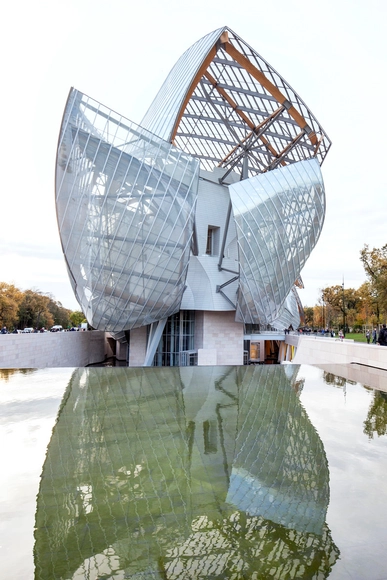
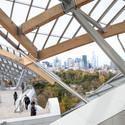
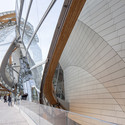
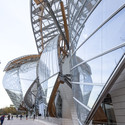
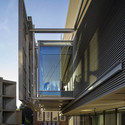
Architecture photographer Danica O. Kus has shared with us images of Frank Gehry's recently completed Fondation Louis Vuitton. Labeled as a "late-career triumph" by Los Angeles Times critic Christopher Hawthorne, the sailed glass structure teeters on the edge of a Parisian water garden in Jardin d’Acclimatation. For a closer look at the building's much-discussed structure, check out all of Kus' images after the break.
As part of their quest to synchronise our digital and analogue worlds, sketchbook designer Moleskine have joined forces with the Adobe Creative Cloud platform to "simplify workflows" for illustrators, designers and architects. Suggesting that the initial stages of the creative process often occur offline, out of the studio or in transit, the team behind the collaboration note that as a portable, uncomplicated object, the Moleskine notebook "can be used anytime, anywhere and especially on the move. Sketching on paper is immediate, and can even be done on a crowded train."
Now users with a Creative Cloud subscription, combined with a special Moleskine sketchbook, can capture images of their drawings with the associated app (iOS only). These are then converted into smooth vector files which are automatically synchronised to desktop programs such as Photoshop (as a .jpeg) or Illustrator (as a .svg).
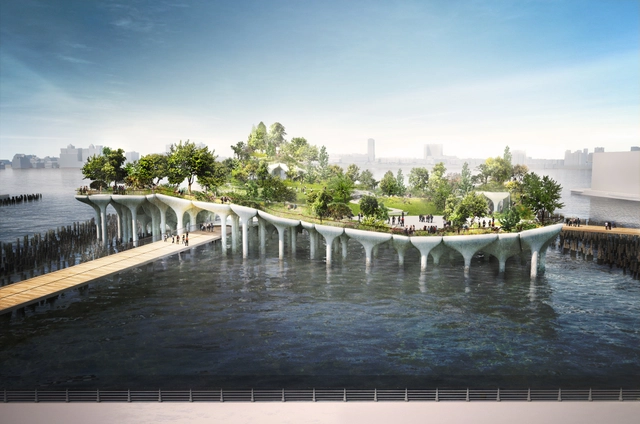
Last week, Thomas Heatherwick unveiled his fairytale-like designs for what will hopefully be New York's latest and most ambitious park, Pier 55 (with apologies to the High Line, New York's last "next big thing" in the public park arena). Envisaged as an undulating artificial landscape on a cloud of mushroom-like supports, Pier 55 has the internet buzzing. In this interview with FastCo Design, Heatherwick discusses the inspirations behind his latest project, explaining how everything including New York's street grid, the ruins of Pier 54 and yes, even the city's other recent global green space phenomenon, have manifested themselves in his latest madcap creation. Read the full article here for more.
Paul Katz, president and managing principal of Kohn Pedersen Fox (KPF), has died at the age of 57. The “mastermind” behind some of the world’s tallest mixed-use buildings, such as the Shanghai World Financial Center and International Commerce Centre in Hong Kong, Katz was praised by colleagues for his attention to detail and ability to foresee a building’s impact on the larger urban scale. “For Paul, it was the entire assemblage, not triumphant individual pieces, that gave the project its urban value,” said KPF design director James von Klemperer, who will succeed Katz as president.
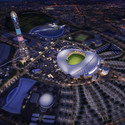
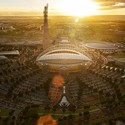
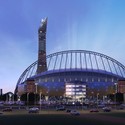
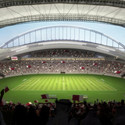
The Supreme Committee for Delivery & Legacy has released images of the third 2022 World Cup Stadium planned for Qatar. Revamping an existing 40-year-old stadium at Gulf Cup in Riyadh, the Khalifa International Stadium will be expanded to accommodate 40,000 spectators and equipped with an “innovative cooling technology” that will allow players to compete at a comfortable 26 degrees Celsius.
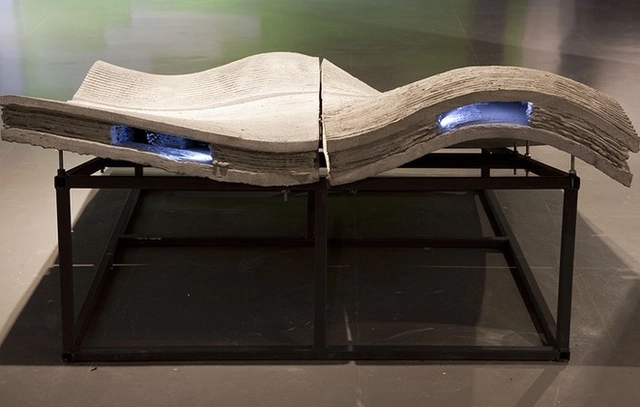
Global construction company Skanska is teaming up with Foster + Partners and the engineers at Loughborough University (LU) to create the world’s first commercial 3D concrete printing robot. The company has signed an agreement with LU, who has been working on the project since 2007, to partake in an 18-month initiative with a consortium of partners focused on developing a robot capable of printing complex structural components with concrete.
A video about LU's research on 3D concrete printing and Foster + Partner's involvement, after the break.
Comparing Feilden Clegg Bradley Studios’Dyson Centre for Neonatal Care to a Scandinavian spa, Gizmodo author Lucy Maddox considers the healing potential of well-designed hospitals as she recounts one woman’s postpartum experience following the birth of premature twins. Natural light, calming materials and colors, a thoughtful layout and clever use of technology have all contributed to making patient recoveries in the new center outperform those in the old hospital’s corridors. “Essentially we want the building to be a great big nurse. A really good nurse," says clinical psychologist Dr Mike Osborn. Read the complete article, here.
ArchDaily is in need of a select group of awesome, architecture-obsessed interns to join our team for Spring 2015 (January - June)! If you want to spend your days researching/writing about the best architecture around the globe – and find out what it takes to work for the world’s most visited architecture website – then read on after the break…
https://www.archdaily.com/569258/call-for-archdaily-interns-spring-2015AD Editorial Team
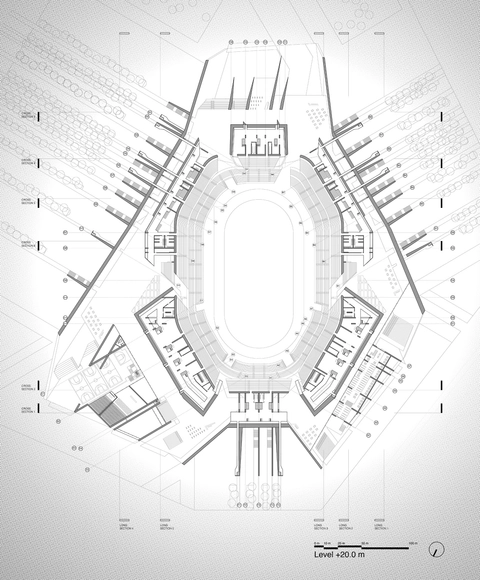
Olympic host cities around the world are increasingly facing issues of post-event sustainability, with many stadiums and arenas falling into disuse and dilapidation mere months after the games. The soaring costs associated with constructing Olympic facilities have plagued organizers for decades, resulting in an all-time low number of bids from host cities for the 2022 Winter Olympics, according to the International Olympic Committee. Yaohua Wang is a recent architecture graduate of the Harvard University Graduate School of Design and a native of China - where facilities constructed for the 2008 Beijing Olympics are slowly being converted to new post-Olympic uses, typified by the transformation of the Watercube into the city's newest waterpark. Wang's thesis project, Salvaged Stadium, delves into the afterlife of Olympic facilities, providing a solution for arena reuse with potential for application worldwide.
Find out how Wang re-evaluated the Olympic development problem after the break
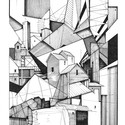
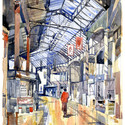
Others featured in the auction include architects Alison Brooks, Peter Murray, Jack Pringle, Christophe Egret, Rab BennettsJe Ahn and Stuart Piercy, alongside artists including Ben Johnson, Norman Ackroyd and Jeanette Barnes. Until the auction on December 6th, all the works are on display at the Anise Gallery, however online bidding opens on November 26th here - alternatively, check out a selection of the available lots after the break.
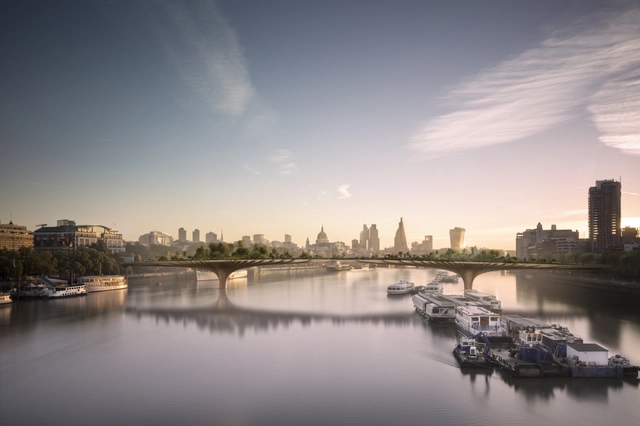
After a fortnight of highs and lows for Thomas Heatherwick and British celebrity Joanna Lumley's campaign for a garden bridge stretching across London's River Thames, Rowan Moore of The Observer has meticulously described the project as "nothing but a wasteful blight." Although he acknowledges that support for the bridge "has been overwhelming," he argues that Heatherwick - though an "inventive and talented product designer" - has a past record in large scale design which "raises reasonable doubts about whether his bridge will be everything now promised."
In this video from Crane TV, writer, poet, artist, and architect Vito Acconci discusses why his goal is not always to have his projects realized. Beginning his career with an education in creative writing from the University of Iowa, Acconci expresses his longtime desire as an artist for art to become “part of the world,” explaining that this eventually led him to extend his creativity beyond words and artworks. Architecture was the perfect vehicle for this because, unlike art, it is inescapable: "there isn't any place you can be where you aren't in the middle of architecture," he says.
However, unlike many architects, his projects push beyond the constraints of realistic structures, and he estimates that only 10 percent of Acconci Studio’s proposals are realized. To some architects this would seem like a failure, but to Acconci it means that his creative ideas are unprecedented, perhaps paving the way for what architecture could be in the distant future.
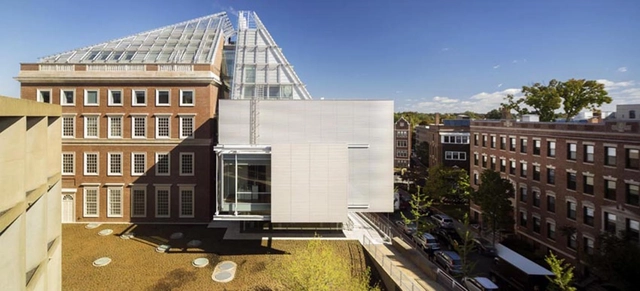
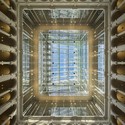
With the opening of the Harvard Art Museums a week ago today, Renzo Piano was able to finally complete on a project which, in various guises, has been in progress for seventeen years. The relationship between Piano and Harvard began with a 1997 plan to build a new branch of the Fogg Museum on the Charles River and ended, after objections from locals and then the 2008 recession, in the decision to consolidate the university's three museums (The Fogg, Busch-Reisinger and Arthur M Sackler Museums) under one roof.
With its long history, restricted space, the listed facade of the original Fogg Museum and the ultimate difficult neighbor in Le Corbusier's Carpenter Center for the Visual Arts, the Harvard Art Museums project was inevitably going to cause a fuss on completion. So how did Piano do? Find out what the critics said after the break.
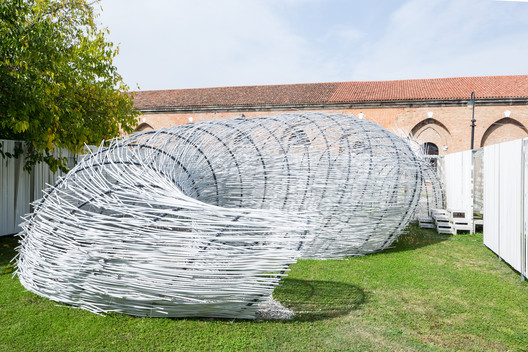
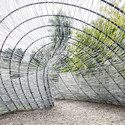
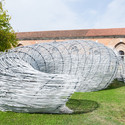
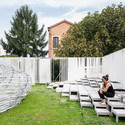
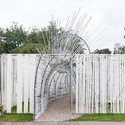
Casting complex shadows and engulfing visitors in a series of maze-like spaces, the Parasite Pavilion was constructed as part of the Synergy & Symbiosis event at the 2014 Venice Biennale, which showcased the best of the UABB Shenzhen and Hong Kong Biennale from 2005 to 2014. Based on the Bug Dome pavilion, a similar experiment from Hong Kong 2009, constructed by Weak! Architects as an icon of "illegal architecture," this new pavilion is the product of an intensive five day workshop, with the cooperation of architects and students from Europe, Australia, and China. Read on after the break to learn more about the Pavilion and Workshop.
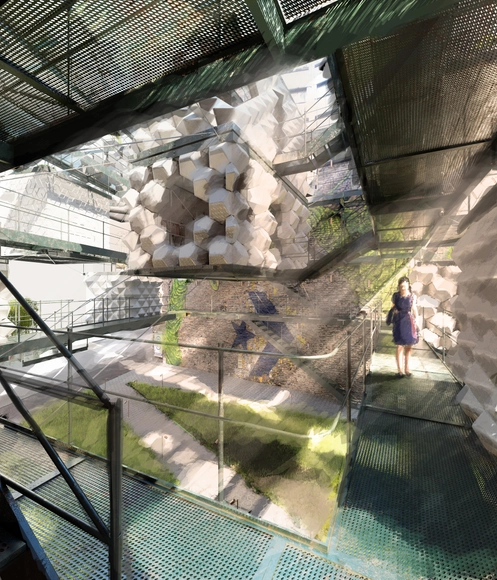
3D printing technology is quickly emerging as a technology that could be applied at the scale of the built environment. But could we use 3D printed materials to create engaging urban spaces that are constantly changing? Creative communications agency, The Neighbourhood, has imagined speculative architecture based on 3D printed materials.
Harvard Art Museums have released this time-lapse video of their recently completed four-year renovation and expansion project carried out by Renzo Piano Building Workshop and Payette. Filmed from June 2010 – November 2014, the video shows the amount of work that went into renovating, expanding and uniting the Fogg Museum, the Busch-Reisinger Museum and the Arthur M. Sackler Museum under the same roof. Watch as snow falls (and then melts) on the construction site in the full video above and learn more about the project here.
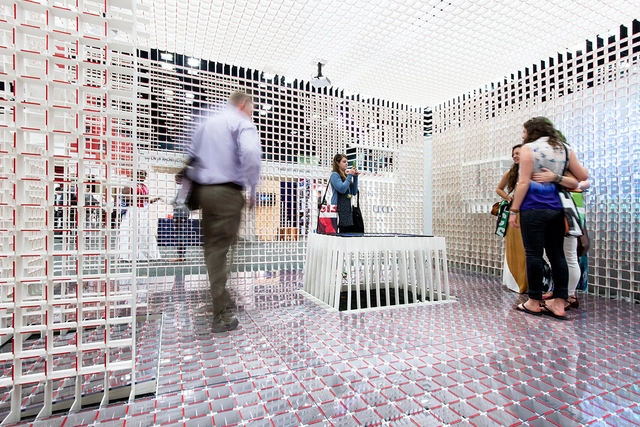
This year’s UIA World Congress was held in Durban, South Africa, and saw the participation of many well-respected firms. Representing South Korea were Kang Jun Lee and Yung A Kim of Studio Origin, whose pavilion highlighted the city of Seoul. Meant to herald the city as the host for the 2017 World Congress, their carefully arranged design offers space for a number of different promotional displays. See the details on this unique structure, after the break.
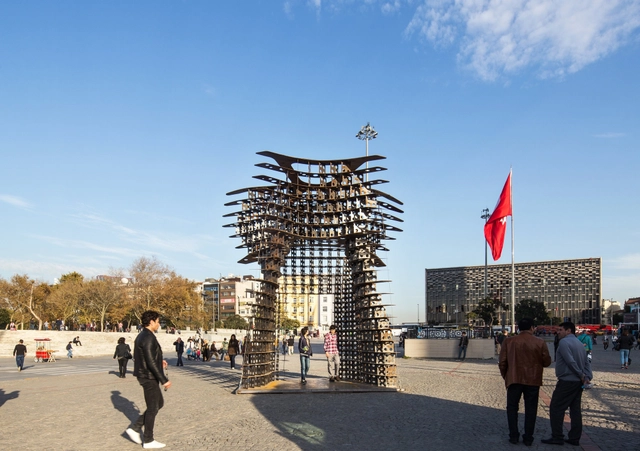
GAD Architecture has installed their latest sculptural design, Serra Gate, in Istanbul’s Taksim Square, just in time for Istanbul Design Week. Named after the minimalist sculptor whose work inspired the design, the Serra gate’s steel form was created using cutting edge technology. The sinuous curvature was conceived through the software “Mathematica,” and was modeled using the latest 3D printing technologies.
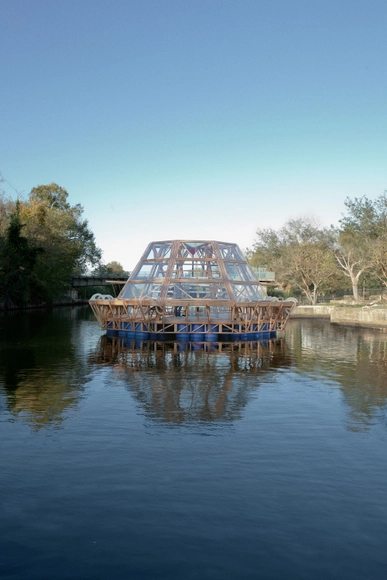
With the earth’s population increasing at an exponential rate, sustainable agriculture and access to clean water are becoming desperately important. Cristiana Favretto and Antonio Giraridi of Studiomobile recognize this and have proposed a solution. Dubbed the Jellyfish Barge for its shape and translucency, this floating greenhouse is capable of growing its own food hydroponically and producing up to 150 liters of fresh drinking water per day. Even more beneficial is its low-cost, easy-to-assemble design that can be implemented in a variety of locations. Learn more about how this fascinating project works, after the break.
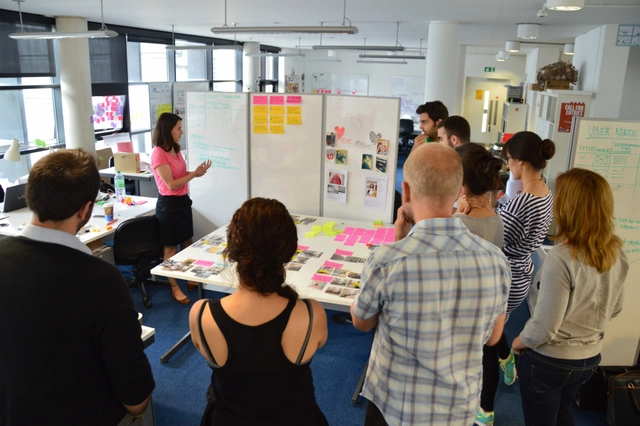
Career prospects in Architecture, Engineering, Construction and Interior Design have changed profoundly in nearly half a decade. We believe that practices that are global enough are finding great opportunities in this evolution, and that professionals that are excellent in design and in business are thriving.
A+u magazine was recently granted an exclusive interview with the co-founders of Flux, the Google[x] startup whose mission is to harness data to automate architectural and urban design. The discussion is one of 14 essays and interviews from leading urban technologists in the current November issue, Data-Driven Cities.
“We began our exploration with the premise that buildings and the sustainability of our modern lifestyle are deeply intertwined. In addition, buildings – more specifically, housing – is an issue of human dignity. We wanted to find ways to apply Google-scale thinking to tackle these important issues," says co-founder Nicholas Chim in the interview.
Read on after the break for a+u magazine's full interview with Flux co-founders, Nicholas Chim and Michelle Kaufmann. And check out the November issue of a+u magazine, available in digital and print editions, which features new essays by Carlo Ratti (MIT), Dan Hill (City of Sound), Alastair Parvin (Wikihouse) and more.
Parallel Projections has announced the winners of the Reanimate the Ruins competition, an international challenge to redesign and memorialize Detroit's historic Packard Motor Plant. The competition called for designers to simultaneously honor Detroit's history, while envisioning a future of technological, social, and aesthetic healing.
This year's jury has selected three winners and six honorable mentions. Read more after the break to explore the award-winning proposals.
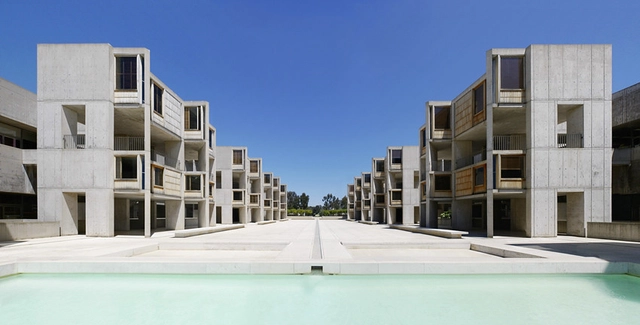
New Republic has presented a list of 100 great thinkers from the past 100 years. The list, as the magazine puts it, honors “people we believe have made the greatest intellectual contributions to the fields and causes that this magazine holds dear.” One of these fields is architecture, and New Republic’s honoree for that category is the illustrious Louis Kahn. Kahn is famous for projects such as the Kimbell Museum and the Salk Institute. His work displays what architecture critic Sarah Williams Goldhagen describes as a “cognitively rich, metaphorically complex, multi-sensorial approach.” Curious to see who else made the list? See the full roster here!




.jpg?1416853943&format=webp&width=640&height=580)










![A+U Interviews Co-Founders of Google[x] Startup, Flux - Featured Image](https://snoopy.archdaily.com/images/archdaily/media/images/546b/8b9c/e58e/cea7/5a00/0123/large_jpg/au1411_cover.jpg?1416334233&format=webp&width=640&height=580)