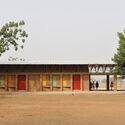
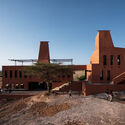
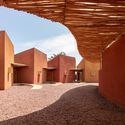
Diébédo Francis Kéré founded his architecture practice Kéré Architecture, in Berlin, Germany in 2005, after a journey in which he started advocating for the building of quality educational architecture in his home country of Burkina Faso. Deprived of proper classrooms and learning conditions as a child, and having faced the same reality as the majority of children in his country, his first works aimed at bringing tangible solutions to the issues faced by the community.
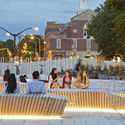
The massive new hub for lab research, by Behnisch Architekten, marks a new chapter of sustainable construction and campus planning. James McCown explores in his article originally published on Metropolis, Harvard's latest addition in the Boston campus, the new Science and Engineering Complex (SEC) designed by German-based firm Behnisch Architekten and centered on sustainability and well-being.
As the oldest institution of higher learning in the United States, Harvard has emerged as one of the world's most well-known universities. Organized into ten academic faculties and the Radcliffe Institute for Advanced Study, it is spread across 200 acres and centers on Harvard Yard in Cambridge. Developed along the Charles River adjacent to the Allston neighborhood of Boston, Harvard has the largest financial endowment of any academic institution. This has supported a number of different campus building projects across the university’s history.
Students and alumni from the Harvard Graduate School of Design are launching an online Design Yard Sale to raise funds in support of the movement against systemic anti-Black racism. The team will sell and auction creative works donated by the design community, and all net proceeds will go towards the Bail Project and Colloqate Design. Among Design Yard Sale’s offerings will be works donated by renowned designers, artists, and scholars such as Toshiko Mori, Oana Stanescu, Rachel Israela, Jeanne Gang, Billie Tsien, Snarkitecture, Jerome Byron and VERV LONDON.
As final juries draw to a close, graduating architecture students are left with a crucial decision to make. While some might take a plunge into the scary real world looking to gain professional experience, others might choose to further reinforce their architecture education and skill set. Of the latter, most enroll in an MArch program, or take well-trodden paths into urban design and planning, landscape architecture, historic preservation, or theory and criticism. But in an increasingly complex world faced with myriad problems, what about those graduate architects looking to bolster their education in other related disciplines that will give them a more unique perspective on design problems? Here, we shortlist seven alternative, interdisciplinary graduate programs offered by architecture schools worldwide.
Videos
From the exhibition: Photograph by Peter Smithson, 1972, showing "Shadrach Woods Descending the Central Green mound, Ivor Prinsloo behind." Frances Loeb Library
Set within the wider framework of “Living Anatomy: an Exhibition about Housing,” currently on view at Harvard Graduate School of Design, this exhibition focuses on ‘Robin Hood Gardens’ - Alison and Peter Smithson’s housing project in East London, completed in 1972. Threatened with demolition yet again, despite an ongoing campaign that still hopes to secure its preservation, Robin Hood Gardens stands today with broken windows, vandalized corridors, crippling facades, and a fractured public reputation. While deteriorating with neglect barely 50 years after its completion, this project’s architecture is still striking in its sense of livelihood and innovation.
Living Anatomy installation detail, with a photograph from Lacaton & Vassal's "Mulhouse Social Housing" in the background.
On Monday, August 24, the Harvard Graduate School of Design opened its main Fall 2015 exhibition Living Anatomy: An Exhibition About Housing. Focusing on the past 50 years, the mixed-media exhibition features both built and academic work and showcases innovative approaches and solutions to housing in contexts around the world.
We will be publishing Nikos Salingaros’ book, Unified Architectural Theory, in a series of installments, making it digitally, freely available for students and architects around the world. In Chapter 13, Salingaros begins to conclude his argument by discussing its counterpart, explaining how post-modern theorists such as Peter Eisenman came to eclipse the ideas of Christopher Alexander – and why Eisenman’s theoretical hegemony is not based upon sound architectural thinking. If you missed them, make sure to read the previous installments here.
Natural and Unnatural Form Languages
The concept of living structure, and the support for the theory offered by both direct experienceand science, offers a basis for designing and understanding architecture. This platform is a sensible way of approaching design and building, because it is beholden neither to ideology, nor to individual agendas. Moreover, it should be contrasted to the irrationality of other schemes that currently appear in and seem to drive architectural discourse.
Massachusetts Institute of Technology (MIT). Cedric Weber / Shutterstock.com
QS has released its annual World University Rankings for 2015, covering 36 individual subjects and sorting based on "academic reputation, employer reputation and research impact." The company, which claims to explore the top 800 universities in the world, began publishing academic rankings in 2011. Read on to see the list of top universities for architecture, and be sure to see the full, sortable list at QS's site.
https://www.archdaily.com/625569/qs-ranks-the-top-100-universities-in-the-world-for-architectureAD Editorial Team
The French duo of Anne Lacaton and Jean-Philippe Vassal are known for their delicate interventions, repurposing neglected structures with apparent effortlessness. Originally published on the Harvard Gazette website entitled "They Build, But Modestly," this article recounts the lessons which they offered students in a recent lecture at the Harvard Graduate School of Design.
Around 1980, two young architects finished their training in Bordeaux, France, and moved to Nigeria. In that African nation’s remote regions, they were inspired by the simple structures they saw amid the stark, stunning desert landscapes. The houses were open to the air, had utilitarian thatched roofs, and were made with bits of local wood. Modesty prevailed in structures that also invited beauty.
The lessons of building in Africa stayed with Anne Lacaton and Jean-Philippe Vassal in their Paris-based practice, Lacaton & Vassal: use what is there, stay simple, embrace open air, and honor light, freedom, and grace. They practice social architecture based on economy, modesty, and the found beauty of environments.
Richard Rogers has announced that the home he built for his parents in Wimbledon, London, will be gifted to Harvard’s Graduate School of Design (GSD) for the training of doctorates in the field of architecture. The home, which will be donated by his charity, the Richard Rogers Charitable Settlement, was completed between 1967 and 1968 by Richard and his then wife Su Rogers. Originally designed for his parents, Dr. William Nino and Dada Rogers, the Grade II* listed pre-fabrictated single storey dwelling was later adapted for Rogers' son Ab and his family, before being put on the market in 2013 for £3.2million ($4.8million).
With "Protoceramics," the Material Processes and Systems Group at the Harvard Graduate School of Design (MaP+S) sought to investigate the architectural possibilities of a material that might often be overlooked: thin, large-format ceramic tiles designed to act as interior finishes or exterior cladding. Instead of accepting the tiles' designation as a surface finish, the team investigated three ways to use them as a self-supporting structural component as part of their ongoing experiment to produce "novel material formations with a special interest in tectonic performance." The three techniques employed focused on the acts of cutting, folding and bending.
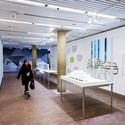
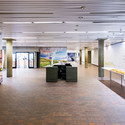
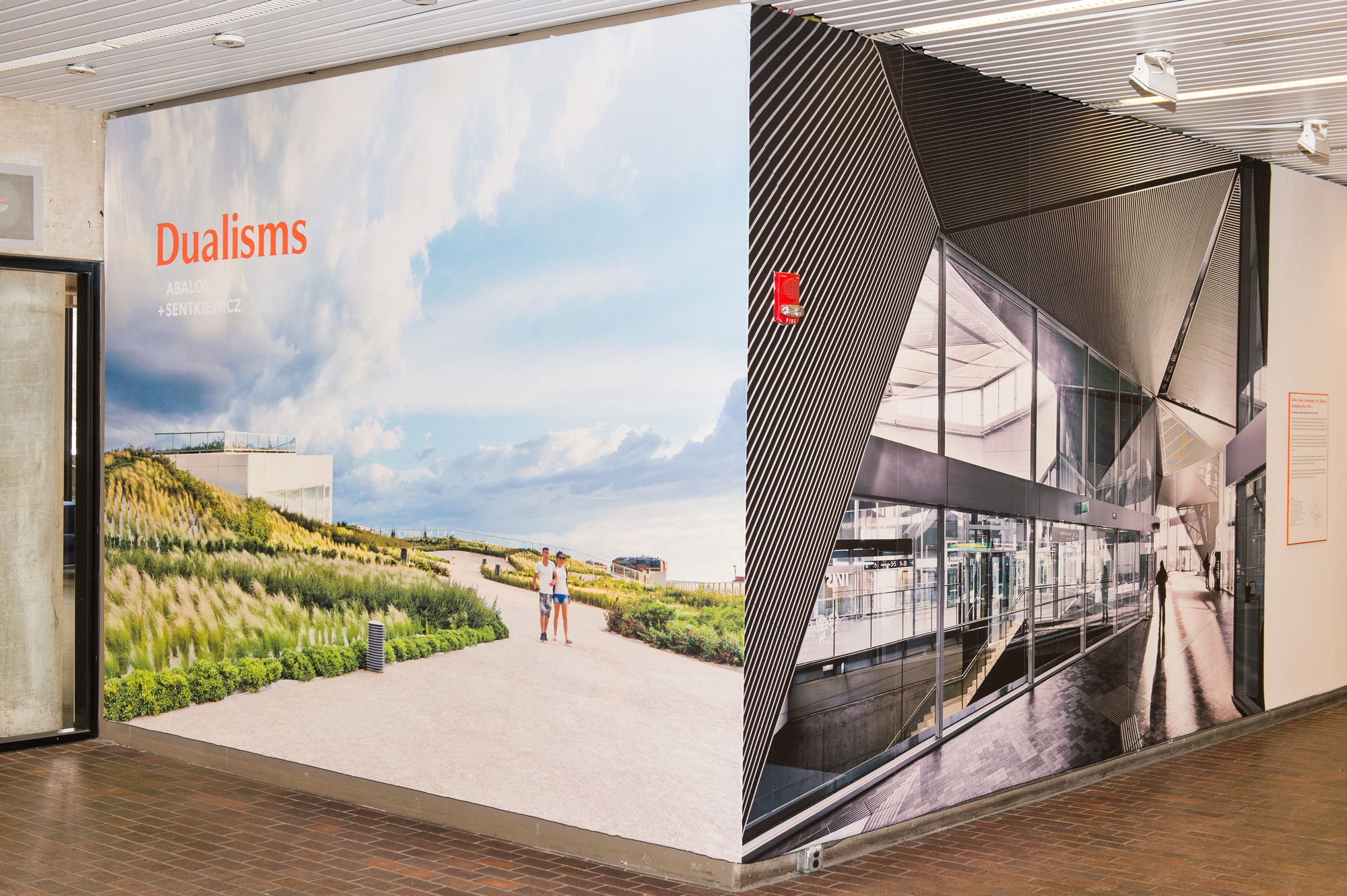
A new exhibition at the Harvard Graduate School of Design by Iñaki Ábalos and Renata Sentkiewicz (Ábalos+Sentkiewicz) will explore Dualisms in architecture: the notion that most historic architecture takes its "composite tension from two theoretically incompatible morphological organisations that correspond to different disciplines or languages." Suggesting that these organisations can possess elements of "compatibility and incompatibility" simultaneously, the appearance of "a kind of hybrid 'Frankenstein's monster'" is characterized by dualism in architecture. For the curators, Dualisms act not only performatively, but also in a creative and composite way. "They are, at once, constraints and formative opportunities."
National libraries, often monumental in scale and "dominated by nationalistic ambitions and overwhelming architectural details," will be the subject of a new exhibition opening later this month at the Harvard Graduate School of Design (GSD). Icons of Knowledge: Architecture and Symbolism in National Libraries seeks to examine why national libraries are amongst the most symbolic icons of modern day countries. In the global milieu of the "rapid digitisation of print," this exhibition aims to shed light on why nations are "vehemently investing resources in the construction of buildings that will project their cultural legacy and house the most precious treasures of their written history."
Olympic host cities around the world are increasingly facing issues of post-event sustainability, with many stadiums and arenas falling into disuse and dilapidation mere months after the games. The soaring costs associated with constructing Olympic facilities have plagued organizers for decades, resulting in an all-time low number of bids from host cities for the 2022 Winter Olympics, according to the International Olympic Committee. Yaohua Wang is a recent architecture graduate of the Harvard University Graduate School of Design and a native of China - where facilities constructed for the 2008 Beijing Olympics are slowly being converted to new post-Olympic uses, typified by the transformation of the Watercube into the city's newest waterpark. Wang's thesis project, Salvaged Stadium, delves into the afterlife of Olympic facilities, providing a solution for arena reuse with potential for application worldwide.
Find out how Wang re-evaluated the Olympic development problem after the break
Fundamentals, the title of the 2014 Venice Biennale, will close its doors in a matter of days (on the 23rd November). From the moment Rem Koolhaasrevealed the title for this year’s Biennale in January 2013, asking national curators to respond directly to the theme of ‘Absorbing Modernity 1914-2014’, there was an inkling that this Biennale would be in some way special. Having rejected offers to direct the Biennale in the past, the fact that Koolhaas chose to act not only as curator but also thematic co-ordinator of the complete international effort, was significant. This announcement led Peter Eisenman (one of Koolhaas' earliest tutors and advocates) to state in one interview that “[Rem is] stating his end: the end of [his] career, the end of [his] hegemony, the end of [his] mythology, the end of everything, the end of architecture.”
DesignIntelligence has released their 2015 rankings of the Best US Architecture Schools for both undergraduate and graduate programs. Over 1,400 professional practice organizations were surveyed and asked to respond to the question: “In your firm’s hiring experience in the past five years, which of the following schools are best preparing students for success in the profession?” In addition, more than 3,800 architecture, landscape architecture, interior design, and industrial design students were also surveyed about their education, in data presented separately from the rankings.
However, perhaps more enlightening than the ranking itself are the firms' responses to several additional issues raised in the report. For example, 54.6% of the firms surveyed selected sustainability and climate change as the professions’ biggest concern, while maintaining design quality was a close second. Firms also provided insights on the most important qualities of new graduates entering the workplace, with an overwhelming 70.1% selecting attitude/personality as the most important attribute.
Read on after the break for the Top 10 undergraduate and graduate programs.
Courtesy of Strelka Institute for Media, Architecture, and Design, via Flickr
In this interview, originally published in The Architectural Review, Andrew Mackenzie sits down with OMA founder Rem Koolhaas to discuss the Venice Biennale, the extinction of national identities, his fascination with Asia, the link between De Rotterdam and Delirious New York, and the future of the profession.
Your proposition for this year’s Venice Architecture Biennale asks whether national identity has been, as you say, ‘sacrificed to modernity’. Some might view this as a project of reclamation, not unlike Frampton’s regionalism. How would you differentiate your proposition from Frampton’s?
Well, Kenneth Frampton is a smart guy, but the problem is that he looked at regionalism as an antidote to cosmopolitan development. In so doing he perverted the cause of regionalism, because suddenly regionalism was mobilised as a private cause that it couldn’t sustain. However, the question of national identity is an open one. For instance, at first sight the Netherlands is a very internationalist country, but looking closely you can see an enormous return of, not vernacular, but quasi-vernacular architecture and quasi-old fortresses that are newly built with a national flavour. Look at Zaandam, and that huge assemblage of so-called vernacular buildings.