This article was originally published on August 27, 2017. To read the stories behind other celebrated architecture projects, visit our AD Classics section.
In 1959, Jonas Salk, the man who had discovered the vaccine for polio, approached Louis I. Kahn with a project. The city of San Diego, California had gifted him with a picturesque site in La Jolla along the Pacific coast, where Salk intended to found and build a biological research center. Salk, whose vaccine had already had a profound impact on the prevention of the disease, was adamant that the design for this new facility should explore the implications of the sciences for humanity. He also had a broader, if no less profound, directive for his chosen architect: to “create a facility worthy of a visit by Picasso.” The result was the Salk Institute, a facility lauded for both its functionality and its striking aesthetics – and the manner in which each supports the other.[1,2]

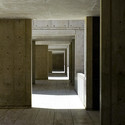


Along with these lofty instructions, Salk laid down a series of more practical requirements. Laboratory spaces in the new facility would have to be open, spacious, and easily updated as new discoveries and technologies advanced the course of scientific research. The entire structure was to be simple and durable, requiring minimal maintenance. At the same time, it was to be bright and welcoming – an inspiring environment for the researchers who would work there.[3]
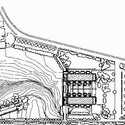
Kahn’s scheme for the Institute is spatially orchestrated in a similar way to a monastery: a secluded intellectual community. Three zones were to stand apart, all facing the ocean to the west: the Meeting House, the Village, and the laboratories. The Meeting House was to be a large community and conference venue, while the Village was to have provided living quarters; each part of the complex would then have been separated from its parallel neighbors by a water garden. Ultimately, the Meeting House and Village were cut from the project, and only the laboratories were built.[4]

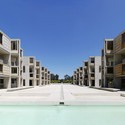
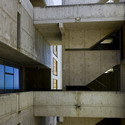
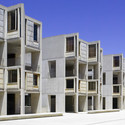
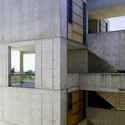
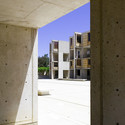
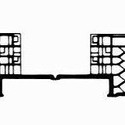
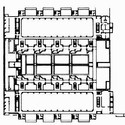
The laboratories of the Salk Institute, first conceived as a pair of towers separated by a garden, evolved into two elongated blocks mirroring each other across a paved plaza. The central court is lined by a series of detached towers whose diagonal protrusions allow for windows facing westward onto the ocean. These towers are connected to the rectangular laboratory blocks by small bridges, providing passage across the rifts of the two sunken courts which allow natural light to permeate into the research spaces below. Kahn included these courts not only as light wells, but as references to the cloisters of the monastery of St. Francis of Assisi – an example for which Salk had previously expressed his admiration.[5,6]
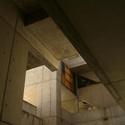
Many of the design decisions Kahn implemented in the Salk Institute derived from lessons learned during his work on the Richards Medical Research Laboratories at the University of Pennsylvania. Issues with crowding at the Richards Laboratories led to the more open, unobstructed layout at Salk. It was also in Pennsylvania that Kahn first developed the notion of separating research spaces from utilities infrastructure on different floors, an innovation which would be applied more comprehensively in his later project. The alternation of laboratory and infrastructural levels allows for building maintenance to occur without disrupting the research taking place above or below.[7]

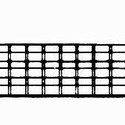
Per Salk’s instructions, Kahn also designed the laboratories to be easily upgraded. Support beams are restricted to the edges of each lab, allowing for greater flexibility in reconfiguring the equipment and spaces within. Mechanical systems are not sealed away behind concrete, but behind block walls which can be moved out of the way during maintenance and renovations. Laboratory windows are held in place by screws, allowing them to be temporarily removed so that large equipment can be moved in and out of the building without requiring any of the structure to be demolished.The building is able to “guess tomorrow,” Salk suggested in 1967.[8]
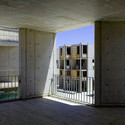
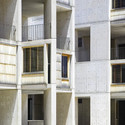
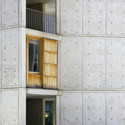
The laboratories are, by design, spaces of shared enterprise and spontaneous collaboration; those seeking privacy must cross the bridges into one of the ten towers which line the central square. The towers contain small studies, with their west-facing windows directing views toward the square and the Pacific Ocean beyond.[9] The western ends of both laboratory wings are also devoted to office space, the result being that both the offices and studies are afforded views of the sea.[10]


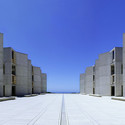
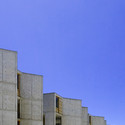
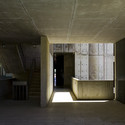
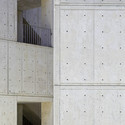
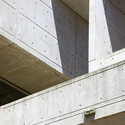
Between the rhythmically-spaced study towers is a nearly featureless expanse of off-white travertine stone. Kahn initially planned to fill the space with a garden, but was convinced by architect Luis Barragán to leave the space as a void.[11] A thin channel of water bisects the plaza, drawing one’s eye toward the blue horizon. The unfinished concrete which forms the walls of the Institute is nearly identical in color to the travertine in the square, lending the space a primitive and almost sublime monumentality that hints at ancient Roman forebears without direct stylistic reference. (The comparison is suggested, however, by Kahn’s specification of pozzolanic concrete – the same type used in Roman construction.) Inset teak paneling identifies the locations of study and office windows, providing the only material relief from the monolithic concrete and stone used throughout the Institute.[12]
In the five decades that have passed since the Salk Institute opened its doors in 1965, the external appearance of Kahn’s masterwork remains largely unaltered. The concrete and stone have withstood the seaside elements almost entirely unscathed, while a recent preservation effort by the Getty Foundation sought to repair the teak paneling while preserving 70% of the original material. Salk and Kahn’s foresight in the design of the laboratories has also allowed the Institute to remain a functioning facility for advanced research, one which has played host to half a dozen Nobel laureates since its founding. With its flexible design and masterful interplay of material and space, the Salk Institute is likely to retain its significance as both a research center and an architectural wonder far into the future.[13]

References
[1] Miranda, Carolina A. "Louis Kahn's Salk Institute, the building that guesses tomorrow, is aging — very, very gracefully." Los Angeles Times. November 22, 2016. [access].
[2] Curtis, William J. R. Modern Architecture Since 1900. London: Phaidon Press, 2013. p522.
[3] "About Salk Architecture." Salk Institute for Biological Studies. Accessed August 11, 2017. [access].
[4] Curtis, p522.
[5] Weston, Richard. Key Buildings of the Twentieth Century: Plans, Sections and Elevations. London: Laurence King, 2004. p138.
[6] Gast, Klaus-Peter, Susanne Schindler, and Louis I. Kahn. Louis I. Kahn. Basel: Birkhäuser Verlag, 1999. p64.
[7] Miranda.
[8] Miranda.
[9] Curtis, p522.
[10] “About Salk Architecture.”
[11] Curtis, p522-523.
[12] “About Salk Architecture.”
[13] Miranda.
-
Architects: Louis Kahn
- Year: 1965
-
Photographs:Liao Yusheng
AD Classics: Palazzo dei Congressi / Louis Kahn
The city of Venice has been caught in a tug of war between progress and traditionalism for many years, and particularly since the construction of a railroad viaduct in 1846 linked the island city to the Italian mainland for the first time in its history.[1] Over a century later, the Venetian government commissioned Louis Kahn to design a new Palazzo dei Congressi for the city; his proposal, while paying respect to the histories of both the Republic of Venice and a unified Italy, could not escape similar controversy.
Light Matters: Louis Kahn and the Power of Shadow
Light matters, a monthly column on light and space, is written by Thomas Schielke More Light Matters, after the break... . Based in Germany, he is fascinated by architectural lighting, has published numerous articles and co-authored the book „Light Perspectives". Does shadow have the power to give form to architecture?
The Tranquility of Louis Kahn's Salk Institute
Watching the sunrise over Louis Kahn's Salk Institute for Biological Sciences is arguably one of architecture's most transformative experiences. The famous building has become an emblem of tranquility in architecture thanks to its tremendous location in San Diego, California, a quality enhanced by the carefully planned symmetrical vistas overlooking the Pacific Ocean.