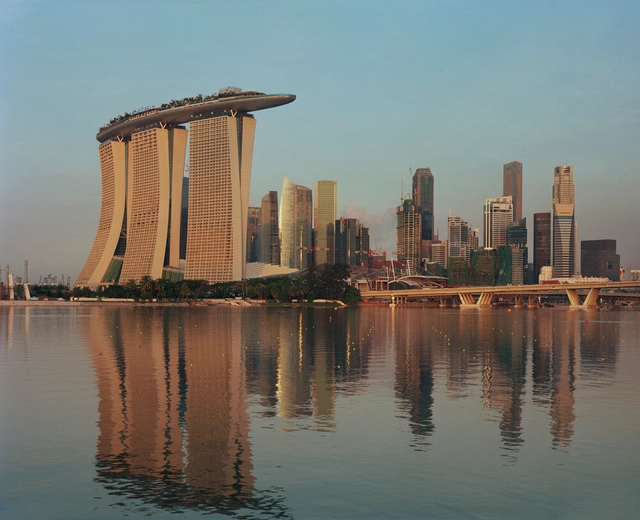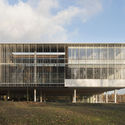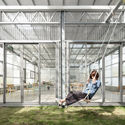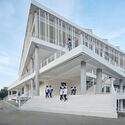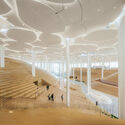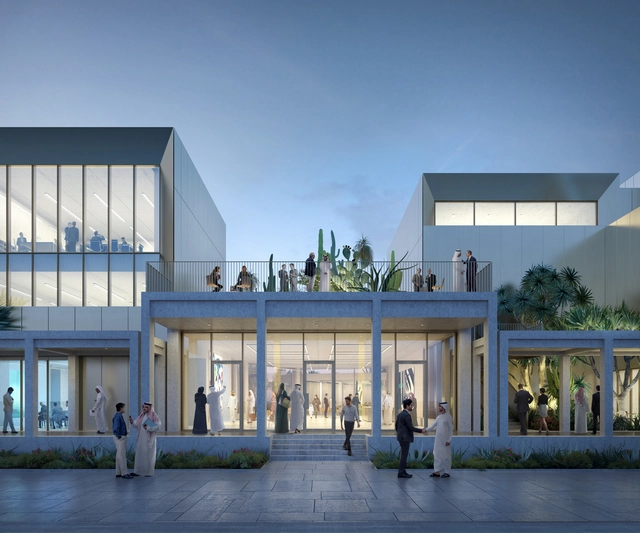
Courtesy of Safdie Architects | Marina Bay Islands
Nestled in the heart of Southeast Asia, Singapore stands as a beacon of sustainable urbanization. According to the 2016 Green City Index, the city-state of Singapore was the greenest city in Asia at one point. Renowned as the "City in a Garden," Singapore has intertwined lush greenery, verdant parks, and new environmental policies into its urban fabric/ After gaining independence in 1965, the city-state stands as a testament to how urban life can integrate with nature.
In 1926, Le Corbusier developed the five points that would become the foundations for modern architecture. Once materialized in 1929 in the iconic Villa Savoye project, Le Corbusier's principles - pilotis, free design of the ground plan, free design of the facade, horizontal window, and roof garden - have been extensively explored in modern architecture and continue to influence the most diverse contemporary architectural projects to this day.
The five points became a kind of guideline for the New Architecture, as Corbusier used to call it. Even after decades, new technologies, materials, and demands of society have continued to update those architectural solutions, announced almost a century ago as the basis for a new architecture.
In a large-scale, central installation at the 2017 Chicago Architecture Biennial, the likes of 6a architects, Barozzi Veiga, Kéré Architecture, MOS, OFFICE KGDVS, and Sergison Bates—among others—have designed and constructed sixteen five meter-tall contemporary iterations of the renowned 1922 Chicago Tribune Tower design contest.
https://www.archdaily.com/879715/in-vertical-city-16-contemporary-architects-reinterpret-the-tribune-tower-at-2017-chicago-architecture-biennialAD Editorial Team
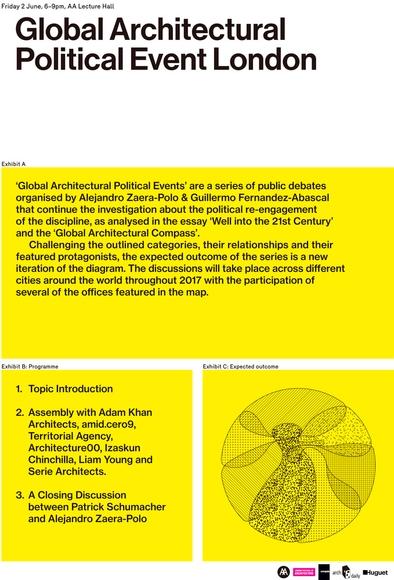
‘Global Architectural Political Events’ are a series of public debates organised by Alejandro Zaera-Polo & Guillermo Fernandez-Abascal that continue the investigation about the political re-engagement of the discipline, as analysed in the essay ‘Well into the 21st Century’ and the ‘Global Architectural Compass’.
The 10,000 square meter, three-story, multi-disciplinary space is designed to become a “hub for educational and research initiatives, while its wider programming embraces collaboration and partnerships with local, regional, and international artists, curators, and organizations.”
James Welling, 8183, 2016 from the series Chicago, 2016-2017, Courtesy the Artist and David Zwirner, New York and London. Image Courtesy of Chicago Architecture Biennial
The Chicago Architecture Biennial has announced the list of participants invited to contribute to the event’s second edition, which will be held from September 16 to January 7, 2018 in Chicago. More than 100 architecture firms and artists have been selected by 2017 artistic directors Sharon Johnston and Mark Lee, founders of Los Angeles–based Johnston Marklee, to design exhibitions that will be displayed at the Chicago Cultural Center and throughout the city.
“Our goal for the 2017 Chicago Architecture Biennial is to continue to build on the themes and ideas presented in the first edition,” explained Johnston and Lee. “We hope to examine, through the work of the chosen participants, the continuous engagement with questions of history and architecture as an evolutionary practice.”
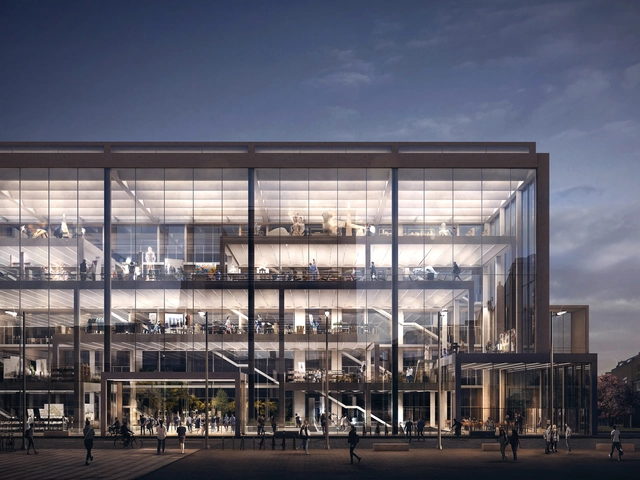
Serie Architects has released its proposal for the Royal College of Art’s (RCA) campus in Battersea, London. Designed for the campus’ competition—which was won by Herzog & de Meuron—the 15,000-square-meter project would house the schools of architecture, material, and fine art, as well as specialist research centers and entrepreneurial incubators.
In an effort to create a spatial model that encourages collaboration across academic disciplines, the proposal centers on the idea of stacked planes, or “tables,” each of which defines a particular space, but which is not enclosed. The resulting space, through the overlapping of tables and double- and triple-height ceilings, creates an open and highly visible environment.
London's Royal College of Art (RCA) have revealed seven invited shortlisted practices for its new state-of-the-art £108million Battersea South campus. Featuring a smattering of architects from Europe, including Herzog & de Meuron and Lacaton & Vassal, and from the USA, such as Diller Scofidio + Renfro and Studio Gang, the organisation intends to announce the winning scheme in October 2016.
https://www.archdaily.com/793059/kerez-herzog-de-meuron-studio-gang-shortlist-london-royal-college-of-arts-battersea-south-campusAD Editorial Team
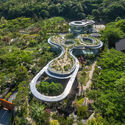
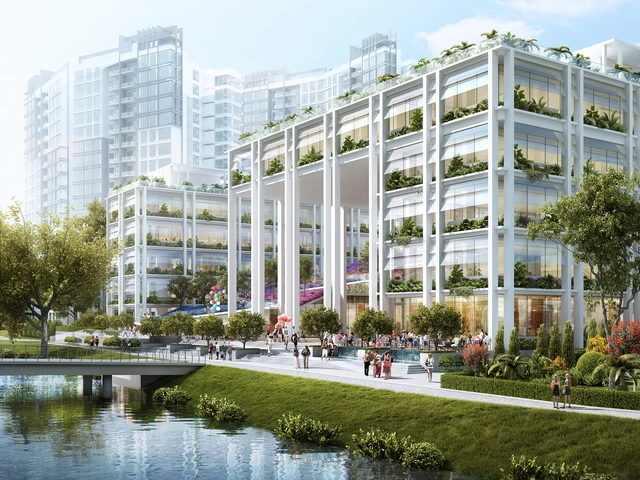
London-based Serie Architects, in collaboration with Multiply Architects of Singapore, has unveiled its winning design for a Neighbourhood Centre and Polyclinic in Punggol, Singapore. Called Oasis Terrace, the project will become the new center for public amenities for Singapore’s Housing & Development Board in Punggol.
The design spans 27,400 square meters, of which 9,400 square meters will be comprised of healthcare facilities, while the rest will include “communal gardens, play spaces, gyms, retail spaces, dining, [and] learning spaces,” all of which is expected to come together into “a new generation of integrated development.”
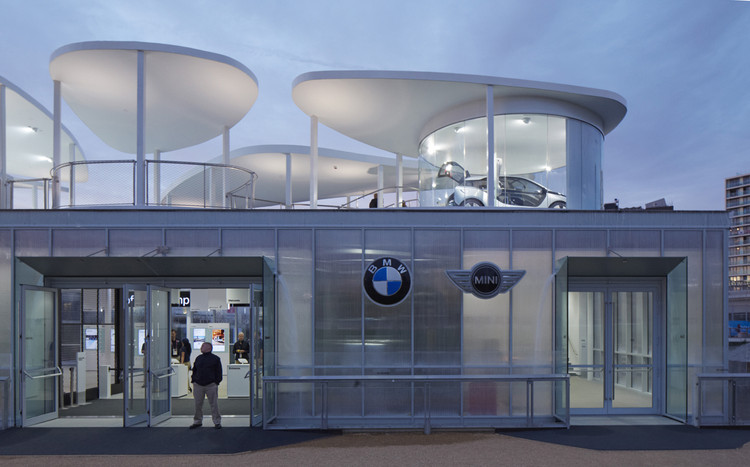
Architects: Serie Architects Location: London, UK Design Architects: Serie Architects Executive Architects: Franken Architekten Structural Engineering: AKT II Project Year: 2012 Photographs: Edmund Sumner
Serie Architects‘ proposal was recently selected as the design for the 2012 Olympic Pavilion for BMW following a sustainable design competition. Their cutting-edge design will represent a significant architectural addition to the Olympic Park, while reflecting the company’s deep commitment to sustainability. BMW’s pavilion, which has a floor space of 800m2, will be built on an elevated site above the Waterworks River, situated between the Olympic Stadium and the Aquatics Center. More images and architects’ description after the break.
Serie Architects has been awarded first prize by the competition Technical Committee for the Wuxi Xishan Civic Centre in China. Serie saw off strong competition from a high-powered international shortlist which included NihonSekkei, GMP Architekten, AS Architecture-Studio, and Arte Charpentier.
The scheme is oriented around a large public plaza which is intended to form the centre of public life and expression within the Civic Centre. This unadorned open space hosts public gatherings and events, government displays and temporary exhibitions. The importance of symmetry within the composition of the plan is expressed in the strong axial relationship to the main entrance. More images and architects’ description after the break.
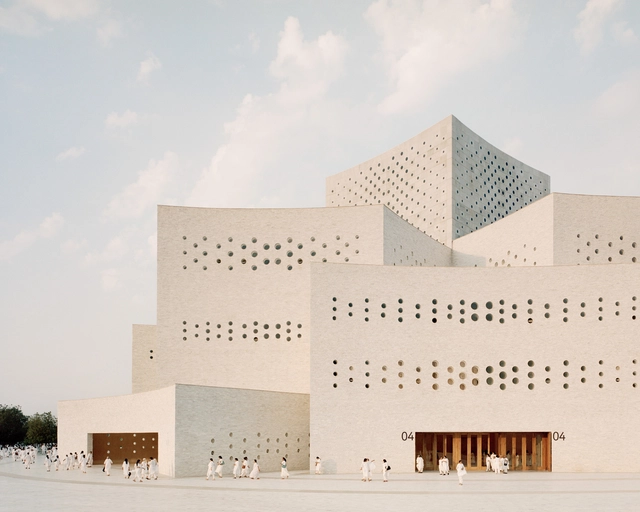
Yan ZhenQing Museum, designed by Serie Architects, displays works from the important calligrapher of the same name who lived in Shandong Province in China during the 8th century. His work introduced an element of vertical rhythm into the calligraphic script, and set up a style that was simpler and bolder. Situated in the beautiful landscape near the city of Linyi, the museum also strikes a bold stance in relation to its landscape. Rather than merge into the landscape the museum is placed on a series of three terraces that rise slightly above the topography. On these plateaus the museum takes on the qualities of a type of traditional Chinese garden known as the scholars’ garden. More images and architects’ description after the break.
In an adaptive re-use project, Serie Architects, Grimshaw of London and Pysall Ruge Arkitekten of Berlin were asked to renovate four factories in Hangzhou that would form a new urban core for the city center. For Serie’s factory, the firm decided to preserve the unique16 ft tall main hall of the factory and to “accentuate the industrial drama of this massive void by restoring the concrete truss roof structure and by bringing additional light down through a newly glazed lantern.” The design truly feeds upon the existing conditions, as the newer programs are situated on a large plinth, respecting the historic presence of the factory.
Chris Lee and Kapil Gupta from Serie Architects have converted a disused building from Mumbai’s colonial past into a banquet hall, restaurant and bar called ‘The Tote’. The site was covered with mature rain trees whose wide spread leaves shaded most of the spaces throughout the year, permitting almost the entire new program to occur outdoors.
More images and more about the project after the break.