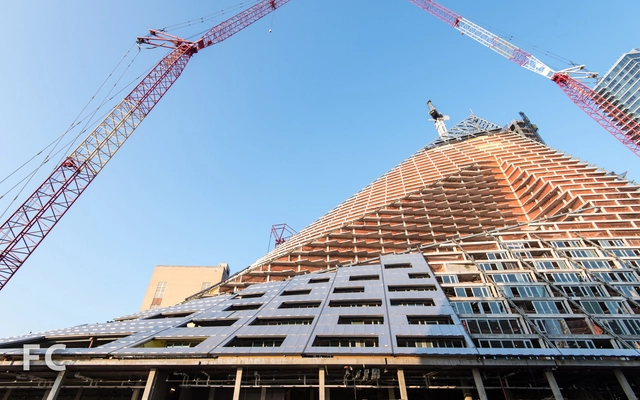
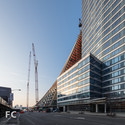
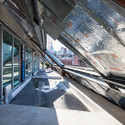
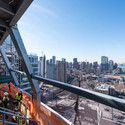
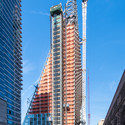
Field Condition has published a photographic tour through BIG’s first New York project, two months after W57 topped out. A “courtscraper,” as the Danish practice affectionately calls it, the 32-story, 709-unit tower is a hybrid of the European courtyard block and New York City skyscraper. It’s tetrahedral shape, “born from logic,” is designed to provide every resident in the building's North Tower to have views of the Hudson River, while allowing sunlight deep into the building's interior space. View the project from within, after the break.
The latest innovation in workplace design, Clive Wilkinson Architects’ “Activity Based Working” (ABW) has revolutionized the way people go about their daily activities at the GLG Global Headquarters in New York. Broadening the idea of workable area to a number of specialized environments, ABW fosters a new dynamic in office relations, providing spaces for both individualized activity and collaboration. Experience this through the Spirit of Space-produced video above.
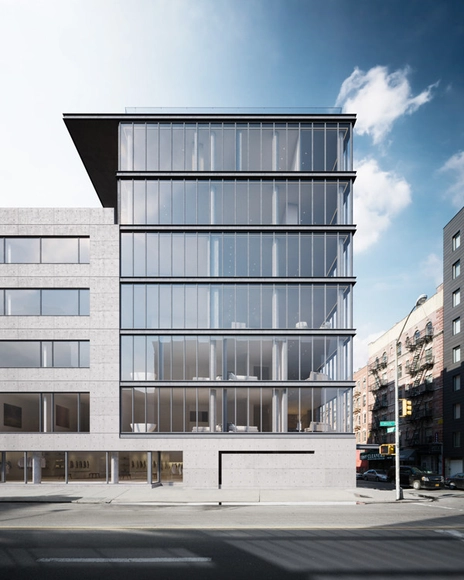
Tadao Ando has unveiled his first New York building. An “ultra-luxury” condominium project known as 152 Elizabeth Street, the 32,000-square-foot building will replace an existing parking lot with a concrete structure comprised of seven residences - all of which will be “treated as custom homes” and “individually configured.”
“Part concrete, part jewel box, the building makes a strong yet quiet statement with a façade comprised of voluminous glass, galvanized steel and flanked by poured in-place concrete and a living green wall that rises the height of the building,” says the architects. The green wall, measuring 55-feet-high and 99-feet-wide and spanning the entire southern façade, is expected to be one of the largest in New York and will be designed by landscaping firm M. Paul Friedberg and Partners.
Sketches by Gaudí on the left, with Joan Matamala's drawing of the building on the right. Image Courtesy of 6sqft
Ever since its unprecedented skyward growth in the late 19th and early 20th centuries, Manhattan has been an icon of construction all over the world, with recent estimates concluding that the island contains some 47,000 buildings. However, as with all construction, completed projects are just the tip of the architectural iceberg; Manhattan is also the home of many thousands of unloved, incomplete, and downright impossible proposals that never made it big in the Big Apple.
Of course, the challenges of New York are indiscriminate, and even world-renowned architects often have difficulties building in the city. After the break, we take a look at just three of these proposals, by Antoni Gaudí, Frank Lloyd Wright and Frank Gehry, courtesy of 6sqft.
Conceptual plans of Perkins+Will’s East 37th Street Residential Tower in New York City have been unveiled. Debuted in Cannes, France, during MIPIM, where the high-rise received a “Future Projects Award,” the 700-foot-tall Manhattan tower boasts a “shimmering, angled curtain wall” organized by five clusters of shared amenities and open-air gardens.
More about the 65-story, 150,000-square-foot condominium tower, after the break.
A few months ago, we announced that Izaskun Chinchilla Architects emerged as one of two winners of FIGMENT’s international “City of Dreams” pavilion competition in New York. Their proposal entitled “Organic Growth” is slated for assembly on Governors Island this summer, but they need your help! Due to the split funding of selecting two winners and FIGMENT’s non-profit status, the design team has launched a kickstarter campaign to make their proposal a reality through public contributions.
Learn more about how you can get involved, after the break.
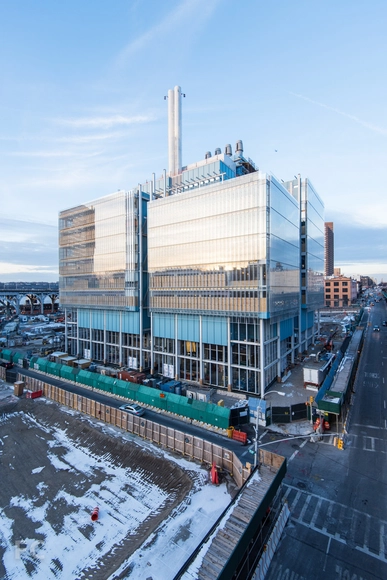
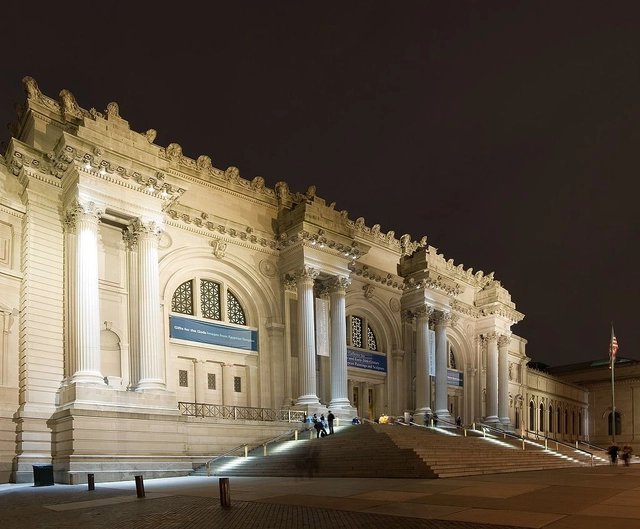
The Metropolitan Museum of Art in New York has tapped British architect David Chipperfield to design its new Southwest Wing for modern and contemporary art. The commission, a result of an international competition, aims to increase gallery space, double the size of the museum’s popular roof garden, and establish accessible on-site storage. “The new design will also enhance gallery configuration and visitor navigation throughout the Southwest Wing, and support a more open dialogue between the Museum and Central Park,” says the architects.
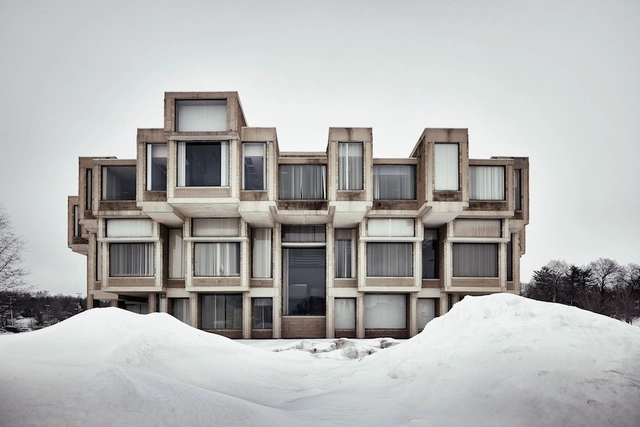
The 44-year-old brutalist landmark has been the center of a preservation debate for years; lawmakers argue that the building is “not easy to love” and expensive to maintain, while preservationists declare the building is an important piece of modern history and blame its state of disrepair on neglect. The council vetoed an offer last summer to allow a New York architect to purchase the property and transform it into artist studios. More on the decision, and more of Matthew Carbone's images for Architect Magazine, after the break.
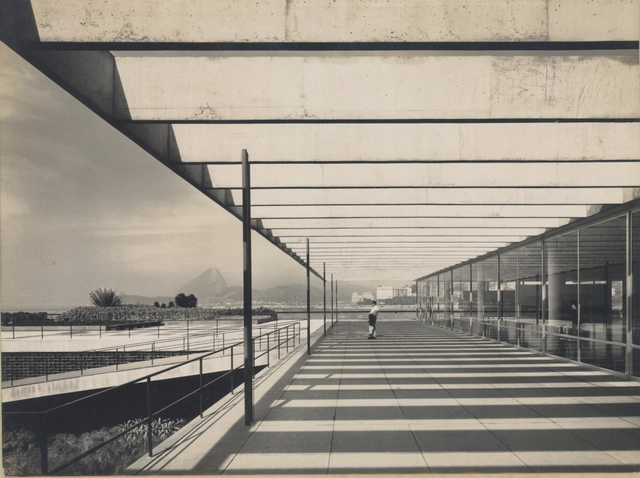
In 1955 the Museum of Modern Art staged Latin American Architecture since 1945, a landmark survey of modern architecture in Latin America. On the 60th anniversary of that important show, the Museum returns to the region to offer a complex overview of the positions, debates, and architectural creativity from Mexico and Cuba to the Southern Cone between 1955 and the early 1980s.
UPDATE: Congratulations to Colin from Philadelphia and Guillaume from France - you've been randomly selected as the winners! Thank you everyone for participating.
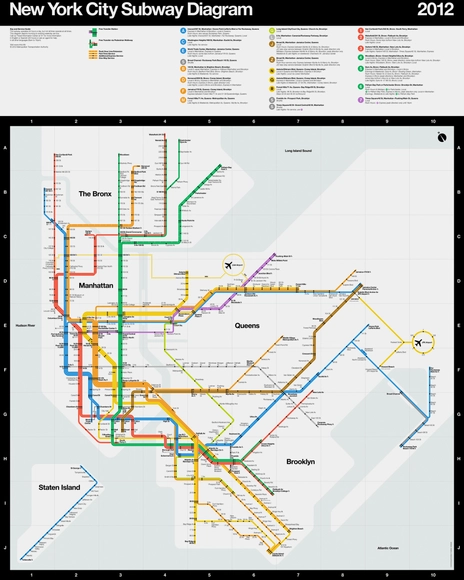
SuperWarmRed Designs has offered our readers a chance to win Massimo Vignelli’s limited-edition (unsigned) MTA New York City Subway Diagram. Designed in 2012 by Vignelli, in collaboration with Vignelli Associates Beatriz Cifuentes and Yoshiki Waterhouse, the diagram is the first Vignelli subway map to be printed by the MTA since the 1970s and is slated to be made part of the Museum of Modern Art’s permanent collection this year.
Using concepts from Vignelli’s iconic Subway Map design of 1972, the new diagram was informed by satellite data and rebuilt for greater clarity and legibility. Revised to reflect the current subway system, colors and nomenclature, the poster has been printed in vivid Pantone and Hexachrome inks on acid-free archival cover-weight paper.
SuperWarmRed has agreed to giveaway one 36” x 45” Subway Diagram and one 16” x 24” Subway Diagram Detail Series. Read on after the break for the official rules.
With floor areas clocking in at as little as 260 square feet, My Micro NY housing units by nARCHITECTS are the latest singles-oriented housing option to enter the New York rental market. The modular units will be fabricated at the Brooklyn Navy Yard for stacking in Kips Bay this spring, and are projected to welcome their first inhabitants by the end of 2015.
Current New York city zoning and density rules set a minimum apartment floor area of 400 square feet, yet this regulation was waived for My Micro NY in the interests of creating more affordable housing. An inflated rental market has long posed issues for those seeking housing in the city, particularly singles and students with tight budgets. My Micro NY will create 9 stories and 55 individual apartments, whose features include 9 and 10 foot ceiling heights, Juliette balconies, and concealed storage space.
A vision to protect post-SandyManhattan against future superstorms, Bjarke Ingels Group’s (BIG) “Dry Line” seeks to form a continuous storm barrier around lower Manhattan by transforming underutilized waterfront spaces into a “protective ribbon” of public parks and amenities. Though ambitious, the project is not impossible; it was one of six winners in the US’ Rebuild by Design competition that is envisioning ways New York can protect its edge.