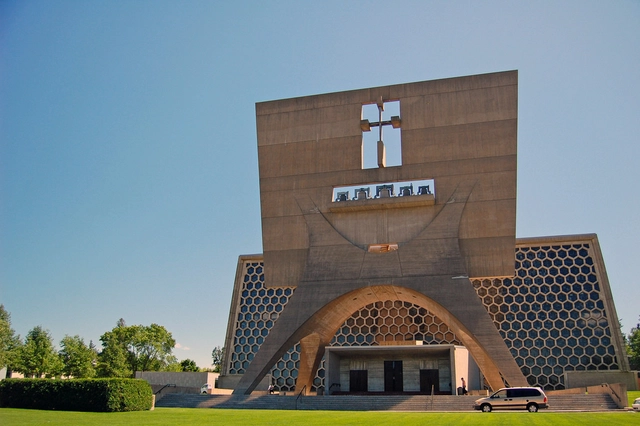
Known as Lajkó to his friends, Marcel Lajos Breuer (21 May 1902 – 1 July 1981) helped define first the interior contents, then the form, of the modernist house for millions; his influential approach to housing was one of the first to demonstrate modernism on a domestic, practical level. Beginning as a furniture designer at the height of Bauhaus, Breuer was hailed as one of the most innovative designers working in the 1930s, before moving to architecture and helping define the modernist vernacular—most notably as one of America's foremost Brutalist architects.
Every Building in Baghdad, installation view at Columbia University's Arthur Ross Architecture Gallery
This exhibition of several hundred original photographs examines the work of Iraqi architect Rifat Chadirji through the collection of his documents held at the Arab Image Foundation in Beirut. With the work of his architectural office, Iraq Consult, and in his other roles as a planning consultant and as director of buildings for several government agencies, Chadirji became a pivotal cultural figure in Baghdad during the period of its postwar modernization from the 1950s through the 1970s. Chadirji was central to the organization and consolidation of the image of the postwar city and helped foster the emergence of the factories,
At last year’s inaugural Chicago Architecture Biennial, one of the celebrated exhibits was Architecture is Everywhere by Sou Fujimoto Architects, in which the firm used everyday items like staples, boxes, potato chips, rocks, and ping pong balls, coupled with scaled human figures to posit new architectural forms. Operating with the philosophy that “architecture is first found and then made,” the project expresses the firm’s belief that we need not look to typical sources for bold thinking on the formal possibilities of architecture.
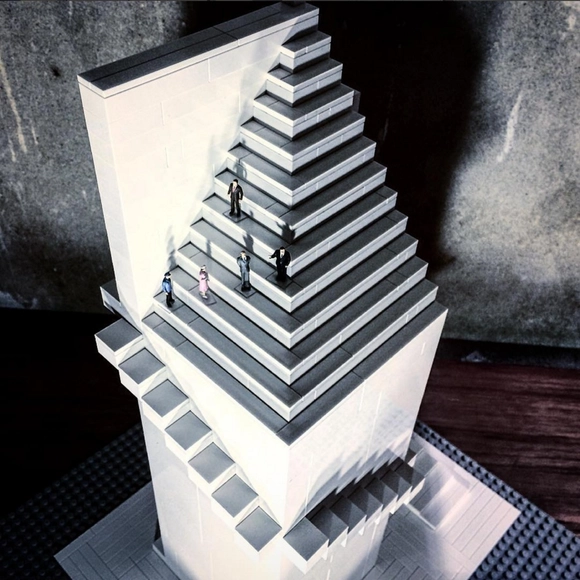
Building on this philosophy and using only the white-brick Legos from the company’s Studio Architecture kit, Berlin-based artist Arndt Schlaudraff has created a series of constructions that emulate real-world precedents, but lack their materiality and color. The results are sterilized, scaleless forms restricted by the orthogonality of the interlocking brick forms. These stripped Brutalist and Modernist buildings morph into white-washed facsimiles which allow us to see many recognizable projects with a set of fresh eyes. Posting the completed projects on Instagram, Schlaudraff has reimagined icons like the Tate Modern, Alejandro Aravena’s Innovation Center UC, and the Barcelona Pavilion of Ludwig Mies van der Rohe, interspersing them with his own creations and adding another layer of reality distortion to that which is already enabled by the Legos.
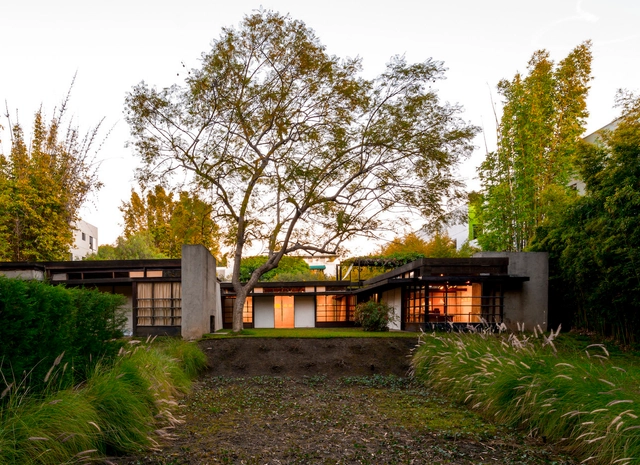
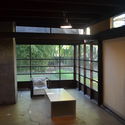
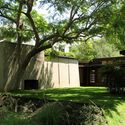
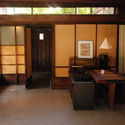
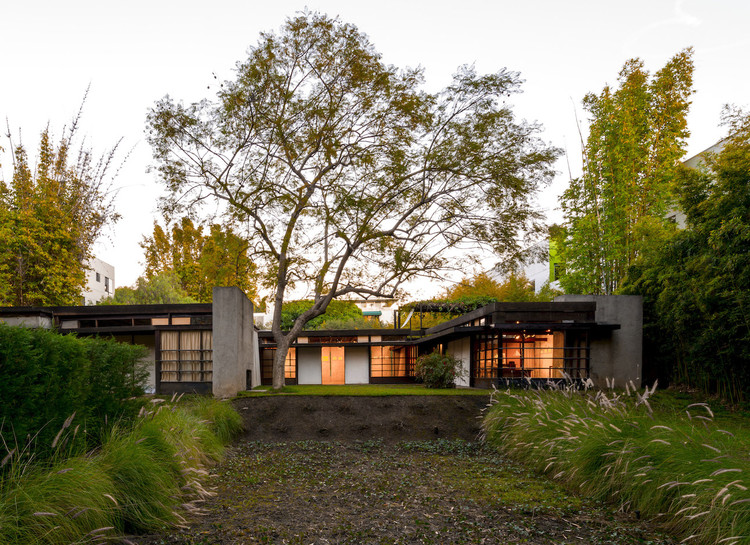
Secluded behind a screen of tall bamboo shoots in West Hollywood, Los Angeles, the Kings Road House may be considered the first home ever built in the Modernist style.[1] Designed by Rudolf Schindler in 1921, the architect’s use of tilt-slab concrete construction (highly innovative at the time) and an informal studio layout, set it apart from its contemporaries; indeed, the design would set the tone for other Modernist residential design for decades.
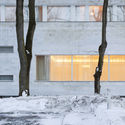
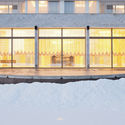
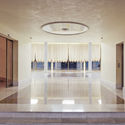
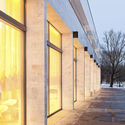
In this article, which originally appeared in theCalvert Journal, Ksenia Litvinenko narrates the story of the K-2 Dacha – a governmental residence in St. Petersburg which sought to shrug off Russian Classicism and Soviet Modernism in favor of the principles of Finnish Modernism. Illustrated by photographs by Egor Rogalev and researched alongside Vladimir Frolov, this article examines a Modernist gem that you probably won't have heard of, or seen, before.
If you ever find yourself in St. Petersburg, take a taxi along the Pesochnaya embankment, far away from the polished attractions of the city centre. Sit back and watch the landscape changing on the other bank of the Malaya Nevka. Among the trees you will see the former dachas of Russian nobles, private residences of local officials and the buildings of the new elite, overlooking the river. This is the best and perhaps the only perspective from which to see the K-2 dacha.
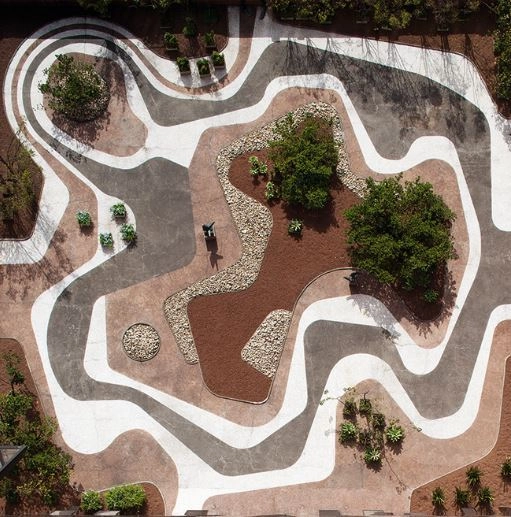
The Brazilian artist Roberto Burle Marx (1909-1994) is one of the most prominent landscape architects of the twentieth century. His famous projects range from the remarkable mosaic pavements on the seaside avenue of Rio de Janeiro’s Copacabana Beach to the multitude of gardens that embellish Brasilia, one of several-large scale projects he executed in collaboration with famed architect Oscar Niemeyer. Although his landscape design work is renowned worldwide, the artist’s work in other media remains little known. Roberto Burle Marx: Brazilian Modernist therefore explores the richness and breadth of the artist’s oeuvre—from landscape architecture to painting, from sculpture to theater
For nearly two millennia, European architecture was closely affiliated with and shaped by Christianity. Prior to the advent of Modernism, there was scarcely a style that was not promoted, or more likely defined, by the designs of churches. Such a hypothesis makes it difficult to imagine Medieval England outside the purview of GothicCathedrals, or Renaissance Italy as separate from its Basilicas. But with the Industrial Revolution and the economic and population growth that ensued, infrastructure and housing became the new symbols and necessities of cultural representation, finding their ultimate expression in the ease and simplicity of Modernism. The field of architecture, so long shaped and dominated by the church, had been subsumed by the changing concerns of a commercially driven society. Of course there were still churches being built, but the typology that once defined architecture in its ubiquity became novel and rare. Or so we’ve all been lead to believe.
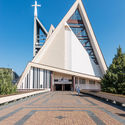
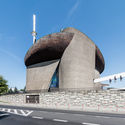
Surprising as it might be, in the wake of World War II and under Soviet control, Poland built more churches than any other country in Europe. The majority were built in the 1980s, at a time when church construction was neither authorized nor forbidden, and as a result played a pronounced role in Cold War politics. The construction of these churches was a calculated affront to the proletariat-minded Modernism of the Soviets. In their project Architecture of the VII Day, Kuba Snopek, Iza Cichońska and Karolina Popera have sought to comprehensively document these Polish churches and the circumstances of their construction. Unique not only in how they defied the prefabrication and regularity of the Eastern Bloc, the churches were community-led endeavors that relied on local funding and input, long before these practices became buzzwords in 21st century architectural circles.
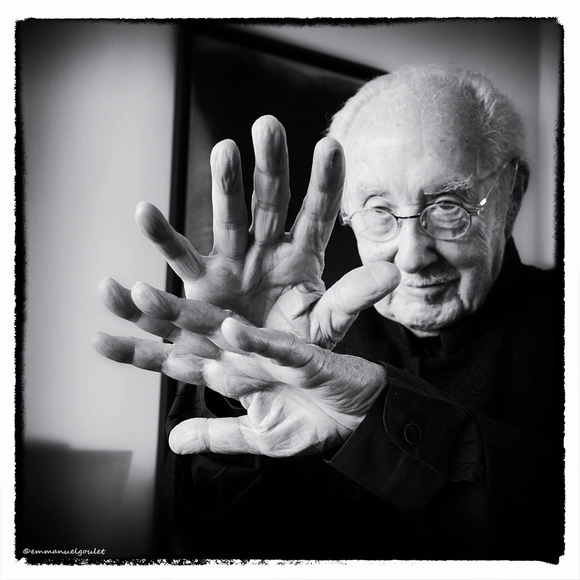
Claude Parent, a celebrated French architect and Commandeur de la Légion d'honneur, died on the evening of the 27th February 2016, the day after his 93rd birthday. Born in 1923 in Neuilly-sur-Seine, Parent was a member of the Académie des Beaux-Arts in Paris and, throughout his career, developed a limited but extremely influential body of built work ranging from nuclear power stations to shockingly unconventional shopping centers, such as his project in Sens. Described as both a utopian and a 'supermodernist' in his own lifetime, the methodology he shaped has played a significant role for his peers of all generations and for contemporary artists and thinkers including Jean Nouvel, who began his professional life as a collaborator.
In this video, one of Jean Prouvé's famous 1944 demountable houses - in this case a 6-meter by 6-meter variation - is rapidly constructed on a beach, showing off the design's ruthlessly efficient structural system and sequence of construction. The video is one of a series in recent years, almost always published in a time-lapse format, that show off how quickly this early example of mass-produced, temporary social housing could be put together.
The video, as with others before it, is an interesting look at such an early example of small-scale modular buildings - but with the advances made in material and manufacturing technology in the 70 years since its design, the building is hardly a revelation in how to create buildings quickly and cheaply. So what's behind all this interest in the Prouvé demountable house?
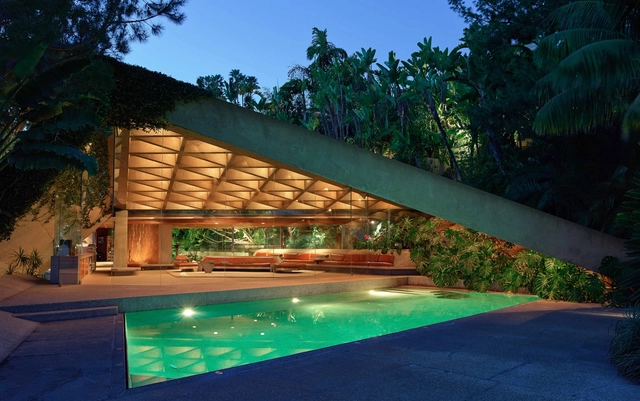
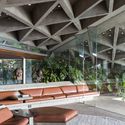
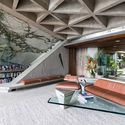
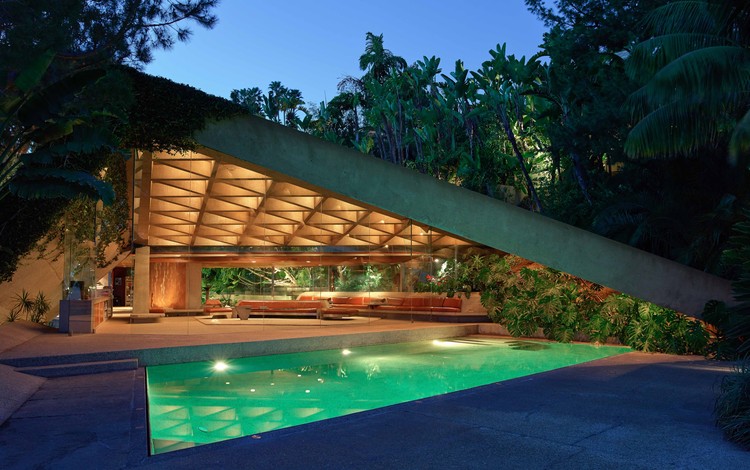
The Los Angeles County Museum of Art (LACMA) has announced that John Lautner's famous LA residence, the James Goldstein House - often referred to as the Sheats Goldstein Residence - has been promised to the museum by its current owner James Goldstein. The gift includes the house itself, a James Turrell skyspace which is located on the property, and architectural models of the home (as well as a number of artworks and Goldstein's 1961 Rolls Royce for good measure). The house will be the museum's first architectural acquisition, following similar acquisitions of Modernist homes by other museums such as Crystal Bridges Museum's recently-opened Bachmann-Wilson House by Frank Lloyd Wright.
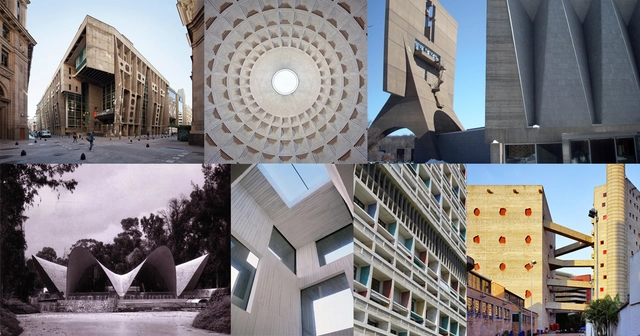
“Concrete has the ability to be primitive and technological, massive and levitating, to combine the properties of steel with those of mud,” says Rowan Moore in his list of The 10 best concrete buildings created for The Guardian. Through examples spanning three continents, Moore unites old standbys with unexpected wonders, all of which show the varied possibilities inherent in mixing water, aggregate, and cement. In a list that incorporates examples from Classical times to the present, Moore establishes concrete’s unique ability to adapt to different times, styles, applications, and treatments.
Examples by Le Corbusier, Álvaro Siza, Lina Bo Bardi, and Marcel Breuer demonstrate that concrete is anything but workaday or utilitarian. Moore’s list affirms that a material simultaneously strong and light, durable, sustainable, and fire-resistant, can scarcely be considered anything short of miraculous. Of course, ten buildings can only provide an abridged version of concrete’s possibilities, and Moore cheekily apologizes for some of the obvious omissions. Check out the full list here.
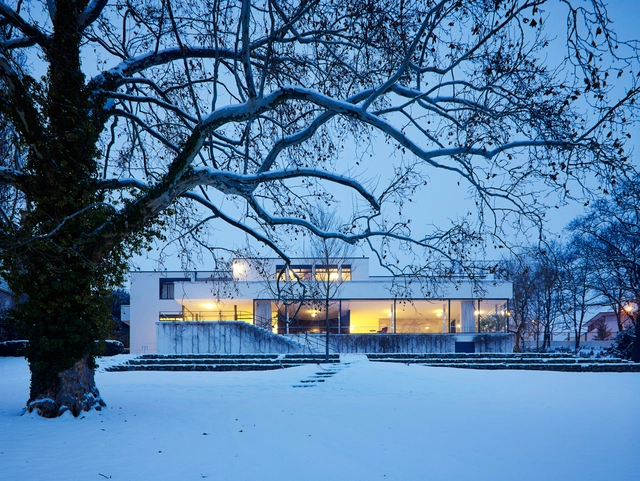
Villa Tugendhat (1928–30) in the Czech Republic is the most well-preserved example of Ludwig Mies van der Rohe’s early functionalism. It is regarded as one of the world’s most important manifestations of villa architecture and has been listed as a UNESCO World Heritage Site. The building also likely inspired the Norwegian architect Arne Korsmo’s work on Villa Stenersen (1937–39).
Modernism was a stylistic evolution meant to jettison the baggage that had moored culture to habits and historicism. But it was more than an architectural style: it was a new and universal way of life meant to eradicate variability, to relish in the ease of sameness and reproducibility. It’s easy to be seduced by Modernism when you’re talking about motel rooms, or Starbucks, or your shirt size at a favorite store, all instances where replication is reassuring. But the movement’s biggest advocates, governments and developers, pushed the style to its extreme in large housing blocks - a typology long out of fashion in the United States, but which continues to be de rigueur in countries intent on achieving rapid economic expansion and concentrating its populations in urban regions.
Look at an aerial photograph of the periphery of any Chinese city and you will see the monotony of towers that rise out of the ground like modules on a silicon circuit board. Viewing drabness with cautionary eyes, designer Feifei Feng’s project "Urban Playhouse: A Communal Drama in Seven Acts," proposes a series of interventions, or "acts," on a field of four and six-story slab housing buildings in Jinan, China, adding social spaces ("follies") that are intended to regenerate the spontaneity and theatricality of living in close quarters.
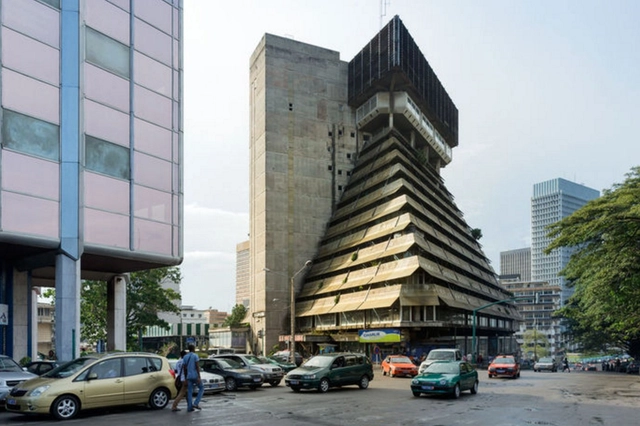
A new exhibition opening later this month at Chicago's Graham Foundation seeks to explore the complex history and legacy of modernist architecture in sub-Saharan Africa during the 1960s and 1970s. Architecture of Independence: African Modernismwill feature nearly eighty buildings in commissioned photographs by Iwan Baan, Alexia Webster, and Manuel Herz. Alongside archival material, the exhibition "imparts a new perspective on the intersection of architecture and nation-building in Ghana, Senegal, Côte d’Ivoire, Kenya, and Zambia and investigates some of the most compelling yet under-studied examples of 1960s and 1970s architecture worldwide."
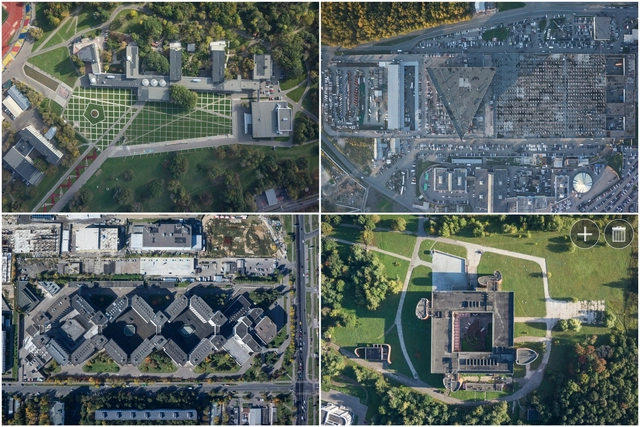
Though the ahistorical dogma of modernism would seem a perfect fit for the Soviet Union’s mandated break with traditions, the architectural history of the USSR was somewhat more complex. Stalin’s neoclassically-inflected socialist realism superseded the constructivist heyday of the early Soviet Union, only to be replaced by a return to modernism under Khrushchev, facilitated by an opening to the West. Architectural photographers Denis Esakov and Dmitry Vasilenko recently used a drone to capture photographs of several landmark structures of the Khrushchev-era return to modernism, focusing on how these aerial views reinforce their rational geometries and regimented forms. Until the recent advent of satellite imagery and commercially available drones, these were views that were only ever seen by the architects, and the officials who reviewed the plans. Even so, the photographer notes that these methodical forms must have been very attractive to the state officers tasked with implementing Khrushchev’s mandated aesthetic.
The photographs, taken in and around Moscow, include works by several prominent Soviet architects. Leonid Pavlov’s long career spanned the full spectrum of state-sponsored architectural styles, starting as a constructivist, and moving into more historicist designs under Stalin, before emerging as one of the Soviet Union’s most prominent post-war modernists. Similarly, Yuri Platonov’s work received extensive state recognition, earning him the title of “People’s architect of the USSR,” as well as awards such the Silver Medal of the Arts Academy of the USSR, the USSR State Prize, and the State Prize of Russia.
In his book We Have Never Been Modern, philosopher Bruno Latour concludes that an inability to make humanity and nature inherently separate is one of Modernism’s most misguided tropes. Thus, contemporary designers that hope to riff on or have continuity with modernism must understand that architecture, even at its most aestheticized, is not hermetically sealed off from the outside world - and that therefore modernism is not a plateau of design, but another base camp on the road to further refinement.
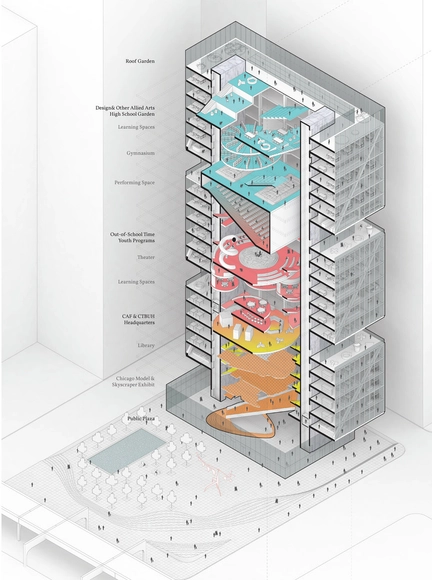
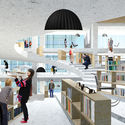
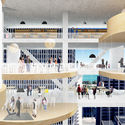
In Chicago, the city where Modernism reached both its metaphoric and physical peak, Atelier 2B, a team of Yewon Ji, Nicolas Lee, Ryan Otterson, recently shared the top-five prize of the Chicago Architecture Foundation's ChiDesign Competition (part of the Chicago Architecture Biennial) for their project Soft in the Middle: The Collaborative Core. Indebted to the legacy of Mies and the International Style, Atelier 2B proposed a Modernist-tower-redux that (externally at least) is composed of three stacked rectangular volumes bisected with terraces, set back from the street by a large public plaza. The project brief called for “a new center for architecture, design and education,” in a competition judged by critics including Stanley Tigerman, David Adjaye, Ned Cramer, Monica Ponce de Leon, and Billie Tsien.
Drone Brasília has shared with us a brief video filmed by a drone that gives a bird’s eye view of a signature feature of Brasília -- the “tesourinhas,” the so-called cloverleaf interchange that the city’s highways form.
In just thirty seconds the video shows the scale of the space, marked by cars traveling through the wide avenues, which themselves are projected onto an expansive green plane.
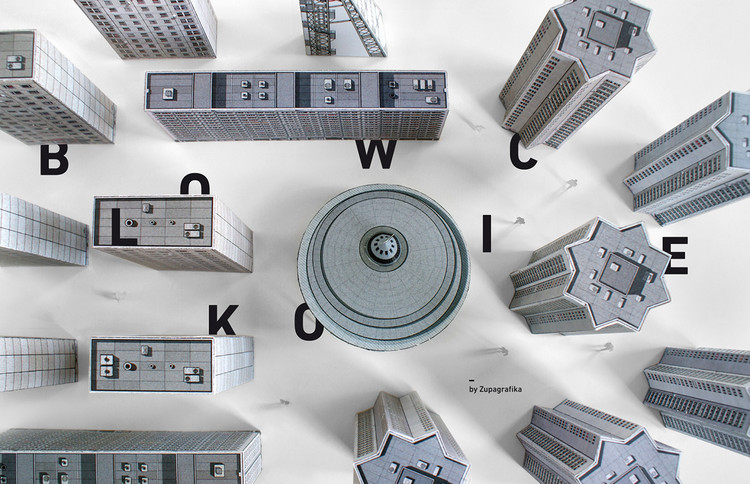
Inspired by the architecture of the Upper Silesian Industrial Region, Blokowice features modernist and brutalist buildings from the 1960-80s. The collection includes the Spodek and Superjednostka, two iconic buildings from the city center, Osiedle Gwiazdy, a characteristic star-shaped estate, Osiedle Odrodzenia, prefabricated panel blocks from the outskirts of the city, and the controversial Katowice railway station building that was demolished in 2011.