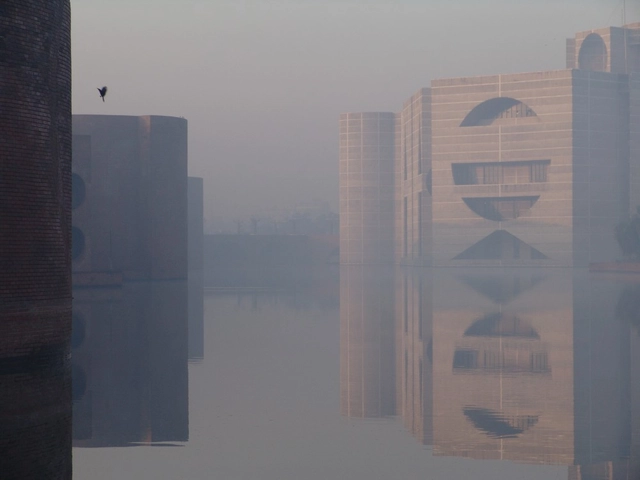
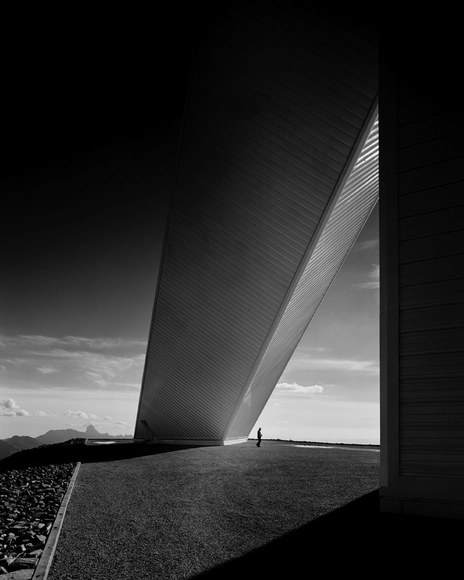
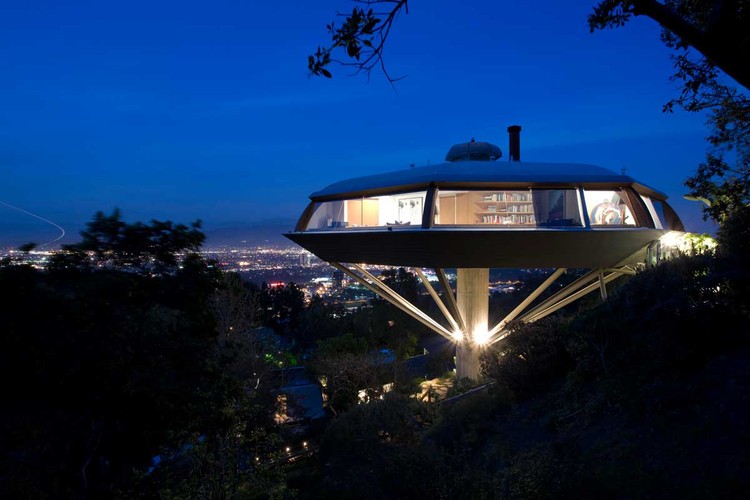
In this interview with BD, Richard J Williams discusses his recent book "Sex and Buildings," which analyses how some places, such as his home town of Edinburgh, "wear their morality on their sleeve," while other places. such as Brazil, have an idea that "modernism can be sexy." He also talks about the US attitudes to sex and modernism, bringing up the 'Playboy townhouse' of the 1960s and the TV show Mad Men, as well as architects Richard Neutra, Rudolph Schindler and John Portman. You can read the full interview here.
“Modern Architecture: International Exhibition” is the title of an exhibition that took place in 1932 at the Museum of Modern Art in New York City. Curated by Philip Johnson and Henry-Russell Hitchcock, the exhibition introduced an emerging architectural style characterized by simplified geometry and a lack of ornamentation; known as the “International Style,” it was described by Johnson as “probably the first fundamentally original and widely distributed style since the Gothic.” The exhibition, along with an accompanying catalogue, laid the principles for the canon of Modern architecture.
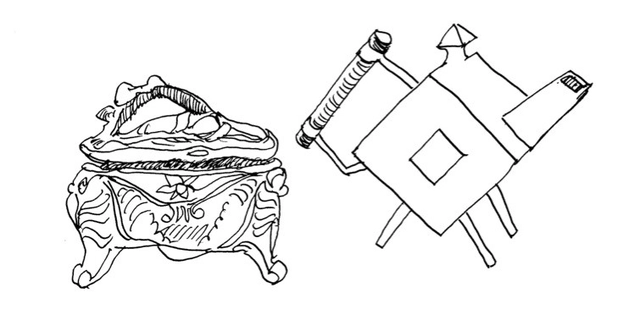
Figure 1. On the left, mass-produced Art Nouveau silver jewelry box by P. A. Coon, 1908. On the right, hand-made Machine Aesthetic silver teapot by C. Dresser, 1879. Drawing by Nikos Salingaros.
This figure was published on April 2013 in the article “How Modernism Got Square” co-authored with Michael Mehaffy. It has been reproduced several times when reprinting the original article, and in essays by other authors who discuss our ideas.
And yet, the above figure subsequently re-appears with a new accompanying caption that completely reverses the facts and switches our original message. Well-meaning editors and authors chose the new caption “From Artisan to Industiral” (first here, and then again on ArchDaily), which conforms to the modernist orthodoxy on the evolution of historical design styles. They are in no way pushing modernism (being interested instead in my criticism of modernist design): it’s simply that the dogma is so pervasive in our civilization that the mislabeling becomes automatic, a conditioned response.
Nikos Salingaros is unafraid of a controversial statement. A professor of Mathematics and Urban theory, he has been using his scientific approach to study architecture and urban environments for years, and has come to a conclusion: Modernism is just about the worst thing that happened to architecture.
As Salingaros explains, not only is it impossible to have any "Green" architecture within a modernist framework, but, moreover, Modernism encourages us to deny our biologically-evolved senses and embrace an unnatural, inhuman built world - and why? Because there's a whole lot of money and power behind those "modernist boxes." As Salingaros puts it:
Architectural Education ever since the Bauhaus, and continuing to the present day without interruption, teaches students to interpret built forms according to very peculiar abstract criteria, and not through their own biologically-evolved senses and cognitive intelligence. This is radical training in sensory denial: desensitizing people so that their interpretation of the world can be defined by others with an agenda.
I interviewed Salingaros to get to the bottom of his theories and understand his anti-Modern crusade. Read it all, including Salingaros' incendiary takes on Architecture education, sustainability, and urban planning, after the break...
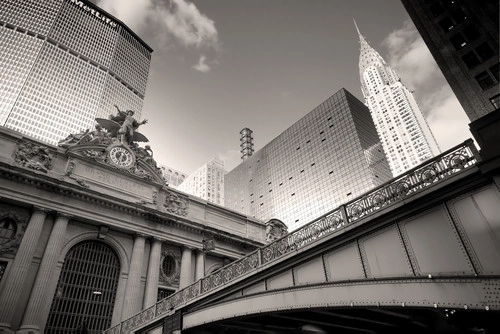
Grand Central Station (1913) in front of the MetLife (formerly Pan Am Building, 1963) and next to the Chrysler Building (1930). Image Courtesy of emin kuliyev / Shutterstock.com
This article, by David Brussat of The Providence Journal's editorial board, first appeared at providencejournal.com.
In a rating of energy efficiency by the Environmental Protection Administration, New York's venerable Chrysler Building scored 84 out of 100 points; the Empire State Building, 80; but the modernist 7 World Trade Center scored 74 (below the cutoff of 75 for "high efficiency"); the Pan Am Building, 39; Lever House, 20; the Seagram Building, 3. The New York Times reported this story last Dec. 24 under the headline "City's Law Tracking Energy Use Yields Some Surprises."
It was no surprise to Nikos Salingaros and Michael Mehaffy, who have investigated why modern architecture thrives despite its inability to live up to any of its longstanding promises -- aesthetic, social or utilitarian.
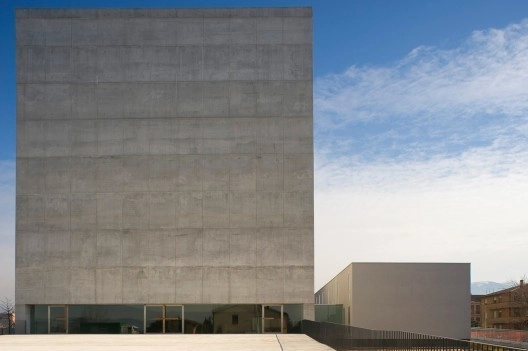
Church in Foligno, Italy / Massimiliano and Doriana Fuksas
"Space, lines, light and sound" are the essential components of the experience of architecture and the most profound buildings have captured these moments through thoughtfully orchestrated design. Recently, architects that have designed churches with these primary elements in mind have come under criticism by the Vatican for diverting from the traditional form and iconography of churches. According to a recent article in The Telegraph, Massimiliano and Doriana Fuksas' design for a church in Foligno, Italy has been labeled as problematic by the parish and Cardinal Gianfranco Ravasi, head of the Vatican's Pontificial Council for Culture for its resemblance to a museum instead of a place of worship - based on traditional Catholic values placed on the altar and imagery. Regardless of the Vatican's criticism of the aesthetic approach of architects that break with tradition, this seems more of an issue of miscommunication between the architects and the congregations that have commissioned the projects that are being criticized.
(Almost) everything you need to know about 20th century design has been synthesized into 6 brightly-colored, easily-digestible videos (all narrated by the sweet Scottish tones of one Ewan MacGregor).
From the Gothic Revival to Post-Modernism, this series of shorts from The Open University’s OpenLearn website just touches the surface of these design movements; however, they act as a great introduction for the un-design-initiated (indeed, The Open University sees them as an intro to their free course on Design Thinking) or, for design-aficionados, a fun refresher.
We're particular to the video on the Bauhaus (after all, we also tackled the movement in a brilliant infographic) and the Modernist video (after the break) - but you can find all 6 at OpenLearn. Enjoy!
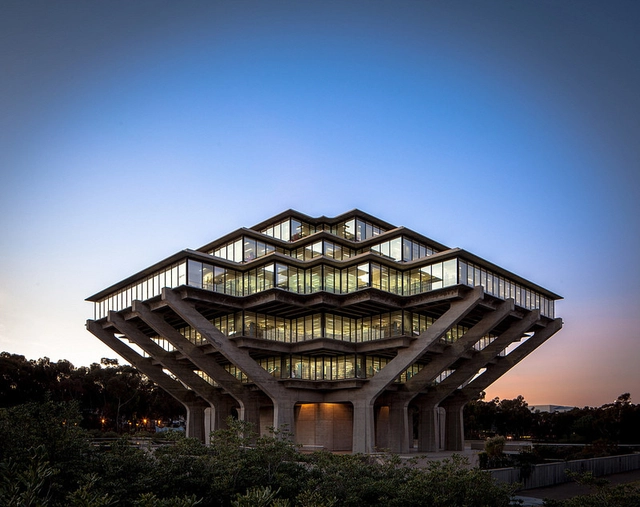
At just a little over 50 years old, the University of California San Diego is one of the younger college campuses in the United States, but despite this it is one of the most architecturally fascinating universities around. In the official UCSD campus guide, Dirk Sutro emphasizes that "UCSD does not have a single example of the historical-revival styles prevalent at other University of California campuses... and at San Diego's two other major universities". The history of UCSD architecture is one of ambition, which has made the campus a display case of modernism in all of its forms from the last half a century.
Thanks to photographer Darren Bradley, we can now share this history and a selection of the exciting structures it has produced.
Find out more about the UCSD campus after the break
Architecture is inseparable from planning, and the huge challenge for the current generation is the growth and shrinkage of cities. Some cities, mainly in the Southern Hemisphere, are growing at exponential rates, while former global hubs in the northern are turning into countrysides. In the south, populations are still growing a lot, while populations are dwindling in Europe, Russia and North East Asia. The dream of the Bilbao effect was based on the hope that there might be a quick fix to both of these problems. Well, there is not.
A decade ago, few people even recognized this was a real issue and even today it is hardly ever mentioned in a political context. As a politician, you cannot say out loud that you have given up on a huge part of the electorate, or that it makes sense for the national economy to favor another part. Reclaiming the agricultural part of a nation is a political suicide issue whether you are in Europe or Latin America. And investing in urban development in a few, hand-picked areas while other areas are desolate is equally despised.
The one person, who is consistently thinking and writing about this problem, is Rem Koolhaas, a co-founder of OMA.
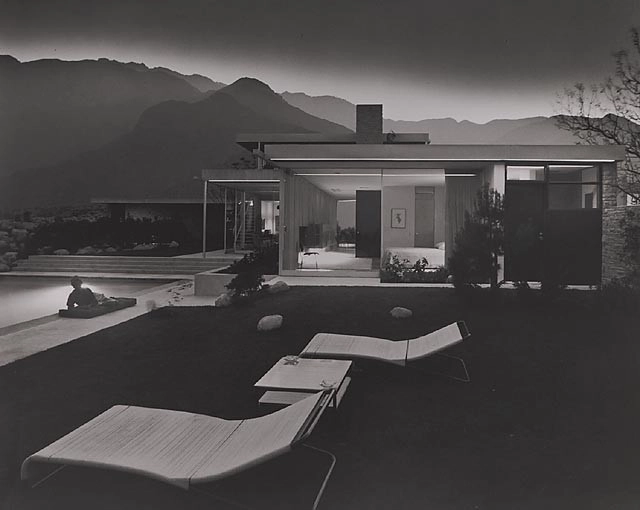
The mid-century modern master, Richard Neutra was well known for his cutting edge modernism. Since Julius Shulman immortalized his houses in his iconic photographs, Neutra's bright, airy homes have widely been seen as the pinacle of modernism and desirability. One problem though, they're in high demand and it's not exactly like they're making any more Neutra buildings; in fact, quite the opposite is true and as a result they have become a pretty expensive commodity.
Read more about how to get your very own Neutra home after the break...
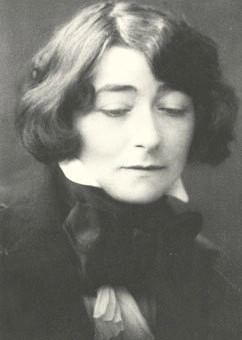
As we've mentioned before, Irish designer Eileen Gray was undoubtedly one of the most influential, and most overlooked, designers of the 20th century. However, a new Kickstarter campaign aims to put that right once and for all. The campaign is seeking funds to help renovate Gray's seminal house, E-1027, for the production of a feature film about the architect.
When emigrating from Germany in 1938 to head Chicago’s Armour Institute, Ludwig Mies van der Rohe was challenged with two tasks: first reform the schools curriculum to his “back-to-basics” approach and then develop plans for a newly expanded 120-acre campus for the creation of Illinois Institute of Technology, a product of the Armour Institute and Lewis Institute merger. Mies was able to exceed both challenges and the outcomes have had a lasting influence on Chicago and modernism for the past 75 years. In celebration of this legacy and Mies’ 127th birthday, IIT was complied this comprehensive video that features Mies’ contribution to the modern landscape of their campus and city.
Now on view at the Yossi Milo Gallery through March 2, rarely-seen images by modernist architectural photographer Ezra Stroller (American, 1915-2004) captures a Post-War American landscape with stunning images of industry, technology, transportation and working class Americans.
Beyond Architecture covers the full range of Stoller’s work, including photographs commissioned by Fortune, Architectural Forum, and House Beautiful magazines in the 1940s and for commercial projects for IBM, Upjohn Pharmaceuticals and CBS in the 1940s and 1950s. Included are photographs of Skidmore, Owings & Merrill’s John Hancock Building, Chicago, and the United Nations Headquarters, designed by an international team of architects led by Wallace K. Harrison and including Oscar Niemeyer and Le Corbusier.
This article comes courtesy of ArchDaily friend Charlotte Neilson, the author of the fascinating design blog Casting Architecture, which discusses architecture and production design. Charlotte is not only a dedicated cinephile but also an honours graduate of the University of Newcastle, Australia.
We all know that psychopaths prefer contemporary design. Hollywood has told us so for decades. The classic film connection between minimal interiors and emotional detachment (see: any Bond adversary) or modern buildings and subversive values is well documented - and regrettable. The modernist philosophy of getting to the essence of a building was intended to be liberating and enriching for the lives of occupants. Hardly fair then that these buildings are routinely portrayed with villainous associations.
What the representation of Modernist architecture in film tells us about our society, after the break...
The relationship between social dynamics and architecture has always been intimate. It is a constant dialogue between social norms and politics, stylistic trends and aesthetic choices, individual preferences and the collective good. The Modernist Period was a time when architecture took on the challenge of many social problems. In all the arts – architecture, design, music and film – the period was highly politicized and the choices often gave way to a utilitarian ideal that was a hybrid of efficiency, simplicity and comfort. Jake Gorst’s new film Modern Tide: Midcentury Architecture on Long Island, supported by Design Onscreen, is a message of preservation that takes us through the history of the modernist housing boom that took place on Long Island, NY in the period between the Great Depression and the 1970s.
“Legos were the ultimate building tool, capable of making the most advanced space ships, powerful vehicles, impressive buildings, and incredible cities. As a child, everyone I knew loved Legos, and this never seemed to change. In high school, whenever a conversation with friends happened to shift upon Legos, everyone would gleefully reminisce about their days making fantastic structures out of those awesome little building blocks. No doubt Legos played a supporting role in my growth in appreciation for architecture.” - Architect Albert Lam, in a Blog post for the LPA
When you ask architects what inspired them, almost all (according to one study, 99%) can trace the calling back to the same, simple origin: playing with their LEGO bricks.
The LEGO Group, which turns 80 today, can boast that there are approximately 62 LEGO bricks for ever person on earth. However, it wasn’t until 1958, when the newly-plastic LEGO bricks incorporated the classic knob-and-tube-connecting-system, that they overtook the Froebel block (Frank Lloyd Wright’s toy of choice) to become the massively popular architectural inspiration they are today.
But while the influence of LEGO on architects may be self-evident, not many know about Architecture’s contribution to LEGO. In fact, only through the lens of Architecture, can you truly understand why LEGO merits its bold moniker as “The Toy of the Century.”
Find out Architecture & LEGOs unlikely relationship, after the break…
Tensions mounted between modernist and traditionalist camps earlier last month when Paul Finch, UK Chairman for the Commission for Architecture and the Build Environment, praised the fact that modernists had won bids to design buildings for the 2012 Olympics. In response, Robert Adam, member of the Traditional Architecture Group, and Michael Taylor, senior partner at Hopkins, the firm that designed the Olympic velodrome, met for a discussion on hegemony, timeliness, and pastiche moderated by Guardian staffer Lanre Bakare.