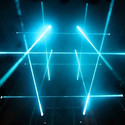
As part of the Semaine Digitale, in October Bordaux will host 1024 Architecture's Tesseract, an installation inspired by the so called "four-dimensional cube." Created from no more than ordinary scaffolding, a translucent fabric skin and a series of electronically controlled lights, the installation plays with complex geometrical compositions, as the light beams rapidly create and deconstruct shapes within the outer 10 metre cubic frame.
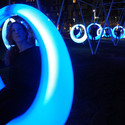
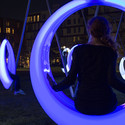
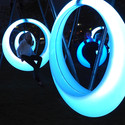
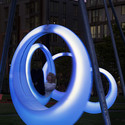
In Boston, playgrounds are no longer just for kids. Twenty LED-lit circular swings have been installed outdoors as a part of "Swing Time," Boston's first interactive sculpture installation. The hanging, glowing orbs are a twist on traditional rubber-and-rope swings, dangling from a minimal steel structure similar to those used in conventional playgrounds. LED lights embedded in the swings activate and change color as each swing moves, returning to a dim white light when static. The piece is designed to blend Boston's design community with its expanding technology sector while playfully engaging residents.
Take a seat in "Swing Time" with more photos and info after the break.
Jeffrey Inaba’s Brooklyn practice INABA has been selected as the first-ever winner in the Flatiron Plaza Holiday Design Competition with New York Light. Organized by the Flatiron/23rd Street Partnership and Van Alen Institute, the inaugural installation will be constructed in front of the famous Flatiron Building for the duration of the 2014 winter season.
Folly is a word not often used in architecture. By definition, 'folly' is a lack of good sense, or foolishness. And in the realm of architecture, folly is used to describe an extravagantly ornamented structure with no practical purpose. Yet gathering their inspiration from this word, Warren Techentin Architecture (WTARCH) have created and mounted a functional folly, appropriately named La Cage aux Folles (The Cage of Follies). Constructed of painted, steel tubes and installed at Materials & Applications, an exhibition centre in Los Angeles, La Cage aux Folles played host to an array of musical performances and lectures.
Explore La Cage aux Folles with more photos and info after the break.
Imagine walking beneath an illuminated canopy of lush greenery, in the form of inverted pyramids sculpted to perfection. In early August 2014 visitors were welcomed by this succulent living roof to the Harmony Arts Festival in West Vancouver, British Columbia. Guests were guided through the fairgrounds beneath the 90-foot long canopy, creating an immersive sensory experience befitting the interdisciplinary creative arts festival. Designed by Matthew Soules Architecture and curated by the Museum of West Vancouver, Vermilion Sands was created as a temporary installation for the ten day festival.
Submerge yourself in Vermilion Sands with photos and more info after the break.
The use of fiberglass allowed for the pavilion to be thin and brittle, but also had the strength to span a large face. The pigment made it fire retardant. Image Courtesy of Louis Webb Bird/AECOM
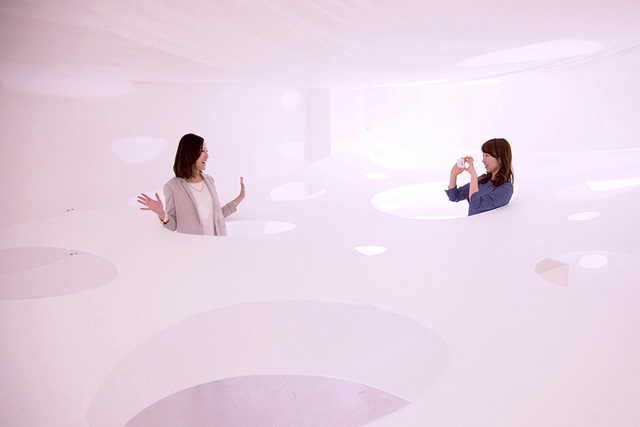
Settled neatly in the quiet hum of London's Kensington Gardens rests Smiljan Radić's 2014 Serpentine Pavilion, an ethereal mass of carefully moulded fiberglass punctuated by precisely cut openings. Radić desired a structure that appears thin and brittle, yet was strong enough to support itself, and his affection for the rudimental layered qualities of papier-mâché - his maquette medium of choice - inspired the use of fiberglass by AECOM, who engineered Radić's wild ideas. In this article, originally published by Metropolis Magazine as "Paper-Thin Walls," an AECOM engineer explains their solution. Read on after the break to find out more.
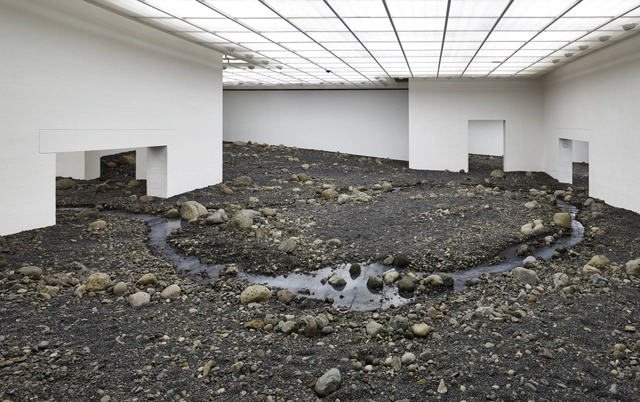
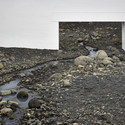
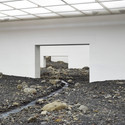
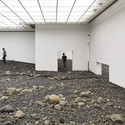
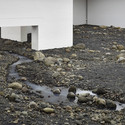
Blurring the boundaries between the Natural world and the Manmade in one wide, sweeping gesture, Danish-Icelandic artist Olafur Eliasson's first solo exhibit, aptly titled Riverbed, brings the Outdoors in.
Recreating an enormous, ruggedly enchanting landscape, complete with riverbed and rocky earth, the artist draws heavily from site-specific inspiration. The Louisiana Museum of Modern Art's location on the Danish coast lends a raw, elemental and powerful character that extends into the building as a major intervention, transforming into a work of art.
Ryo Yamada's "Air Garden" installation is a passage, but not in the traditional sense of the word. It's not a passage that connects one point to another, since the walkway does not lead to a tangible destination, but rather a passage that connects an enclosed garden to the vastness of the open sky. The artist believes everyone shares a common desire for the sky, which represents freedom and equality. Read on after the break for more information, images and a video.
One of the latest installations at London'sSerpentine Gallery, where Smiljan Radicrecently unveiled an ethereal pavilion, is Marina Abramović's performance installation entitled 512 Hours. Creating what has been described as "the simplest of settings" in one of the gallery's large spaces, the artwork employs Abramović's most frequently used material: herself. Coupled with the audience and a selection of common objects, the constantly changing sequence of events on display is the very first live installation by the artist displayed in the UK. Upon arrival, visitors are asked leave their baggage (including mobile phones, cameras and any other electronic equipment) behind in order to enter the exhibition. Find out more about what you can expect from it here.
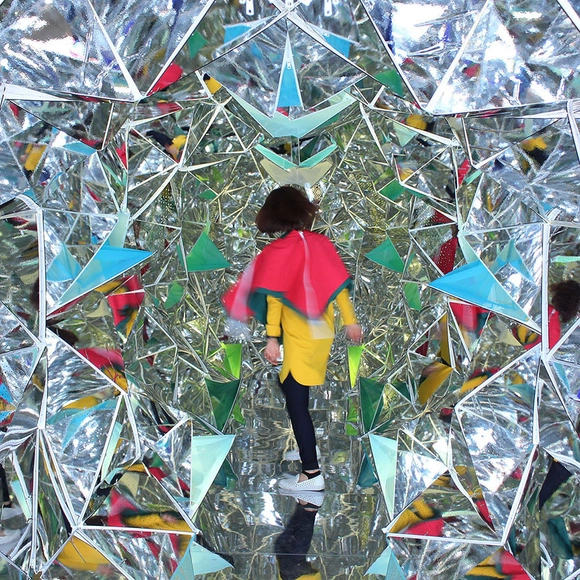
2013 KOBE Biennale visitors had the opportunity to experience the magic of a kaleidoscope in a whole new way thanks to Saya Miyazaki and Masakazu Shiranes' award-winning installation. The psychedelic polyhedral installation was designed for the Art Container Contest, which challenged participants to create interesting environments within the confines of a single shipping container. As visitors meandered through the installation, they became active participants – rather than passive observers – in the kaleidoscope's constantly changing appearance. For more images and information, continue after the break.
Japanese firm Kotaro Horiuchi Architecture's "Fusionner 1.0" was on display this past March at the White Gallery Cube in Nagoya, Aichi, Japan. The installation consisted of two horizontal floating membranes stretched across a simple rectilinear room, dividing the space vertically into three sections.
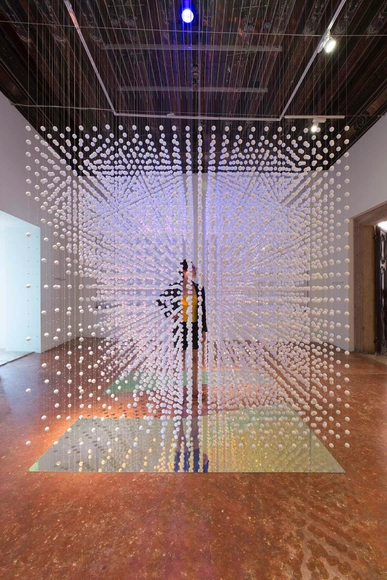
Dutch practice Bekkering Adams Architecten, in cooperation with ABT and BeersNielsen, recently unveiled an installation at the Palazzo Mora, Venice as part of a collateral event with this year's Venice Biennale. Entitled Form-ContraForm, the sculptural piece reflects on the conceptual and human perception of space - something which they describe as "a space that surrounds and envelops." Distilling architecture's fundamentals (which is also the theme of this year's Biennale) down to the definition of co-ordinates in space, the experience created by Bekkering Adams is akin to the notion of "the mass versus the cavity."
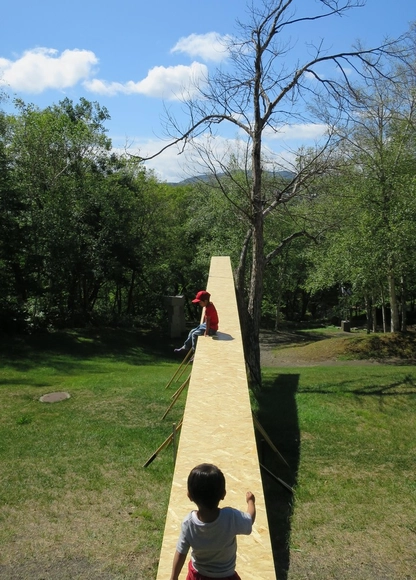
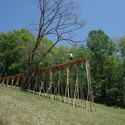
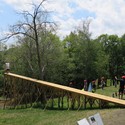
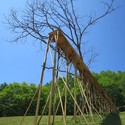
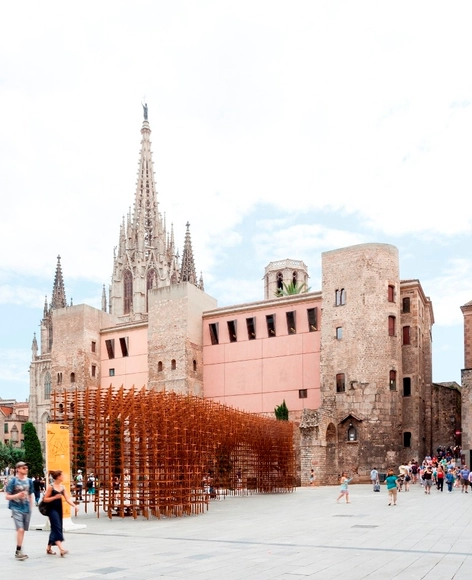
Every year, citizens of Catalonia commemorate the events of September 11th 1714, a key date in the War of the Spanish Succession that has come to symbolize what Voltaire called "the Barcelonans' extreme love of freedom." With this year marking the 300th anniversary of these events, Barcelona Cultura enlisted the Fundació Enric Miralles to curate 7 public installations around the city as part of its Tricentenari BCN program.
The result is BCN RE.SET, organized by Benedetta Tagliabue of the Fundació Enric Miralles and stage director Àlex Ollé, which invited guest architects from countries all over the world to colloborate with local universities and create installations symbolizing 6 political and ideological concepts: identity, freedom, Europe, diversity, democracy and memory. These installations will be in place until September 11th. Read on after the break for descriptions of all 6 installations.
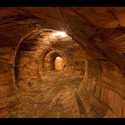
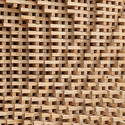
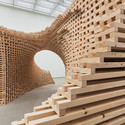
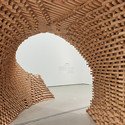
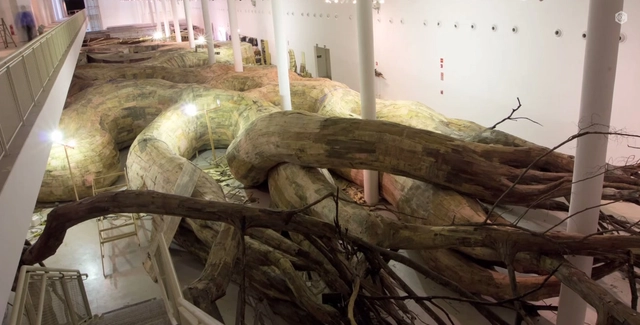
Given a cavernous gallery space at the Museu de Arte Contemporânea da Universidade in São Paulo, artist Henrique Oliveira has created Transarquitetônica, a breathtaking installation from plywood, which fills the room with twisted tree roots large enough for gallery visitors to walk inside.
Read on after the break for more images of the installation, including photos of its construction
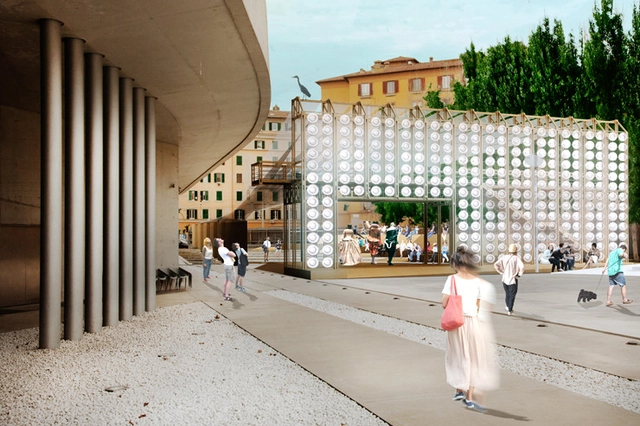
Just as the 2014 winners of the Young Architects Program (YAP) in Chile and Korea were announced this week, the architecture collective of Orizzontalewas crowned victorious for the program’s MAXXI edition in Rome.
The winning scheme, dubbed “8 1/2,” will be a translucent wall of recycled beer kegs and an inhabitable timber podium that will be used as a stage for summer events within the confines of the MAXXI piazza. Shaded during the day and illuminated at night, the glass wall is intended to inspire people to rest, play, watch and listen.
YAP Korea 2014: Shinseon Play / Moon Ji Bang. Image Courtesy of MoMA
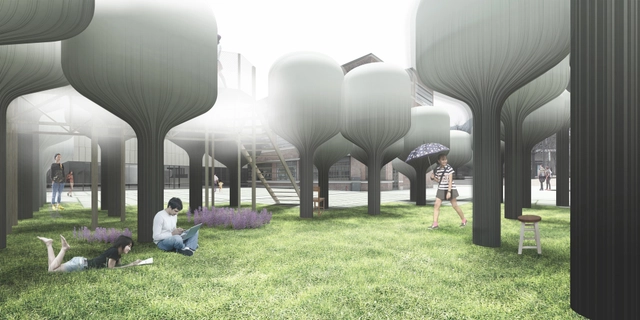
The Museum of Modern Art and MoMA PS1 has announced a partnership with the National Museum of Modern and Contemporary Art (MMCA) in Seoul that has expanded the international Young Architects Program (YAP) to South Korea. Just as YAP presents opportunities for emerging architects to design and build temporary installations in New York, Chile, Rome and Istanbul, YAP Korea will offer the MMCA’s outdoor Museum Plaza as the summer installation site.
Already, a winner has been chosen from 26 submissions to serve as the inaugural YAPKorea installation. With completion planned for July 8, winning team Moon Ji Bang (Threshold) is amidst the final preparations for mystical, mythology-inspired installation that will transcend visitors from the daily hustle into a cloud-like landscape of air balloon structures.
The Brooklyn based firm The Principals are known for their interactive design, industrial design and installation work. The video above hi-lights their latest "bionic" installation, which actually responds and reacts to human movement thanks to myoelectric sensors that pick up voltage increases on the skin when a muscle contracts. To learn more head over to their website - and make sure to check out all of The Principals other installations featured on ArchDaily.









.jpg?1408972517&format=webp&width=640&height=580)








.jpg?1404009231 "Diversity / Yael Reisner + Peter Cook. Image © Marcela Grassi")
.jpg?1404009282 "Freedom / Anupama Kundoo. Image © Marcela Grassi")
.jpg?1404009313 "Memory / Grafton Architects. Image © Marcela Grassi")

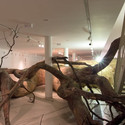
.jpg?1401996770 "Courtesy of MAC USP via www.mac.usp.br")