Filament Mind is a human information-driven installation by E/B Officewhich is designed to visualize the collective curiosities and questions of Wyoming’s Teton County Library visitors through a dynamic and interactive spatial sculpture. The project is inspired by the concept that our civic spaces should be intelligent and responsive, communicating as much to us as we do to each other, enabling a form of intra-environmental social interaction between our thoughts and the material of our built environments. More images and architects’ description after the break.
Exploring the evolving way in which we work, the POP-UP Office is an installation by DUBBELDAM Architecture + Design that uses modular units that can be combined in different ways. The result is a workspace that is simultaneously bare bones and tailored to the individual. This design becomes a great response to the profound shift in the way we work; when all we need is a surface to work on and a place to plug in, the working environment is no longer static. More images and architects’ description after the break.
With an intention to attract and impress viewers with his massive scale, Hehas been selected as winner of the 2013 Young Architects Program (YAP) MAXXI in Rome, an annual competition that promotes and supports young and emerging architects in collaboration with MAXXI Architettura, MoMA/MoMA PS1 of New York, Constructo of Santiago and, for the first time, Istanbul Modern, Turkey.
Turin-based studio bam! bottega di architettura sostenibile, designed He as a grandiose and buoyant installation that transforms the concrete MAXXI facade and expansive piazza into a visual spectacular, while offering a shady escape from the Summer heat.
Created and conceived by Patrick Duffy, the creative director of the OUT NYC, and designed by award-winning Italian designer and architect Antonio Pio Saracino, the Arches of Hope installation will be launched at its opening reception on Thursday, January 17, from 6:30pm-8:30pm at the OUT NYC and be on display until January 24. In collaboration with Lifebeat: Music Fights HIV/AIDS and the MTV Staying Alive Foundation, the stunning and inspiring interactive art installation will be unveiled on the eve of President Obama’s second inauguration as part of a multi-faceted campaign aimed at raising awareness of the rise of HIV and AIDS in young people. More images and information after the break.
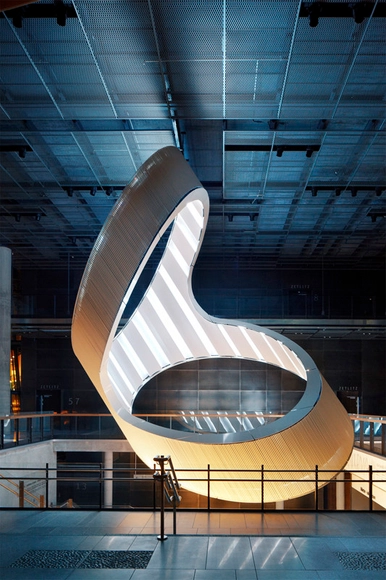
INABA has completed Skylight, a permanent installation for KORO Public Art Norway. The 6.6 m (22 ft) diameter, 11.5 m (38 ft) long structure hangs from the foyer of the New Concert Hall in Stavanger, Norway. It is visible from the adjacent public plaza, and surrounding neighborhood and harbor, serving as a light beacon for the complex.
Responding to the region’s extreme atmospheric conditions, Skylight emits a range of pure color light patterns that contrast and complement the blended luminous tones of the dawn and twilight Nordic sky. Conceived of as an inverted chandelier, Skylight’s light fixtures are mounted to face inward and illuminate the structure’s interior surface. Its programmable LED system is animated to change in brightness and hue, and produce distinct patterns during arrival, theater calls, intermission, departure, and after hours.
Video, images and more information on Skylight after the break.
FXFOWLE Architects shared with us their custom-design for the inaugural Miami Project art fair. Their installation, known as the ‘FXFOWLE Lounge’, features a free-standing architectural pavilion housed within a well-appointed lounge and bar area. The pavilion – which pairs technologically-sophisticated scripting software with simple museum board – comprises 180 varying segments that, together, take the form of complex structural geometries. More images and architects’ description after the break.
Building on a previous piece entitled “Suspension Bridge, the passage”, Olivier Grossetête’s ‘Pont de Singe’ in the UK is a model of floating bridge attached to helium balloons, thus taking literally the term “suspension bridge “. The object aims to connect two mobile spaces, questioning its usefulness. This bridge becomes a floating symbol of all relationships, and embodies the space surrounding its slight movements caused by our air movement. More images and architects’ description after the break.
Rain Room is an art installation by rAndom presented at the Barbican in London composed of a hundred square metre field of falling water through which it is possible to walk, trusting that a path can be navigated, without being drenched in the process. As you progress through The Curve, the sound of water and a suggestion of moisture fill the air, before you are confronted by this carefully choreographed downpour that responds to your movements and presence. The installation was made possible through the generous support of the Maxine and Stuart Frankel Foundation for Art. The video was done by Gramafilm, with music by Max Richter. More images can be viewed after the break.
Originating from the ‘pure plate’ structure occurring in natural structures such as sea urchins, and based on a hexagonal geometry, the Spaceplates Greenhouse is being used for the first time this term by horticultural staff and students at City of Bristol College’s South Bristol Skills Academy in Hengrove Park, Bristol. Designed by N55, with Architect, Anne Romme, the project is constructed using an innovative building system based on aluminum and polycarbonate and accommodates work, growing and teaching space. More images and architects’ description after the break.
The HARDWARE SOFTCORE Installation, designed by Gabriele Falconi, is directed to the interaction of the viewer, to his involvement, even physical, as an actor aware of choices and paths. Of monumental size, its modular installation was born from the idea of using the standard scaffolding system, which is made of shiny galvanized steel, repeating and assembling in vertical and horizontal direction.“The use of construction element, the simplest, declined to unusual, different, ambiguous shapes. For a skeleton of a large lizard, a cathedral with many naves, an interstellar starship. All that is involved here is multiple and transforms itself, starting from temporary basis to monumental forms, contradicting its premises. And finding its attractive side in construction hardware.” – Falconi. More images and architects’ description after the break.
Established in June 2010, 100Landschaftsarchitektur shared with us the current status of Jardin de la Connaissance which is still up and thriving. With the knowledge truly disappearing into the forest, the book structures have decayed in the natural setting, but have also provided various micro-environments for a range of local creatures. Interacting with the forest, seedlings and insects have activated the walls, carpets and benches while mushrooms – those cultivated and those who have come by themselves – have made the garden their home. More images and architects’ description after the break.
Anupama Kundoo‘s Wall House, originally built in Auroville, India in 2000, will be partially reconstructed at a 1:1 scale at the Venice Biennale this year for the theme of “Common Ground” by director David Chipperfield. This portion of the exhibition is supported by the University of Queensland, whose students and staff will assist with the construction of the replica alongside Indian craftspeople and Italian builders. The house has been described as a testing ground for spatial and technological innovation. In its debut at the Venice Biennale, it will afford Kundoo the opportunity to further explore these experiments.
Follow us after the break to see the innovations behind this widely acknowledged piece of architecture.
Among the rushed atmosphere of the Singapore Changi Airport, ART+COM has created an installation in which brings all the commotion to a halt. Located in the departure check-in hall of Terminal 1, “Kinetic Rain” is composed of 608 lightweight aluminum rain droplets, coated in copper, that are suspended from thin steel ropes on two opposing escalators. Each droplet seemingly floats into its precise location during a 15-minute, computationally designed choreography where the two parts move together in unison. The entire installation spans a total area of more than 75 square meters and spreads over 7.3 meters in height.
Designed by OH.NO.SUMO, the ‘Stairway Cinema’ installation experiments with architecture and the way it can engage with the public in unique and exciting ways. This project takes inspiration from the site and its inhabitants. Located at the busy pedestrian intersection of two inner city streets in Auckland, New Zealand, the installation offers a very simple programmatic response to recognize and counter the issue of how a community must be linked not only virtually but also physically. More images and architects’ description after the break.
The idea of the Quattro Punti per una Torre installation, designed by Massimo Iosa Ghini for FMG Fabbrica Marmi e Graniti, is to use the primordial monolith, the whole massive block of stone material. In collaboration with Iguzzini, Tecnovision, and Faraonea, the project at the University of Milan represents produced architecture and sculptures from time immemorial, repeated through the use of the large-sized ceramic slab with a finish that draws inspiration from the quarry stone. More images and architects’ description after the break.
Stefan Tuchila, an architecture photographer based in Bucarest/Paris shared with us a set of images of the latest Monumenta exhibition in Paris. After the amazing installation by Anish Kapoor last year, it was Daniel Buren‘s time to take this challenge and create a concept for the 2012 edition.
The first stage in the Augmented Structures project by Salon2 is the Augmented Structures v1.1: Acoustic Formations / İstiklâl Caddesi installation which reanimates phenomena (architecture, sound and visual arts) that appear to be completed and concluded. The acoustic memory of İstiklâl Caddesi is first transformed into an architectural surface and then this solid form becomes a dynamic visual performance through a 400m2 installation on the facade of Yapı Kredi Bank Culture Building. More images and architects’ description after the break.


.jpg?1414498661)