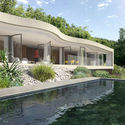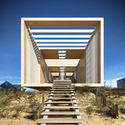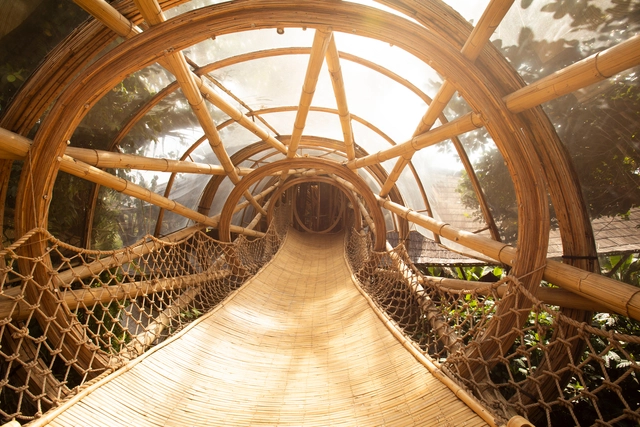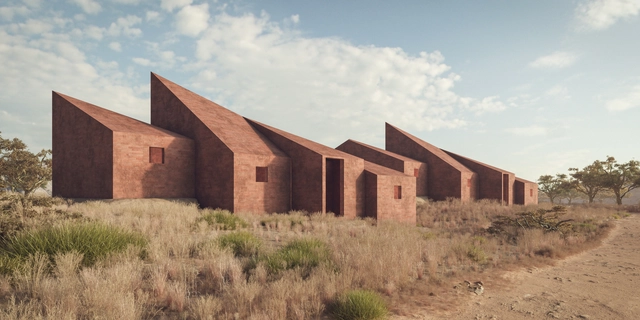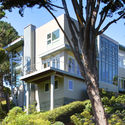
In this week's piece by Metropolis, author Kelly Beamon explores in her original article "the patriotism associated with pitched roofs and shares how architects are reimagining this staple of suburban house styles". According to its definition, a gable roof is a classic roof shape, usually in cold or temperate climates, consisting of two roof sections sloping in opposite directions and placed such that the highest, horizontal edges meet to form the roof ridge. Emblematic of the US, this article discusses its return to the urban fabric.
Ancient builders had deep knowledge about environmental conditions and the physical needs of humans in their search for shelter. Regardless of technological advances and the evolution of our perception of the world around us, this kind of knowledge and relationship with our surroundings can still be applied today and adapted to our current context. Natural stone, when used in architecture shows just that, as we explore its many different styles and applications.
José Adrião. Douradores Apartments Lisbon | 2013–2020. Photo by Nuno Almendra, 2020
"The house is among the first concepts shared by society and architecture", states André Tavares and Pippo Ciorra, curators of the exhibition called At Home: Projects for Contemporary Housing, on display at Garagem Sul / Centro Cultural Belém, in Lisbon. The show, which is the unfolding of another one previously held at the MAXXI Museum in Rome, gathers pieces from the huge collection of the Italian institution and seeks intersections with contemporary Portuguese architectural production. Its main topic – the house, the home – has never been more discussed than right now.
Bringing together houses of different scales, built in diverse locations by various methods and techniques, and designed by Italian, Portuguese and international architects, the exhibition gathers, in groups of three, projects from which it is possible to weave relationships that go beyond geographies and materialities and foster reflections about the future of housing and what the home of tomorrow will look like.
We had the opportunity to talk with Tavares and Ciorra about the exhibition, its motivations and expectations with its opening in the physical venue of Garagem Sul. Read below.
Focusing on the different typologies of houses, this week’s curated selection of Best Unbuilt Architecture highlights conceptual projects submitted by the ArchDaily Community. From urban developments to tiny homes, this article explores the topic of residential architecture and presents approaches from all over the world.
Featuring a cabin amidst the verdant forested region of northern Iran, a development in Georgia that offers an 80% recreational space to 20% housing ratio, and a project in Paris that re-questions our urban reality, and rethinks traditional forms of housing, this roundup tackles a multitude of scales. In addition, it underlines a collection of beach houses in Greece, Italy, Argentina, and Latvia each responding to a different landscape and topography. Other ideas underlined include the renovation of existing developments in Moscow, a residential-led transformation of a former factory in Manchester, and a family of blocks grouped around an elevated communal garden in the Netherlands.
In architecture, split-level houses are typically in response to a plot's uneven or sloping topography. In the case of the houses featured here, their split level interiors are a matter of function, allowing spaces to be virtually separated by dividing them between raised and semi-subterranean floor layouts. For example, adjoining two spaces with a 50cm step up or drop off allows for separation without the use of walls or other physical barriers.
Going out twice per month, our curated selection of Best Unbuilt Architecture submitted by our readers highlights inventive conceptual approaches and designs. Showcasing projects from all over the world, this article puts together several programs, from houses to master plans. Moreover, it presents winning proposals from international competitions, buildings in progress, and creative concepts.
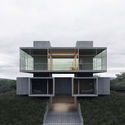
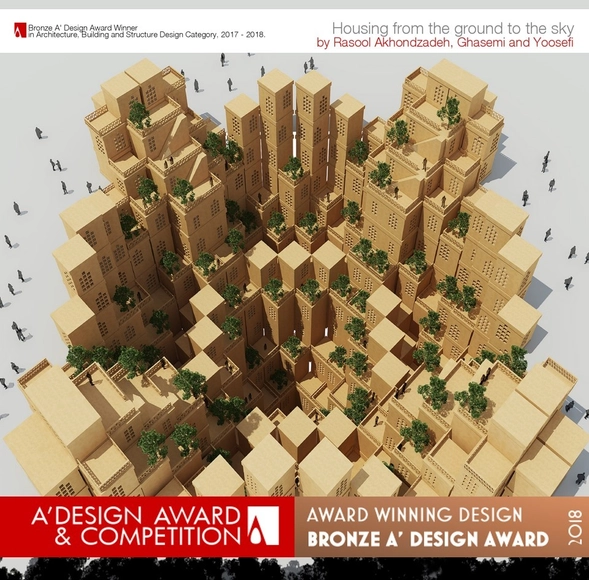
In the housing category, the roundup features an underground bunker-like house plan in Ukraine, a suspended glass structure cabin in Portugal, a complex of residential units in France, and a site-less, style-inclusive reinterpretation of the vertical housing block. In addition, a playful commercial building in Iran, a WWI memorial in Serbia, and an extension for the Glasgow School of Art join the selection, with their imaginative architecture and out of the box ideas.
ARC House. Image Courtesy of M.E architecture studio
Houses and Villas are the most researched topics on ArchDaily. Putting together a curated selection of conceptual interventions, this week’s Best Unbuilt Architecture focuses on the residential sector. From all over the world, this group presents proposals submitted by our readers.
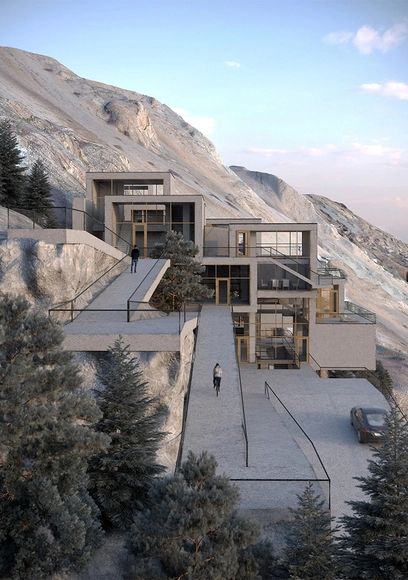
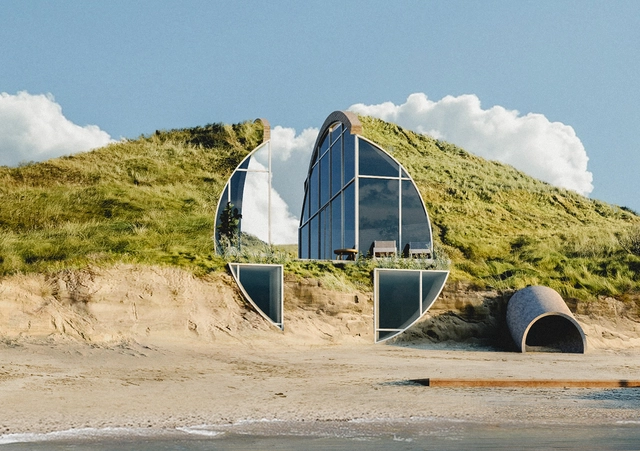
This article highlights a floating terraces project from India, a lodge in Ethiopia, a seasonal home for an Iranian family in Germany, and a residential compound in Saudi Arabia. Beach houses in Greece, Croatia, and the U.S. are also featured, showcasing different approaches for the same program. Moreover, more futuristic interventions include the Mountain House on the rocky cliffs of British Columbia, and the blue house, an aquarium-like type of home.
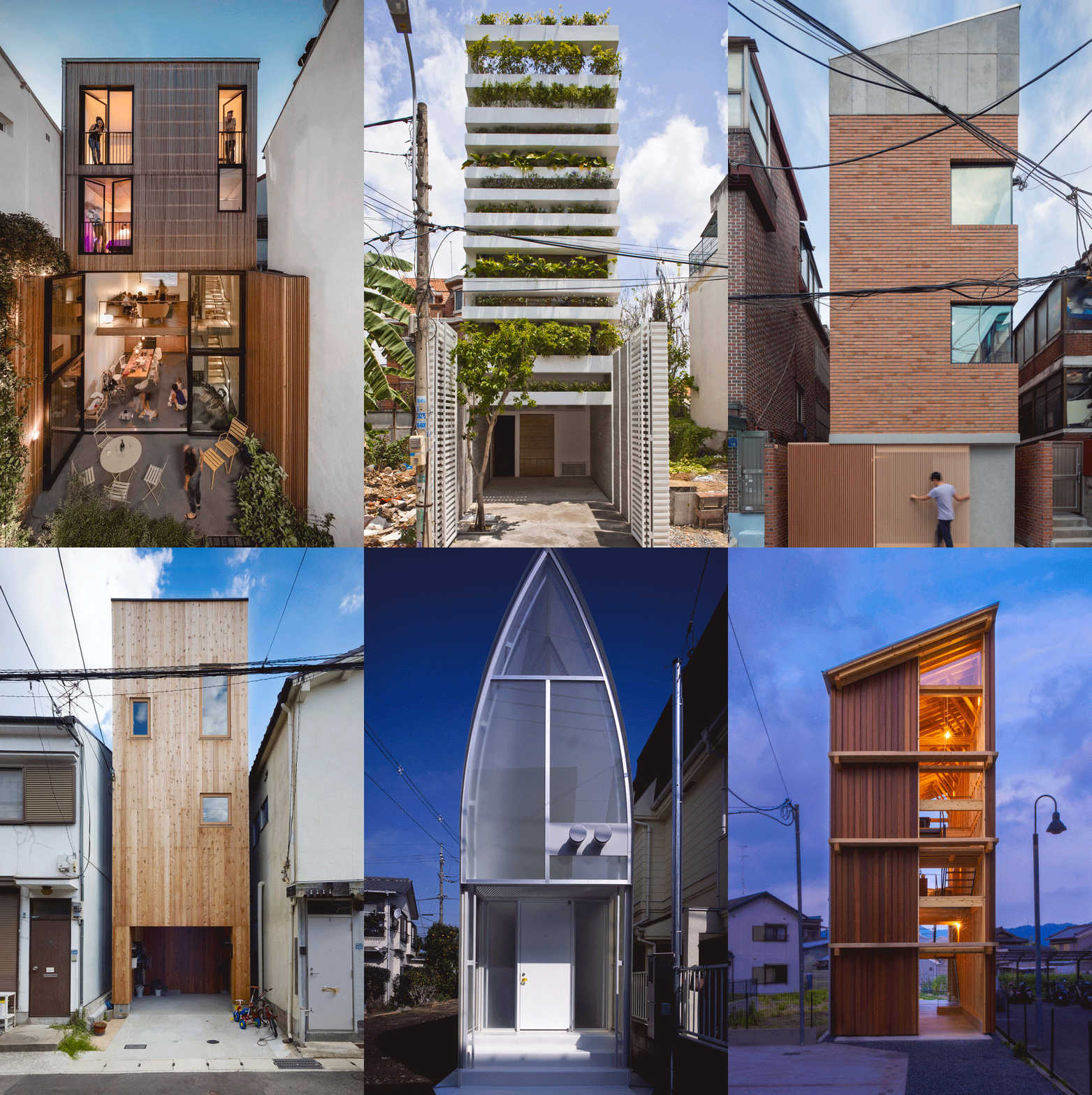
In all cities around the world, there are some forms of residual space, forgotten pieces of the urban fabric, remnants of overlapping layers of past development. This land whose conditions make it unsuitable for most types of conventional construction might be a fertile ground for architectural invention. Assigning a new value to vacant corner lots, dead-end alleys and strangely shaped plots opens up a new field of opportunities for inward urban development, expanding available living space and increasing amenities in densely populated cities. The following explores the potential for experiment and urban activation held by urban leftover space.
We've recently passed the halfway point of 2020, and to date, we've published hundreds of residential projects featuring distinct ways of living on ArchDaily. In a year marked by the worst health crisis that humanity has experienced in the last century, the Covid-19 pandemic, the house has gained new meanings and values, reiterating that no matter how diverse its program, a home's purpose is to shelter its inhabitants.
This week’s curated selection of best unbuilt architecture features conceptual residential projects submitted by our readers from all around the world. Highlighting innovative designs, approaches, and compositions, this roundup puts together a series of inspiring interventions that offer a fresh look on the typical house structure.
In the following article, ArchDaily has gathered ideas from Poland, France, Hungary, Iran, and the United States. Grouped under one common theme, the feature includes a new take on the typical building complex, an attempt to shorten the transitional gap between a house and an apartment, and a collection of modular residential models that can be implemented anywhere. Moreover, it also showcases Christophe Benichou’s latest intervention, “The Pleated House” located in the Hautes Alpes in France, a hyper-sustainable house on the beach and a structure completely erased and integrated into the natural landscape.
Brick is one of the most widely used materials in Colombia, making the architectural designs in its capital city, Bogotá, stand out worldwide. Due to the excellent quality of the clay found in some regions of the country, brick is used in all aspects of construction, from adobe floor slabs to exterior facades.
German design has become synonymous with accuracy, efficiency and precision. While the stereotype has roots in geography and local culture, the country's built environment reflects an affinity for structure, privacy and order. Combined with influences across Europe, Germany's contemporary architecture showcases refined forms and an emphasis on craft.
“Home” is a new documentary series created by Apple TV+ that takes viewers on a tour of some of the world’s most intriguing dwellings. The first season, spanning nine episodes, showcases how domestic architecture is being re-evaluated across different contexts and geographical areas, taking radical, innovative, and highly creative forms.
Gathering the best-unbuilt architecture from our readers' submissions, this curated collection features conventional, original and innovative functions. With projects from all over the world, this roundup is a conceptual discovery of different architectural approaches.
Art takes center stage in this week’s article with a different kind of museum for Burning Man, a futuristic art center in Slovakia, a museum dedicated to writing, and the Chinimachin Museum, inspired by the urban fabric of the city of Bayburt in Turkey. Moreover, the editorial showcases integrated houses, a redevelopment of a city block in London and mixed-use projects in Ukraine and Poland. New highlighted functions include a concrete lighthouse in Greece, a retirement complex in the Rocky Mountains of Lebanon, and a thermal hotel and spa in Cappadocia.
Marc Thorpe, New York-based architect and multidisciplinary studio, has designed the Dakar Houses for the workers of Moroso M’Afrique furniture collection. Located on the outskirts of the Senegalese capital in West Africa, the prototype houses are made from earth bricks.
“A House is a place (…) as physical as a set of feelings. (…) a home is a relation between materiality and mastery and imaginative processes, where the physical location and materiality and the feelings and ideas are united and influence each other, instead of being separated and distinct. (…) a house is a process of creation and comprehension of ways of living and belonging. A house is lived, as well as imagined. The meaning of house and the way it materially manifests itself, it´s something that is created and recreated in an unceasingly way through every day domestic tasks, which are themselves connected to the spacial imaginary of the house”1
The sentence above is the starting-point of the current reflection, in an exercise that will mark meaningfully my approach to the way of projecting houses.
Our home will always be the place for which we feel the deepest affection, no matter where we are. Home is our ‘little world’ where we dream of getting condensed after a hard day at work.’ Home is the place where we desire to be after a long vacation, to be able to feel the warmth of the walls surrounding us. Home is a very important link between a man and his idea of safety. It is the envelope that represents privacy, comfort and stability in our lives. It is that one