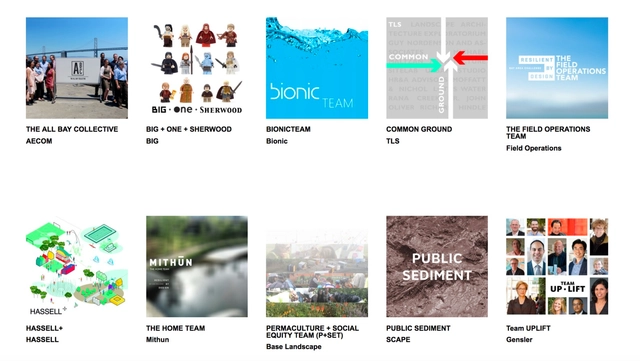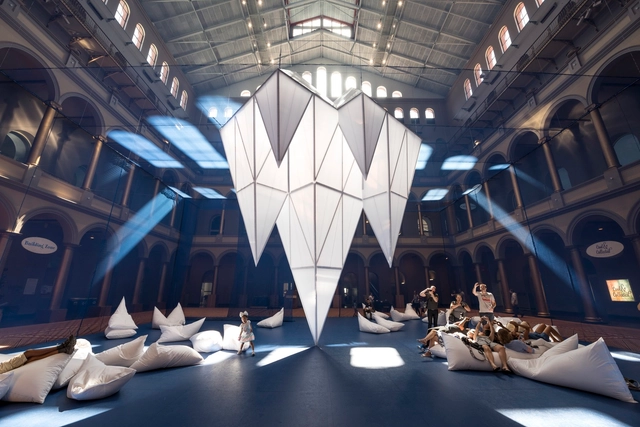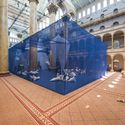
This year’s installment of the National Building Museum’s Summer Block Party Series, James Corner Field Operations’ ICEBERGS, is now open to the public. On display until September 5th, ICEBERGS takes the form of a shimmering, underwater world of glacial ice fields located in the museum’s expansive Great Hall to provide the public with an escape from the hot Washington, D.C. summer.
First International Conference on Urban Physics, Quito - Galápagos, 25 September - 2 October 2016
The First International Conference on Urban Physics aims to be a founding event for the numerical simulation of cities and megacities, which are facing worldwide critical problems, such as their dual participation - as victims and actors - to the present and upcoming climate changes. The conference will provide an opportunity for scientists from different disciplines (computer graphics, environmental physics, numerical models, renewable energies, urban planning ...) to confront their ideas and methods for the detection and analysis of physical quantities, in order to better manage the development of cities and
UNDERSTANDING PLACE showcases selections from a seven-year long rich investigation that capture the essence of Dhaka’s extreme wet-dry climate flux in a totally immersive atmospheric experience. Lit by an 8’ tall rear projection screen of audio-video captured footage, a narrated mind-map floor animation, an illuminated wall of colorful photographs, and LED monitor slide-shows of student projects, the visitor is invited to meander through four zones identifying the architectural design process: observation, data collection, analysis, and proposals.
Created by the Union International des Architects (UIA)in 2005, World Architecture Day is celebrated on the first Monday of October with the aim of reminding the world about the collective responsibility of architects in designing our future cities and settlements.
This year, the UIA has selected “Architecture, Building, Climate” as the theme of the day, seeking to highlight the essential role that architecture, design and urbanism have in the reduction of greenhouse gas emissions. With international climate treaty negotiations set to happen later this year, the “UIA members, working bodies and partners will mobilize on 5 October to promote actions and solutions that apply the enormous power of architecture and urban design in coping with global climate change, one of the greatest challenges of our time.”
Through small actions architects can collectively make a big difference and create significant changes. To celebrate World Architecture Day, we have rounded up a selection of projects that have taken steps towards the challenge of protecting our environment.
https://www.archdaily.com/774798/happy-world-architecture-dayAD Editorial Team
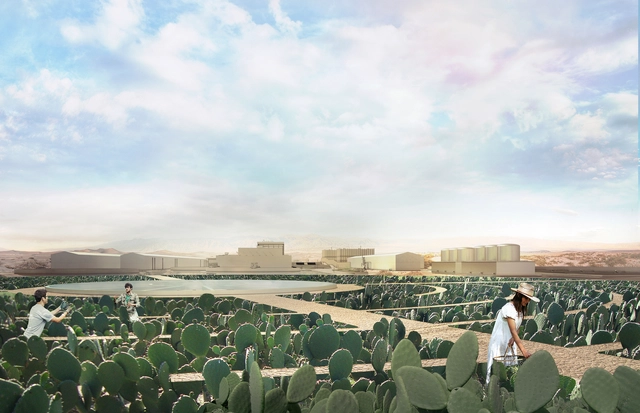
Although global warming may only be partially to blame for California’s now four-year, record-breaking drought – intensifying it by 15 to 20 percent, say scientists – the long term implications of the weather phenomenon are a preview of a drier future with less predictable weather patterns.[1] As ecology and architecture begin to share responsibility in the implications of climate change, future solutions will need to balance architectural needs with ecological imperatives. Many designers are accounting for water scarcity in schemes for the drought-stricken state, but only recently have ideas addressed this issue head-on. “Grassroots Cactivism,” an award-winning proposal by Ali Chen, suggests that the drought-tolerant nopales cactus, with a variety of uses, is an ideal candidate for aiding water-conservation in California.
Read on for more about this biological breakthrough in water conservation.
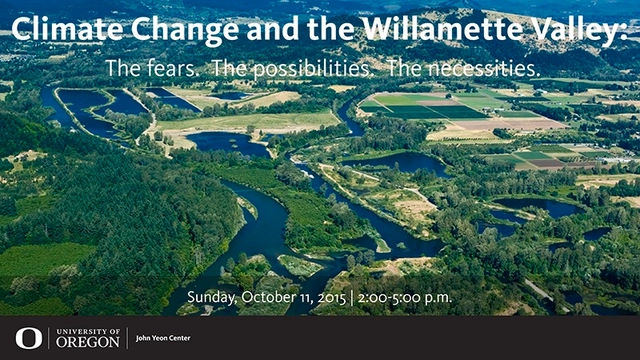
Farmland prices hitting new records, self-identified “climate refugees” fleeing the droughts in the southwest for verdant Oregon, rising water temperatures killing fish —the warming climate is already changing the Willamette Valley. Things will look very different here for farming, urban livability, and ecosystem health.
To ponder this rapidly evolving ecosystem, the John Yeon Center for Architecture and the Landscape will present four leading thinkers on the Willamette Valley and its future. What lies ahead for Oregon’s primary population center, breadbasket, garden, natural landscape, and playground? Moderated by Yeon Center director Randy Gragg, the conversation will explore the research that has been done, the successes and shortcomings of programs in place, what kinds of initiatives might be developed to shape a warmer, more populous valley to benefit its urban and rural populations, industries, and ecological health.
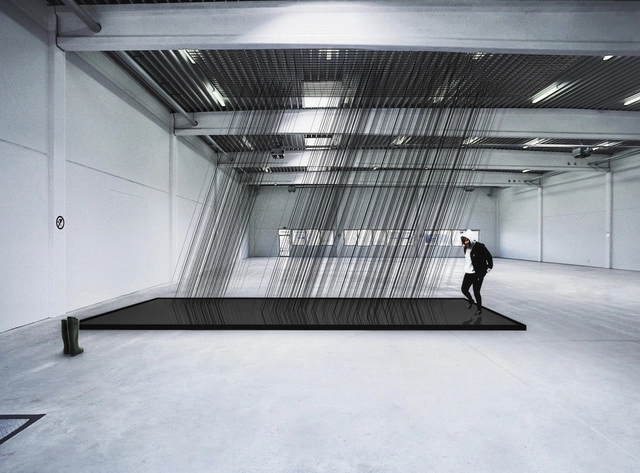
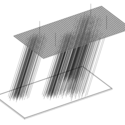
Architect Alban Guého's “Flood” installation for Paris' 2015 Nuit Blanche arts festival aims to serve as a stark reminder of climate change and the impact humanity has on the world. The 50-square-meter (538 square-foot) installation is composed of weaved filaments that connect the ceiling to the floor. A thick, dark liquid (either oil or black paint) will slowly flow down each string, trickling into a black pool. Flood seeks to address the theme of this year’s Nuit Blanche, which is to echo the issues stemming from COP21, Paris’ Sustainable Innovation Forum.
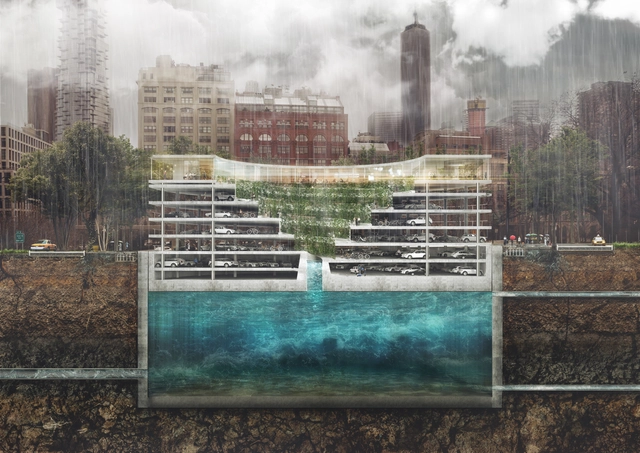
If you want to see the future of urban adaptation, head to the Maldives. That’s the message and warning behind Mayank Thammalla’s master's thesis from the Unitec School of Architecture in Auckland, New Zealand. Under even the most conservative IPCC forecasts, the low-lying Republic of Maldives will become almost uninhabitable as sea levels rise, while any further rise could leave many of the 200 inhabited islands underwater. It’s an existential threat like no other - in as little as ten year's time, the Maldivian government could be faced with the impossible situation of deciding how to deal with over 400,000 refugees leaving the area where their country used to be. Instead of attempting to rebuild the Maldives elsewhere or mount a series of defences against the oncoming sea, Thammalla’s research project has the difficult goal of realistically preserving Maldivian life in the same geographical location as it is now. His solution? Semi-submersible oil rigs.
Climate change, particularly rising sea levels, is expected to have a substantial impact in Miami, Florida over the next 100 years. Miami 2100: Envisioning a Resilient Second Century, an exhibition at the Coral Gables Museum, addresses this pressing issue, examining effective design solutions through the lens of architecture, landscape architecture, and urban planning. The exhibition of graduate student work from Florida International University uses the city's existing infrastructure and architecture as the groundwork for future adaptation and development. A panel discussion highlighting the topic will take place on Thursday, February 12, with architects from BIG, OMA and West 8. Learn more, after the break.
The Urban Implications of Living With Water, a recent report by the Urban Land Institute (ULI) Boston, opens with the clear assertion: "We are beginning to feel the effects of climate change." The result of a conversation amongst over seventy experts from the fields of architecture, engineering, public policy, real estate and more, the report covers the proposed integrated solutions for a future of living in a city that proactively meets the challenges accompanying rising water levels.
"We accept that the seas are rising, the weather is changing, and our communities are at risk; and we recognize that no solution can be all-encompassing. It is our hope that this report will spark conversation, shift our understanding of what is possible, and aid us in reframing challenges into opportunities as we move toward this new era of development."
Become part of the discussion and read more about the collective ideas, after the break.
At the New Cities Summit – held last year in São Paulo – we caught up with Eric Bunge of New York-based practice nArchitects outside of Oscar Niemeyer’s Ibirapuera auditorium. The summit’s theme was centered on the future of cities and Bunge was presenting his firm’s My Micro NY project, which was the winning design of former New York City mayor Michael Bloomberg’s adAPT NYC competition. “We’re kind of influenced by New York itself as a microcosm. Our project looks a little bit like a microcosm of the skyline. We’re interested in this idea of re-inventing what micro is and how much of New York you can inhabit,” Bunge said regarding the project.
According to Bunge, housing is based on regulation and therefore one of the most constrained things to design. “I think we can reinvent housing,” he told us.
Watch the full interview to learn more about Bunge's thoughts on reinventing housing, the inspiration behind his My Micro NY project and how he strives to address climate change in his projects.
Joe Paxton of the Bartlett School of Architecture, University College London, was awarded the 2014 RIBA Norman Foster Travelling Scholarship for his proposal “Buffer Landscapes 2060.” The £6,000 travel grant will enable him to study the impact of climate change in a number of locations, ultimately to propose some measures that might mitigate the threat of floods, droughts, melting glaciers and rising temperatures. A comment from Foster, after the break...
Former New York mayor Michael Bloomberg has been appointed to be the U.N. special envoy for cities and climate change. Upon receiving the news, Bloomberg tweeted: "Cities are taking measurable action to reduce emissions, emerging as leaders in the battle against climate change... I look forward to working with cities around the world and the UN to accelerate progress [to combat global warming].” You can read more here on USNews.
The challenges of sea-level rise cross boundaries of all sorts: geographic, political, social, economic. Proposed mitigation strategies will also necessarily shift and overlap. Here, we present five case studies from across the globe that offer intriguing ways—some operational, some philosophical—to address the threats associated with climate change. Drawing on a research initiative focused on vulnerabilities in Boston, a team at Sasaki Associates developed these additional design-strategy icons to illustrate the layered approaches. They are adaptable, the better to meet the unique demands of each coastal community.
This four part series (originally published on Aggregate’s website) examines the Gherkin, the London office tower designed by Foster + Partners, showing how the urban icon engaged and leveraged perceptions of risk. In part one, author Jonathan Massey introduced the concept of "risk design” to describe how the Gherkin’s design managed the risks posed by climate change, terrorism, and globalization. In parts two and three, Massey examined the building’s treatment of risks associated with climate change and terrorism. In this final installment, Massey concludes by addressing the building’s engagement with risks posed to the City of London by globalization.
Unlike New York and other cities in which zoning codes entitle landowners to some kinds of development “as of right,” the City of London regulates property development through case-by-case review by planning officers, who judge how well the proposed construction conforms to City-wide plans and guidelines regarding factors such as building height, development density, access to transit, and impact on views and the visual character of the area. In order to develop the Gherkin, the property owners and Swiss Re had to secure planning consent from the City Corporation through its chief planning officer, Peter Wynne Rees. The review and permitting process that culminated in the granting of planning consent in August 2000 spanned the planning office as well as the market, the courts, and the press. Rees brokered a multilateral negotiation so intensive that we could almost say the building was designed by bureaucracy. Part of that negotiation entailed imagining and staging risk: climate risk, terrorism risk, and, especially, the financial risks associated with globalization.
This four part series (originally published on Aggregate’s website) examines the Gherkin, the London office tower designed by Foster + Partners, showing how the urban icon engaged and leveraged perceptions of risk. In part one, author Jonathan Massey introduced the concept of "risk design” to describe how the Gherkin’s design managed the risks posed by climate change, terrorism, and globalization. In part two, Massey examined the building’s treatment of climate risk. In part three, below, he explains how the Gherkin redesigned the risk imaginary associated with terrorism.
Mornings the Zamboni scrubs the plaza. Moving across the pavement in parallel lines connected by tight turns, the sweeper cleans the stone of cigarette butts and spilled food and beer left the night before by the underwriters and bankers who patronize the bar and shops in the building’s perimeter arcade as well as the adjacent restaurant that in fair weather sets up outdoor tables and chairs.
By pulling away from its irregular property lines, the tower achieves almost perfect formal autonomy from its context. The gap between the circular tower base and trapezoidal site boundaries forms a privately owned public space, a civic and commercial amenity in this densely built part of the City.
This four part series (originally published on Aggregate’s website) examines The Gherkin, the London office tower designed by Foster + Partners, showing how the urban icon engaged and leveraged perceptions of risk. In part one, author Jonathan Massey introduced the concept of "risk design” to describe how the Gherkin’s design managed the risks posed by climate change, terrorism, and globalization. In part two, below, Massey examines the Gherkin’s enclosure and ventilation systems in detail to explain how the building negotiated climate risk.
In a poster promoting London’s bid to host the Olympic Games, the Gherkin supported gymnast Ben Brown as he vaulted over the building’s conical peak. The image associated British athleticism and architecture as complementary manifestations of daring and skill, enlisting the Gherkin as evidence that London possessed the expertise and panache to handle the risk involved in hosting an Olympic Games.
But a poster created three years later offered a very different image. Created by activists from the Camp for Climate Action to publicize a mass protest at Heathrow Airport against the environmental degradation caused by air travel, this poster shows the Gherkin affording only precarious footing to a giant polar bear that swats at passing jets as its claws grasp at the slight relief offered by spiraling mullions and fins.
How does design change the nature and distribution of risk? In this, the first of four installments examining the Gherkin, the London office tower and urban icon designed by Foster + Partners, author Jonathan Massey introduces the concept of “risk design.” The series, originally published on Aggregate's website, explains how the Gherkin leveraged perceptions of risk to generate profits, promote economic growth, and raise the currency of design expertise.
Designing Risk
Back the Bid. Leap for London. Make Britain Proud. Emblazoned across photomontages of oversized athletes jumping over, diving off, and shooting for architectural landmarks old and new, these slogans appeared in 2004 on posters encouraging Londoners to support the city’s bid to host the 2012 Olympic Games. Featured twice in the series of six posters—along with Buckingham Palace, Nelson’s Column, the Tower Bridge, the London Eye, and the Thames Barrier—was 30 St Mary Axe, the office tower known colloquially as the Gherkin for its resemblance to a pickle, or as the Swiss Re building, after the Zurich-based reinsurance company that commissioned the building and remains its major tenant.