Habitat: Vernacular Architecture for a Changing Planet
Climate change is the biggest challenge facing our planet. There has never been a more important time to understand how to make the best use of local natural resources and to produce buildings that connect to ecosystems and livelihoods and do not rely on stripping the environment or transporting materials across the globe.
The culmination of years of specialist research, Habitat: Vernacular Architecture for a Changing Planet, a once-in-a-generation large format publication, gathers together an international team of more than one hundred leading experts across a diverse range of disciplines to examine what the traditions of vernacular architecture and its
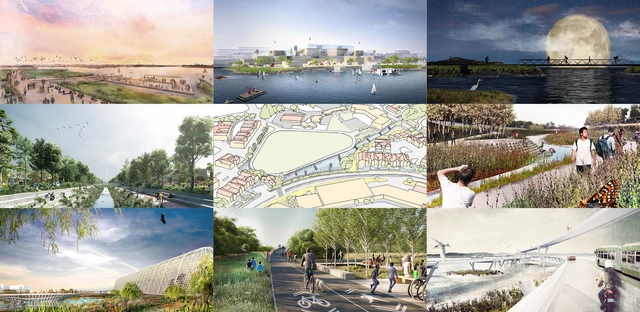
One year after the launch of Resilient by Design's Bay Area Challenge, led by TLS Landscape has presented the final nine design concepts. The Bay Area Challenge launched with a call to action to "bring together local residents, community organizations, public officials and local, national, and international experts to develop innovative solutions that will strengthen our region's resilience to sea level rise, severe storms, flooding, and earthquakes." The idea formulated as a “blueprint for resilience” that can be replicated and utilized locally and globally. Other urban challenges will also be addressed, including housing, transport, health and economic disparity as a means of not just protecting the current regions, but strengthening them.
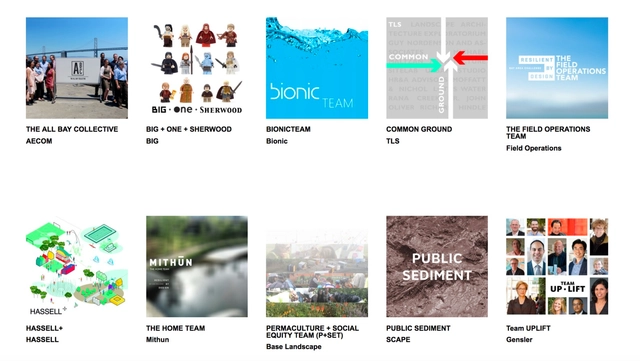
The elite, collaborative teams include world-renowned designers like BIG, Mithun and HASSELL+.
Read on for more about each of the final design concepts.
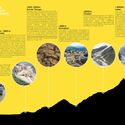
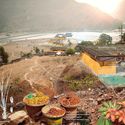
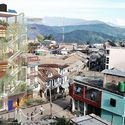
KTK-BELT Studio, a not-for-profit organization based in rural Nepal, is currently working with local communities to create a fascinating "Vertical University," which will teach students about biodiversity and environmental conservation in 6 "living classrooms" positioned along a vertical forest corridor that stretches from 67 meters above sea level to the top of an 8,856-meter peak. These 6 stops encapsulate the 5 climatic zones of Eastern Nepal: tropical, subtropical, temperate, subarctic and arctic.
The project explores the specific impacts of climate change in each climatic zone, creating “classrooms” where students can walk from Koshi Tappu to Mt. Kanchenjunga, the third tallest peak in the world, and learn onsite from indigenous farmers about the biological diversity of each area. By teaching place-based skills in these micro-conservation hubs, the project aims to conserve and activate local knowledge. Each of these “classrooms” responds to the visual and cultural cues of its unique landscape, with one campus focusing on a flood-proof design in a heavy monsoon area, and another mimicking the semi-nomadic lifestyle of local yak-herders.
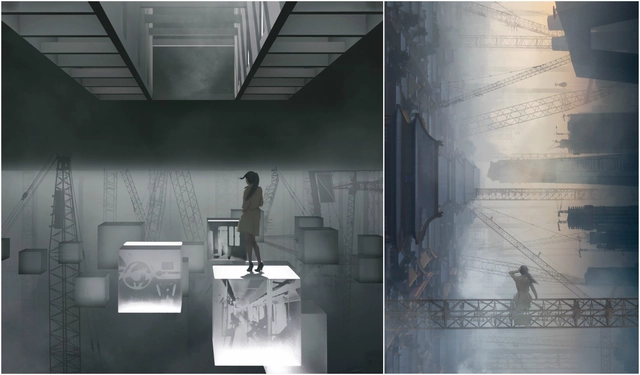
1st Place: Deep Pool That Never Dries. Image Courtesy of Blank Space
Blank Space, in collaboration with The National Building Museum, has announced winners of their fifth annual Fairy Tales competition, unveiled in front of a live audience at the Washington D.C. National Building Museum. The competition saw submissions from 65 countries, with 3 prize winners, a runner-up, and 9 honorable mentions chosen for their exploration of current events and the creative process through well-crafted short stories and artwork. The winners were chosen by a jury of 20 leading architects, including Daniel Libeskind, Bjarke Ingels, and Maria Aiolova.
https://www.archdaily.com/891849/a-tale-of-misplaced-trust-in-news-media-wins-2018-fairy-tales-competitionNiall Patrick Walsh
Following recent natural disasters including the Northern California wildfires, the HASSELL + team have been inspired to reimagine the San Francisco Bay Area as a vibrant community hub, equipped to provide temporary facilities in an emergency. As part of the competition Resilient by Design, the ten teams were asked to provide solutions for the waterfront through site-specific conceptual design and collaborative research projects.
An integral and substantial component of TAW 2018, the International Scientific Conference aims at exploring contemporary research activities and design tactics that deal with the topic of co-habitation from different perspectives and within different fields of interest, directly or indirectly related to architecture, city, and landscape. Through the observation of different tactics adopted by researchers and professionals, the hope is to identify new research and design trajectories.
The International Scientific Conference aims at exploring contemporary research activities and design tactics that deal with the topic of co-habitation from different perspectives and within different fields of interest, directly or indirectly related to architecture, city, and landscape.
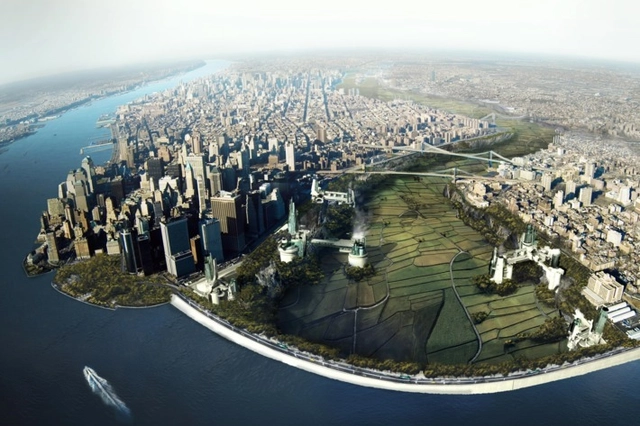
New York Magazine asked some of New York City’s distinguished architects how they would improve the city and save it from climate change. NY Mag reported on their findings.
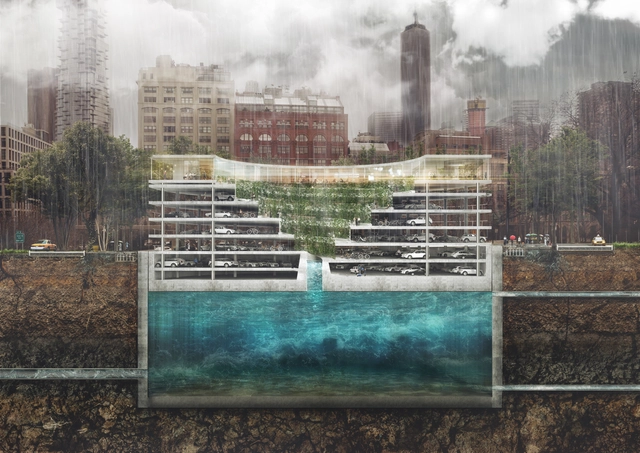
As Earth’s population continues to grow, so does car traffic and issues related to climate change. It has been estimated about 30% of urban roadway congestion are drivers searching for a place to park. Car culture puts the pressure on cities to build more parking garages, which usually win out over green parks. Meanwhile, climate change continues to challenge cities to handle a great deal of stormwater. The 2017 Atlantic hurricane season is proof of this - as of Monday, 13 named storms have formed in the Atlantic ocean, costing 210 lives and counting.
THIRD NATURE, a Danish architecture firm, designed a solution for the modern-day urban issues of flooding, parking and lacking green spaces with their project, POP-UP. A stacked green space, car park, and water reservoir, from top to bottom respectively, POP-UP uses Archimedes’ principle to store water and create floating space to store cars.
From a pool of over fifty submissions, Resilient by Design have chosen ten winning teams to collaborate with engineers, climate change experts, designers, architects and community members to imagine a better future for The Bay Area in the face of potentially devastating climate change. The winning teams AECOM, BIG, Bionic, TLS, Field Operations, HASSELL, Mithun, Base Landscape, SCAPE and Gensler will spend the next year on a combination of collaborative research projects and site-specific conceptual design solutions.
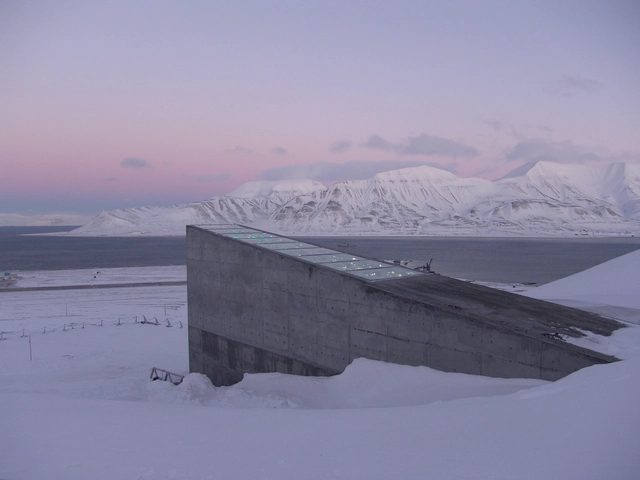
Located 130 meters inside a mountain in the Arctic Svalbard archipelago, the vault was constructed as part of a worldwide initiative to protect global biodiversity by preserving the seeds of the world’s important food crops. The structure, which cost $9 million USD to build, was intended to be buried deep into the permafrost to protect against both natural and manmade disasters, but this year’s incident uncovered several design flaws that allowed water to breach the vault’s access tunnel.
James Hansen, professor of Earth and Environmental Sciences at Columbia University, former NASA scientist, and the planet’s preeminent climatologist, was among the first to sound the alarm on climate change during his 1988 testimony before Congress. Since then, he has continued to shine a light on the problem through lectures, interviews, TED talks, and his blog. He has warned that a mere 2-degree increase in temperature could result in a sea level rise of five to nine meters by the end of the century, flooding coastal cities and rendering them uninhabitable.
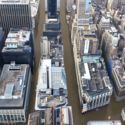
Inspired by Hansen, filmmakers Menilmonde have imagined Manhattan underwater. The French duo's previous videos experiment with subtle subversions of the world we experience, and their latest creation, 2°C New York City, is arguably their most powerful to date.
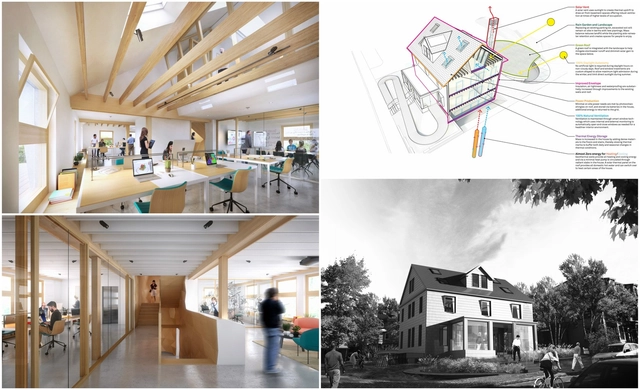
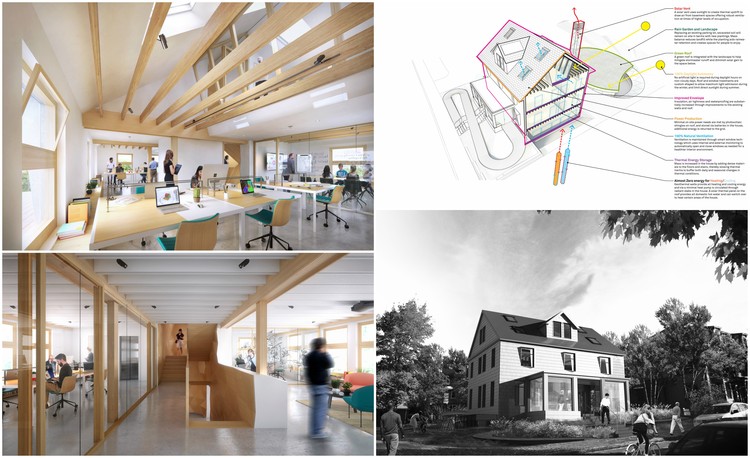
ZeroHouse aims to set a new benchmark for sustainable retrofitting. Image Courtesy of Snøhetta/Plompmozes
As part of a global, interdisciplinary effort to tackle climate change, architects are devoting resources towards optimizing the energy efficiency of buildings old and new. This effort is more than justified, given that buildings account for almost 40% of UK and US emissions. Although sustainability is now a hallmark of many new architectural schemes, the energy inefficiency of structures from the 18th and 19th centuries still contribute to global carbon emissions on a vast scale.
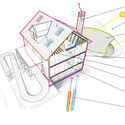
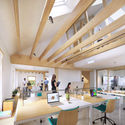
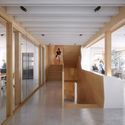
In order to address the challenge of intelligently retrofitting existing buildings, the Harvard Center for Green Buildings (CGBC) at the Harvard University Graduate School of Design, in collaboration with Snøhetta and Skanska Technology, are retrofitting the CGBC’s headquarters in a pre-1940s timber-framed building, aiming to create one of the world’s most ambitious sustainable buildings. HouseZero is driven by uncompromising performance targets, such as 100% natural ventilation, 100% daylight autonomy, and almost zero energy required for heating and cooling. The result will be a prototype for ultra-efficiency, reducing reliance on energy-intensive technology whilst creating a comfortable indoor environment.
https://www.archdaily.com/872073/harvard-housezero-a-retrofit-response-to-climate-changeNiall Patrick Walsh
Earlier this year, the Global Seed Vault in Svalbard was flooded after record high temperatures over the winter caused some of the permafrost surrounding the vault to melt, reports The Guardian. The building's entrance tunnel was flooded and then froze to create conditions "like a glacier" for those trying to enter. Fortunately, the vault itself was not breached, meaning no harm came to the building's precious contents. However, the incident has raised questions about whether the building will be able to fulfill its purpose in the long term.
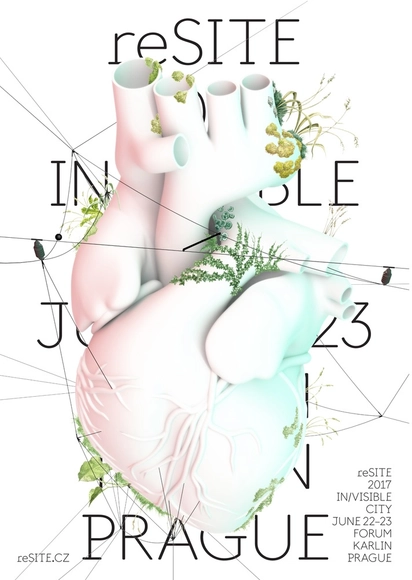
reSITE brings the 6th annual architecture and urbanism event, reSITE 2017: In/visible City, back to Prague at the Ricardo Bofill-designed Forum Karlin.
How does invisible infrastructure shape the visible aspects of a city?
40 international thought leaders will discuss the intersections of design and infrastructure and the presence of these vital systems in the architecture and landscape of cities.
Professor Alan Short of the University of Cambridge has published a book advocating for the revival of 19th-century architectural ideas to address the crippling energy use of modern skyscrapers. The Recovery of Natural Environments in Architecture proposes an end to the architectural fetish for glass, steel, and air conditioning, instead drawing inspiration from forgotten techniques in naturally ventilated buildings of the 1800s. The book is a culmination of 30 years’ research and design by Prof. Short and his colleagues at the University of Cambridge.
https://www.archdaily.com/866864/new-book-calls-for-an-end-to-our-fetish-for-conditioned-skyscrapersNiall Patrick Walsh
Update: Unfortunately this free online viewing was only intended for a limited time and National Geographic has now removed the video. If you didn't catch the documentary in time, you can still watch it on DVD. In place of the full documentary, we have now included the trailer above.
As a group, architects are without question among the most enthusiastic supporters of sustainable initiatives around. It should therefore be welcome news to many architects that National Geographic has released its latest documentary on climate change, Before the Flood, for free on Youtube, Facebook, Twitter—pretty much everywhere.
Presented by Hollywood superstar and recently-appointed UN Climate Ambassador Leonardo DiCaprio, the documentary is perhaps the most ambitious film about climate change since Al Gore's 2006 An Inconvenient Truth. Throughout the course of the 90-minute film, DiCaprio travels the globe to see the damage wrought by the early signs of irreversible climate change, from melting glaciers, to dying coral reefs, to flooding cities. Speaking to world leaders including Barack Obama and The Pope, as well as a whole host of climate scientists, DiCaprio's aim is not so much to convince viewers of the existence of climate change, as with An Inconvenient Truth, but instead to investigate just how far down the wrong path we've traveled, and whether there is any hope for humanity to save itself.
This book is a collection of essays at the intersection of architecture and climate change. Neither a collective lament nor an inventory of architectural responses, the essays consider cultural values ascribed to climate and ask how climate reflects our conception of what architecture is and does.
Which materials and conceptual infrastructures render climate legible, knowable, and actionable, and what are their spatial implications? How do these interrelated questions offer new vantage points on the architectural ramifications of climate change at the interface of resiliency, sustainability, and eco-technology?





















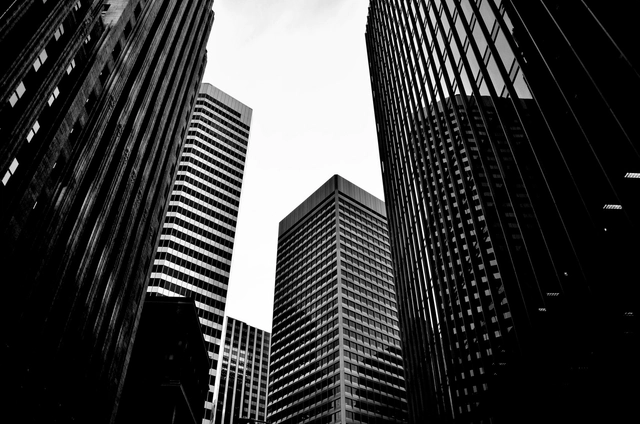

_Paolo_Rosselli_DSC_8101.jpg?1489090441 "Professor Short argues that skyscraper design must depart from its current reliance on glass and steel, and begin to harness natural ventilation. Boeri Studio's Bosco Verticale. Image Courtesy of Paolo Rosselli")