Windshape / nArchitects

Uploaded by — Filed under: Art ,Selected ,Structures , , , ,
 

Architect: nArchitects
Location: Lacoste, France
Project Completion Year: July 2006
Design Team: Eric Bunge, Mimi Hoang (Partners); Daniela Zimmer (Project Architect), Kazuya Katagiri, Takuya Shinoda, Shuji Suzumori / Fabrication by nARCHITECTS and SCAD (Jim Bischoff, Michael Gunter, Cindy Hartness, Michael Porten, Ryan Townsend, Troy Wandzel, with Natalie Bray and Sarah Walko)
Client: Savannah College of Art and Design (SCAD)
Program: Ephemeral pavilions
Photographs: Daniela Zimmer & nArchitects


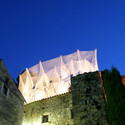
Windshape was an ephemeral structure commissioned by the Savannah College of Art & Design (SCAD) as a venue and gathering space near their Provence campus in Lacoste, France. Built by nARCHITECTS and a team of SCAD over a period of five weeks, Windshape became the small town’s main public meeting space, and hosted concerts, exhibitions, and ceremonies throughout the summer of 2006.

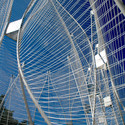
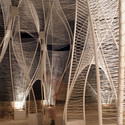
Windshape was conceived as two eight-meter-high pavilions that dynamically changed with the Provençale wind. A vine-like structural network of white plastic pipes, joined together and stretched apart by aluminum collars, emerged from the limestone walls and terraces of Lacoste’s hillside. Fifty kilometers of white polypropylene string was threaded through the lattice to create swaying enclosures. The string was woven into dense regions and surfaces and pinched to define doorways, windows, and spaces for seating.

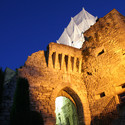
By varying the degree of tension in the string, nARCHITECTS built Windshape to respond to the wind in several ways, from rhythmic oscillations to fast ripples across its surfaces. During heavy winds, Windshape moved dramatically, and made a hissing sound akin to dozens of jumpropes. The pavilions took on a multitude of temporary forms over the course of the summer, as they billowed in and out, and momentarily came to rest. In this way, the local winds and the Mistral gave shape to constantly mutating structures. The pavilions were illuminated at night against the backdrop of the Marquis de Sade’s castle, and were visible from as far away as the village of Bonnieux, 5 kilometers away.

landscapes diagram

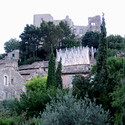
The pavilions’ design reflects a desire to remix the hard and soft landscapes of Provence in an innovative tectonic system. The village of Lacoste appears hewn out of limestone, its streets and network of terraces seemingly chiseled out as voids in the hillside. In contrast, the surrounding fields, vineyards, and lavender bushes form a luminous, soft, and changeable landscape. Windshape refers in its exterior form and angular geometry to the medieval townscape, while echoing the mutating, softer agricultural landscape in its internal experience and dynamic qualities.

Windshape was a laboratory that allowed us to test the idea of a building that can respond to natural stimuli. Rather than simply sheltering us from the elements, buildings of the future could connect inhabitants to their environment, reminding them of its strength and beauty.

Construction Process

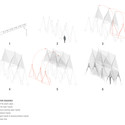
construction sequence diagram

Windshape was constructed by nARCHITECTS and a team of SCAD students over a period of five weeks. The architects developed a construction sequence that optimized the use of measured and non-measured fabrication methods. The basic components of string, plastic pipes and aluminum collars were all digitally modeled and translated into a set of 2D drawings and data. To achieve the project’s complex, interwoven geometries, the pavilions were built as a series of stacked and staggered “tripods”. Comprised of groups of three pipes inserted into an aluminum collar, the tripods were pre-assembled, woven with string on the ground, and hoisted in place. Interstitial string surfaces were then woven in between the tripods in the air.

nARCHITECTS exploited the different properties of two weak and supple materials to create a strong yet elastic structural network. Similar to an archer’s bow, the pipes were placed in bending and the string in tension to achieve structural integrity as well as a desired range of movement in the wind. The interdependent structural system of string, pipes and collars required a flexible fabrication method. An initial stitching of string through the pipes allowed for improvisation in weaving strategies to provide enclosure, openings or stability. In this way, Windshape’s indeterminate structure relied equally on precise translations from digital models as well as in-situ building tactics.


Thumb up Thumb down 0
Lauren Armellini says:

I graduated from SCAD (Photography) in 99—so great to see students doing this amazing work!

 
# September 4, 2008 at 13:06
Thumb up Thumb down 0
Kim says:

Beautiful, just so poetic…

 
# January 13, 2009 at 21:31
Thumb up Thumb down 0
Julianne-Claire says:

Hello! I really enjoy the term “Ephemeral Pavilion”…
I have two questions, one is if there are, or if it is intended that these strings work like an aeolian harp? (does it make sound?)
Also, curious, if there was a reason why you chose just the mortar (and not the bricks), and the agricultural landscape (the rows), as inspiration?
(if you are busy, I’m more interested in if it makes sound!)
Thanks so much!

 
# March 14, 2009 at 19:47
Thumb up Thumb down 0
Lucas Gray says:

Elegant and inspiring!

 
# April 14, 2009 at 10:55
Thumb up Thumb down 0
2MACoff says:

клевая ХРЕНОВИНА, красавцы…

 
# June 13, 2009 at 18:47
    Thumb up Thumb down 0
    IC1A says:

    da 100 % :D

     
    # November 18, 2010 at 11:37
Thumb up Thumb down 0
Ralph Lee says:

My client, Kia Motors America would like to use one of your images utilizing students of Savannah College of the Arts (no students visible) in it’s Open Road Magazine, issue 5 this coming December 12-26-09. The image is entitled “Windshap” a night scene taken from above.

Thank you for the opportunity.

Ralph Lee, Creative Director

 
# November 11, 2009 at 16:29
Thumb up Thumb down 0
lara atassi Azzouz says:

Nice one

 
# August 25, 2010 at 10:03
Thumb up Thumb down 0
Jet says:

Amazing !! Design :)

 
# January 14, 2011 at 15:37
    Thumb up Thumb down 0
    Muhammad says:

    Yeahh,,, I agrreee with you

     
    # January 8, 2012 at 12:01
Thumb up Thumb down 0

6:16 PM May 5th

Reading: "Windshape / nArchitects | ArchDaily"( http://twitthis.com/irv3ge )

Thumb up Thumb down 0

6:14 AM Jun 9th

nice subtile structure – Windshape from nArchitects- http://bit.ly/dmIKCN #architecture

Thumb up Thumb down 0

9:07 AM Jul 29th

Para hoje sugiro menu leve.Ontem à noite soundmood contra o stress,hoje arquitetura efêmera que segue a forma do vento http://migre.me/10JWL

Thumb up Thumb down 0

4:45 PM Aug 29th

Windshape / nArchitects | ArchDaily http://t.co/S0r8J2D vía @archdaily

Thumb up Thumb down 0

7:48 PM Dec 6th

メモ Windshape / nArchitects | ArchDaily http://t.co/GEEENhc via @archdaily

Thumb up Thumb down 0

7:32 PM Dec 23rd

thAts AMAZING!! I LOVE!! Windshape / nArchitects | ArchDaily http://t.co/qCIPWne via @archdaily

Thumb up Thumb down 0

12:51 PM Jan 21st

Windshape / nArchitects | ArchDaily http://t.co/ThMbQ5Z via @archdaily – such a beatiful place))

Leave a Reply »


Latest Comments »

very attractive great construction.[+]
Very attractive great job.[+]
I love buildings of this proportion. May be I should go...[+]
how does the tall one stay up?[+]
Oompa Lumpa + Violet Beauregarde...[+]

Upcoming Architecture Events »

got events? invite us! click here

Architecture Books & Magazines »

A Peripheral Moment

A Peripheral Moment

This book is an account of the highly productive decade of architectural experimentation in Croatia lodged between the violent break-up of Yugoslavia and their slow integration into the EU. Ivan Rupnik guides the reader through the emergence of this


Architectural Modelmaking

Architectural Modelmaking

“The representation of creative ideas is of primary importance within any design-based discipline, and is particularly relevant in architecture where we often do not get to see the finished results, i.e. the building, until the very end of the…


Construction Manual for Polymers + Membranes / Knippers, Cremers, Gabler, Lienhard

Construction Manual for Polymers + Membranes / Knippers, Cremers, Gabler, Lienhard

From the history of plastics and membranes in architecture to their material properties and requirements in construction and design, the Construction Manual for Polymers + Membranes cuts to the chase, providing the kind of solid and comprehensive overview of


Our partners »

AD on iPad via Pulse

Browse by date »

Browse by category »

Friends »