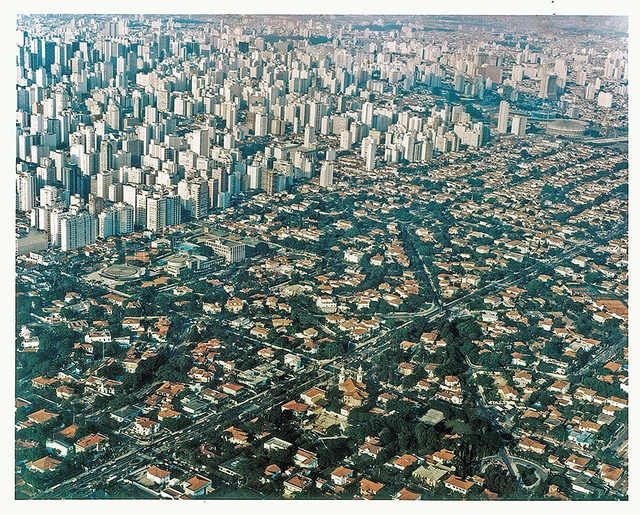
In this interview, originally published in Metropolis Magazine as "The Charms of Suburbia", Martin Pedersen interviews Robert A.M. Stern about his new book, "Paradise Planned: The Garden Suburb and the Modern City". Pedersen's interview delves into the history behind the Garden Suburb - a typology that is distinct from the stereotype of suburban sprawl.
Robert A.M. Stern is nothing if not counterintuitive. How else do you explain—in an increasingly digital and urban-centric world—his recently released book, a 1,072-page tome, containing more than 3,000 images, on the history of the garden suburb? Paradise Planned: The Garden Suburb and the Modern City (the Monacelli Press, 2013) was written with longtime, in-house collaborators David Fishman and Jacob Tilove, who also worked with Stern on the fifth volume of the architect’s epic New York series.
Paradise Planned is similarly expansive. “The book grew like Topsy,” Stern says. “We’d think we had all the examples down, and a new one would pop up. So it just got bigger and bigger. And I thought: if we’re going to do this book, we really ought to do it as the definitive text. Now, it’s not forever text. People will always be adding things. But this is a pretty comprehensive view.” I recently talked to Stern about his new book, the folly of “landscape urbanism,” and the lessons learned from the garden suburb.
Read on for the rest of the interview
.jpg?1392998805&format=webp&width=640&height=580)























.jpg?1391806773&format=webp&width=640&height=580)
_Tuomo_Tammenpa%C3%8C%CB%86a%C3%8C%CB%86.jpg?1391784293&format=webp&width=640&height=580)
_Tuomo_Tammenpa%C3%8C%CB%86a%C3%8C%CB%86.jpg?1391784314 "© Tuomo Tammenpää")
_Pekka_Turunen.jpg?1391784061 "© Pekka Turunen")
_Tuomo_Tammenpa%C3%8C%CB%86a%C3%8C%CB%86.jpg?1391784144 "© Tuomo Tammenpää")
_Tuomo_Tammenpa%C3%8C%CB%86a%C3%8C%CB%86.jpg?1391784245 "© Tuomo Tammenpää")
_Tuomo_Tammenpa%C3%8C%CB%86a%C3%8C%CB%86.jpg?1391784293)