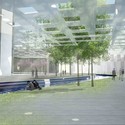
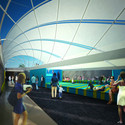
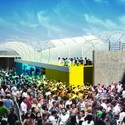
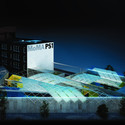
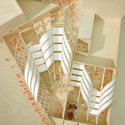
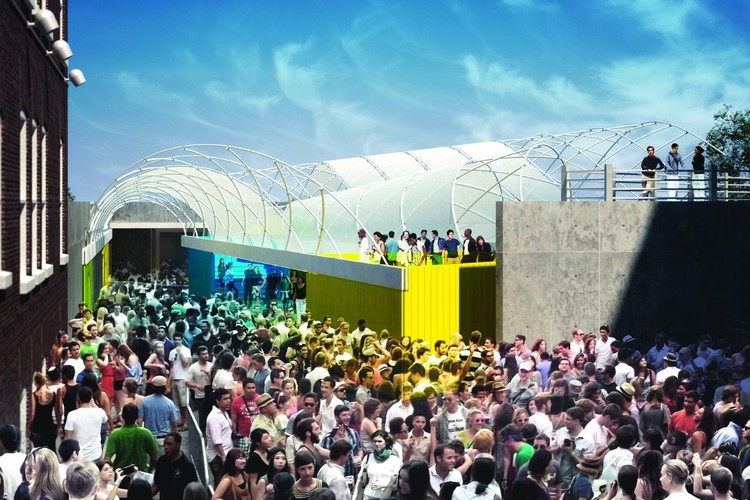
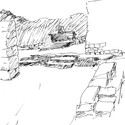
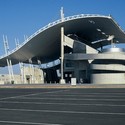
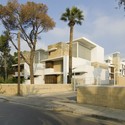
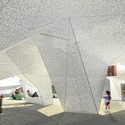
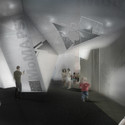
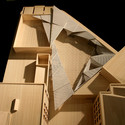
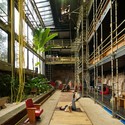
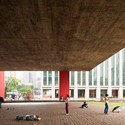
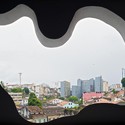
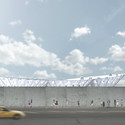
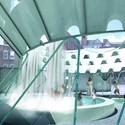
Space Group, based out of Oslo, Norway, recently completed the master plan for Lexington, Kentucky’s new Arena, Arts and Entertainment District. Beating out 13 other architectural firms, the 46 acre development will incorporate a basketball arena, convention center, performing arts center, school of the arts, offices, retail shops and housing. A unique aspect that was incorporated was the distinctive compactness of the existing downtown area and its proximity to residential neighborhoods. In order to accommodate predicted future growth, Space Group conceived a strategy that mirrors the footprint of the existing downtown district and projects it along an axis in line with the Rupp Arena. More info after the break.
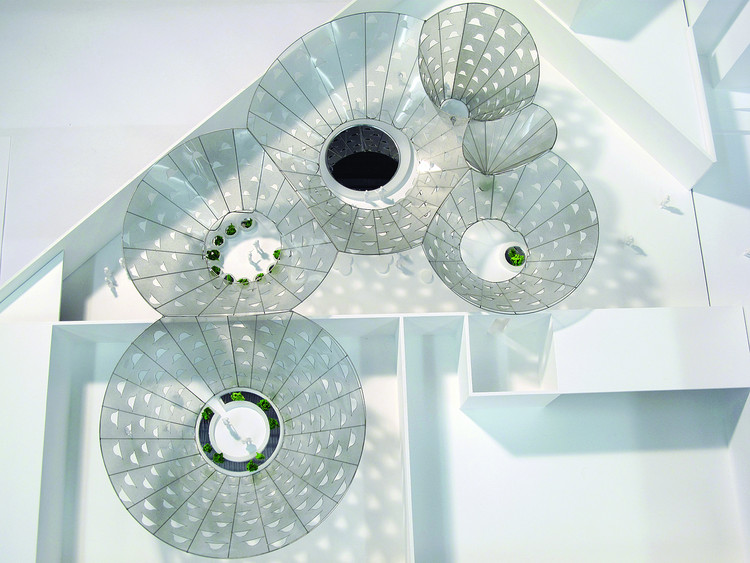
ArchDaily announced the winning proposal for the 2012 MoMA PS1 Young Architects Program (YAP) in February. In order to bring you full coverage of the annual competition, we are featuring the other four creative designs that competed against HWKN’s Wendy.Cameron Wu(Cambridge, MA) proposed Coney Inland, an architectural strategy which formally unifies and spatially modulates the challenging MoMA PS1 courtyard site. A series of developable surfaces (cones and cylinders) and their base structures normalize the contingencies of scale and shape of the three courtyard spaces, while their legible transformations register the idiosyncratic nature of the overall site geometry.
For generations of New Yorkers, Coney Island has served as the quintessential local retreat from the city. Unfettered access to sky, land, and sea makes it a clear contrast to the urban metropolis, drawing crowds in search of spatial and social release. Through the architectural translation of qualities inherent to this ocean-side precedent, Coney Inland imports the culture of casual beach leisure into the courtyard at MoMA PS1.
According to the national weather service, 30 tornadoes struck 6 Midwest states hit by a string a tornadoes. In many places there was a severe weather warning but no tornado alert. Harrisburg, a town in southern Illinois of 9000, was hit the hardest with 300 homes, 25 businesses and 6 lives lost. Illinois and Missouri declared state emergencies and are being assisted by relief organizations.
2011 was the worst tornado season since 1936 and the events of this week mark an early start to the Midwest’s storm season. More tornadoes touched down in Alabama Friday morning, destroying several homes and damaging a prison. More continue to touch down as this message is going out. Harrisburg was spared further damage this week, but storm season has just begun.
Currently, community members and the Red Cross are teaming to repair roofs, clear debris and provide emergency relief services in Harrisburg. Branson, MO, launched a similar cleanup. As lightly-damaged homes and households recover, attention will turn to long-term recovery. That’s where we come in.
Yesterday brought an impressive appeal for volunteer and fundraisings support, and Architecture for Humanity has launched the Midwest Tornadoes Recovery campaign with a fundraiser goal of $100,000.
Architecture for Humanity is calling all architects for help! If you are in the area, please consider volunteering. If you are not in the area but would like to help, just go to this link at Architecture for Humanity to donate and support architects volunteering in the Midwest.
In 1995, Portuguese architect Álvaro Siza packed a few changes of clothes, some poetry books and a single sketchbook as he set forth to Peru. These few items were all he needed to record and interpret his voyage, allowing him to integrate his investigations into his architecture. More than a half a century earlier, Peruvian photographer Martín Chambi ventured into the peaks of Macchu Picchu were he captured a famous series of portraits of the ancient Inca ruins. His project was more political, it acted as a re-appropriation of the site by its locals, but the tools of Chambi and Siza are the same: the production of images to define a reality.
The Canadian Center for Architecture (CCA) presents Alturas de Macchu Picchu: Martín Chambi – Álvaro Siza at work – an exhibit featuring thirty-five original sketches by Álvaro Siza alongside the historic 1920s photographs by Martín Chambi, now on view at in the CCA’s Octagonal Gallery until April 22, 2012. Continue reading for more information.
DS+R plans to redevelop the nineteenth-century Union Terrace Gardens with a Granite Web that intends to “fuse nature and culture into a vital social network at the heart of the city” with an “elastic web of three-dimensional interconnections” that spans across the six-hectare site. Continue reading for more information.
Tonight in Brooklyn, New York – Architect, alumnus and longtime Pratt Architecture Professor Theoharis David, FAIA, will deliver a lecture which will be introduced by visionary architect Lebbeus Woods reflecting on David’s 43 years as a teacher through the work of his former students, many of whom have gone on to become accomplished architects and teachers. The lecture will be followed by an opening reception for “Built Ideas: A Life of Teaching, Learning, and Action,” an exhibition of models, photos, and concept drawings by David that will be on view at The School of Architecture through March 30. The Pratt’s Department of Exhibitions are also presenting “An Architect Drawing,” an exhibition of drawings and texts from David’s architectural experiences through September 28.
Tonight’s lecture is open to the public; however please note that seating priority is reserved for members of the Pratt community at 5:30PM and members of the public will be admitted at 5:50PM. Continue reading for more information.
After Mayor Bloomberg, Cornell President Skorton and Technion President Lavie announced Cornell’s victory over Stanford to build an eleven acre state-of-the-art tech campus on Roosevelt Island in New York City, the team has now tackled their next step in choosing six high-profile architecture firms competing to design the schools first academic facility.
After winning the RIBA Norman Foster Travelling Scholarship in 2011, Sahil Despande of the Rizvi College of Architecture in Mumbai has focused his research on understanding an urban planning scheme that would look beyond the typical architectural desires of constructing houses and public spaces, to the broader problem of providing proper sanitation. Proper sanitation is not a necessity most can afford; in fact, over 2.5 billion people have poor access to proper sanitation and for 1.5 billion, access is seemingly impossible. Without such a basic amenity, a city or settlement’s economic and health structure are often jeopardized. Despande feels the issue of providing proper sanitation is one in which architects often shy away from, as master plans focus on spatial aspects of the formation of a city rather than trying to install the proper infrastructure necessary for its citizens. In his research, Despande traveled to thirteen vastly different cities – ranging from the poorest informal settlement, Kibera, in Nairobi, Kenya to places such as Zurich, Beijing and Delhi – in an effort to study the existing sanitation systems and understand the cultural context in which they reside. Despande’s research is bringing sanitation to the forefront to generate awareness about its inherent linkage with public health, and urge architects to tackle the issue to improve the conditions for billions of people. Check out his presentation and let us know what you think of his research findings.
The program promoting and supporting young architecture organized by MAXXI Architettura together with MoMA/MoMA PS1 in New York and CONSTRUCTO of Santiago in Chile has announced UNIRE/UNITE by Urban Movement Design as winner of the 2012 Young Architects Program (YAP) MAXXI in Rome. Following MAXXI’s first successful summer installation named WHATAMI by stARTT, Urban Movement Design now has the opportunity to reinvent the MAXXI piazza with an interactive installation featuring a long and sinuous band of wood and grass that encourages a playful bond between the building and its users. This proposal was selected over four other shortlisted contestants who where chosen by an Italian jury.
Both UNIRE/UNITE by Urban Movement Design and WENDY by HWKN (HollwichKushner) will be inaugurated in the MAXXI piazza and the courtyard at MoMA PSI in June 2012, along with an exhibit showcasing the fifteen design proposals from the finalists.
Continue reading for more information on this years MAXXI winner, UNIRE/UNITE.
In recent years, the growth of China has been incredible. We have often likened the massive surge of projects in the country to the explosive levels of architectural experimentation in Dubai. OMA, Hadid, Holl, Foster, Morphosis – strong powerhouses of architecture – all seeking to help China meet the demands of its emerging world power position by springing from the basis of a historically isolated culture and leaping to craft a more globalized image for the country. Such an image creates the desire for an architecture which can continually out shine itself as it challenges traditional materiality, scale and contextual relationships in China’s modern cities such as Shanghai and Beijing, Hangzhou and West Kowloon.
Perhaps, that is precisely why many have not heard of Wang Shu and Amateur Architecture Studio. And, perhaps, that is precisely why this Pritzker award carries such weight.
ArchDaily announced the winning proposal for the 2012 MoMA PS1 Young Architects Program (YAP) earlier this month. In order to bring you full coverage of the annual competition, we are featuring the other four creative designs that competed against HWKN’s Wendy. Ibañez Kim Studio (Mariana Ibañez and Simon Kim) proposed a Mechanical Garden that enjoyed a unique partnership with artists and engineers in Philadelphia.
President Obama attended the official ground breaking ceremony of the National Museum for African American History and Culture (NMAAHC) on February 22, commemorating this milestone for the Smithsonian Institution’s new museum on Washington’s National Mall. The Tanzanian-born, London-based architect David Adjaye serves as Lead Designer for the Freelon Adjaye Bond/SmithGroup (FAB) team that was selected by the Smithsonian Institute back in 2009 in the international competition for the design of the nation’s new prestigious building.
The President began his brief remarks by stating, “As others have mentioned, this day has been a long time coming. The idea for a museum dedicated to African Americans was first put forward by black veterans of the Civil War. And years later, the call was picked up by members of the civil rights generation -– by men and women who knew how to fight for what was right and strive for what is just. This is their day. This is your day. It’s an honor to be here to see the fruit of your labor.”
Continue reading for more information on the project and a video of President Obama’s speech.
The Architecture Billings Index (ABI) has clocked in at a positive 50.9 for January. Although the score brings the ABI into positive territories for the past three months, 50.9 is slightly over the positive measuring marker and actually, just under December’s mark of 51.0. Regional averages place the Midwest as the leading area with 53.7; followed by the South (51.6), Northeast (50.7), and West (45.6). AIA Chief Economist, Kermit Baker, PhD, Hon. AIA explained that even though the index is showing a similar upturn in design billings to the late 2010 and early 2011, firms are still having a hard time staying on their feet. “We still continue to hear about struggling firms and some continued uncertainly in the market, we expect that overall economic improvements in the design and construction sector to be modest in the coming months.”
ArchDaily previously ran an article about the Manufacturers Trust Company Bank Branch at 510 Fifth Avenue in Manhattan designed by Gordon Bunshaft of Skidmore, Owings & Merrill and interior designer Eleanor H. Le Maire, a building designated as protected under the Landmarks Preservation Commission with first the exterior in 1997 and later the interior in early 2011. But as recently as October 2011, the building was already listed under the 2012 World Monuments Fund in the 2012 World Monuments Watch as the current owners, Vornado Realty Trust, began compromising the landmarked conditions of the interior of the building as it was being adapted for reuse. With preservationists in an uproar, support for the protection of the building was enough to bring Vornado Realty Trust to New York State Supreme Court where a settlement was reached.
Read on for more details on the settlement and continuing efforts to protect endangered monuments.
Are you an avid lover of the High Line? If you’ve been keeping up with our coverage of the project byJames Corner Field Operations and DS+R, then you have been following the development of the High Line’s different sections – such as the early stages for a the design of the Gansevoort entrance and elevated street ampitheater of Stage One, and the picture frame and tree fly over of Stage Two. And, yet the amazing public space is still developing further. Friends of the High Line are presenting initial design concepts for the rail yards section of the High Line, which requires new zoning that would preserve the entire rail yards section, including the Spur, as public open space. At a community input meeting on Monday, March 12, the High Line design team will share their visions and answer questions about the soon-to-be newest part of the project.
More information about the meeting after the break.
Sydney Opera House is not only a building with great beauty but it has also become known throughout the world as a symbol for not only a city, but a whole country.
The LEGO version of the Sydney Opera House seeks to capture the essence of this grand building in a small scale. Like the other models in the series it was created by Adam Reed-Tucker.
The set will be available in stores on March 1st at a suggested price of $39.99. More images after the break:
https://www.archdaily.com/210308/lego%25c2%25ae-architecture-series-sydney-opera-house-by-jorn-utzonAmber P
Tonight, Columbia University’s Graduate School of Architecture, Planning and Preservation (GSAPP) Studio-X NYC welcomes Fast Company’s Greg Lindsay and the Institute for the Future’s Anthony Townsend for the first of a new series of events focused on the “smart city”.
“Lindsay and Townsend are calling the series “X-Cities,” where X marks the spot at which information technology and mega-urbanization converge. In this first session, the pair will lay out their respective cases for the top-down, intelligent design of “smart cities” versus the bottom-up evolution of crowd-sourced “civic laboratories.” Is information technology a real tool for city-building? And, if so, what is its bright and/or scary future?”
This event will begin at 6:30PM at 180 Varick Street in New York. It is free and open to the public. No RSVP is required. Continue reading for more information.
Newark-native Richard Meier has not forgotten his roots. Established by the Puritans as a colony to follow the rules of the church in the 17th century, Newark evolved into a prosperous industrial center during the 19th century, experienced a harsh period of industrial and social decline after WWII, and is currently seeking to reestablish its reputation as a renewed urban metropolis. Meier has supported such efforts to restore the city’s vitality, including chairing an international design competition for the creation of a Visitors’ Center for Newark (check out some proposals we’ve previously featured here). Back in 2010, Meier & Partners shared their vision for a new Teachers Village for the city – a four block-long mixed-use development aimed at attracting young professionals who work in the educational system to reside in the downtown area. This past week, we are happy to share that the Village, which includes two school buildings with three charter schools and a daycare center, 70,000 sqf for retail space, in addition to the rental apartments for Newark teachers, has broken ground.
Opening on February 24th at the Architectural Association School of Architecture in London, Lina & Gio: The Last Humanistswill explore for the first time the relationship between two seminal figures in twentieth-century design: Lina Bo Bardi (1914-1992) and Gio Ponti (1891-1979). More details after the break.
ArchDaily announced the winning proposal for the 2012 MoMA PS1 Young Architects Program (YAP) earlier this month. In order to bring you full coverage of the annual competition, we are featuring the other four creative designs that competed against HWKN’s Wendy. Virtual Water, a collaborative design brought to you by UrbanLab, endrestudio and Method Design, formally manifests what is hidden in plain sight: RAIN. The project reveals and plays with thousands of gallons of summertime rainwater that would otherwise be discarded from the PS1 courtyard.
Virtual Water refers to water hidden in everyday products. A pair of jeans, for example, has a 3000 gallon Virtual Water footprint because 3000 gallons of water are consumed in the various steps of its production chain (growing the cotton, dyeing the fabric, etc).
Nearly two years after OMA was announced the winner of a two-stage international competition, the construction of the new Taipei Performing Arts Center has commenced. This ambitious project, led by OMA partners Rem Koolhaas and David Gianotten, generated a lot of debate among architects when it was announced back in 2009 due to its particular form. Morphed by a series of programmatic operations, the form intersects three types of theater in order to accommodate a variety of performances.
The Proscenium Playhouse, which seats 800, is expressed on the exterior as a large sphere while the other two theaters, respectively capable of seating 1,500 and 800, are represented as peripheric cubes. All the stage accommodations are brought together within the central cube, allowing for more flexibility as theaters can be used independently or combined, thus expanding the possibilities for experimental performances – an art that is very strong in Taiwan. At the same time, and in a similar way as OMA’s CCTV building in Beijing, China, a “public loop” channels circulation through the building, exposing the spaces that make the TPAC work, areas typically are hidden from the public but are as revealing as the performances themselves.
In this aspect, the building is like a machine at work with its engine exposed, somehow reminding me of OMA’s Prada Transformer – a machine-like building (the anti-blob) that changed its configuration to host different types of events.
The 180 million dollar project is set to be completed in 2015. More details, including sections and updated renders, after the break:
The controversy surrounding Frank Gehry’s proposal for the Eisenhower Memorial has just reached new heights as the Chicago Tribune’s Blair Kamin has recently published a 1,500-word essay, written by the influential neo-traditionalist architect Leon Krier, that bashes Gehry’s proposal and ideology. Krier calls Gehry a “greatly confused artist” who’s “style is a century old” and “seems “innovative” only to the ignorant”. Kier continues to claim the commission who appointed Gehry’s design “shares his [Gehry’s] intellectual confusion and distaste of classical Washington D.C.” Continue reading for more.
Last September, we attended MoMA’s PS 1 Open Studio event to catch a glimpse of the collaborative projects of five multidisciplinary teams focusing on how to re-think, re-organize and re-energize the concept of an American suburb in the wake of the foreclosure crisis. When we visited, the teams were in the final stages of their designs and preparing to send their visions to the Museum of Modern Art for the exhibition “Foreclosed: Rehousing the American Dream. One of the team’s we talked with was WORK Architecture Company about their Nature-City proposal, an extension of the suburb whichhas been designed in an abstracted way to serve as a plug in model to create cities elsewhere.