MVRDV exhibits “China Hills: A vision of future cities”
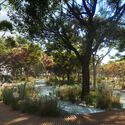
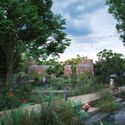
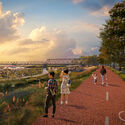
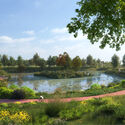
Saturday 28th of November the Beijing Centre for the Arts opened the exhibition “Green Projects II, Three Dimensional City: Future China” featuring work of Paolo Soleri and MVRDV. The centre piece is an installation by MVRDV, “China Hills”: a scale model of a future Chinese city which offers alternatives to the current urbanization in China.
On a hypothetical site of 1x1x0.5 km the plan offers space to accommodate up to 100,000 inhabitants and a well balanced mix of urban program and nature, agriculture and energy production; all in the shape of a Chinese mountain landscape: realizable with today’s technologies. The exhibition is open until February 28th 2010.
More information at the Beijing Center for the Arts official website.
Construction of MVRDV’s Market Hall started

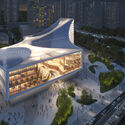
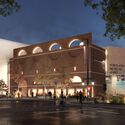
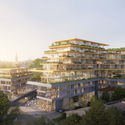
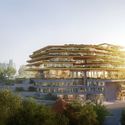
Yesterday the mayor of Rotterdam, Ahmed Aboutaleb and city councilor Hamit Karakus officially started the construction of the new Rotterdam Market Hall (previously featured here). The arched building located in the centre of Rotterdam, developed by Provast and designed by MVRDV is a hybrid of public market and apartment building.
The project with a total of 100.000 m2 is set to be completed in 2014 and part of the current regeneration of Rotterdam’s post war centre. Project developer Provast realizes the building, Unibail Rodamco invested in the shops and restaurants whilst Housing Corporation Vesteda will manage the rental apartments, making the building a socially integrated part of the city.
More images after the break.
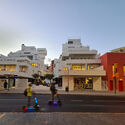
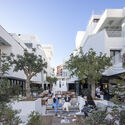
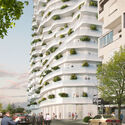
Celosia Building / MVRDV with Blanca Lleó
Architect: MVRDV & Blanca Lleó
Location: Madrid, Spain
Client: EMVS
Year: 2009
Budget: 12.6M Euro
Constructed Area: 21,550 sqm
Photographs: Ricardo Espinosa
Vision 2030 / MVRDV
With the city of Almere’s growth expected to require thousands of new residences, work places and related facilities, MVRDV was commissioned to collaborate with the city to design a concept structure vision to accommodate such drastic expansion. MVRDV’s Vision 2030 will create a framework to satisfy the growth for about 20 years. ”The structure vision for Almere is more than an urban master plan…” said Adri Duivesteijn, city councilor of Almere, “…it describes how the city can develop in economic, cultural and social terms. The expansion is not a quantitative effort. Even though the number of 60,000 new homes is impressive, the main objective is the addition of new qualities. Almere wants to serve the demand of the Randstad and at the same time needs the chance to develop into an ecologic, social and economically sustainable city”.
More about the city plan after the break.
MVRDV + 24 Architects on the future of Almere

The 24 architecture teams with the client, Almere city officials and the project teams of MVRDV on site, photo by © Xander Remkes
We all know that the Dutch are experts on reclaiming land from the sea. And with all this new land, come new cities. One of these is Almere, a city founded in 1984, which is growing fast into becoming the fifth largest city in the Netherlands. This growing city is now into the process of consolidating a new center, Olympiakwartier, envisioned on a larger master plan for a sustainable city by Mecanoo.
By 2030, Almere expects to grow into a city with a stronger identity and a total of 350,000 inhabitants, which involves the building of 60,000 new homes and the creation of 100,000 new jobs for the expected 150,000 new inhabitants. For this, Amsterdam based housing association Housing Stadgenoot commissioned MVRDV to be planner for 60,000m2 work space, 120,000m2 housing (1,000 homes), 15,000m2 education, 2,000m2 commercial space, 2,640 parking spaces and various public spaces. This total has been split into 93 volumes of which MVRDV will design 45. The plan demands individual development of the buildings: a dense mix of living and working leading to a complex urban condition. Retail, a public square and communal gardens are also part of the comprehensive plan which introduces inner city life to the mostly suburban typology of Almere. Flexibility is a key objective: All ground floors and part of the office and apartment buildings are designed to facilitate future change of use. In this way the owner, Stadgenoot, can adjust the district more and more to the needs of the growing new town and its inhabitants.
The remaining 48 buildings (500m2 to 5,000m2) are going to be designed by a selected group of 24 international practices, including established and emerging offices (see list after the break).
This project is very ambitious, with the potential of becoming a milestone on urban planning, apart from recent mega projects by groups of architects we have seen lately, which can be very innovative in terms of form or solving individual housing problems, but lack of a clear master plan that make all the individual architect’s efforts act as a whole. It sort of reminds me of the Weissenhof Estate, lets hope this one becomes an example for future architects.
Market Hall in Rotterdam / MVRDV
Dutch architects MVRDV strike another one with a new mixed use project in the new inner city heart for the Laurens Quarter, the pre-war centre of Rotterdam.
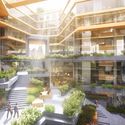
The project, comissioned by Provast, includes an open air market, that due to new hygienic constraints of dutch laws has to be covered. It also includes 246 residences, that form an arc that covers the open market area.
This results on a 3,000sqm retail area, with a 1,600sqm catering area on the ground level and first floor, a 1,800sqm supermarket and an underground car park for 1,100 cars.
The interior face of the arc will be covered with LEDs for an ever changing interior. The front and backside are covered with a flexible suspended glass facade, allowing for maximum transparency and a minimum of structure.
This new icon for Rotterdam is expected to be completed in 2014. More images after the break.
Balancing Barn / MVRDV and Mole Architects
Our friends from MVRDV sent us their latest project with Living Architecture, the Balancing Barn, a cantilevered holiday home near the village of Thorington in Suffolk, England. Living Architecture, a British organization devoted to architecture as experience, has commissioned a series of outstanding holiday homes in the UK. MVRDV and co-architect Mole Architects from Cambridge will create a house sympathetic in spirit and materials to the exceptional natural site, which will be available for holiday rental from 2010.
More images and architect’s description, after the break.
Sky Village in Rødovre / MVRDV

Some time ago we featured a mid rise building by OMA in New York, a cantilevered volume that brings a new concept for tall buildings. A similar approach can be found at a recent competition for the Rødovre Skyscraper won by MVRDV in association with ADEPT: A 116m tall mixed use tower, based on a 60sqm module arranged around the central core of the building.
It´s interesting to see the structural approach for this new typology, as you can see on another render below: the inner core -actually 3 cores to access the different program segments- is made out of concrete, with the units wrapping it around on a steel structure.
Something interesting in times like this, is that the building allows for different configurations responding to unstable markets, flexibility achieved by re-designating these 60sqm units.