1. ArchDaily
  2. Installations

Installations: The Latest Architecture and News

Video: This Kinetic Green Wall Displays 'Pixel' Plant Art

Subscriber Access | 

BAD. Built by Associative Data’s Associative Data Research has collaborated with Green Studios to create Kinetic Green Canvas, a prototype Green-Art Installation for building façades.

The Canvas consists of individual modules, each of which is a cube made from steel framework, back paneling, L-shaped jambs, secondary structure, waterproofing board, irrigation piping, Green Studios hydroponic skin, and plants. These layered components are assembled on four sides of the cube module, with a motor and water pipe attachment that circulates water throughout.

Hello Wood Creates Reusable Christmas Tree From Lightboxes in Budapest

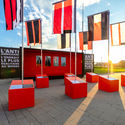
Hello Wood has continued its tradition of building socially responsive Christmas trees in European cities though its latest addition, the Tree of Arts, built in front of Budapest’s largest concert hall, Müpa, also known as the Palace of Arts.

Based on the idea that the spirit of Christmas should live beyond the holiday season and continue to symbolize community-building and sustainability into the New Year, the 11-meter tall tree made from lightboxes will be recycled into display units for the inside of the cultural venue in 2017.

Lightboxes in the installation feature the names of performances that will be visiting Budapest in the coming year, including the New York Philharmonic Orchestra, John McLaughlin, and Cameron Carpenter.

Hello Wood Creates Reusable Christmas Tree From Lightboxes in Budapest - Image 1 of 4Hello Wood Creates Reusable Christmas Tree From Lightboxes in Budapest - Image 2 of 4Hello Wood Creates Reusable Christmas Tree From Lightboxes in Budapest - Image 3 of 4Hello Wood Creates Reusable Christmas Tree From Lightboxes in Budapest - Image 4 of 4Hello Wood Creates Reusable Christmas Tree From Lightboxes in Budapest - More Images+ 5

5 Firms Shortlisted for 2017 MoMA PS1 Young Architects Program

MoMA P.S.1 has named five finalists competing in the 2017 Young Architects Program (YAP).

Now in it’s 17th year, the competition was founded to offer emerging architectural talent the opportunity to design a temporary, outdoor installation within the walls of the P.S.1 courtyard for MoMA’s annual summer “Warm-Up” series. Architects are challenged to develop creative designs that provide shade, seating and water, while working within guidelines that address environmental issues, including sustainability and recycling.

LOT Wins Competition to Transform Flatiron Plaza in New York

LOT has been selected as the winner of the third annual Flatiron Public Plaza design competition in New York, which called for proposals from 5 New York City firms to design a temporary installation to be located at the base of the iconic Flatiron Building.

The winning proposal, titled “Flatiron Sky-Line,” consists of a series of 10 large contiguous arches, constructed out of white powder-coated steel tubes housing LED lights, from which an array of hammocks will be suspended to allow visitors to rest and take in the surrounding landmarks such as the Met Life Tower and Empire State Building.

LOT Wins Competition to Transform Flatiron Plaza in New York - Image 3 of 4LOT Wins Competition to Transform Flatiron Plaza in New York - Image 4 of 4LOT Wins Competition to Transform Flatiron Plaza in New York - Image 5 of 4LOT Wins Competition to Transform Flatiron Plaza in New York - Image 6 of 4LOT Wins Competition to Transform Flatiron Plaza in New York - More Images+ 2

This Maple Leaf Shaped Tunnel Commemorates Hungarian Refugees in Canada

In memorial of the 1956 Hungarian Revolution, which resulted in the emigration of over 37,000 Hungarians to Canada, architectural studio Hello Wood has created Tunnel Through Time, a contemporary interpretation of the historic event that remembers the heroes of the revolution and especially honoring the Canadian people who welcomed Hungarian refugees.

Composed of 37,565 pieces—one for each Hungarian refugee accepted into Canada—the tunnel begins with a Hungarian flag with a hole in the middle, representing how protesters cut the communist coat of arms out of the Hungarian flag during the revolution. The tunnel then morphs—as a representation of the journey of the refugees—until it reaches an exit, which is shaped like the national symbol of Canada, the maple leaf.

This Maple Leaf Shaped Tunnel Commemorates Hungarian Refugees in Canada  - Image 2 of 4This Maple Leaf Shaped Tunnel Commemorates Hungarian Refugees in Canada  - Image 3 of 4This Maple Leaf Shaped Tunnel Commemorates Hungarian Refugees in Canada  - Image 18 of 4This Maple Leaf Shaped Tunnel Commemorates Hungarian Refugees in Canada  - Image 36 of 4This Maple Leaf Shaped Tunnel Commemorates Hungarian Refugees in Canada  - More Images+ 36

Tatiana Blass' "Penelope" Crosses Chapel Walls with Enigmatic Red Wool

Made from a combination of tangled and woven red wool, Brazilian artist Tatiana Blass’ installation, “Penelope,” flows inside and out of the Chapel of Morumbi in São Paulo, Brazil.

The installation was inspired by the Greek myth of Penelope, who was Odysseus’ wife in Homer’s Odyssey. In the story, Penelope weaves and destroys a burial shroud for her husband, in a tribute to the power of love and to weaving. 

Tatiana Blass' "Penelope" Crosses Chapel Walls with Enigmatic Red Wool - Image 1 of 4Tatiana Blass' "Penelope" Crosses Chapel Walls with Enigmatic Red Wool - Image 2 of 4Tatiana Blass' "Penelope" Crosses Chapel Walls with Enigmatic Red Wool - Image 3 of 4Tatiana Blass' "Penelope" Crosses Chapel Walls with Enigmatic Red Wool - Image 4 of 4Tatiana Blass' Penelope Crosses Chapel Walls with Enigmatic Red Wool - More Images+ 2

Design Week Mexico and Museo Tamayo Launch Museum of Immortality Pavilion

Now in its eighth edition, Design Week Mexico, in collaboration with Museo Tamayo, has unveiled the design for a major public architectural pavilion designed by leading German architects Nikolaus Hirsch and Michel Müller. Until Spring 2017, the installation will be a cultural attraction at Chapultepec Park, Mexico City’s largest public park.

Design Week Mexico and Museo Tamayo Launch Museum of Immortality Pavilion - Image 1 of 4Design Week Mexico and Museo Tamayo Launch Museum of Immortality Pavilion - Image 2 of 4Design Week Mexico and Museo Tamayo Launch Museum of Immortality Pavilion - Image 3 of 4Design Week Mexico and Museo Tamayo Launch Museum of Immortality Pavilion - Image 4 of 4Design Week Mexico and Museo Tamayo Launch Museum of Immortality Pavilion - More Images+ 13

Bijoy Jain's 2016 MPavilion Opens in Melbourne

The 2016 MPavilion, designed by Indian architect Bijoy Jain of Studio Mumbai, has opened in Melbourne’s Queen Victoria Gardens. Over the next four months, the bamboo structure will play host to a free public program of over 400 talks, workshops, performances and installations.

Bijoy Jain’s design joins the growing international trend of “handmade architecture” as it becomes the largest bamboo structure in Australia, utilizing 7 kilometers of Indian bamboo, 50,000 kilograms of Australian bluestone, 5,000 wooden pins and 26 kilometers of rope to cover a 16.8 square meter area. The slatted roof panels are constructed from sticks of the Karvi plant and were woven together by craftspeople in India over a four month period.

Bijoy Jain's 2016 MPavilion Opens in Melbourne - Image 1 of 4Bijoy Jain's 2016 MPavilion Opens in Melbourne - Image 2 of 4Bijoy Jain's 2016 MPavilion Opens in Melbourne - Image 3 of 4Bijoy Jain's 2016 MPavilion Opens in Melbourne - Image 4 of 4Bijoy Jain's 2016 MPavilion Opens in Melbourne - More Images+ 1

Walk on Water with Space Caviar's Floating Cultural Installation on Italian Lake

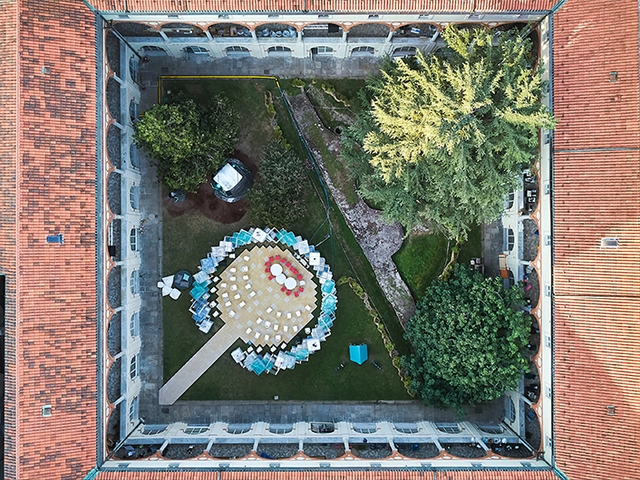
Genoa-based studio Space Caviar has recently unveiled Arcipelago di Ocno, an aquatic installation on a lake in Mantova, Italy, which is the 2016 Italian Capital of Culture. Named after the local demigod Ocno, the installation recalls the form of a lotus, a plant with an extensive presence in Mantova’s lakes.

Acting as an aquatic piazza for the city, the archipelago of floating islands “[extends] Mantova’s urban fabric onto the lakes that surround its historic center,” utilizing modular units to create a venue for Mantova’s cultural activities for years to come.

Walk on Water with Space Caviar's Floating Cultural Installation on Italian Lake - Image 1 of 4Walk on Water with Space Caviar's Floating Cultural Installation on Italian Lake - Image 2 of 4Walk on Water with Space Caviar's Floating Cultural Installation on Italian Lake - Image 3 of 4Walk on Water with Space Caviar's Floating Cultural Installation on Italian Lake - Image 4 of 4Walk on Water with Space Caviar's Floating Cultural Installation on Italian Lake - More Images+ 13

When Droplets Create Space: A Look at Liquid Architecture

Throughout the past century, architecture's relationship with water has developed along a variety of different paths. With his “Fallingwater” house, for example, the American master Frank Lloyd Wright confronted the dramatic flow of water with strong horizontal lines to heighten the experience of nature. Since then, architecture's use of water has become more varied and complex. A space made almost purely of water emerged with Isamu Noguchi's design at the Osaka World Expo: glistening water appeared to fall from nowhere and glowed in the dark. Later with digitalization and fluid forms as design parameters, the focus shifted towards liquid architecture made of water and light. The interpretations have ranged from architectural forms modeled after literal drops of water, like Bernhard Franken´s visionary “Bubble” for BMW, to spectacular walk-in installations made of lines of water, transformed into pixels by light.

When Droplets Create Space: A Look at Liquid Architecture - Image 5 of 4When Droplets Create Space: A Look at Liquid Architecture - Image 8 of 4When Droplets Create Space: A Look at Liquid Architecture - Image 9 of 4When Droplets Create Space: A Look at Liquid Architecture - Image 14 of 4When Droplets Create Space: A Look at Liquid Architecture - More Images+ 15

Bijoy Jain Designs Australia's Largest Bamboo Structure for 2016 MPavilion

The Naomi Milgrom Foundation has released plans for Studio Mumbai founder Bijoy Jain’s design for the 2016 MPavilion, the Australian counterpart to London's wildly successful Serpentine Gallery Pavilion program. Continuing the concepts driving Studio Mumbai’s work, the pavilion will utilize a process Jain describes as ‘Lore,’ an exploration of handmade architecture and simplicity of building craft that centers on the relationship between making and human connectedness.

Bijoy Jain Designs Australia's Largest Bamboo Structure for 2016 MPavilion  - Image 1 of 4Bijoy Jain Designs Australia's Largest Bamboo Structure for 2016 MPavilion  - Image 2 of 4Bijoy Jain Designs Australia's Largest Bamboo Structure for 2016 MPavilion  - Image 3 of 4Bijoy Jain Designs Australia's Largest Bamboo Structure for 2016 MPavilion  - Image 4 of 4Bijoy Jain Designs Australia's Largest Bamboo Structure for 2016 MPavilion  - More Images+ 18

RAAAF Propose to "Reclaim" Venice's Giardini by Shrouding National Pavilions with Fabric

Few have ever considered what the Giardini—the park of national pavilions for the Art and Architecture Biennales in Venice—is like during the winter months. In light of the fact that, during their "off-season," the gardens are often left in a state of disrepair, RAAAF—a Dutch multidisciplinary studio based in Amsterdam, alongside architect Marcel Moonen—have proposed a series of installations in an attempt to "reclaim valuable public space" which sits at the heart of an often overcrowded city.

Moonolith Installation Reflects Moon and Stars in Geodesic Dome Like Structure

Slovenian artist Martin Bricelj Baraga has created Moonolith, a monument to the moon and stars, in collaboration with the City of Ljubljana, Slovenia. Based on the modular design of Buckminster Fuller’s geodesic dome, Moonolith “is a modern three-dimensional squaring of the circle, projected into Euclidean space.”

As a part of the artist’s Nonument series, the installation “[carries] a strong symbolic message in a physical, mental, and virtual space,” reflecting “research of the meaning and development of monuments and the phenomenology of collective memory.”

Sou Fujimoto to Create "Forest of Light" for Fashion Brand COS

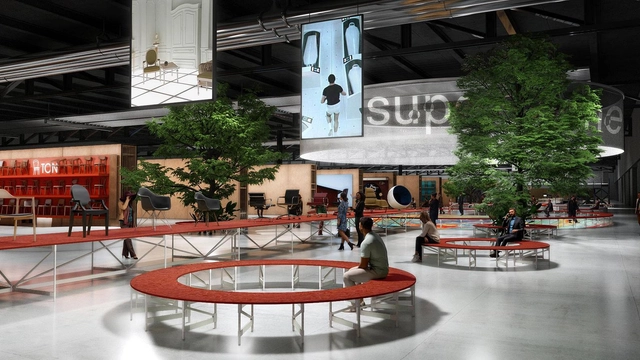
Sou Fujimoto has been commissioned by Swedish clothing brand COS to design its installation for this year's Salone del Mobile in Milan. Taking place from April 12-17, the event will be the brand's fifth year participating.

"In this installation for COS, I envisage to make a forest of light," said Fujimoto. "A forest which consists of countless light cones made from spotlights above. These lights pulsate and constantly undergo transience of state and flow. People meander through this forest, as if lured by the charm of the light. Light and people interact with one another, its existence defining the transition of the other."

Collective–LOK’s "Heart of Hearts" Takes Shape in Times Square

Collective–LOK's Heart of Hearts installation has officially opened in New York City's Times Square, just in time for Valentine's Day. Winner of this year's annual Times Square Valentine Heart Design, a competition curated by the Center for Architecture, the "faceted ring of 12 golden, mirrored hearts" will remain on view in Duffy Square through March 6.

Studio Mumbai Founder Bijoy Jain to Design Melbourne's Next MPavilion

The Naomi Milgrom Foundation has chosen Bijoy Jain of Studio Mumbai to design Melbourne's 2016 MPavilion. Following Amanda Levete's rendition of the unique commission, which closed its doors Sunday after hosting four months of free events, Jain will be the third architect to design the annual MPavilion.

"I’m honored to be commissioned by the Naomi Milgrom Foundation to design the next MPavilion in Melbourne. I want it to be a symbol of the elemental nature of communal structures. Like Naomi, I see MPavilion as a place of engagement: a space to discover the essentials of the world - and of oneself," commented Jain.

Gabriel Calatrava Creates Interactive String Installation for the 92Y Music Festival in New York

As a part of the 92Y Seeing Music festival in New York, architect and engineer Gabriel Calatrava has created a moving installation that “illuminates and interprets the Brentano String Quartet’s live performance of J.S. Bach’s The Art of the Fugue.” Operated by a dance corps, the set design “provides audiences with a new way to experience and interpret the music they hear on stage, while allowing various art forms to complement and inform each other.”

Gabriel Calatrava Creates Interactive String Installation for the 92Y Music Festival in New York  - Image 1 of 4Gabriel Calatrava Creates Interactive String Installation for the 92Y Music Festival in New York  - Image 2 of 4Gabriel Calatrava Creates Interactive String Installation for the 92Y Music Festival in New York  - Image 3 of 4Gabriel Calatrava Creates Interactive String Installation for the 92Y Music Festival in New York  - Image 4 of 4Gabriel Calatrava Creates Interactive String Installation for the 92Y Music Festival in New York  - More Images+ 6

Achim Menges to Create Robotic Pavilion for V&A

Stuttgart experimental architect Achim Menges has been commissioned to kickstart the V&A's first ever Engineering Season with a site specific, nature-inspired installation fabricated by robots. Complemented by Ove Arup's first major retrospective, Engineering the World: Ove Arup and the Philosophy of Total Design, the Elytra Filament Pavilion will be Menges' first public commission in the UK. He will work with Moritz Dörstelmann, structural engineer Jan Knippers and climate engineer Thomas Auer to complete the project.

"Elytra Filament Pavilion will explore the impact of emerging robotic technologies on architectural design, engineering and making," says the V&A. "Inspired by a lightweight construction principle found in nature, the fibrous structures of the forewing shells of flying beetles known as elytra, the Pavilion will be an undulating canopy of tightly-woven carbon fibre cells created using a novel robotic production process."