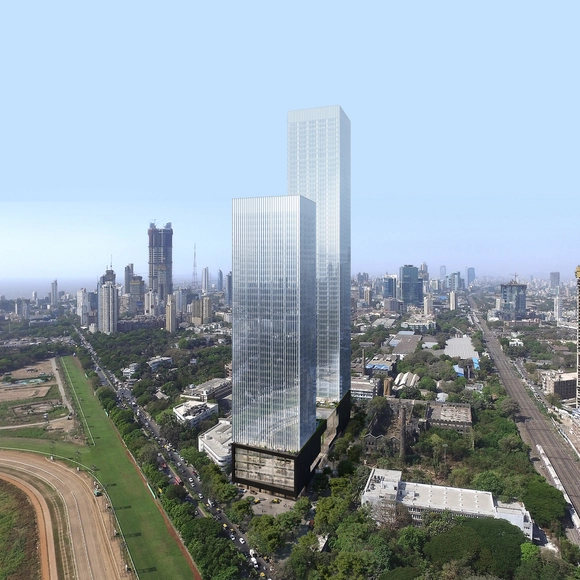
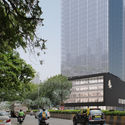
Led by Iyad Alsaka, Adrianne Fisher, and Wael Sleiman, OMA’s latest project, the Prestige Liberty Towers, breaks ground in Mumbai, India. Expected to be completed in 2025, the mixed-used complex is the firm’s first venture in India, located in the historic textile mills at the heart of the city.
Skidmore, Owings & Merrill (SOM) has collaborated with University of Michigan Taubman College to create the SPLAM [SPatial LAMinated timber], a robotically-fabricated timber pavilion for the 2021 Chicago Architecture Biennial. The pavilion employs prefabricated framing panels manufactured using robotic technology, and will serve as an open-air education facility and gathering space for a school in Chicago. The pavilion was inaugurated on September 17, with the opening of the Chicago Biennial, and will remain on display until December 18th.
Hotel sign in downtown São Paulo. Image via Giovana Martino's collection
Sex Day is an unofficial holiday created by marketers celebrated on September 6th in Brazil, highlighting one of the greatest taboos in modern society: sexuality. From an architectural and urban point of view, the immorality associated with sexual activities, especially in exchange for payment, deeply impacts our society and also affects the territory.
While sometimes considered morally wrong, sinful, forbidden, and impure, sex, sexuality, and pleasure are all inherent to human physiology. Prostitution is sometimes referred to as "the world's oldest profession," playing a fundamental role in our societies, as well as in our territory, in the spatial organization and dynamics of cities. This practice is at the margins of modern society and therefore has ended up occupying segregated spaces in the cities.
Commercial spaces must be enticing enough to pull people in, and comforting enough to keep them there. It’s this balance that makes the utilization of technical lighting so important to master.
It can be hard for spaces such as hospitality venues, offices, and retail environments to create comfortable, functional, and eye-catching lighting networks. But with venues, companies, and brands fighting harder than ever for the attention of shoppers, buyers, and workers, ensuring they present the perfect combination of ambiance, comfort, and aesthetic, all while staying completely on brand, is even harder than it appears.
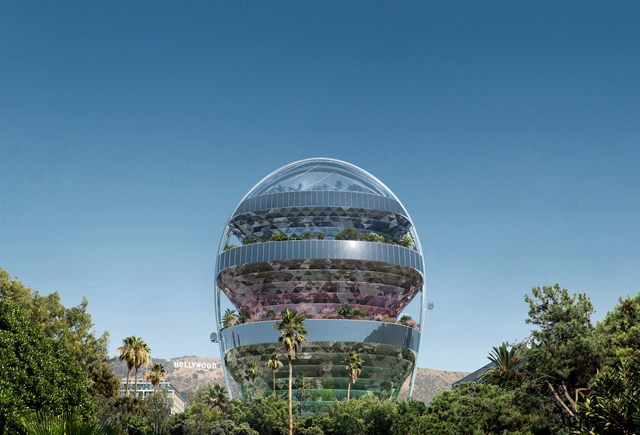
MAD Architects has announced "The Star", a new landmark that will foster culture, creativity, and inspiration in Los Angeles, California. Nestled in the heart of Hollywood, the Star's reflective architecture nods the neighborhood's glamorous characteristics and embeds nature within its structure with natural lighting, greenery, and workplaces that cater to the employees' mental and physical wellbeing.
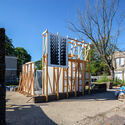
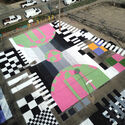
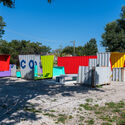
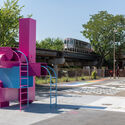
The fourth edition of the ChicagoArchitecture Biennial opened to the public on September 17th, showcasing a series of 15 site-specific interventions within the urban environment that tap into ideas of shared space and collective agency, exploring “who gets to participate in the design of the city”. Led by Artistic Director David Brown, this year’s edition operating under the theme The Available City, intends to highlight the potential of vacant urban areas as collective spaces through interventions developed in close collaboration with the local community. At the same time, the event underscores the potential for “immediate new possibilities” and illustrates the significant impact of small urban gestures.
Since the 2015 Paris agreement, mitigating climate change has been established as a common, world-encompassing goal; however, both the impacts of the climate crisis and the actions currently being taken vary widely across the globe. At the moment, the most prominent cities are outpacing governments in addressing the climate crisis and fostering a green transition, but their actions are counteracted by inaction and an increase in carbon emissions elsewhere. Moreover, the vulnerabilities and adaptive capacity to different levels of climate disruptions vary across nations. Discussing environmental inequalities through the lens of climate risks and mitigation actions, the following highlights the need for a global coordinated and transdisciplinary effort in addressing the climate crisis.
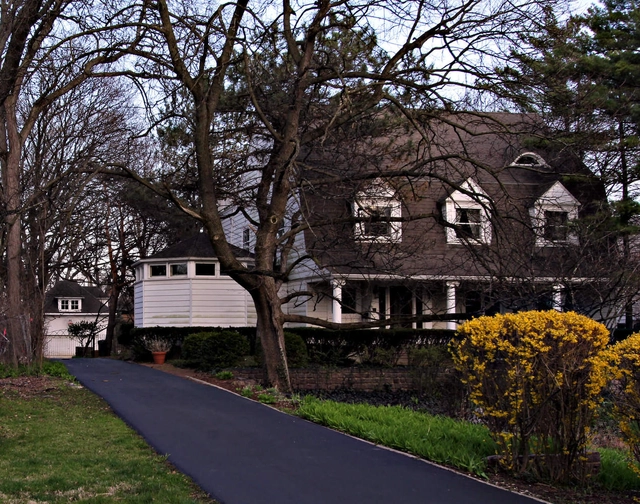
Contemporary view of the Bagley House. Image Courtesy of Patrick Mahoney, AIA
Less than two months ago, the future of an 1894 Dutch Colonial-style home designed by Frank Lloyd Wright wasn’t looking all that bright after it hit the market for $1.3 million in the Chicago suburb of Hinsdale, Illinois. As of this week, however, the historic Frederick Bagley House, described by the nonprofit Frank Lloyd Wright Building Conservancy as a “unique and irreplaceable” early work of Wright, has found a very happy ending—or, more aptly, a new beginning.
Boats offer delightful distractions for a surprisingly large number of architects. So many in fact, that there seems to be something about boats that appeals specifically to those trained in architecture.
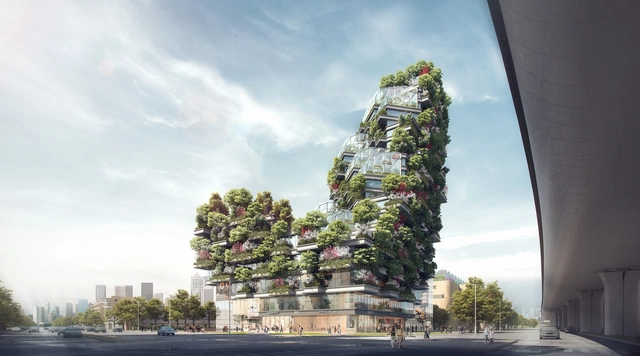
Courtesy of Lifang International Digital Technology Co., Ltd. Stefano Boeri Architetti
Stefano Boeri Architetti combined the concept of "Vertical Forest" and "Farm of agricultural industry" in its newly-unveiled urban vertical farm titled "Urban Vertical Farm of Brightfood". The project explored a new way of urban production in metropolitan areas by combining greenery, food production, and visual aesthetics in a 110,000 square-meter structure. In addition to its ecological features, the new urban agricultural complex offers commercial and office spaces in the vibrant city of Shanghai.
London’s Design District, the new purpose-built creative hub at the heart of the Greenwich Peninsula, opened its doors to the public and is set on becoming a prominent destination for the city’s creative community. Comprising 16 buildings designed by a collective of eight renowned architectural studios and with landscaping by Schulze+Grassov, the project aims to gather startups, artists and entrepreneurs across many industries, generating a vibrant new neighbourhood.
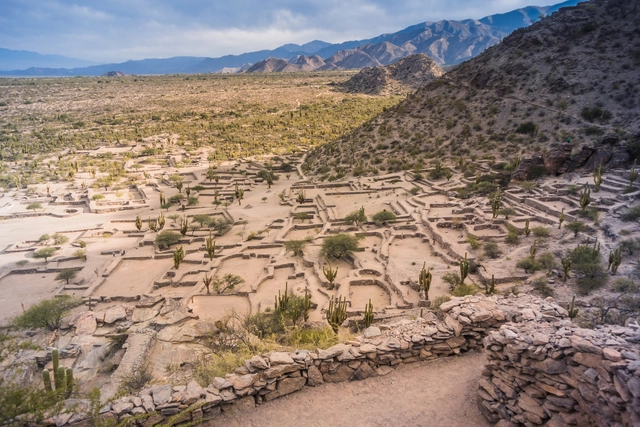
Quilmes Ruins, Tucumán, Argentina. Imagen de Guaxinim. Image via Shutterstock
One of the most advanced civilizations in Latin America, the Quilmes people inhabited what is today known as the Santa Maria Valley in the northwestern sector of the Tucumán province, in the center of the Calchaquíes Valleys. Their city contains remnants of village life from centuries ago, giving a clear view of life in the village from generations past, including the economy, religious sites, public and private spaces, and interactions with other civilizations. At its height, the Quilmes' city had 450,000 inhabitants prior to the Spanish invasion.
These settlements, built in the Calchaquíes Valleys since approximately the 10th century, are considered to be Argentina's first pre-Hispanic cities. Even though little remains of these cities, their ruins highlight a complex history of a material and spiritual culture ripe with social and economic advancements.
In the evolving campaign to combat climate change, big and bold solutions are increasingly easy to find, from the conceptual “water smart city” and ecologist Allan Savory’s vision for greening the world’s deserts to NYC Mayor Bill de Blasio’s plan to turn part of Governors Island into a “living laboratory” for climate research. Oyster reef restoration is occurring at nearly every critical junction along the eastern seaboard, from Florida to Maine. These are worthy efforts, and yet, when considered collectively, the onus for solving our climate crisis is being left largely to municipal governments and private actors, making most solutions piecemeal, at best. The success of one approach has little to no correlation with that of another. But what happens when all related solutions can be applied within a single, controlled ecosystem when environmentalism and urbanism are not at odds, but working in concert? Enter the experimental city.
https://www.archdaily.com/968595/rethinking-the-role-of-experimental-cities-in-combating-climate-changeJustin R. Wolf
Time magazine has released the World’s Greatest Places Of 2021, selecting 100 destinations from around the globe. With revitalized riverfronts, affordable artistic incubators, and superlative city-states, the list is a tribute to the built and natural environment that found a way “to adapt, build and innovate”, amidst the challenges of the past year.
Encompassing the world’s longest pedestrian suspension bridge, London’s Design District, new repurposed spaces in Helsinki, Historic gems in South Korea, and Hanoi’s renewed life in the old quarter, the World’s Greatest Places Of 2021 has a considerable selection of architectural destinations.
As our cities densify and building types become more and more mixed-use, we tend to spend a lot of time in noisy environments. When we think about acoustic comfort, we rarely think of places like restaurants, venues, and big offices; places with a lot of people, machinery, and background noise. The quality of sound can entirely change the experience of people in an interior space, and improving the space's acoustic quality relies on treating all surfaces, from walls to ceilings, and flooring. In this article, we will present a variety of solutions for ceilings, flooring, and walls, their different combinations, and a simple guide of how to apply them correctly in public spaces without compromising the aesthetic of the interior.
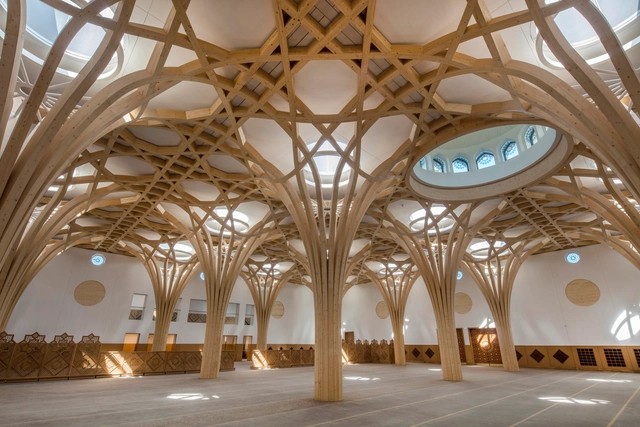
The Royal Institute of British Architects (RIBA) has revealed the six shortlisted buildings contending for this year's RIBA Stirling Prize. Celebrating its 25th year, the award is given to the United Kingdom's best new building. The selected buildings demonstrate "the innovation and ambition that lies at the heart of exceptional architecture", varying from a city mosque in Cambridge to a remote bridge in Cornwall and a vibrant gathering space in Kingston.
Since before the first industrial revolution, sociologists, historians, and urban planners have been addressing the relationship between the city and the countryside, but this debate has become more pressing nowadays with the spread of megacities, typically with a population of more than 10 million people. With more and more people living in urban areas, it is imperative to think of solutions for food production within cities, thereby making cities more independent from rural areas, which have historically been responsible for the supply of food to the entire planet.
The idea that cities will become self-sufficient in food production in the near future is both unrealistic and naive. Nevertheless, small initiatives such as urban gardens, either at home or public gardens run by the community, might be a good starting point for a much bigger change in the future. Or perhaps they simply represent a desire to return to one's roots and achieve a slightly slower lifestyle.
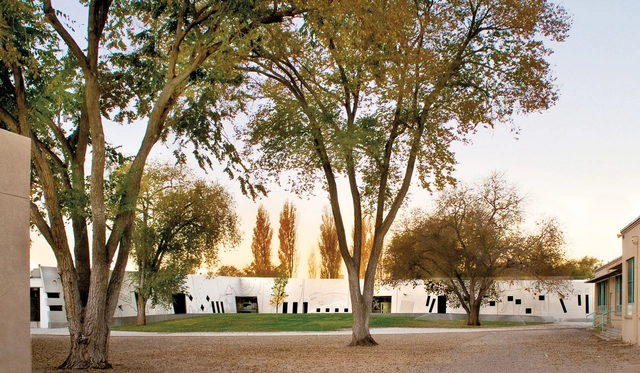
VALLE VISTA ELEMENTARY SCHOOL Suina Design + Architecture, founded by Elizabeth Suina of Cochiti Pueblo, conceived a much-needed addition to an existing 1952 structure in Albuquerque. The structure’s most salient feature is a concrete outdoor Learning Wall, gently tilted up and punctuated with geometric openings and patterns that relate to the school’s curriculum and various Chacoan motifs, such as the sun-cast Sun Dagger.. Image Courtesy of Suina Design + Architecture
In this week's reprint from Metropolis magazine, authors Theodore (Ted) Jojola and Lynn Paxson talk about embracing “place knowing” as a process to understand building and planning, and highlight modern achievements in Pueblo architecture.
The Pueblo people of the Southwest have been stewards of their lands for millennia. In contrast to the colonial and territorial experiences of many tribal nations, the Pueblos avoided being displaced from their homelands. This prevented many of their places from being erased. As such, their ancient worldviews still remain at the core of their planning and design. Nothing is so important as their imprint on the expression of architecture, especially its form and function.




.jpg?1632206620&format=webp&width=640&height=580)
.jpg?1632206607 "© Kendall McCaugherty © Hall+Merrick Photographers")

.jpg?1632206604 "© Kendall McCaugherty © Hall+Merrick Photographers")
.jpg?1632206620 "© Kendall McCaugherty © Hall+Merrick Photographers")
.jpg?1632206620)








.jpg?1632124377)