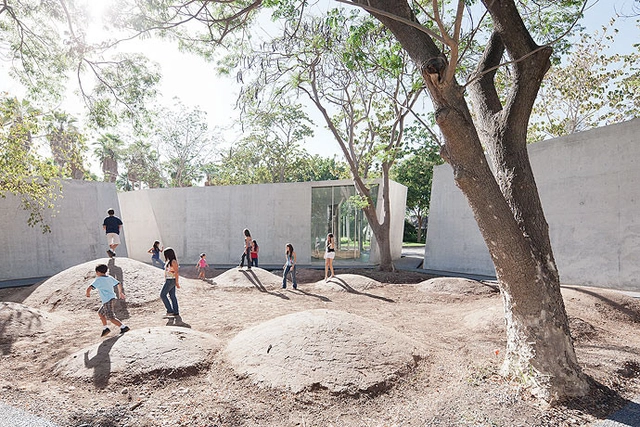
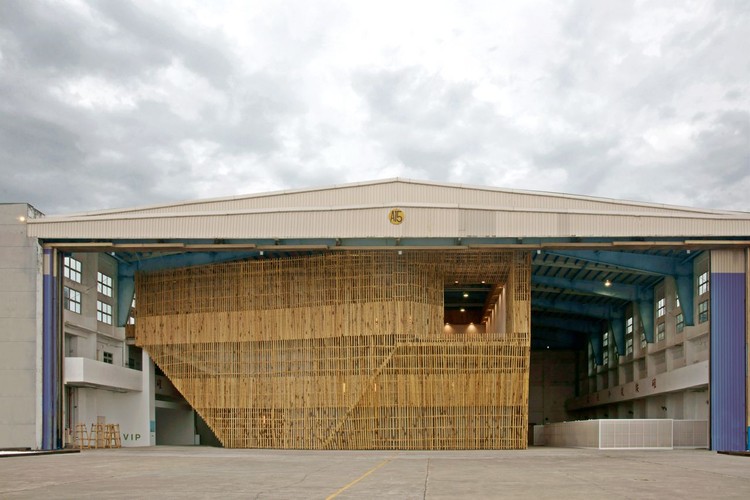
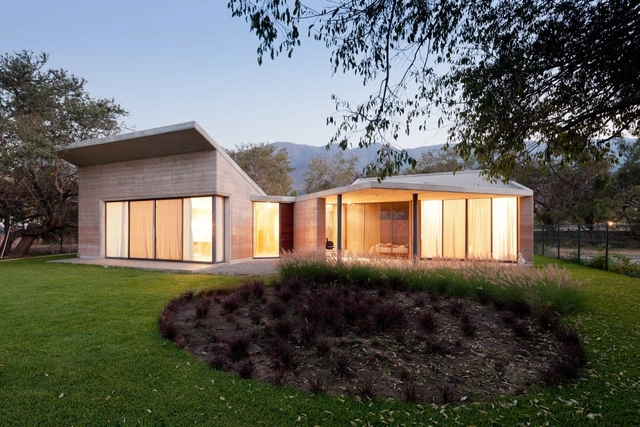
The simple concrete-hewn structures designed by Tatiana Bilbao acknowledge their context in a way that most buildings don't. In a recent interview with uncube Magazine, Bilbao explains how her outlook on design shifted after she realized that "the quality of architecture relies heavily on the people who build it and what techniques and materials they are used to." And it seems this novel approach hasn't gone unnoticed - she recently showed her work at Berlin's Architekturgalerie and is on a star-studded shortlist to design the Menil Drawing Institute. Read the full interview here.
https://www.archdaily.com/444493/redefining-context-with-tatiana-bilbaoKatherine Allen
Most architects are familiar with the work of Iwan Baan, the eminent photographer who has documented some of the most famous buildings of our time. But what you may not know is that Baan had not originally intended to photograph architecture. Had it not been for a chance meeting with Rem Koolhaas, things may have turned out quite differently.
In the video above, Baan speaks with ERCO at the Louvre Lens, a SANAA-designed offshoot of the Paris Louvre located in a small mining town in the north of France. As he traipses around the museum's campus, he speaks about everything from his approach to photography (one that is less wrapped up in architecture than you might think) to the importance and transformative properties of light .
The list of architects that have collaborated with Zhang Xin’s development company, SOHO China, reads like the roster of an architectural dream team (which includes Zaha Hadid, Yung Ho Chang, Bjarke Ingels, Kengo Kuma, Kazuyo Sejima, Herzog & de Meuron, Thom Mayne, David Adjaye, Toyo Ito and others). So it’s no surprise that the self-made billionaire lectured to a packed house at Harvard University’s Graduate School of Design last Thursday. Xin spoke about her commitment to and love of design, explaining that her company’s mission is to bring a variety of architectural languages to China. And though SOHO’s projects are certainly experimental, Xin contends that her developer mindset actually helps meliorate the architect’s propensity to take the experiment too far—all without sacrificing the impressive and iconic forms of SOHO’s building portfolio.
WatchZhang Xin link her practice in real estate to larger global issues and catch a glimpse of two Zaha Hadid-designs currently under construction: Wangjing SOHO and Sky SOHO.
To celebrate excellence in architecture and urban design in New York City, the Municipal Art Society has announced the winners of this year’s MASterworks Awards. Starting with “Best New Building,” Steven Holl was awarded for his Campbell Sports Center in Manhattan. See who else was honored, after the break.
Videos
At the Clinton Global Initiative (l to r) Robert Ivy, FAIA; New Orleans Mayor Mitch Landrieu; Cameron Sinclair, co-founder Architecture for Humanity; Former U.S. President Bill Clinton; Martyn Parker, Chairman Global Partnerships at Swiss Re; Alex Karp, co-founder Palantir; Judith Rodin, Ph.D, President of The Rockefeller Foundation. Image Courtesy of The AIA
Last week, we noted how the American Institute of Architect's (AIA) participation with the Clinton Global Initiative (CGI), as well as it's many other initiatives, signify the organization's commitment to putting resiliency on the agenda. The following article, written by Brooks Rainwater, the Director of Public Policy at the AIA, outlines these efforts and emphasizes how architects are tackling today's most pressing global challenges.
Architects are increasingly demonstrating their ability to help solve large-scale problems in the areas of resilience and health. At the same time the continued ascendancy of social impact design has helped elevate the conversation and prescribed a needed emphasis on equity considerations, uplifting global populations, and the idea that design should be for and impact all people.
With more than 1,000 global leaders convened in New York last week for the Clinton Global Initiative Annual Meeting it is an ideal time to ask the question, how does design fit into the global conversation?
Together with the African Wildlife Foundation (AWF), MASS Design Group is helping to build 15 conservation primary schools over the next 10 years in African landscapes, home to some of world's most important wildlife populations, including elephants, rhinos, great apes, and lions. They will design non-traditional educational campuses for primary school children that offer lessons and other services extending beyond the classroom walls.
Starting your own firm is a daunting task, especially if you're not completely sure of what you're getting yourself into. Author Mark LePage, founder of Entrepreneur Architect knows this firsthand. This guide, originally published on Entrepreneur Architect, discusses the financial implications of starting your own firm and acts as a guide through the challenge, leading you to success.
How much will it cost to start my own architecture firm?
That is a question that many of my readers ask me each week. The answer will certainly differ depending on whom you ask. When architects ask me how much it will cost to launch an architecture firm, I say, “as much as you need.”
Below I will discuss the very basics required to launch a sole proprietor architecture firm. Depending on your circumstance and the region in which you live, the numbers may vary for you.
Design is subjective, and often quite personal. So, in a field where being able to explain yourself is critical, is designing by instinct foolish? In this article, originally published by Metropolis Magazine as "Designing with Metaphors," IDEO Boston manager, Michael Hendrix, argues that not only is it sensible, it can make for truly evocative and powerful work.
When you make a design choice, how do you justify it to others? Do you wrap it in a layer of industry jargon? Do you construct an elaborate post-rationalization? I admit I’ve done both when I’ve been at a loss to express my intuition. But new scientific research confirms it is exactly that intuition—built upon universal experiences and human truths— that determines whether a design is relevant or not.
If Henry Ford were reincarnated as a bike maker, Le Corbusier as an architect of buildings and cities for bikes, and Robert Moses as their bike-loving ally in government, today’s bike plans would be far more ambitious in scope. Ford would be aiming to sell billions of bikes, Corb would be wanting to save the whole world, and, even if it took him a lifetime, Moses would be aiming to leave a permanent mark.
They would want to give bicycle transport a leg-up, like the leg-up the motorcar received from farmlands being opened for suburban development. So who are our modern-day, bicycle-loving Le Corbusiers? And what, exactly, is their task?
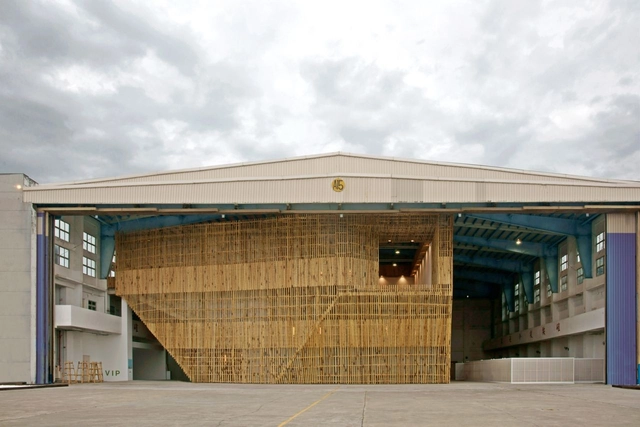
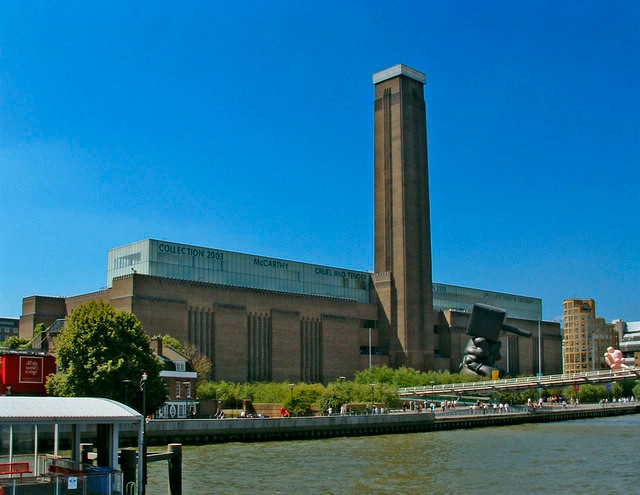
London’s Bankside Power Station stood disused from 1981 until 2000, when it opened to the public as The Tate Modern. Swiss architects Herzog & de Meuron approached the conversion with a relatively light hand, creating a contemporary public space without diminishing the building's historical presence. The impressive cultural icon has since become the most visited museum of modern art in the world, revitalizing its formerly sequestered, industrial neighborhood.
The syn chron space by Carsten Nicolai. Image Courtesy of artcentron.com
“The modern architect is designing for the deaf.” Canadian composer R. Murray Schafer makes a valid point. [1] The topic of sound is practically non-existent in modern architectural discourse. Why? We, as architects, think in terms of form and space; we balance scientific understanding and artistic vision. The problem is, we have a tendency to give ample thought to objects rather than processes and systems. Essentially, our field is ocular-centric by nature. So how do we start to “see” sound? And more importantly, how do we use it to promote health, safety and well-being?
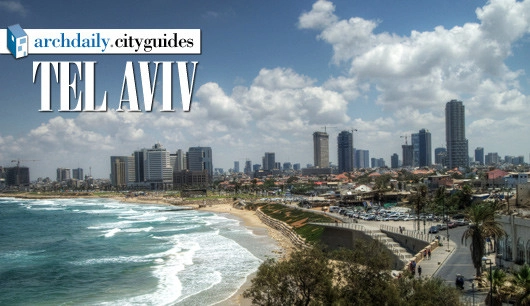
This AD Architecture City Guide is dedicated to the vibrant city of Tel Aviv, originally established as a garden-city on the sandy shores of the Mediterranean in 1909. Although widely known as “The White City” for boasting the world’s largest collection of International Style Buildings, Tel Aviv is not merely a monochromatic Bauhaus colony: it presents a rich mosaic of locally interpreted styles, from Eclectic to Brutalist to contemporary, which are the result of foreign and locally-born architects who adapted to the local cultural and climatic conditions.
Join us for our architectural city guide through the "Non-Stop City" after the break…
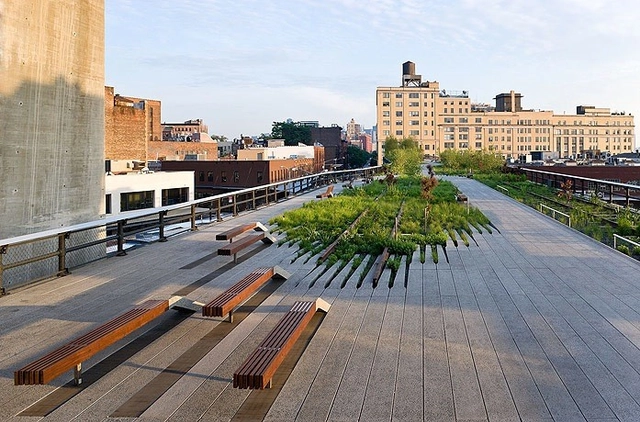
The National Building Museum has awarded the 15th Vincent Scully Prize to Joshua David and Robert Hammond, the founders of the High Line in New York. In 1999 the pair formed the non-profit organisation Friends of the High Line; this award recognizing their efforts in transforming the abandoned structure is the latest accolade for the internationally celebrated project. David and Hammond were also awarded the Jane Jacobs Medal in 2010.
Read more about the award and the High Line after the break.












.jpg?1378430764&format=webp&width=640&height=580)
.jpg?1378430752&format=webp&width=230&height=230&crop=true)
.jpg?1378430764&format=webp&width=230&height=230&crop=true)


.jpg?1378430764)