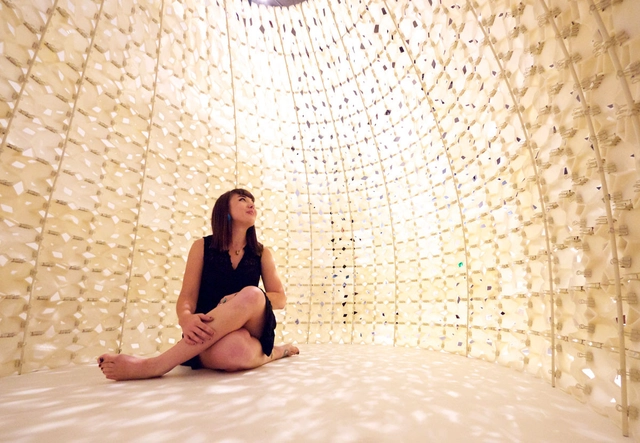
A portrait of Moore, who was always more interested in how people moved through spaces—and the resulting fragmentary views—than a single beauty shot. Image Courtesy of Charles Moore Foundation
“Who threw this tantrum?” This question sums up how Charles Moore’s peers reacted when they saw his Lovejoy Fountain project for the first time. Moore was always a bit unconventional by contemporary standards – he designed what others would not dare, creating a body of work that alludes to everything from Italian baroque forms to Mexican folk art colors to Japanese wood construction. Originally published as Why Charles Moore (Still) Matters on Metropolis Magazine, check out Alexandra Lange’s thoughtful piece on the influential architect after the break.
“Stop work. It looks like a prison.” That was the telegram from the developers in response to Moore Lyndon Turnbull Whitaker’s (MLTW) first design for the Sea Ranch, which celebrates its 50th anniversary this year. Architects Charles Moore, Donlyn Lyndon, William Turnbull, and Richard Whitaker, working with landscape architect Lawrence Halprin, had used sugar cubes to model the 24-foot module for each of the condominium’s original ten units. And that boxy choice, combined with the simplest of windows and vertical redwood siding, produced something more penitentiary than vacation (it’s sited on a choice stretch of Sonoma coast).
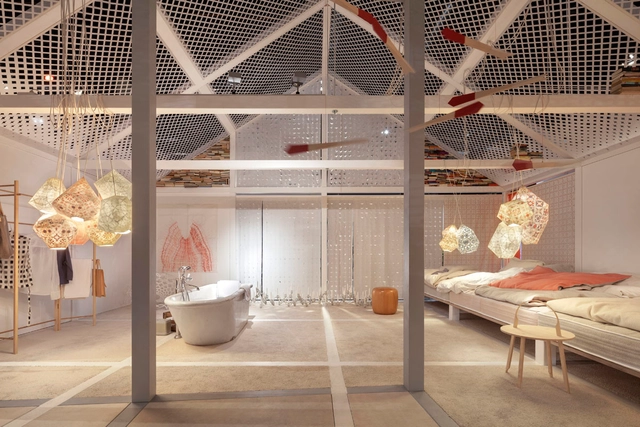
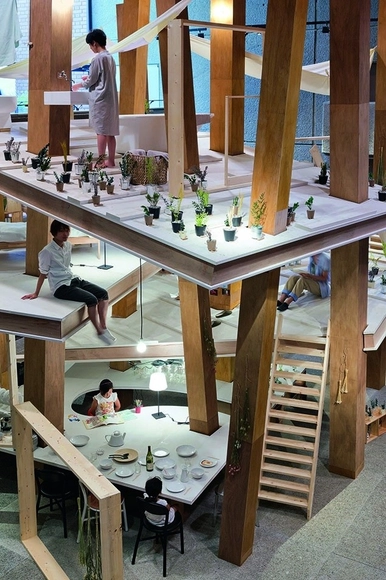
The space is filled with inventive details, including a 100-year-old stoneware tub (above) and a wall of 573 tools for the kitchen-cum-workshop (below). Image Courtesy of Constantin Meyer/Koelnmess
If you could design the ideal house of the future, what would it look like? Given the opportunity to answer this question, interior and product designer Louise Campbell turned to an unlikely source – Alice in Wonderland. To learn how the fairytale influenced the design, check out the following article, originally published as Through the Looking Glass on Metropolis Magazine.
Every year, the imm Cologne furniture fair hosts Das Haus, a life-size model of an ideal future house. In the past, architects and product designers—such as Zaha Hadid and Naoto Fukasawa in 2007— have teamed up to design their dream house, without pesky constraints like clients or budget. This year, Louise Campbell wore both hats. An interior and product designer, Campbell created what looked like a machine for communal living (or maybe the dwelling of a well-heeled Scandinavian commune).
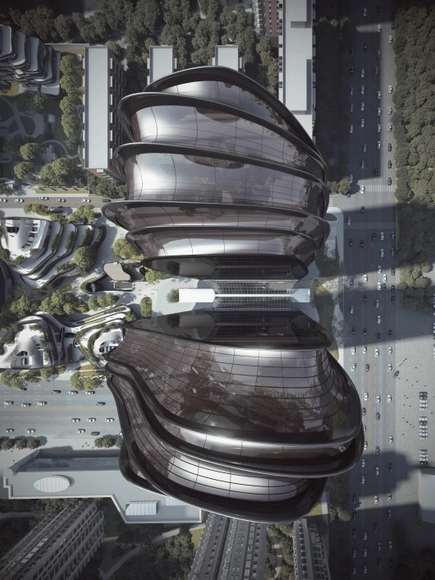
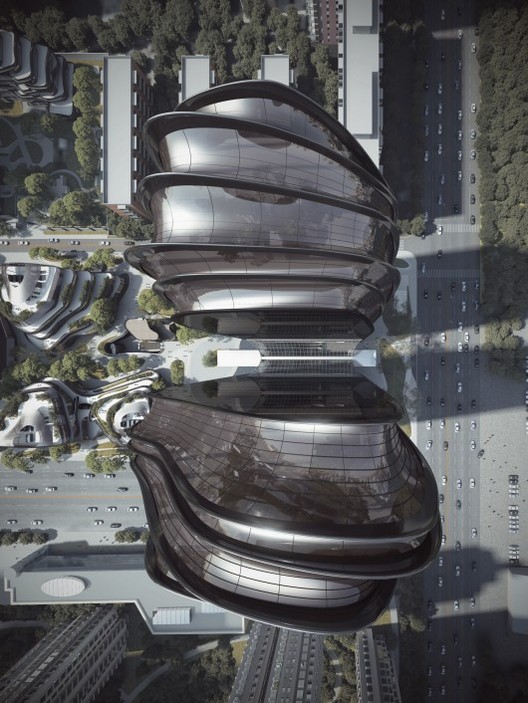
When you think about the future, how do you envision the built environment? According to this article, originally appearing on The Huffington Post as The Architecture of the Future is Far More Spectacular than You Could Imagine, the future is closer than we might think – current projects are already answering the imagined needs and desires of the next generation. From a tower with rotating floors to a park with the ability to cleanse raw sewage, check out fourteen projects believed to embody the architecture of tomorrow, after the break.
The Brussels-based design initiative MANIERA invites emerging architects to design series of limited edition furniture. This April, their first show opened with works by the Belgian architects OFFICE KERSTEN GEERS DAVID VAN SEVEREN and the Dutch artist and architect Anne Holptrop. The objects are on view in the loft-like living space of Kwinten Lavigne and Amaryllis Jacobs, the couple who founded MANIERA. Since both have a background in the art world, it’s not surprising that the design objects shown at MANIERA are more than just furniture, but rather a deliberate search for collisions between the realms of architecture, design and art.
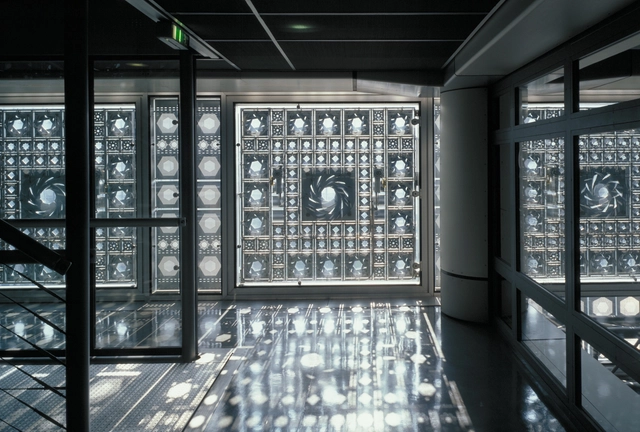
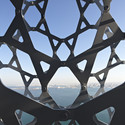
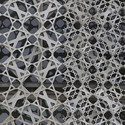
The delicate mashrabiya has offered effective protection against intense sunlight in the Middle East for several centuries. However, nowadays this traditional Islamic window element with its characteristic latticework is used to cover entire buildings as an oriental ornament, providing local identity and a sun-shading device for cooling. In fact, designers have even transformed the vernacular wooden structure into high-tech responsive daylight systems.
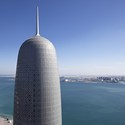
Jean Nouvel is one of the leading architects who has strongly influenced the debate about modern mashrabiyas. His Institut du monde arabe in Paris was only the precedent to two buildings he designed for the harsh sun of the Middle East: The Doha Tower, which is completely wrapped with a re-interpretation of the mashrabiya, and the Louvre Abu Dhabi museum with its luminous dome.
Videos
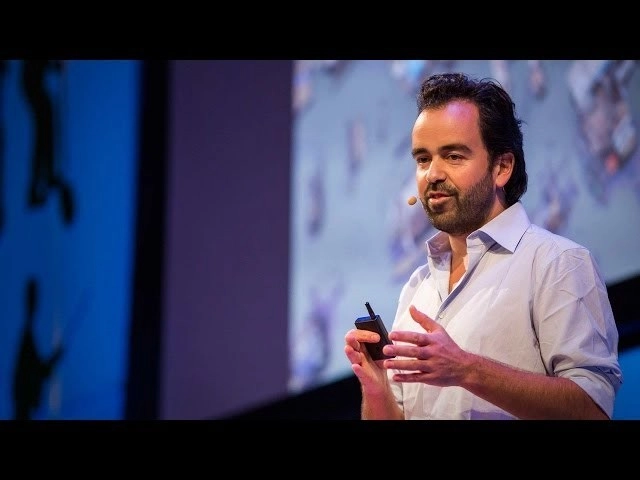
Iwan Baan on the unexpected in his travels as an architectural photographer and documenter. Image via TED Talk on YouTube
Are you feeling short on inspiration today? For a jump-start, try watching one of these twenty TED Talks – a follow-up to last year's post "The 10 Most Inspirational TED Talks for Architects." Wherever your interests lie, the passionate people featured in these videos - from WikiHouse founder Alastair Parvin to famed photographer Iwan Baan and architectural great Moshe Safdie - will get your creative juices flowing. See them all, after the break.
Leadership in Energy and Environmental Design (LEED), with its advantages and disadvantages, has dominated the green building certification market for a long time. But now alternatives - like the GBI's Green Globes, the Living Building Challenge, and Build It Green – are beginning to emerge. So how does a competitor like Green Globes shape up in comparison to LEED? And what does this developing competition mean for green rating systems in general? To learn more, keep reading after the break.
The Brooklyn based firm The Principals are known for their interactive design, industrial design and installation work. The video above hi-lights their latest "bionic" installation, which actually responds and reacts to human movement thanks to myoelectric sensors that pick up voltage increases on the skin when a muscle contracts. To learn more head over to their website - and make sure to check out all of The Principals other installations featured on ArchDaily.
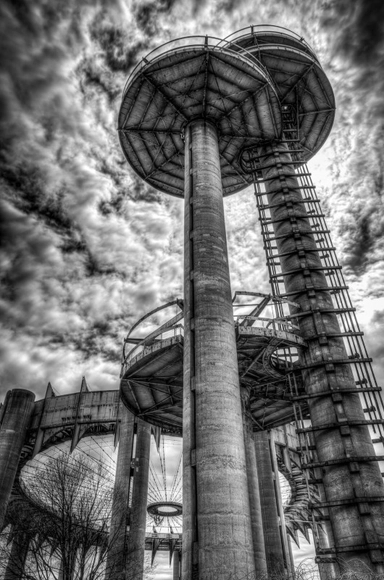
If you haven't heard of CyArk yet, make sure to check out their recent Kickstarter project. The not-for-profit company digitally preserves some of the world's most important sites: including Easter Island, Mt. Rushmore and The Pantheon, to name a few. Now the group is headed to New York to preserve Philip Johnson and Lev Zetlin's 1964 World’s Fair New York State Pavilion. Since the fair ended, the pavilion has fallen into disrepair and been heavily vandalized. With assistance from the University of Central Florida, they plan to release the digitally preserved 3D files to the public, for free. To help preserve this "National Treasure," check out their Kickstarter page.
We will be publishing Nikos Salingaros’ book, Unified Architectural Theory, in a series of installments, making it digitally, freely available for students and architects around the world. The following chapter discusses the complexity of form languages and describes how to use the form language checklist to measure these complexities. If you missed them, make sure to read the introduction, Chapter One, Chapters 2A and Chapter 2B, and Chapter 3 first.
There exists a volume of writings by architects in the early 20th century, and we can look through them for the form languages of Modernism. Unfortunately, the useful material turns out to be very little, most of it describing not a form language but rather marketing and declarations of a political nature. Moreover, those pieces of very personal form languages are presented as normative theories: a prescription of what to do and what not to do, with the weight of universal ethics, even though they are based solely on opinion, not empirical observations or systematic study.
In this article, first published by Indochino as “What makes some buildings happy?” architect Bruce Haden, principal at DIALOG in Vancouver, discusses why some places feel good to be in and why some just have that awkward, quiet feeling.
Award-winning architect and urban planner. Dad. Researcher on happy vs. lonely cities. We talked to Bruce Haden about why some places feel good to be in, and some just have that awwwkward, quiet feeling.
Bruce Haden has only been an architect and a bartender. So ask him what he likes about it, and his answer is he doesn’t really know anything else. In high school, he didn’t want to pick between calculus and woodshop, so he ended up in a profession that’s part art, part engineering (and a fair amount of politics). Now, he works on a lot of large, public buildings. But he also spends a lot of time thinking about happy and lonely cities. He talks about how working with a client is like dating, why some buildings are worth being in and others are just empty, and whether adventure or luxury wins.
The following six "miracle" materials could be headed straight into your home, office, car and more. Dina Spector at Business Insider recently rounded up the six most promising materials. As of now, their potential applications have just scratched the surface, but the possibilities are endless. Presented by AD Materials.
Scientists are constantly on the look out for lighter, stronger, and more energy-efficient materials. Here's a glance at some materials that will change the way we build things in the future.
https://www.archdaily.com/508576/six-miracle-materials-that-will-change-their-industriesDina Spector, Business Insider
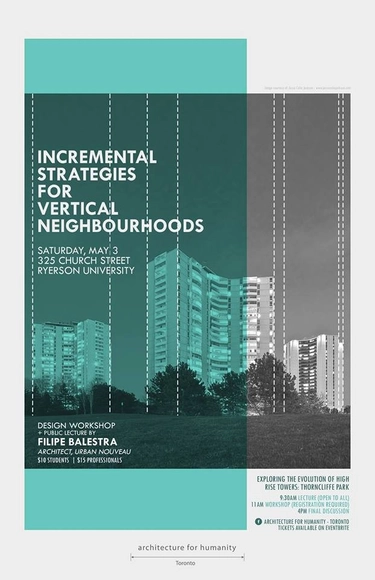
According to the most recent national census in Canada, almost half of Toronto residents are immigrants, one-third of whom arrived in the past ten years. To allow the city to adapt to this surging flow of immigrants, Architecture for Humanity Toronto (AFHTO) has called upon students and professionals from various backgrounds to rethink Toronto's urban fabric - and, in particular, its high-rise developments - by establishing a series of lectures and workshops entitled "Incremental Strategies for Vertical Neighborhoods."
At the inaugural event a few weeks ago, Filipe Balestra of Urban Nouveau* was invited to speak about his work and contribute to a design charrette inspired by the City of Toronto's Tower Renewal program. For more on Balestra and the event, keep reading after the break.
The largest private project New York City has seen in over 100 years may also be the smartest. In a recent article on Engadget, Joseph Volpe explores the resilience of high-tech ideas such as clean energy and power during Sandy-style storms. With construction on the platform started, the Culture Shed awaiting approval, and Thomas Heatherwick designing a 75-Million dollar art piece and park – the private project is making incredible headway. But with the technology rapidly evolving, how do investors know the technology won't become obsolete before its even built?
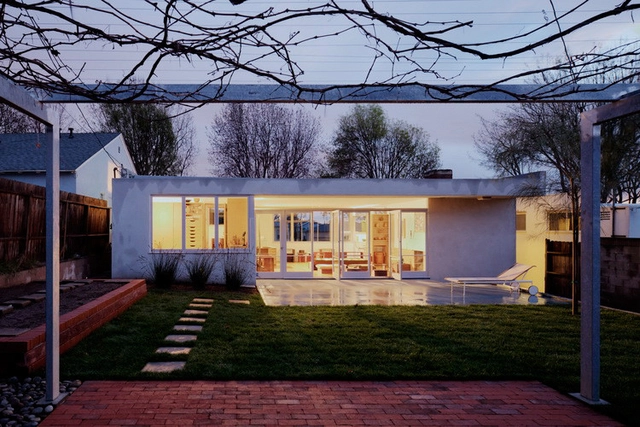
How do you make a space more livable by current standards, while simultaneously upholding the original architect's design intentions? It's a delicate endeavor, but one that was recently accomplished by a couple of architects in Southern California. Originally published by AIArchitect as "Pacific Coast Sun Rises on Modernist House Restorations," this article investigates the thoughtful restorations of three homes designed by the pioneering modernists Rudolph Schindler, John Lautner, and Charles and Ray Eames.
Los Angeles’ early Modernist pioneers are no longer around to oversee the restoration of homes they designed more than a half-century ago, but their landmark projects are offering a new generation of designers historic case studies in Modernist preservation that grow more and more significant with each passing day. Vintage architectural renderings and drawings, photos, and notes are all ingredients these architects use to summon the spirits of Rudolph Schindler, John Lautner, and Charles and Ray Eames, to name a few, bringing their early works of California Modernism back to life.
Taschen’s latest volume draws together the architectural underdogs that, despite their minute, whimsical forms, are setting bold new trends for design.
When economies falter and construction halts, what happens to architecture? Rather than indulgent, personal projects, the need for small and perfectly formed spaces is becoming an economic necessity, pushing designers to go further with less. In their new volume Small: Architecture Now!, Taschen have drawn together the teahouses, cabins, saunas and dollhouses that set the trends for the small, sensitive and sustainable, with designers ranging from Pritzker Laureate Shigeru Ban to emerging young practices.
Is it more dangerous to be a soldier or a construction worker? Astonishingly, it’s the latter. According to a recent report in the Guardian, 448 British soldiers have been killed in Afghanistan since 2001. In the same period, 760 construction workers died on British building sites.
Life is cheap at the dirty end of architecture and not just in the UK. The number of fatalities of largely migrant workers from the Indian subcontinent imported to implement Qatar’s architectural ambitions, notably the stadiums for the 2022 World Cup, has been the subject of much hand-wringing discussion. And rightly so − over 400 Indian and Nepali building workers died in Qatar in 2013, and the International Trade Union Confederation (ITUC) has warned that up to 4,000 workers may die before a ball is finally kicked in 2022.
If 400 people perished in a plane crash, there would be exhaustive inquiries into aircraft safety, lessons would be learnt and strategies of improvement implemented. There would also be a palpable sense of loss and accountability. But a fatality here and there on a construction site over a period of time does not have the same galvanizing impetus.
Hale County, Alabama is a place full of architects, and often high profile ones. The likes of Todd Williams and Billie Tsien have ventured there, as have Peter Gluck and Xavier Vendrell, all to converge upon Auburn University’s Rural Studio. Despite the influx of designers, it is a place where an ensemble of all black will mark you as an outsider. I learned this during my year as an Outreach student there, and was reminded recently when I ventured south for the Studio’s 20th Anniversary celebration. While the most recent graduates took the stage, I watched the ceremony from the bed of a pick-up truck, indulging in corn-coated, deep-fried catfish, and reflected on what the organization represents to the architecture world.
Since its founding in 1993 by D.K. Ruth and Samuel Mockbee, the Studio has built more than 150 projects and educated over 600 students. Those first years evoke images of stacked tires coated with concrete and car windshields pinned up like shingles over a modest chapel. In the past two decades, leadership has passed from Mockbee and Ruth to the current director, Andrew Freear, and the palette has evolved to feature more conventional materials, but the Studio remains faithful to its founding principal: all people deserve good design. Now that it is officially a twenty-something, what canRural Studio teach us about good design?
https://www.archdaily.com/505030/on-its-20th-anniversary-what-rural-studio-continues-to-teach-us-about-good-designRennie Jones
Originally published in Metropolis Magazine as "Possibilities over Prescriptions," this article by Marshall Brown suggests that we open up the conversation to a wider range of possibilities for the Barack Obama Presidential Library. Brown asks "Rather than narrowing the president’s choices based on race, what if the field of candidates could be expanded?"
The official process to build the Barack Obama Presidential Library has finally been launched. After years of gossip and rumors about architects and sites, this could be the moment for some intelligent and informed debate among the design community. Unfortunately, the conversation so far has been dominated by narrow prescriptions about what the library should be, who should design it, and where it should be located, as opposed to broader speculation about what it could be. So I propose that, rather than making prescriptions to the president based on a narrow set of perceived realities, we can help him by expanding the conversation and laying out a broader set of possibilities.
https://www.archdaily.com/505012/forget-race-here-are-the-issues-we-should-be-considering-for-the-obama-library-designMarshall Brown
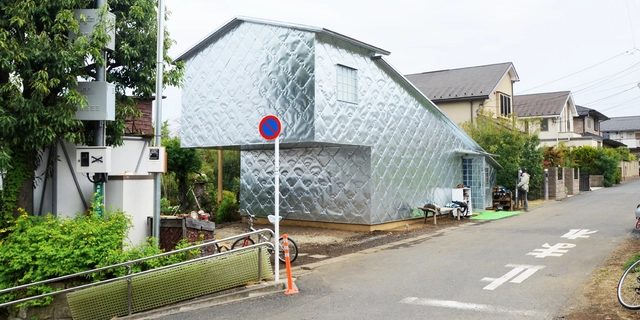
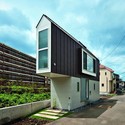
A new private house designed by an exceptional Japanese architect, Terunobu Fujimori, has opened. The new building is located in a small provincial town near to Tokyo. Neighbored by typical one-family residences, the newcomer comes to the fore. Different, shiny and apparently softmetallic façade catches the visitor’s eye.
Yet the scaleof the building is much smaller than one might expect. Every height, width and depth are accurately measured and left from a certain point of view spatially stingy: no waste is admissible here.
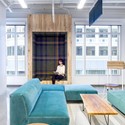
Although office design has dramatically and drastically changed over the course of the 20th century, we aren't finished yet. San Francisco firmO+A is actively searching for today's optimal office design, designing work spaces to encourage both concentration and collaboration by merging elements from the cubicle-style office with those popularized by Steve Jobs. In this article, originally published by Metropolis Magazine as “Noises Off,” Eva Hagberg takes a look at some of their built works.
In the beginning was the cubicle. And the cubicle was almost everywhere, and the cubicle held almost everyone, and it was good. Then there was the backlash, and the cubicle was destroyed, put aside, swept away in favor of the open plan, the endless span of space, floor, and ceiling—punctuated by the occasional column so that the roof wouldn’t collapse onto the floor plate—and everyone talked about collaboration, togetherness, synergy, randomness and happenstance. Renzo Piano designed a New York Times building with open stairways so writers and editors could (would have to) run into one another, and everyone remembered the always-ahead-of-the-curve Steve Jobs who, when he was running Pixar, asked for only two bathrooms in the whole Emeryville building, and insisted they be put on the ground floor lobby so that designers and renderers could (would have to) run into each other, and such was the office culture of the new millennium.
And then there was the backlash to the backlash. Those writers wanted their own offices, and editors wanted privacy, and not everyone wanted to be running into people all the time, because not everyone was actually collaborating, even though their bosses and their bosses’ bosses said that they should, because collaboration, teamwork, and togetherness—these were the new workplace buzzwords. Until they weren’t. Until people realized that they were missing—as architect Ben Jacobson said in a Gensler sponsored panel on the need to create a balance between focus and collaboration—the concept of “parallel play,” i.e. people working next to each other, but not necessarily with each other. Until individuality came back, particularly in San Francisco in the tech scene, and particularly in the iconoclastic start-up tech scene, where people began to want something a little different.
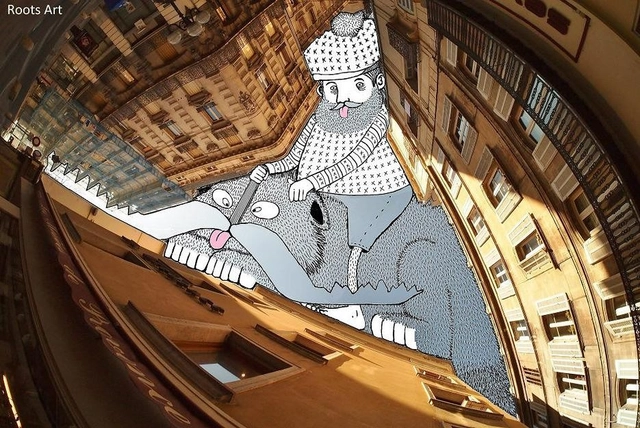
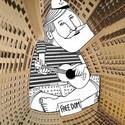
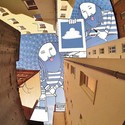
When you're surrounded by buildings on all sides, what do you see? In his SkyArt series, French artist Lamadieu Thomas gives us his answer. He takes claustrophobia-inducing photographs of urban landscapes through a fish-eye lens, framing the sky with rooftops and filling the negative space with playful illustrations. Thomas describes his whimsical approach to art as an attempt to show "what we can construct with a boundless imagination" and "a different perception of urban architecture and the everyday environment around us." To see more from the collection, continue after the break.
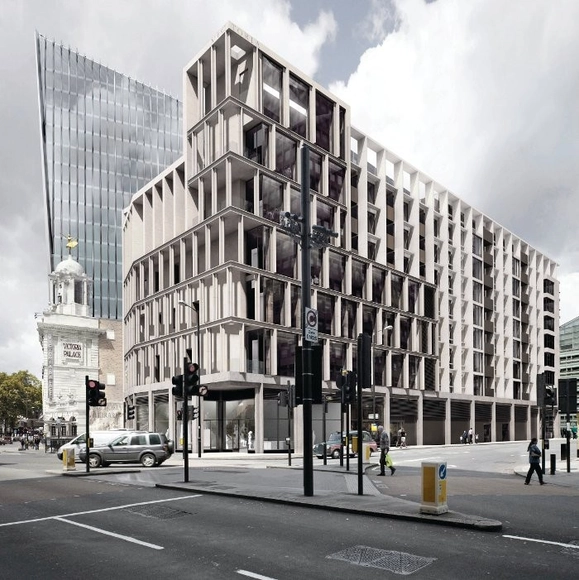
Victoria Library Housing and Office by Patrick Lynch for Land Securities. Image Courtesy of Design Curial
Although the design world has maintained a negative opinion of property developers for a very long time, the relationship between architect and developer has begun to evolve in the United Kingdom. In this article, first published in Blueprint issue #333 as "Why Architects Are Working for Property Developers," the cultural shift is explained and explored through case studies.
Developers have not, traditionally, enjoyed a very good reputation within the architectural fraternity - or with the general public, for that matter. At worst they are seen as sharp-suited pirates of urban space, stripping out centuries-old residential or commercial buildings to replace them with shoddy, design-by-numbers structures, thrown up with no driving objective other than maximising their cash before they move on.
But times have changed. Whether it's economic necessity - driven by the lack of buyers for bad housing or poor office space - or just good sense, there is a growing number of developers out there that appear to be cherry-picking some of the UK's better practices to transform our urban wastelands and unloved spaces. This new breed appears to enjoy and understand the value of architecture and design. Some of them even consider architects their natural collaborators - the creative yang to their commercial yin.
The following article is presented by ArchDaily Materials. In this article, originally published by Metropolis Magazine, Lara Kristin Herndon and Derrick Mead explore seven innovative architectural materials and the designers behind them. Some materials are byproducts, some will help buildings breathe and one is making the leap from 3D printing to 4D printing.
When Arthur C. Clarke said that any sufficiently advanced technology is indistinguishable from magic, he was speaking from the spectator’s point of view, not the magician’s. As our list of smart materials shows, technology solves difficult problems, but getting there requires more than just a wave of the magic wand. Each of the following projects looks past easy answers. Whether it’s a new way of looking at old problems, a new material that maximizes the efficiency of an old technique, or a new method to tap the potential of an abundant or underutilized resource, here are seven innovators who take technology out of the realm of science fiction.















.jpg?1400008808&format=webp&width=640&height=580)