


New footage from drone videographer Duncan Sinfield reveals that finishing touches are being applied to one of the Apple Campus's more important outward-facing buildings, and perhaps its most 'public' – the "Steve Jobs Theater". Designed and constructed using similar elements to the nearby office 'ring'—including large convex glazed panels and precise, rounded cladding panels—the theater's main function will be to host the company's world-renowned keynote addresses, in which they present new products.
Steve Jobs: The Latest Architecture and News
New Drone Footage Captures Finishing Touches Being Applied to Apple's "Steve Jobs Theater"
https://www.archdaily.com/874648/new-drone-footage-captures-finishing-touches-being-applied-to-apples-steve-jobs-theaterAD Editorial Team
The Spaceship Has Landed: Apple’s New Campus Opens

“It’s a pretty amazing building. It’s a little like a spaceship landed” - Steve Jobs
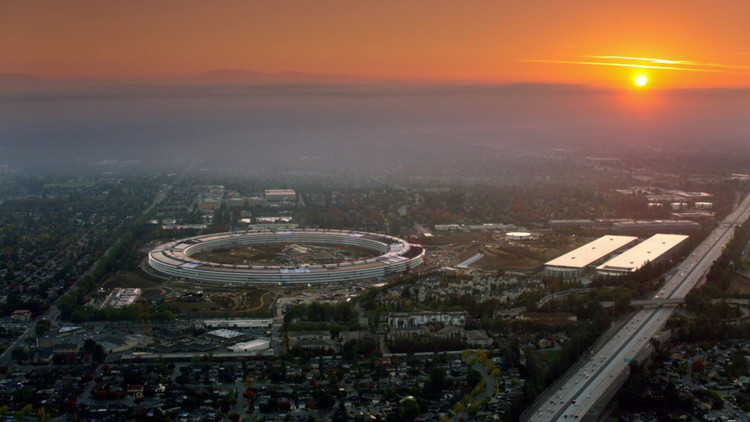
WIRED has published an in-depth article exclusively detailing Apple’s new headquarters that has now opened in Cupertino, California. Coined as the “One Last Thing” Steve Jobs had envisioned prior to his death in 2011, journalist Steven Levy takes the reader through a step-by-step tour of the new Apple Park campus guided by design spearhead Jonathan Ive and head of facilities Dan Whisenunt. Designed in collaboration with Foster + Partners, the sprawling 75 acres hosts facilities ranging from a 100,000 square foot Wellness Center, a hilltop theater, a 755-foot entrance tunnel (tiled Apple white of course) and immense 4-storey glass doors that open up the Ring’s equally giant café to the elements.


https://www.archdaily.com/871559/the-spaceship-has-landed-apples-new-campus-opensSabrina Syed
Video: Apple 2 Campus Headed Toward Completion
Foster + Partners' Apple 2 Campus is racing towards its December 2016 completion date. As seen in this drone video captured by aerial videographer Matthew Roberts, the exterior of the spaceship-like main building is nearly finished, with many of the campus' other buildings, such as the auditorium, the research & development center and the 100,000 square foot corporate fitness center, also approaching full realization.
https://www.archdaily.com/792929/video-apple-2-campus-headed-toward-completionPatrick Lynch
VIDEO: Apple Campus 2 Begins to Take Shape
Overlapped with commentary by the late Steve Jobs, a new video update by drone pilot Duncan Sinfield has captured Apple Campus 2 taking shape. According to the report on MacRumors, work is still being done on the main building's multi-level underground parking structure, while the west campus parking structure is nearly complete. The auditorium now has interior walls and progress is being made on the Tantau development housing research facilities.
https://www.archdaily.com/773017/video-apple-campus-2-begins-to-take-shapeKarissa Rosenfield
VIDEO: Norman Foster on Apple's Cupertino Campus

It has been a long road for Foster + Partners's team since first taking on the design for Apple's new campus in 2009. Four years later, despite the criticism and budget concerns, plans for Apple’s corporate headquarters have been approved by Cupertino’s planning commission. A recent video from the Cupertino City Council reveals some insight into the design decisions, including statements by Sir Norman Foster. As Foster states in the video, CEO Steve Jobs called him "out of the blue" in 2009 and said, "It's Steve: Hi Norman, I need some help."
https://www.archdaily.com/442837/video-norman-foster-on-apple-s-cupertino-campusEric Baldwin
The Motherships Are Landing: What Google’s New Headquarters Reveal About Apple 2

When Apple revealed the plans for their new campus in Cupertino, the responses to the “spaceship” were….varied, to say the least:
“Spectacular would be an understatement” ; “So disappointing…” ; a “…panopti-lawn…” ; and – my personal favorite – “Sphincter?” [1]
The announcement instigated a flurry of analyses and criticisms over the meaning of the design for the world – the Zen-like significance of the circle, the role of architecture in this technologically-driven age, the legacy and hubris of Jobs – but produced very little discussion over its meaning for the company itself.
Meanwhile, months before news of the “spaceship” landed, another internet giant was searching the California landscape for its own space to call home. Still very much under-wraps, the new Googleplex will be the first time Google builds a workplace completely from scratch. [2]
These projects will be the Magnum Opuses, the ultimate physical representations, of the two most influential Tech companies in the world, and the two share striking similarities. So let’s clash the plans of these two titans and take another look at Apple 2 – but this time in the light of Google – and see what they can tell us about these companies’ futures.
https://www.archdaily.com/217286/what-googles-new-headquarters-reveal-about-apple-2Vanessa Quirk