The devastating earthquake and tsunami that ravaged northeastern Japan in early March caused unimaginable damage and heartbreak to many. In response, Google has created a website named “Mirai e no kioku”, meaning “Memories for the Future”. The website allows the people of Japan to share photos and videos of their cities in an effort to preserve the memories collected over generations that may have been lost during the disaster. Google has also provided thousands of miles of Street View imagery that includes “Before” and “After” comparisons of the hardest hit areas.

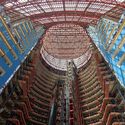
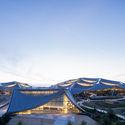
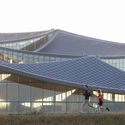
Google Mountain View © Ingenhoven Architects
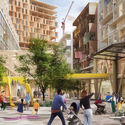
The award winning sustainable German architecture firm, Ingenhoven Architects, has been hired by Google Inc to design their new headquarters in Mountain View, California. Expected to begin construction in 2012, Ingenhoven approached the design with the idea that ‘the architecture should be an expression of the corporate culture and at the same time a model for sustainable architecture in the broadest sense surpassing the LEED-Platinum-Standards with its holistic concept’. Jordan Newman, a Google spokesman shared about Ingenhoven, “we’ve asked them to build the most green, sustainable building possible.”
Google’s offices in Milan, previously featured on ArchDaily can be viewed here. More about this exciting news from the architects following the break.
Our favorite browser is now Google Chrome. It works on every platform here at the office (Mac, Windows, Linux), it’s fast, secure, easy to use, helps you search the web and makes our life easier.
We also developed an extension for Google Chrome so you can see the latest projects featured at ArchDaily straight on your browser just as you can see on the image above. To install the extension just go to the Google Chrome Extensions link, click the Install button and follow the instructions.
If you want to further customize your Google Chrome, you can try the Michael Graves or Karim Rashid themes designed especially for the browser.
Happy browsing.
Architects: Camenzind Evolution
Location: Zürich, Switzerland
Project Team: Stefan Camenzind, Tanya Ruegg
Client: Google Inc.
Site Managment: Quadras Baumanagement Ltd.
Building Engineering: Amstein + Walthert Ltd.
Office Furniture Consultant: Büronauten Ltd.
Catering Consultant: Planbar Ltd.
Project Area: 12,000 sqm
Project year: 2007
Construction year: 2007-2008
Photographs: Camenzind Evolution
Over the course of the summer, Design It: Shelter Competition received submissions from people in 68 countries for a total of nearly 600 entries that met competition requirements. On the occasion of the Guggenheim Museum‘s 50th Anniversary, they are pleased to announce the two winning entries.
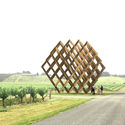
David Mares’s CBS – Cork Block Shelter, won the People’s Prize after receiving 64,875 votes out of more than 100,000 votes submitted online by voters around the world; and David Eltang’s SeaShelter, which was selected by a jury of architecture and design experts for the Juried Prize. Prizes include airfare and two nights accommodation for two in New York City, behind-the-scenes tours of the Guggenheim Museum and Google offices, and Google SketchUp Pro licenses.
Images of the two winners and videos from the competition after the break. read more »
The recent release of Google Sketchup 7.1 gave us powerful tools to easily create accurate models of urban contexts, with the integration of Street View for textures and better geo location of models.
And yersterday, Google released World Builder, a web based tool that enables users to easily model the buildings of 50 cities.
As you can see on the video it is very simple: you choose a regular volume to start with, and you adjust the width and height in views of the terrain from different angles, and voilá! you just modeled a part of the city, available for everyone at Google Earth and 3D Warehouse.
You can see the latest buildings modeled by users at 3D Warehouse… and if you refresh the page you will see how fast this is being populated.
Thank you Google :)
This morning Google announced Google SketchUp 7.1. This new version will be a free upgrade for existing Pro users, and has emphasis on three important aspects of this easy-to-use (yet powerful and extensible) software: performance, an improved version of LayOut (2.1) and collaboration.

As for performance, the engine has been improved and you will notice that orbiting, zooming and drawing can be quicker and smoother in 7.1, for both PC and Mac editions.

LayOut 2.1, the SU componente that enables you to create presentation boards and design documents straight from your model, has now the ability to apply dimensions to scaled SU models and vector graphics. Based on my personal experience, LayOut is very good to deliver quick construction documents and has helped me a lot working with furniture manufacturers. The new dimension tool is something I was waiting for.
LayOut 2.1 also includes snap to the model, an improveed Freehand tool, lists (bullet or numbered, very useful) in the text area, improved grids and improved copy/paste, making it easier to work with other design softwares. You can see more on the video and images below.
This year we not only celebrate the 142nd birthday of Frank Lloyd Wright, but also the 50 years of the Guggenheim, one of his master pieces (completed the year he passed away). These dates are not only commemorated with Lego Kits and exhibitions, but also with a very interesting competition held by the Guggenheim Museum and Google Sketchup.
The interesting part of the Design It: Shelter Competition is that it invites people from around the world to do pretty much what Wright made his apprentices at Taliesin: If you wanted to study to be an architect with Wright, you had to design and build a shelter in the desert outside of Phoenix, Arizona. Then you had to live and study in it, as it have been for the past 7 decades (you can see more of this at the Learn by Doing exhibition).
So, the competition invites people to design a small structure where someone might sleep and work. Your shelter should be created for a specific site anywhere in the world and geo-located in Google Earth. It also should conform to size constraints and must not include running water, gas or electricity. Then it must be submitted to Google 3D Warehouse, as described on the video (more details on how to enter here).
You can submit your shelter until August 23. After that, Taliesin students will pick 10 shelters for the People´s Choice Prize, and a jury will pick a shelter for the Juried Prize. You can read more about the prize and the jury here.
I like that this competition is not aimed to architects only, but to anyone who has a good idea for a shelter. As Frank Lloyd Wright, you don´t need formal architectural training, just a good idea and a pen. Or in this case, a 3d modeling tool easy and powerful as a pen.
Bonus: Architecture for Humanity decided to “hack” the competition, by adding a social component to it: The Purpose Prize. Instead of designing your shelter anywhere, do it for a specific community that can use your design to improve their living standard. So after submitting your entry to Google 3D Warehouse, submit it to the Open Architecture Network following these guidelines and you will be running for the Purpose Prize (US$500 + 10th Anniversary AFH Moleskine Folio). But the most important, you will be helping a community with your design skills, even if you don´t get awarded.

While walking around the booths at the AIA 2009 Convention, I stopped by Google, who are not only presenting Sketchup 7 but also showing architects how to market their firms using AdWords and YouTube.
Also, they have a very good discount for those of you who want to buy Google Sketchup Pro 7: a $100 off (retails at $495).
So, if you were looking to buy the latest version of one of the most easy (yet powerful) modeling tools just head to their store and use promo code SUAIA9, valid until May 15, 2009 on single-user licenses only.
You can also download the basic version for free.