What Does San Francisco’s New Apple Store Say About Commercial Architecture?

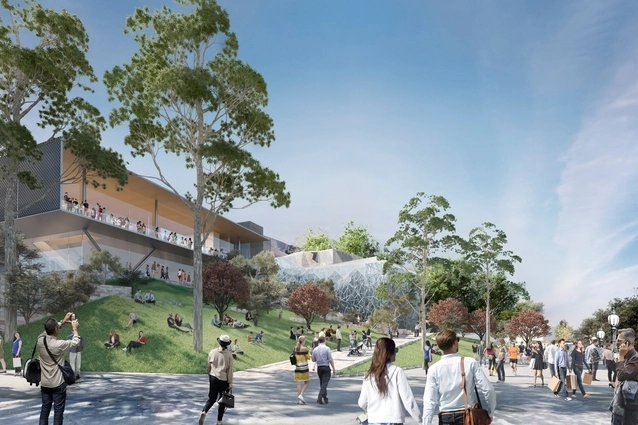
Rendering of the proposed Store in Union Square

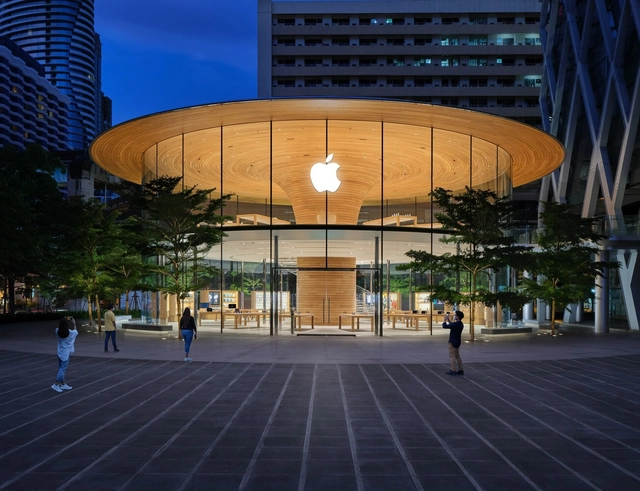
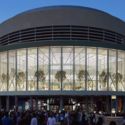
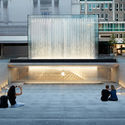
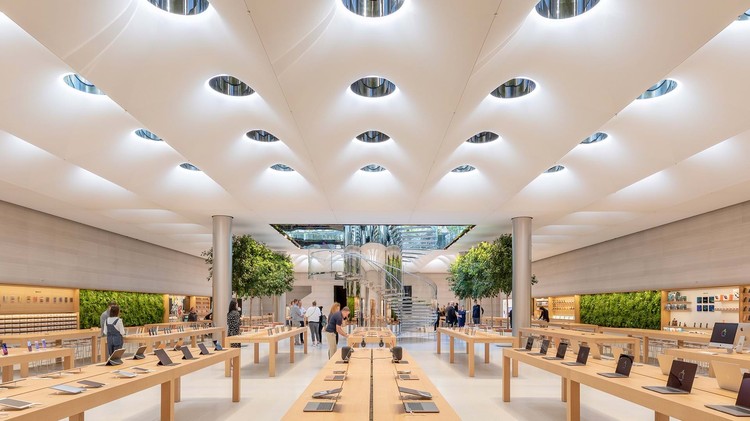
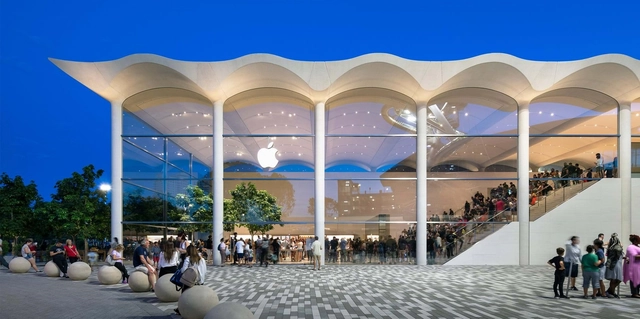
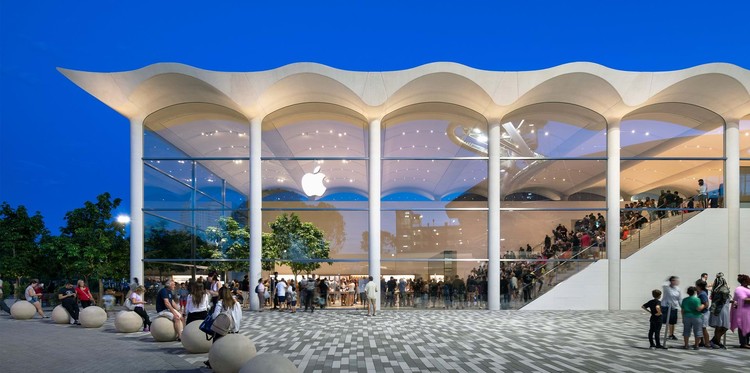
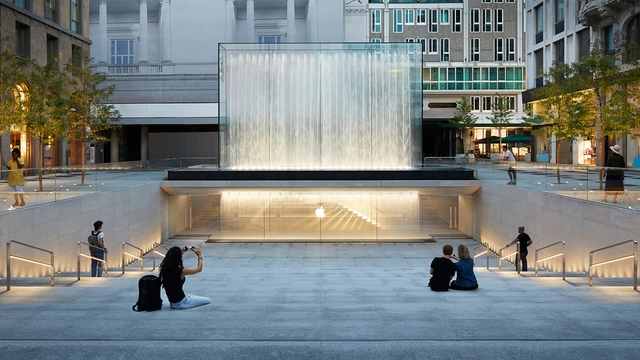
This past May, Apple filed plans to close its existing flagship retail store at 1 Stockton Street in San Francisco and move it three blocks north to one of the city’s most popular spots: Union Square. This plan was met with enthusiasm from city officials until they realized that Apple, and the store’s architects at Foster + Partners, were disregarding a beloved bronze folk art fountain by San Francisco sculptor Ruth Asawa that currently occupies the site. Many have also criticized the store’s design for being a characterless box of metal and glass that contributes nothing unique to the local landscape, raising awareness of a commercial architecture defined more by trademark and less by its surroundings.

More on Apple’s proposal in San Francisco and the problems of trademarked design after the break.

Updated Plans Released for Foster + Partners’ Apple Campus in Cupertino

© Foster + Partners, ARUP, Kier + Wright, OLIN,

The City of has released Apple’s revised campus plans, following the recent news criticizing Steve Job’s “sky-high requirements for fit and finish” that have resulted in a “ballooning budget.”

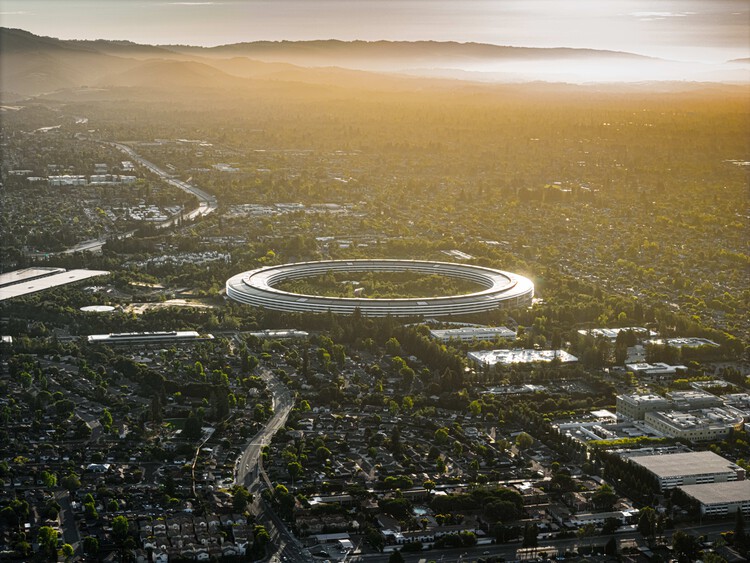
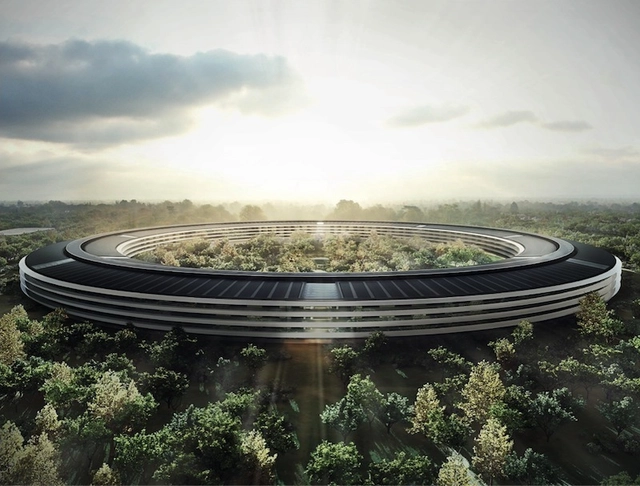
Abandoning Apple’s classic “white” detailing, architects Foster + Partners have opted to clad the 2.8 million square foot, circular monolith in black – a stylistic remedy that seems to be in line with the overarching campus goal to “provide a serene environment reflecting Apple’s brand values of innovation, ease of use and beauty.”

More details after the break… 

Foster’s Apple Headquarters Exceeds Budget by $2 Billion

© , ARUP, Kier + Wright,

The estimated cost of Apple’s Cupertino City headquarters has escalated from an already hefty price of $3 billion to $5 billion (more than $1,500 per square foot), reportedly pushing back the original completion date to 2016. According to Bloomberg, Apple is working with lead architect Foster & Partners to shave $1 billion from the “ballooning budget”. Most of the cost is seemly due to Steve Job’s “sky-high requirements for fit and finish”, as the tech legend called for the 2.8 million square foot, circular monolith to be clad 40-foot panes of German concave glass, along with its four-story office spaces be lined with museum-quality terrazzo floors and capped with polished concrete ceilings.

Although lambasted for his ambitious plans and “doughnut-shaped” design, Steve Jobs wanted to create a masterpiece that looked as good as it functioned, just like his products. During a 2011 presentation to the Cupertino City Council, Jobs stated, “This is not the cheapest way to build something… there is not a straight piece of glass in this building.” He continued, “We have a shot… at building the best office building in the world. I really do think that architecture students will come here to see it.”

More after the break…

Trademark Awarded to Apple Retail Stores

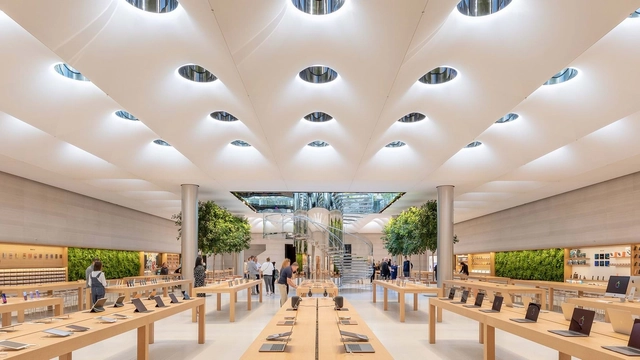
Apple’s Typical Store Design © bfishadow via Flickr

Apple has successfully been awarded a trademark for the “design and layout” of their retail stores. Since opening their first in Virginia over a decade ago, the stores have been at the heart of the company’s branding, with the late heavily involved in their design. Since, the growing presence of similar stores, including a familiar Microsoft chain launched in 2009, has left Apple feeling the need to protect its own distinctive style.

More after the break.

Mac OSX Mountain Lion and Software Compatibility for Architects

Mac OSX 10.8 Mountain Lion

has released the latest version of their operating system: Mac OS X 10.8 Mountain Lion. Over 200 new features have been integrated into Lion with the intent to streamline your work and life. Some of the highlighted features include the built in iCloud that keeps all your content updated and in-sync with your Apple products, a unified notification center to help you stay updated on everything, and ready-to-go dictation that makes typing optional.

Although this all sounds great, what about software we architects use on a daily basis?

A word of advice before you upgrade:

AutoCAD and New Macbook Pro’s Retina Display

Apple's latest Macbook Pro boasts an incredibly high resolution Retina Display

“If I were a drafter, I’d drop everything and buy it.”

So said Rob Maguire, the product manager for Autodesk’s AutoCAD, describing the new 3D-rendering drafting applications that will run on Apple’s latest MacBook Pro.

The new MacBook’s distinguishing feature is its souped-up Retina display  - which boasts 4 times as many pixels as its predecessor, 75% less reflection, and 29% higher contrast.

The implications for architects will be practically life-changing. But there is a catch…

Get the scoop on the new AutoCAD for Macbook, after the break.

The Motherships Are Landing: What Google’s New Headquarters Reveal About Apple 2

When Apple revealed the plans for their new campus in Cupertino, the responses to the “spaceship” were….varied, to say the least:

Spectacular would be an understatement” ; “So disappointing…” ; a “…panopti-lawn…” ; and – my personal favorite – “Sphincter?” [1]

The announcement instigated a flurry of analyses and criticisms over the meaning of the design for the world – the Zen-like significance of the circle, the role of architecture in this technologically-driven age, the legacy and hubris of Jobs – but produced very little discussion over its meaning for the company itself.

Meanwhile, months before news of the “spaceship” landed, another internet giant was searching the California landscape for its own space to call home. Still very much under-wraps, the new Googleplex will be the first time Google builds a workplace completely from scratch. [2]

These projects will be the Magnum Opuses, the ultimate physical representations, of the two most influential Tech companies in the world, and the two share striking similarities. So let’s clash the plans of these two titans and take another look at Apple 2 – but this time in the light of – and see what they can tell us about these companies’ futures.

Moleskine App for iPad: The Hand of the Architect

Screenshot via iTunes

Our favorite sketchbook has gone digital! Moleskine presents The Hand of the Architect – an iPad app featuring 378 sketches and drawings from 110 internationally renowned architects, such as Assadi, Botta, Fuksas, Graves, Gregotti, Hadid, Foster and Piano, “showing that every project always begins by hand”. All the works were collected by FAI (Italian National Trust) with the aim of raising funds to restore Piero Portaluppi’s Villa Necchi, known as a 1930s masterpiece of Italian rationalism in Milan. Sketches and drawings are accompanied by essays, captions and the biographies of the architects. You can purchase the app for $18.99 here on iTunes.

In case you missed it, check out Frank Lloyd Wright’s Fallingwater iPad App and Zaha Hadid Architects iPhone & iPad App, previously featured here on ArchDaily.

Architectural Patents: On what Grounds?

Courtesy of ifoapplestore.com

We have all heard of patenting building systems, building technologies, details and of course, products.  But what about patenting architecture?  Jack Martin brought this to our attention in light of Apple successfully getting an for the design of a store in the Upper West Side in New York City, asking “On what grounds can you patent architecture?”  The inventors listed in the patent are architects Karl Backus, Peter Bohlin and George Bradley of Bohlin Cywinski Jackson, and Robert Bridger, Benjamin L. Fay, Steve Jobs and Bruce Johnson for a design that Architect’s Newspaper describes as “meticulous and seamless as its clients”.

So, what is the extent of patenting architecture?  Structural systems, materials, details, conceptual strategies, the look of it?  We interpret architecture as a language in itself, but it is difficult to conceive of copyright infringement when it comes to architectural design because it is difficult to pin-point exactly what makes all of the parts of a building a copyrighted entity. What if Le Corbusier patented his designs?  Mies van der RoheFrank Lloyd Wright?  Their work and strategies have been copied and implemented all over the world to varying degrees.  So, where is the line between protecting an original idea and creating a barrier against progress? Or does this commercialization of architecture fuel competition to design better or design around strategies already patented? More after the break.

Updated Plans released for Foster + Partner’s new Apple Campus in Cupertino

© , ARUP, Kier + Wright, Apple

Apple has released updated plans revealing an ambitions solar installation for their proposed campus in . Announced back in June, the campus will include an office, research and development building, research facilities, corporate auditorium, fitness center, a central plant and associated parking. Foster + Partners will collaborate with ARUP North America and local civil engineering firm Kier & Wright for the completion of the project.

Continue reading for more details.

Apple Reveals Newly Renovated 5th Avenue Store

Courtesy of MacRumors

The white veil has been removed, exposing the $6.6 million renovation to the Fifth Avenue Retail Store. started the renovation back in June with plans to improve drainage and pavers, remove the bollards on the plaza, and update the cube.

The simplified version utilizes 15 panes of glass rather than the original 90, creating a “seamless” appearance. Each side of the cube consists of three, 10’ wide x 32’ high panels. Visible signs of hardware have disappeared as the connectors are embedded within the glass panes themselves.

Zaha Hadid Architects Launch iPhone & iPad App

© Zaha Hadid Architects

On October 2nd Zaha Hadid Architects launched their much anticipated (to us architecture nerds anyways) iPhone and App, made available through Apple and iTunes. This new App will allow users to browse through ZHA current portfolio of design and architecture. In a future update to the App there will be exclusive access and insight into some of the award winning buildings in the form of interactive guides (coming soon) to be used when visiting Zaha Hadid’s buildings.

Farewell Steve Jobs

photo via

A few hours ago one of the most influential figures in computing, product design, and in a way architecture, passed away.

Back in the 70s and 80s Steve Jobs played a key role in personal computing as the founder of Apple, bringing technology to the masses. I won’t go into details here, as I think that this ad featured on the Wall Street Journal back in 1981 pretty much explains it: “Putting real computer power in the hands of the individual is already improving the way people work, think, learn and communicate and spend their leisure hours”. I knew about his death via a notification on my iPhone, and I’m writing this on my . None of these devices are what we define as “computers”, none of them are wired to what we call a “local network”.

As for product design, the “i” factor is pretty well known, and has been recognized by design masters such as Dieter Rams. In this field, his legacy will last forever.
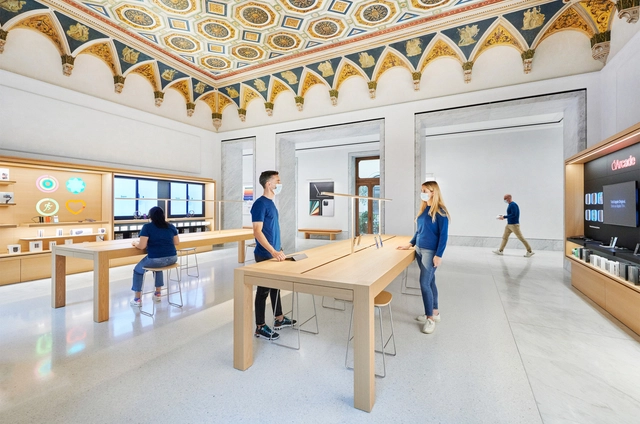
“In most people’s vocabularies, design means veneer. It’s interior decorating. It’s the fabric of the curtains of the sofa. But to me, nothing could be further from the meaning of design. Design is the fundamental soul of a human-made creation that ends up expressing itself in successive outer layers of the product or service. When you’re a carpenter making a beautiful chest of drawers, you’re not going to use a piece of plywood on the back, even though it faces the wall and nobody will ever see it. You’ll know it’s there, so you’re going to use a beautiful piece of wood on the back. For you to sleep well at night, the aesthetic, the quality, has to be carried all the way through.” — Steve Jobs

Apple Shanghai Store, © Roy Zipstein

But back to our field, Steve Jobs was a patron of architecture. Jobs worked with Bohlin Cywinski Jackson, one of the most renowned US architecture firms, to develop state of the art retail stores across the world. In these iconic projects they took glass, one of the most essential materials in architecture, to the next level.

Update: New Apple Retail Store at the Third Street Promenade


As we reported on Wednesday, rumors were circulating about a new Apple retail store at the Third Street Promenade in Santa Monica. Wednesday evening the proposal, a transparent glass ceiling commercial building by an unnamed retailer, went before the Santa Monica Planning Commission. Peggy Clifford of the Santa Monica Dispatch reported that the ‘ Glass House’ was approved without even a second thought.

“The surprise was that the staff put the project on the Consent Calendar. I cannot remember any large, complex commercial project ever going on the Consent Calendar. Apple was the only item on last night’s Calendar. And, under the rules, the Consent Calendar is approved as a whole – unless someone wishes to pull at item for discussion.

And in that crucial blink, the commissioners approved the Consent Calendar (aka Apple Glass House), and that was that – except for a staff report on the redesign of the Project Case List, after which they adjourned.”

The 8,000 sqf proposed one-story 34-foot high glass structure would take the place of an old Borders Bookstore on the Third Street Promenade.

(via Santa Monica Dispatch)

Is a New Apple Retail Store coming to the Third Street Promenade?

We’ve reported two Apple stories this week so why not a third! Rumors have surfaced that tonight the proposal for a transparent glass ceiling commercial building on the Third Street Promenade in Santa Monica by an unnamed retailer could be the newest . According to the Santa Monica Planning Commission report, “The proposed one-story, 34-foot high commercial building will feature an expansive floor-to-ceiling height accentuated by a transparent glass ceiling. The front façade will consist entirely of transparent glass panels that will project five feet from stone paneled side walls.”

Other signs it may be Apple; the report continues, “The applicant will offer all full-time retail employees a $100 monthly transit subsidy towards the purchase of transit fare and a $20 per month bicycle reimbursement subsidy for improvements, maintenance, and service. In addition, secure bicycle parking for employees of the building will be located in the basement level.”

Earlier this week we shared with ArchDaily readers that Apple has revealed their plans for the iconic Fifth Avenue Cube in NYC.  As the sign surrounding the cube states, “We’re simplifying the Fifth Avenue cube. By using larger, seamless pieces of glass, we’re using just 15 panes instead of 90.”

And we also shared with readers that Foster + Partners are indeed the architects for the new Apple Campus in Cupertino. Take a look at Apple’s latest innovative design, a circular almost spaceship looking object that won’t even have a straight piece of glass in the building.  Steve Jobs shared, “We’ve used our experience making retail buildings all over the world now, and we know how to make the biggest pieces of glass in the world for architectural use. And, we want to make the glass specifically for this building here. We can make it curve all the way around the building… It’s pretty cool.”

Therefore, with its signature use of glass and employee perks could the rumors be true?  We will be sure to keep you up to date.

More about Foster + Partner’s new Apple Campus in Cupertino

© Foster + Partners, , Kier + Wright,

The city of Cupertino has released more details about the new Apple Campus, revealed back in June.

The new documents confirm Foster + Partners as the architects, working with ARUP North America and Kier & Wright, a local civil engineering firm that has worked on Apple’s current campus and buildings for other tech companies (eBay, Nvidia, Cisco, Netflix and Sun, among others).

About the program:

  • An Office, Research and Development Building comprising approximately 2.8 million square feet for up to 13,000 employees
  •  A 1,000 seat Corporate Auditorium
  •  A Corporate Fitness Center
  •  Research Facilities comprising approximately 300,000 square feet
  • A Central Plant
  • Associated Parking

It’s a pretty amazing building. It’s a little like a spaceship landed. It’s got this gorgeous courtyard in the middle… It’s a circle. It’s curved all the way around. If you build things, this is not the cheapest way to build something. There is not a straight piece of glass in this building. It’s all curved. We’ve used our experience making retail buildings all over the world now, and we know how to make the biggest pieces of glass in the world for architectural use. And, we want to make the glass specifically for this building here. We can make it curve all the way around the building… It’s pretty cool.

- Steve Jobs

The round shape has also been cited as an important part of the campus’ security (better perimeter control) and to improve internal circulations.

It’s interesting to see that the objectives of the project are focused on reducing the use of electricity by generating its own energy on an on-site Central Plant, provide open green spaces “for Apple employees’ enjoyment” and to “exceed economic, social, and environmental sustainability goals through integrated design and development”. It seems Jobs choose the right firms for this.

By looking at the drawings it seems that the project is ready to go, and now it’s waiting for city approval. The city has revealed that they are very likely to approve the project, so it seems everything is on route for an opening in 2015.

Drawings and renderings after the break:

Mac OSX Lion and CAD software

Mac OSX Lion screen capture

Yesterday Apple released the latest version of their operative system: Mac OS X Lion. I started using it yesterday and it works like a charm on my Macbook. At a first glance, there’s a lot of focus on handling all  your applications thanks to features like Mission Control (an improved view of everything running on your computer) and Launchpad (a new way to organize your ). Other interesting feature is Airdrop, which will allow you to easily share files with your co-workers. There is also a lot of focus on security, back up, system recovery and versions of files, that I know will be very useful for architects.

But what about the software we architects use on a daily basis? A word of advice before you upgrade:

Disclaimer: Graphisoft is the sponsor of our Software section.

The Apple Campus in Cupertino

Apple Campus in Cupertino

Last week the Internet and architecture blogs went crazy after presented the new Apple Campus to the city of Cupertino, .

Rumors about Foster + Partners (an office with a high expertise on work environments) working with Apple on this new campus appeared on December last year on a Spanish newspaper, but there was never an official confirmation (or denial). But given that  the actual project fits with the information we received from an anonymous tipster last December, it seems it could be right:

“I recently got a tour of Norman Foster’s office in London and saw some images of the Apple Campus design. I believe the main building will be a large donut shaped building with all the offices and labs surrounding a large garden. It was a very pure form which connects to some of the recent Apple stores, but I was surprised that it didn’t really scream Apple to me. Of course it could have been a very preliminary design that wasn’t fully resolved yet. Anyway, I just thought I would pass on some info.”

During Steve Job’s presentation to the city of Cupertino we could see this round building, and Jobs outlined several facts on how this new campus for 12,000 people will improve the 98-acre site, such as taking parking underground to reduce the footprint, increasing landscaping from 20% to 80%, and planting more trees (3,700 now, 6,000 in the future). It even includes its own natural gas based energy generation plant (as seen on the drawings) with the electrical grid as backup.

Apple Campus in Cupertino

As for the 4-story round building, Jobs said:

“It’s a pretty amazing building. It’s a little like a spaceship landed. It’s got this gorgeous courtyard in the middle… It’s a circle. It’s curved all the way around. If you build things, this is not the cheapest way to build something. There is not a straight piece of glass in this building. It’s all curved. We’ve used our experience making retail buildings all over the world now, and we know how to make the biggest pieces of glass in the world for architectural use. And, we want to make the glass specifically for this building here. We can make it curve all the way around the building… It’s pretty cool.”

We reached Steve Jobs over the past weekend to get more details about the project and he said that he wasn´t interested in presenting the project on ArchDaily at this time, possibly because the project still needs to be approved by the city. We hope to bring you more details later on, so you can have an informed opinion.

More images from the presentation after the break.

Apple teams with Norman Foster

© Foster + Partners

Recently reported in El Economista, Apple has chosen to team up with Norman Foster for its new Apple Campus in Cupertino, .  Steve Jobs and Norman Foster have been working together for months developing the design for the new campus. The future headquarters will seek to utilize Foster’s innovative vision for sustainability, ability to perfect a building for its users down to the finest detail, and ideas to maximize efficiency in the workplace.

Sustainability, is reported to be a large focus of the new campus.   A network of submerged transportation tunnels is in the works and the campus will incorporate some of the Foster’s innovations already implemented in Masdar City, designed by Foster + Partners.  Masdar City is considered the first city in the world without cars or carbon emissions (capacity 50,000).  The R & D buildings will be multifunctional and will incorporate cutting-edge technology in materials and equipment as well as renewable energy resources.

Apple and architects Bohlin Cywinski Jackson had previously teamed up to design Apple Stores worldwide.  In August we featured the London Apple Store and in July we featured the Apple Store in Shanghai, China both designed Bohlin Cywinski Jackson.

In true Apple fashion, everything is hush hush, and it is all about the reveal.  We will look forward to seeing the result of the collaboration between Jobs and Foster.  Stay tuned to ArchDaily for the latest developments.

The Venice Architecture Biennale 2010 on your iPhone/iPad

You don´t need to be in Venice to witness its Architecture Biennale 2010.

By downloading Biennale App for free, you can navigate through the different events and exhibitions,  from the Vernissage to the conclusion of the Biennale.

More information after the break.

Largest Apple Store Opens Today!

YouTube Preview Image

A short while ago, we shared Apple’s latest cylindrical store designed by Bohlin Cywinski Jackson in Shanghai (check out great photo sets by Flickr user Lesh51 and Roy Zipstein previously featured on AD).  This Saturday morning, Apple is set to open its biggest store yet!  The 30,1000 ft store will be situated in Covent Garden in with more space, more staff and more merchandise than any other Apple store.  The project is a refurbishment of an 1876 building featuring Peter Bohlin’s classical glass and steel details, such as the trademark Apple staircases.  While Bohlin had to work within an existing framework, he was still able to bring Apple’s personality into the project.  Each room is dedicated to a specific Apple gadet, whether it be an iPod or a Mac book, and entire walls are covered with rows of iPads.  If you’re in the area, let us know what you think of the new store!

Video via YouTube user electricpigtv.