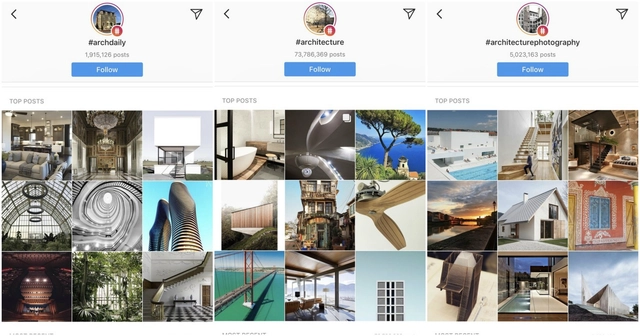
The hashtag officially became part of the Oxford English Dictionary in 2014, and whether you tend to use them or not, they are a pretty unavoidable internet tool that helps users connect related internet content. Maybe you’re hashtagging photos to get featured on a certain account or to poke some fun at yourself (see Justin Timberlake and Jimmy Fallon)? But serious ArchDaily readers have been using “#” to group beautiful photographs of architecture for the better part of a decade. When Instagram announced that it was possible to follow hashtags, die-hard taggers found a way to discover and like new content without actively seeking it out.
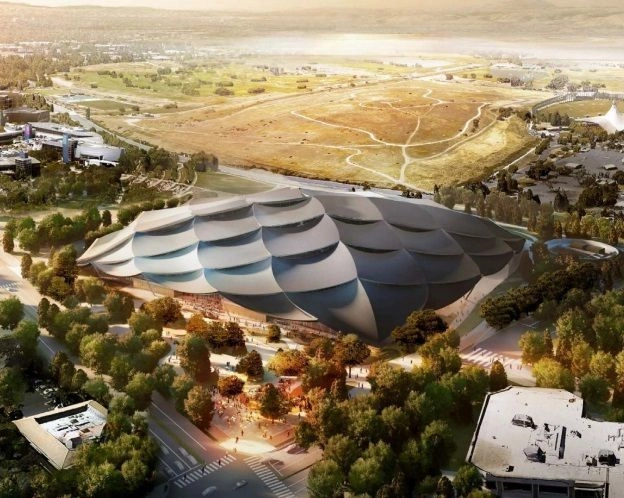
Would BIG and Thomas Heatherwick have designed a huge, adaptable tensile structure for any client other than Google?. Image Courtesy of Google
In January, we covered an interview with Bjarke Ingels where he spoke of the role that clients play in architecture. In the article, Bjarlke Ingels mentioned that "In the world of architecture there are many more things beyond an architect's control than are under his command." The post started a debate among our readers as well as our editors at ArchDaily. Many readers bemoaned the demise of architecture at the hands of clients with big pockets. Some of us talked about how IT giants not only control our digital world, they are now also encroaching upon our urban environments. Several readers blamed big clients for creating starchitects who build grand buildings and, as they allege, cause an "infantalisation" of architecture in the process.
Here at ArchDaily, our editors got to thinking: Can architecture exist without a client? Or is it just a service, a capitalistic exchange? And really, are clients such a bad thing for the field?
We talk to some of our editors to get their perspective.
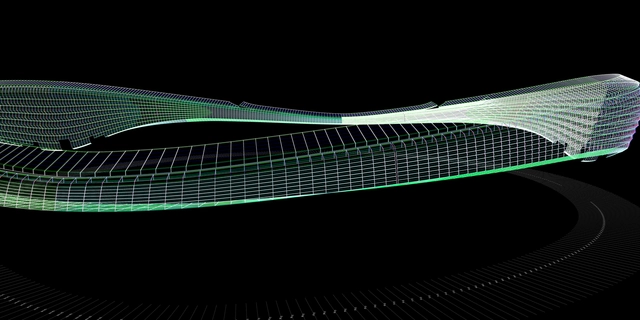
Credits: Supreme Committee for Delivery & Legacy / Architect : ZHA & AECOM / Automatization Processes for Digital Fabrication : ECHOES.PARIS
Applications are open for the third edition of the Design by Data Advanced Master® in Computational Design, Digital Manufacturing and Building Technologies opening in September 2018 in Paris.
Design by Data provides attendees with a cross-disciplinary culture of computational design and a comprehensive knowledge of cutting-edge technologies in the fields of parametric architecture, robotics, digital manufacturing and 3D printing for the construction industry.
Johann David Steingruber was a German architect and designer with over 100 buildings to his name, including many churches, town halls, school buildings and even breweries. However, perhaps what he is best known for today are the intricate illustrations of his 1773 Architectural Alphabet, in which he converted the alphabet into plans for a series of eccentric baroque palaces.
Done more as a "labor of love" rather than for any practical reason, Steingruber's book is a compilation of playful and intricate spatial relationships, with each letter providing its own unique set of challenges. Even though the letters naturally offer more complex shapes than we would ordinarily use for plans, the spaces somehow make sense. The baroque style of oval antichambers, domes, and vaults is evident not only in the plans but also in the elevations.
So many of our readers around the world celebrate Chinese New Year and welcome fresh beginnings in the Year of the Dog, we would like to take a look back at 2017 and share with you the most visited projects from China. This is a collection of projects coming from world-famous practices such as MVRDV and MAD Architects, and also from the younger, local talents who have demonstrated great potential in bringing positive changes to China’s built environment.
https://www.archdaily.com/889257/the-best-chinese-architecture-of-2017Joanna Wong
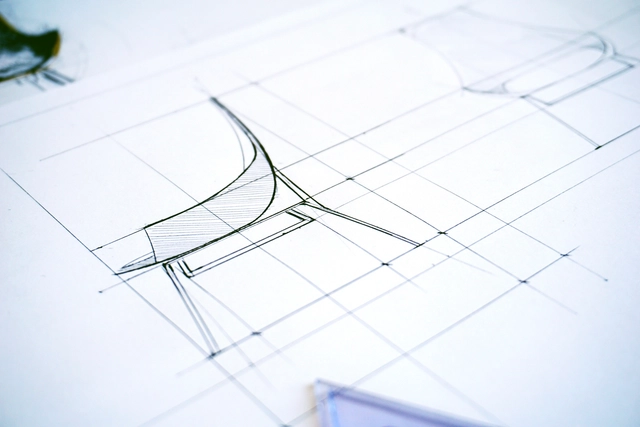
The black sheep of all architectural drawing has got to be technical drawing. Everybody loves drawing perspectives, sketches —you know the creative, interesting and expressive part of architectural drawing. But what about the aspects of drawing: the technical, logical, rational part? It might not be as sexy as freehand drawing, but it is just as important.
If you don’t know proper technical drawing skills it will show in your work; your perspectives will look ‘less smart’ and badly proportioned and your designs will lack consistency. So in order to make technical drawings look less cold and more approachable, I’m sharing the best 20 technical drawing tips I’ve come across.
Last September, Nigerian Afrobeat musician Wizkid played to a sold-out house at the Royal Albert Hall in London, joining a growing list of illustrious African musicians, such as Selif Kaita, Youssou Ndour, Miriam Makeba and others, that have performed at that prestigious venue. This event affirmed the unfolding cultural renaissance across the continent, but it also signified the rising global influence of African music, movies, fashion, cuisine and the arts.
Sadly, traditional African architecture, especially in Sub-Saharan Africa, has not profited from this renaissance and has instead steadily lost its appeal across the continent. In spite of its towering influence in the pre-colonial era, it has largely failed to develop beyond the crude earthen walls and thatch roof architecture; for this reason it has remained unattractive to homeowners who often associate it with poverty. Consequently, the neglect of indigenous architecture has resulted in the dearth of skilled craftsmen knowledgeable in the art of traditional building, a reality that has further dimmed hopes for a revival of this architectural style.
Is there an aspect, a recurring mark, that reveals a difference in the way that male and female architecture photographers see the world? This is, perhaps, one of those rhetorical questions often used as an argument to shed light on works produced by women and for which there is no precise answer.
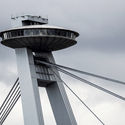
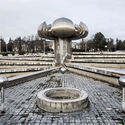
The history of Slovakia is riddled with political unrest and unwanted occupation, with the Slovak people having repeatedly been denied a voice throughout history. In the years following World War I, Slovakia was forced into the common state of Czechoslovakia; the territory was dismembered by the Nazi regime in 1938 and occupied by the Nazis for most of the Second World War, before being eventually liberated by Soviet and Romanian forces in 1945. Over the next four decades of communist rule—first by communists within Czechoslovakia itself and then later by the Soviet Union—the architecture of Slovakia came to develop into a unique form of sci-fi postmodernism that celebrated the shift in industrial influence at the time.
Photographer Stefano Perego has documented the Slovakian architecture from the 1960s–80s and has shared some of his photos with ArchDaily.
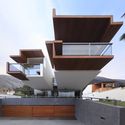
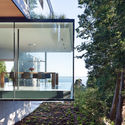
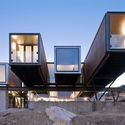
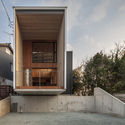
Cantilevers, structures that protrude from a building without the need for supports, are highly popular not only for their dramatic aesthetic effect, but also for the demonstration of technical mastery involved in their development. But we rarely see cantilevers in housing. For this reason, in this installment of our Photos of the Week, we have made a selection of 11 houses that seem to defy the physical laws of construction. Keep reading to see photos of renowned photographers such as Cécile Septet, Ema Peter, and Juan Solano.
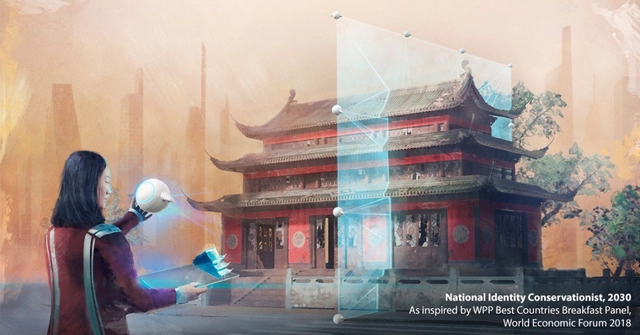
In a world where technology is at the forefront of our lives, it’s hard to imagine that many of the jobs that are available now did not exist 10 years ago; uber drivers, social media managers, app developers and even the job of an ArchDaily writer would have seemed an abstract concept! As technology advances further, even more job positions will be created and others left behind, leaving it open to speculation as to what will come next.
It is almost impossible to predict the future, but digital agency AKQA and Mish Global have attempted the impossible and envisioned several potential jobs in the design and construction industry in 2030 following inspiration from several panels they attended at the World Economic Forum. With the speed of changes over the last decade, they don’t seem too far from reality either.
#donotsettle is an online video project created by Wahyu Pratomo and Kris Provoost about architecture and the way it is perceived by users. They visit buildings, make videos and write extended stories in their exclusive column on ArchDaily, #donotsettle Extra.
Yes, that library. The images of the Tianjin Binhai Library have appeared everywhere, from architecture blogs and news broadcasts to going completely viral on social media. We had to go see it and show you what the space is really like. So, we teamed up with MVRDV who sent us to Tianjin to see it up close.
Tianjin Binhai Library, designed by MVRDV, is part of the bigger master plan for the new Binhai Cultural Center (masterplanned by Germany’s GMP). The building has seen phenomenal success on social media reaching all corners of the world. Since the opening, the number of visitors has been constantly increasing, with many of them coming from way beyond Tianjin. It is a library as destination point, redefined.
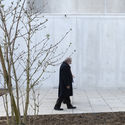
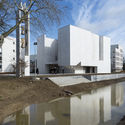
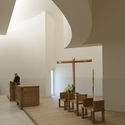
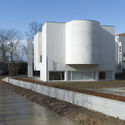
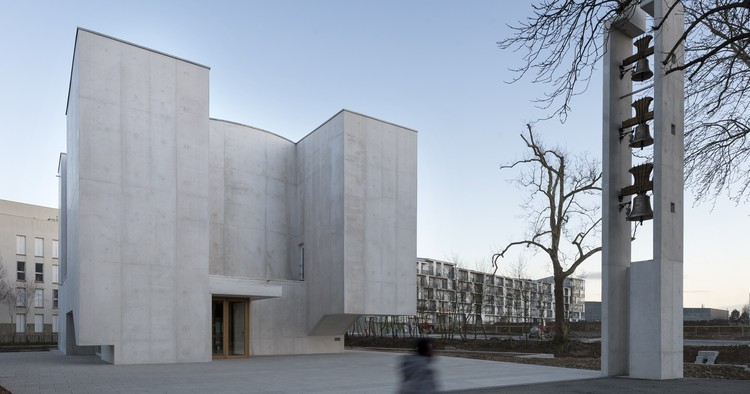
Architecture photographer Ana Amado has shared with us a set of photographs featuring Álvaro Siza's recently inaugurated Church of Saint-Jacques de la Lande, in Rennes—the first church built in Brittany, France this century.
As in many other Siza buildings, this church is built in white concrete and pays special attention to the natural light, which bathes the altar, tabernacle, pulpit and baptismal font from above. Externally, different volumes—blocks, cylinders and incisions—add to the overall mass of the building, distinguishing it from the neighboring housing blocks, while the use of few openings helps to establish a solid, permanent presence in the natural environment. Check Ana Amado's set of photographs below:
One of the last programs I attended as part of the Chicago Architecture Biennial was a panel titled “Making/Writing/Teaching Contested Histories” at the Chicago Cultural Center. The panel, organized by the Feminist Art and Architecture Collaborative (FAAC), aimed to “foreground issues of class, race, and gender, interrogating how they partake in the production of the built environment.”
The panelists, all academics in fields related to the built environment, were asked to bring in an object central to their practice or their teaching method. The objects on display were a painting, a pier, a refugee camp, and a living room.
Three or four decades ago, this array would’ve scandalized an audience of architects and architectural scholars, who might’ve been expecting, I don’t know, a photo of the Pantheon, or a plan of it, or even a piece of wood or a brick. Maybe even the choice of a piece of furniture would’ve induced some surprised gasps or confused looks.
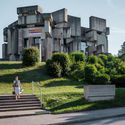
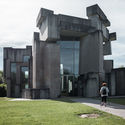
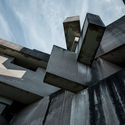
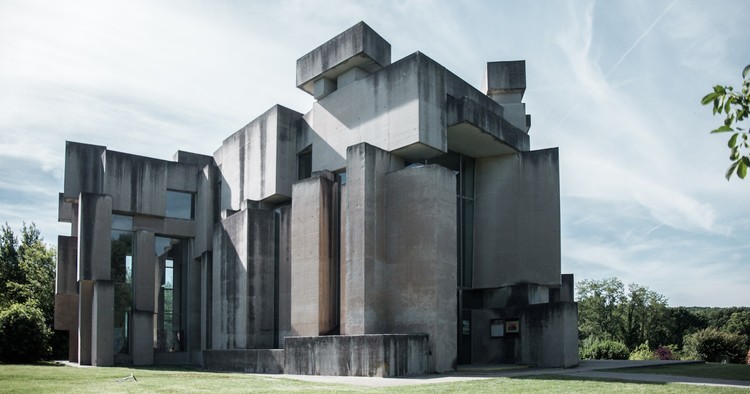
Located on a hill in Mauer, on the outskirts of Vienna, the Wotruba Church was the culmination of sculptor Fritz Wotruba’s life (the project’s architect, Fritz G. Mayr, is often forgotten). Constructed in the mid-1970s, Mayr completed the project one year after Wotruba’s death, enlarging the artist’s clay model to create a functional walk-in concrete sculpture. As can be seen in these images by Denis Esakov, the result is a chaotic brutalist ensemble that toys with the boundaries between art and architecture.
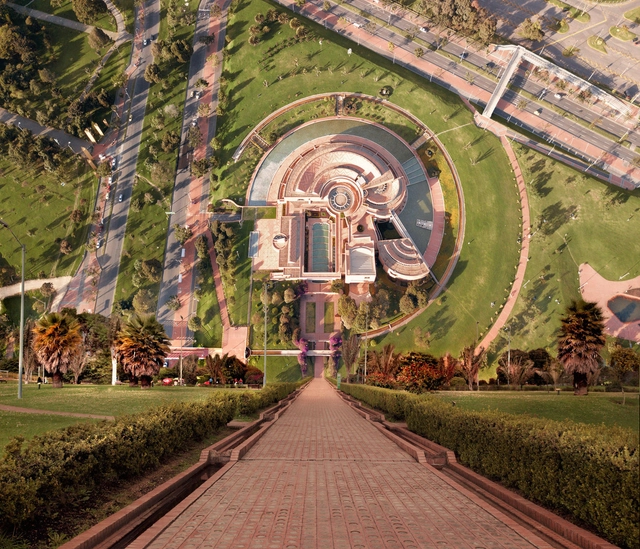
Colombian graphic designer and creative director Camilo Monzón's Instagram account is not your average catalog of Bogotá's iconic architecture.
Camilo explains that his particular way of capturing the city arose while he tried out his drone. "I realized that the tiles from nearby buildings showed me an unedited side of Bogotá that should be revealed and shown to everyone," he said in a conversation with ArchDaily en Español. "I think of it as rediscovering the city."
We live in a world that spends more time online than outside. And as architects and designers, we invest in creating a more engaging world by means of enhancing life through our buildings. However, through a perhaps unique form of tunnel vision, we are missing an incredible opportunity to leverage alternative mediums to impact more people through our design businesses.
Here are 5 ways to utilize your creativity to produce unique content that will help enhance your impact on the world of design, and in turn, push you and your design business forward: