Recently, long-standing architecture critic for the LA Times Christopher Hawthorne announced that he was stepping down to take up the position of chief design officer for the City of Los Angeles in Mayor Eric Garcetti’s administration. According to Hawthorne, the role will involve raising “the quality of public architecture and urban design across the city — and the level of civic conversation about those subjects.” This dramatic shift from the question: what is the role of the critic and architecture criticism in shaping civic architecture?
While Moshe Safdie may be more well known for the bold forms defining his portfolio of built projects—ranging from the National Gallery of Canada and the horizontal Raffles City Chongqing to the iconic Habitat 67—the architect considers his unbuilt works as important, if not more. Safdie ponders the role of these projects and more in PLANE-SITE’s latest addition to the series Time-Space-Existence.
As hundreds of refugees continue to arrive in Paris, France, the city faces an ongoing struggle to find safe and suitable housing for the influx of migrants. As a result, many end up sleeping in underused urban spaces or on the side of the road with almost no access to water, sanitation, and food.
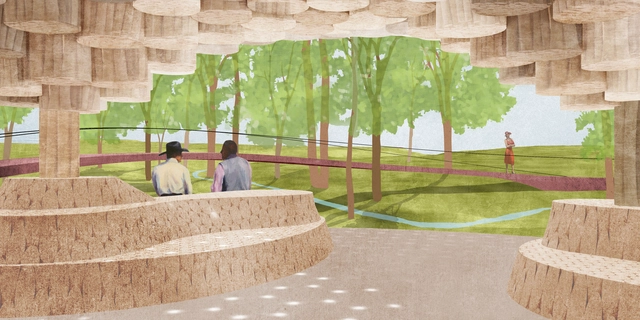
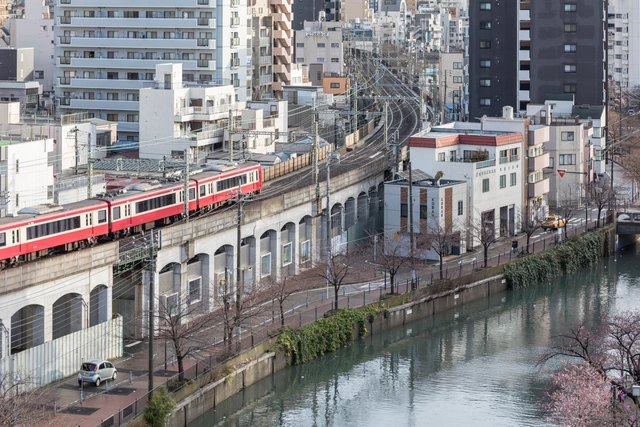
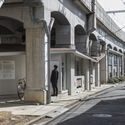
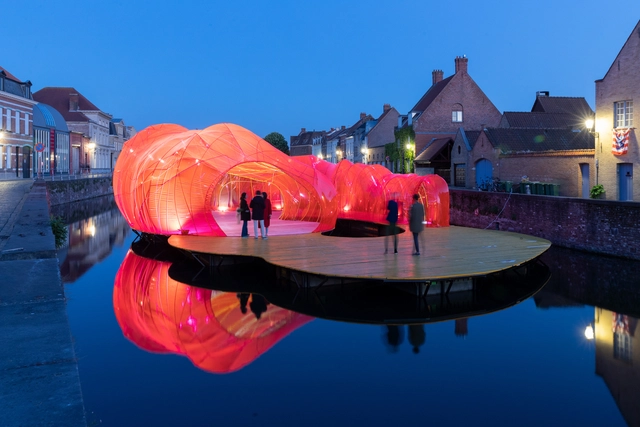
In response, Paris- and Santiago-based firm 1week1project in collaboration with Sophie Picoty unveil their design for a speculative public park titled “Illuminate Paris!” beneath an elevated railway bridge to provide additional support for organizations handling the influx of refugees. This modular “field of experiences” features a series of lantern-like environments forming a canopy along the underside of the bridge that allows for much-need space for migrants who are currently forced to sleep in encampments under similar infrastructure and in parks.
The Shenzhen International Energy Mansion is the main headquarters of the Shenzhen Energy Company in China. In designing the building, Bjarke Ingels Group (BIG) paid special attention to one feature: the building's facade. The firm knew that in such a tropical climate, using a traditional curtain wall glass envelope would overheat the buildings and make people crank up their air conditioners. What BIG came up with in their winning design, and what is now the building's most defining feature, is a folded, origami-like facade. This facade provides high insulation and diffuses incoming sunlight, while reflecting the strongest rays onto solar panels.
Laurian Ghinitoiu points his lens towards this uncommon facade design and places the skyscraper within the lively metropolitan context of Shenzhen, China.
Chicago-based Skidmore, Owings, and Merrill (SOM) have unveiled new images of their proposed 18-story officetower in the trendy Fulton Market area of Chicago. “The Porch,” situated on 330 North Green, will feature a five-story open-air deck, and series of luxury amenities to support the new office environment.
Ancient ruins, like the Parthenon and Luxor Temple, can teach us about the past in a unique way. Through architectural remains, we can gather what building techniques and civilizations were like long ago. Even so, ruins can’t compare to the real deal, and historical reconstructions of these architectural wonders are key to a fuller understanding of the cultures that created them. In these GIFs made for Expedia by NeoMam and Thisisrender, seven architectural wonders are reconstructed into their original form, allowing us to see how the ruins visible today developed from the initial structures in all their glory.
We’ve all seen them: cringeworthy designs and abysmal construction fails. For architects and designers, it's difficult not to hone in on the details of every space we encounter. And, it’s even harder not to laugh at doors incapable of opening, plaster jobs that could have been completed by a 4-year old, and an overly liberal use of caulking to solve any construction mishap.
Inspired by this guilty pleasure, the Instagram account of “Certified Caulk Installer” Trevor Lahey aka greaseball1987 has collected the best of the worst home improvement disasters for your viewing pleasure. See more of Lahey's plethora of hilarious tragedies below.
Building and growing are two actions that should be considered more often than not at the same time. This is how the 2017 "Build to Grow" social housing competition, looked to establish bases that sustain a flexible way of living. The event took place in the Belén district in the city of Iquitos, on 3.7 hectares plot of land. The project that received first place proposed to locate 120 incremental homes, that alternatively allowed users to modify and expand it according to their needs and economic means. In short, a home with a solid nucleus formed by a structure that supports changing activities.
The Harvard Graduate School of Design has announced the appointment of Mark Lee as Chair of the university’s Department of Architecture. Having taught at Harvard GSD since 2013, Lee is also a principal and founding partner at Johnston Marklee Architects. He will succeed K. Michael Hays, who has taught at Harvard GSD since 1998.
Lee has previously held the position of Frank Gehry Chair at the Daniels Faculty of Architecture, Landscape, and Design at the University of Toronto, as well as Cullinan Guest Professor at Rice University School of Architecture. He has also been a design critic at Harvard GSD since 2013, where he himself earned a Masters in Architecture in 1995.
https://www.archdaily.com/891227/harvard-gsd-appoints-mark-lee-as-chair-of-department-of-architectureNiall Patrick Walsh
The proposal for the 120,000-square-foot (11,500-square-meter) district manifests as a vibrant, public-orientated program, including a gym, child care center, café, food court, and spa. A series of courtyards and plazas are laced throughout the scheme, connecting old and new in a “timeless, classic appearance that is also uniquely contemporary.” The design took 2nd place in a competition in which no first place winner was selected, as the jury felt that no entry fully met the competition criteria. As the highest-placing entry, the competition organizers have committed to begin negotiations with Schmidt Hammer Lassen to refine the design.
London-based Grimshaw Architects has been selected to serve as Lead Architect for the design of Newark Liberty International Airport’s new Terminal One building in New Jersey. Grimshaw will work in partnership with STV to design the $1.41 billion terminal, featuring 1 million square feet (93,000 square meters) of space and 33 gates spread across a two-level T-shaped building. The scheme represents the largest transportationinfrastructure design-build project in New Jersey’s state history.
https://www.archdaily.com/891218/grimshaw-to-lead-design-of-newark-liberty-international-airport-terminalNiall Patrick Walsh
The Norwegian Public Roads Administration is opening a new landmark, Ureddplassen, along the Norwegian Scenic Route Helgelandskysten. Consisting of seating benches, a toilet facility and viewing terrace facing the open sea, Ureddplassen evokes a sense of poetic solitude as it complements the natural landscape of Norway.
The Bahá'í International Community has unveiled a proposal for the national Bahá'í House of Worship of Papua New Guinea. In the capital city of Port Moresby, a celebration was held at the temple’s future site to showcase the scheme, coinciding with the Bahá'í New Year. Inspired by the art of weaving, the architects’ vision was for a temple where the people of Papa New Guinea could unite to worship and find inspiration.
Willow Village will form part of Facebook's OMA-designed Willow Campus. Image Courtesy of OMA
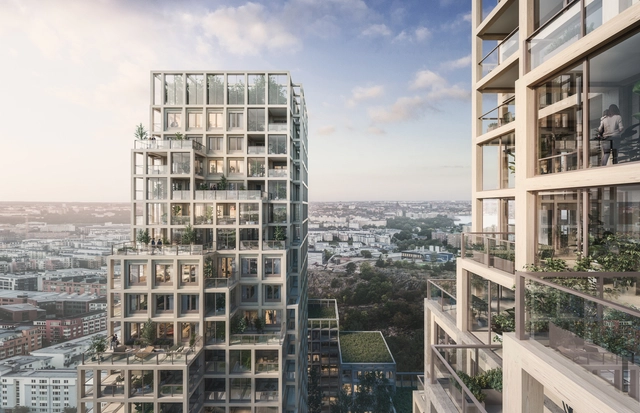
“Do people love tech companies so much that they would live inside them?” This is the question posed by The New York Times in an article reflecting on Facebook’s plans for Willow Village, a 59-acre urban district located at the company’s Menlo Park headquarters in San Francisco, California.
https://www.archdaily.com/891145/zucktown-usa-will-facebook-design-your-future-cityNiall Patrick Walsh
Videos
Section of the Statue and Surrounds. Courtesy of Michael Graves Architecture & Design
The Statue of Unity, to be the world’s tallest statue when completed, has made significant headway with its construction. Designed by Michael Graves Architecture & Design, the Statue of Unity will be 182-meters tall and depict Vallabhbhai “Sardar” Patel, the first deputy Prime Minister of India. Standing at almost twice the height of the Statue of Liberty, the Statue of Unity project will also consist of a hotel, memorial garden, visitor’s center and miles of roadways and bridges to connect the statue to the town of Kevadia, India.
After Pascall+Watson’s success with their concept design for the £130m Arrivals Terminal at Stansted Airport, the firm have been selected for the £600m transformation programme by MAG (Manchester Airports Group owners of Stansted Airport). As demand for air travel continues to increase, Pascall+Watson’s plans aim to provide a greater choice of airlines and destinations by making use of the airport’s spare runway capacity and supporting the future growth.
Adjaye Associates is among a team of high-profile architects tasked with generating ideas for the overhaul of Lancaster West Estate, an area of London containing the ruined Grenfell Tower, tragically destroyed by fire in 2017.
Harvard University Graduate School of Design (Harvard GSD) has announced the four finalists for the 2018 Wheelwright Prize, a $100,000 travel research-based grant available to early-career architects worldwide.
Selected from over 125 applications from nearly 40 countries worldwide, the four finalists are from Belgium, Mexico, Brazil, and the United States. This year’s jury includes 2014 Wheelwright Prize Winner Jose Ahedo, Edward Eigen, Frida Escobedo, K. Michael Hays, Mark Lee, Mohsen Mostafavi, and Michelle Wilkinson. A winner will be named in April.