The British city of Manchester, often seen as the UK's second city alongside Birmingham, will become the first metropolis outside of London to be given greater local autonomy over budgets and city planning. The devolution deal, which will also see the city receive the right to directly elect a Mayor (in line with large cities in the US, for example), will furnish the city with "a new housing investment fund worth up to £300million." As it is understood that the first Mayor of Greater Manchester will be elected in 2017, there's time to discuss how this new political environment in the UK might help boost building in what has described as a "Northern Powerhouse."
Plastic Stereotomy / Justin Diles. Image Courtesy of TEX-FAB
Ohio State University assistant professor Justin Diles has been announced as winner of the TEX-FAB Plasticity International Design Competition for his proposal, Plastic Stereotomy. Selected from 70 entries by a jury consisting of Craig Dykers, Bill Kreysler, Roland Snooks and Greg Lynn, Diles’ entry received top honors for its “approach to blending structural capacity with anthropologic sensitivity,” and for being “aesthetically interesting.”
More about the potential of Plastic Stereotomy, after the break.
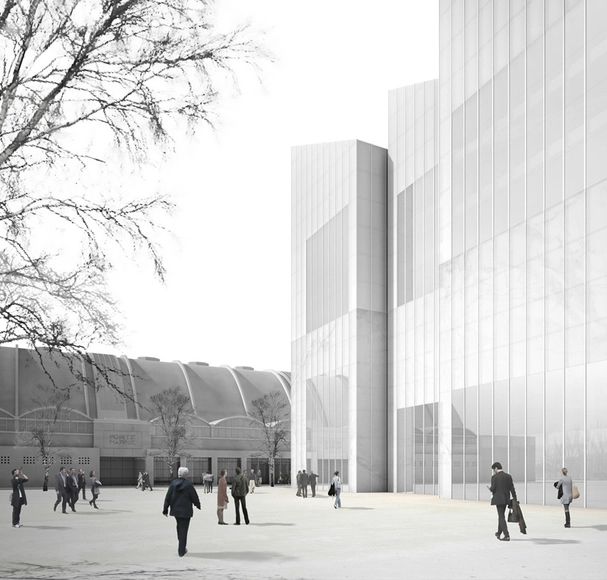
MLZD and Sollberger Bögli Architekten have won an international competition to design a 12,000-seat Tuilière Lausanne Football Stadium in Switzerland. The €70 million project is part of a larger redevelopment plan for northern Lausanne and will serve as the city’s main sporting venue upon completion in 2019.
Wisconsin’s Beloit College has commissioned Studio Gang Architects to reimagine a decommissioned coal-burning power plant as a “lively” student recreation and meeting center. As it currently stands, the “Powerhouse” is a barrier between the College campus and the Rock River. Upon completion in 2018, Studio Gang hopes the structure’s revitalization will reconnect the campus with the waterfront, further catalyzing the redevelopment of Beloit’s riverfront.
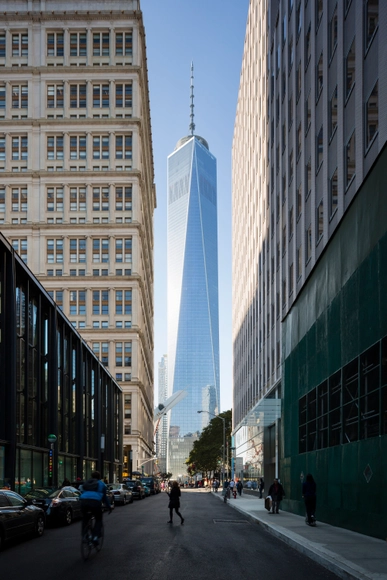
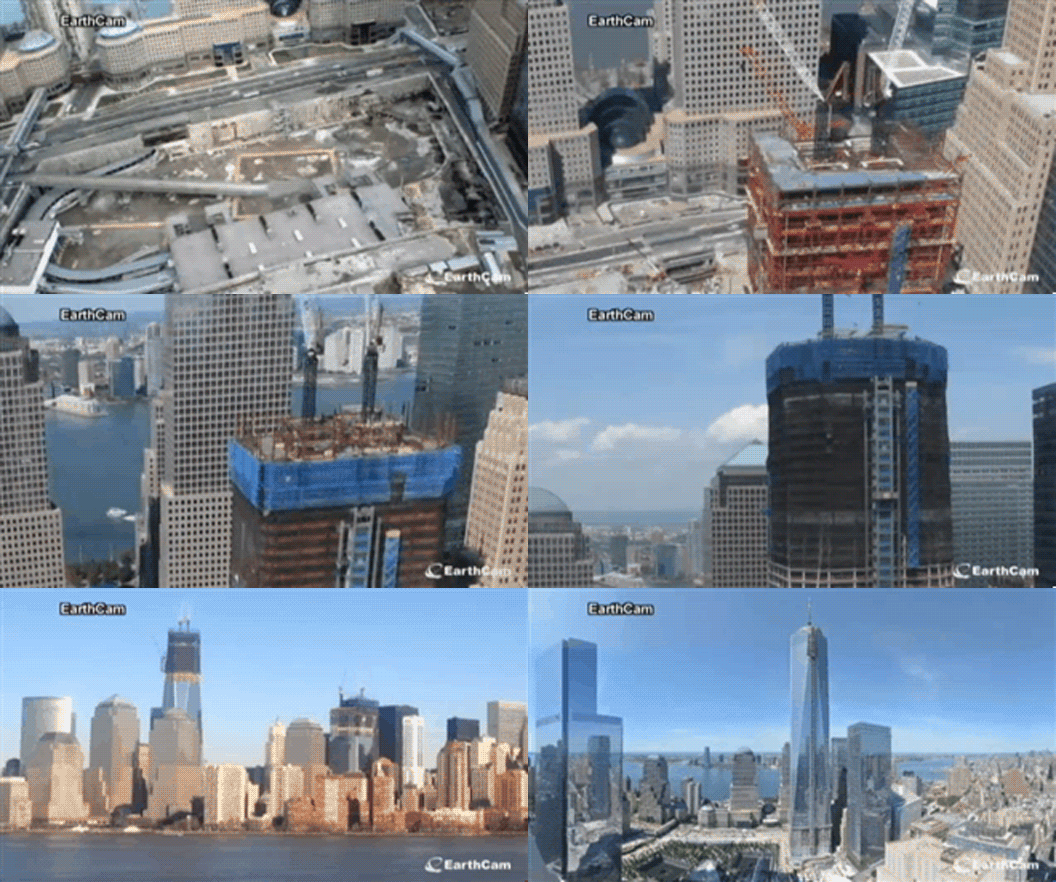
The first tenant has moved into the One World Trade Center, making Monday, November 3, the official opening of the (arguably) tallest building in the Western hemisphere 13 years after the tragedy of 9/11. The “extraordinary moment was passed in the most ordinary of ways,” described the New York Times, as employees of Conde Nast entered into the white marble lobby (taken from the same quarry that produced marble for the original twin towers) and headed straight to the elevators to start their work day.
To celebrate its completion, renowned architectural photographers Iwan Baan and James Ewing took it to the sky to capture the One World Trade Center in all its glory. The images, after the break.
This past month at WIRED by Design, Bjarke Ingels gave a rundown of his most ambitious projects, highlighting one underlining theme: BIG’s mission to “create social infrastructure for resilient cities.” From their Manhattan “BIG U” storm proofing plan, recently awarded $400 million in federal funds, to their “ski slope” waste-to-energy plant currently underway in Copenhagen, the Danish practice is undoubtedly fulfilling their mission in a BIG and infectious way.
Former RIBA president Angela Brady has announced Shereen Sherzad as the recipient of the second annual Tamayouz Women in Architecture and Construction Award, Iraq’s most prestigious architecture prize for women in architecture. Sherzad, an architect, academic and planner, taught at the school of Baghdad School of Architecture and worked as the director of the Higher Commission for the revitalization of the Erbil Citadel, which was awarded World Heritage Status. She is also the author of four architecture textbooks, used as references and teaching materials in Iraq and other Arab schools of Architecture.
The winners of the Young Woman Architect and Special Commemorative Awards, after the break.
The problem of homelessness challenges city governments all over the world, one which, despite many attempts by governments to curb the problems that lead to homelessness, does not seem to have a simple solution. What's more, with many countries still deep in the global economic crises, many governments and non-profits struggle to provide an adequate amount of temporary shelter for the homeless population.
But what if we could make temporary accommodation for the homeless pay for itself? And what if we could provide it by leveraging structures that would be built anyway? This is exactly the approach taken by Michal Polacek, Matej Nedorolik and Martin Lee Keniz of Project Gregory, whose design for small roadside accommodation built into an advertising billboard is currently on Kickstarter.
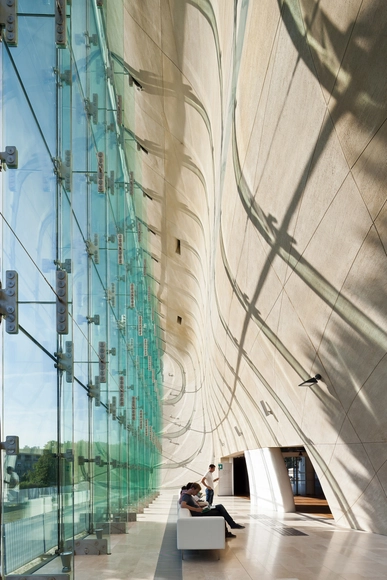
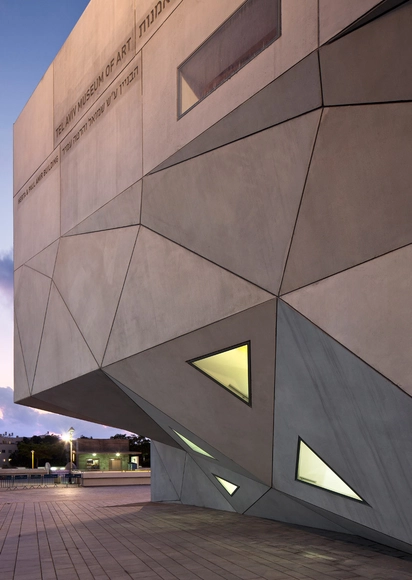
A professor of economics, Sixten Korkman has chosen Lahdelma & Mahlamäki Architects' Museum of the History of Polish Jews in Warsaw as the winner of the inaugural Finlandia Prize for Architecture. The unconventional award, whose intent is to “increase public awareness of high quality Finnish architecture and highlights its benefits for our well-being,” enlisted a group of renowned architects to shortlist the finalists before “layman” Korkman selected the winner as an unbiased representative of the public who valued the building for the way it made him “feel.”
“The idea behind the prize undoubtedly resonates with me. In economics one talks about public goods and externalities, and the built environment is precisely these," stated Korkman after announcing his decision.
"Whether the buildings are in private or public ownership is of no significance. We all see the architecture, experience the architecture, and architecture affects us all. Architecture undoubtedly affects our well-being and comfort: our built environment is our extended living room. In architecture there is also an egalitarian element. Fortunately the sun still shines for both poor and rich. Our built environment exists for us all.”
The Architectural League and Socrates Sculpture Park invite emerging architects and designers to submit proposals for Folly, an annual design/build studio program during March and April 2015 leading to a public exhibition at Socrates opening in early May 2015.
Cloud Citizen. Image Courtesy of Courtesy of Urban Future Organization and CR-Design
By the end of 2015, one in three of the world’s tallest buildings will be in China. With its government planned cities, the Chinese policy often favors high-density development, and some of the most radical and experimental urban design ideas can be applied in China - take for example the recent joint winner of the Shenzhen Bay Super City competition, Cloud Citizen, which takes on a more integrated and interconnected approach to vertical cities. In this article on The Guardian, Nicola Davison investigates how at this critical time in the country’s development, architects and urban planners may choose to move away from previous urban models of isolated skyscrapers, towards a more humane environment that seeks to emulate nature and create diverse public spaces. Read the article in full here.
The relationship between immortality and architecture is ancient one. Writing in The New Yorker, Alexandra Lange discusses the past and future of cemetery design in relation to a new exhibition on display in New York. Featuring a selection of 1300 individual mausoleum designs stored in Columbia University's archives, Lange notes how "patrons weren’t picky about originality. In the late nineteenth century, memorial companies might just bring back a shipment of angels from Carrara to be distributed among future clients." These "rural estates in miniature" eventually gave way to more contemporary designs which dabbled in Realism and Cubism. What will the people of today house their remains in? For Lange, "the design we take personal pleasure from everyday is now less likely to be architecture and more likely to be an interface." Read the article in full here.
Many groups are working on innovative 3D Printing technologies, such as Emerging Objects' designs for a 3D printed house made from locally harvested salt. Image Courtesy of Emerging Objects
Autodesk has announced a new program which aims to invest up to $100 million in 3D printing companies over the next several years. The Spark Investment Fund will invest in innovative entrepreneurs, startups and researchers in the 3D printing field who "push the boundaries of 3D printing technology and accelerate the new industrial revolution."
The investment fund has been developed alongside Autodesk's recently released Spark software, a free and open 3D printing platform which connects a wide range of 3D printing hardware and design software, and can work with any material. The company hopes to encourage the 3D printing community to build upon and improve this software.
DesignIntelligence has released their 2015 rankings of the Best US Architecture Schools for both undergraduate and graduate programs. Over 1,400 professional practice organizations were surveyed and asked to respond to the question: “In your firm’s hiring experience in the past five years, which of the following schools are best preparing students for success in the profession?” In addition, more than 3,800 architecture, landscape architecture, interior design, and industrial design students were also surveyed about their education, in data presented separately from the rankings.
However, perhaps more enlightening than the ranking itself are the firms' responses to several additional issues raised in the report. For example, 54.6% of the firms surveyed selected sustainability and climate change as the professions’ biggest concern, while maintaining design quality was a close second. Firms also provided insights on the most important qualities of new graduates entering the workplace, with an overwhelming 70.1% selecting attitude/personality as the most important attribute.
Read on after the break for the Top 10 undergraduate and graduate programs.
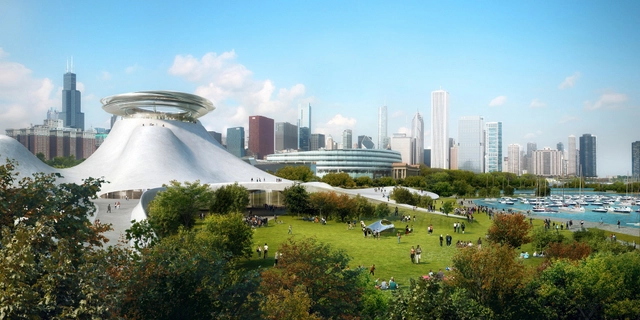
The design for Chicago's Lucas Museum of Narrative Arts has been revealed, with MAD Architects unveiling their plans for a sculptural white "mountain," rising from the site to be topped by a metallic crown. Designed as a landscape that can be approached from all sides, with the main entrance located on a 'floating' public plaza accessed via a network of ramps and steps, the building is organized around a central domed lobby and events space, with four stories of gallery spaces, a set of four theaters, and at the top of the building an observation deck and glass-encased restaurant. In a connected, smaller "mountain" are the building's educational functions, with classrooms, lecture theaters and a library.
Speaking to ArchDaily from Chicago, director of MAD ArchitectsMa Yansong explained how he wanted the design "to be futuristic but at the same time to be natural," connecting with the landscape of the waterfront site.
More about the design from Ma Yansong after the break
The French government has cancelled its £8 million contribution towards the £43 million Musée des Beaux-arts by David Chipperfield Architects, causing the Reims’ mayor to “shelve” the museum for being too costly. As reported by the Architects’ Journal, the funds will be reallocated towards the redevelopment of a recently closed sports complex. The museum, originally awarded to Chipperfield following an international competition, was intended to be built on an excavation area and display mediaeval relics. You can review the design, here.
According to global consultancy firm McKinsey & Company, the projected cost of providing affordable housing to 330 million households around the world currently living in substandard accommodation is $16 trillion USD. The firm's latest report, A Blueprint for Addressing the Global Affordable Housing Challenge, assesses critical pathways for providing housing to families across a range of socio-economic backgrounds and nationalities. According to the report, adequate and affordable housing could be out of reach for more than 1.6 billion people within a decade. The comprehensive report examines everything from income to cost of heating, boiling down the data into four key mandates aimed at solving the global housing crisis.
The proposed solution is one of ascending goals, similar to Maslow's hierarchy of needs, with a four-tiered plan targeted towards households earning 80% or less of the median income for any given region. The program is designed to meet McKinsey's 2025 Housing Challenge which aims to provide housing to a projected 440 million households worldwide within ten years through community engagement, gathering funding, appropriate delivery of housing models, and creation of governmental infrastructure to sustain housing.
Find out the four steps to solving the global affordable housing shortage after the break
In the latest video from Crane.tv, architectural journalist and planner Peter Murray ruminates on the benefits of integrating cycling into the urban fabric of the world's biggest cities. "For the last half century, we've bowed down to the god of the motor car and have destroyed cities across the UK," says Murray, Chairman of New London Architecture and the London Society. Murray and his team at New London Architecture are charged with analyzing and advocating for the improvement of London's Built environment, acting as advisors to Mayor Boris Johnson on an array of projects including the overhaul of cycling infrastructure in the city.
A team of architects from Rome have been announced as winners of CTRL+SPACE’s ideas competition for a digital arts museum in central Madrid. The competition challenged teams to envision a 21st-century contemporary arts museum that embodies technology as an “integrated medium of work” and questions the meaning of “public access.”
The Urban Implications of Living With Water, a recent report by the Urban Land Institute (ULI) Boston, opens with the clear assertion: "We are beginning to feel the effects of climate change." The result of a conversation amongst over seventy experts from the fields of architecture, engineering, public policy, real estate and more, the report covers the proposed integrated solutions for a future of living in a city that proactively meets the challenges accompanying rising water levels.
"We accept that the seas are rising, the weather is changing, and our communities are at risk; and we recognize that no solution can be all-encompassing. It is our hope that this report will spark conversation, shift our understanding of what is possible, and aid us in reframing challenges into opportunities as we move toward this new era of development."
Become part of the discussion and read more about the collective ideas, after the break.
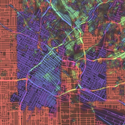
New York City. Image Courtesy of Stephen Von Worley
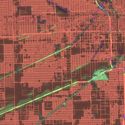
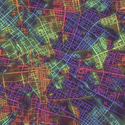
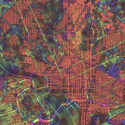
A new series of maps by California-based artist-scientist Stephen Von Worley give colour coding an entirely new meaning. With his latest algorithm-generated project, "Crayon the Grids," Von Worley has taken maps of ten major metropolitan areas and coloured them based on geographical orientation of the urban grid. Each street is assigned a colour specific to its orientation, varying in hue and weight depending on its cardinal direction and length. The result is a dizzying technicolor of urban planning, creating completely new demarcations for some of the world's most recognizable cities.
Enter the chromatic world of coloured city grids after the break
Estudio Macías Peredo is led by Salvador Macías Corona and Magui Peredo Arenas and is based in Guadalajara, Mexico. In their lecture as one of the winners of the Architectural League’s annual Emerging Voices awards, Corona and Arenas reveal the ways in which the local conditions and building traditions of their country have become creative drivers for their contemporary practice of architecture. They have a shared interest in primitive buildings, seeking to incorporate some of the inherent abstract qualities of primitive structures in ways that address contemporary issues.




_Image_de_synth%C3%A8se_%C2%A9_loomn_architektur_visualisierung.jpg?1415219406&format=webp&width=640&height=580)