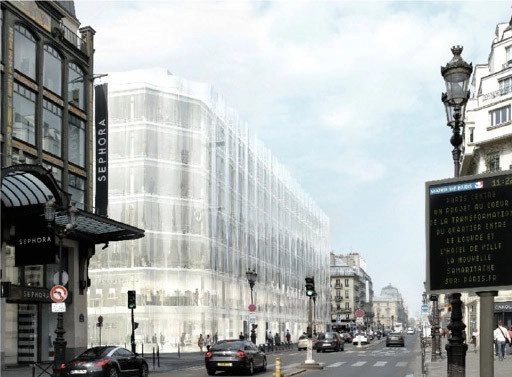
An appeals court has revoked permission for SANAA's restoration of the landmark Art Deco La Samaritaine department store in Paris. The plans, which would see a comprehensive overhaul of the 19th-century structure that finally shut its doors in 2005 following four decades in decline, would create an all-new shopping centre and luxury hotel as part of a 70,000m² mixed use development.
The project, commissioned by the LVMH conglomerate - which owns brands like Dom Pérignon, Givenchy, Louis Vuitton and BVLGARI - was halted because "the wavy, etched-glass facade proposed [SANAA] did not meet local planning requirements and was out of character with the surrounding buildings." It is understood that La Samaritaine will now appeal to the Council of State, France's highest administrative court. The city of Paris has mentioned in a separate statement that it would also support this latest appeal.
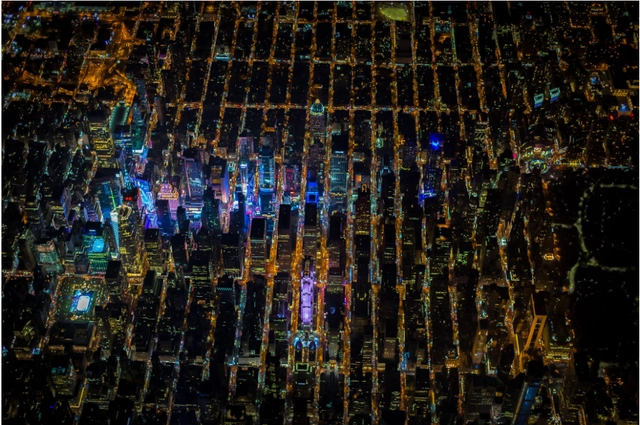
Something he has “dreamed of capturing for decades,” Pulitzer Prize-winning photographer Vincent Laforet has released a stunning set of images that captures his hometown of New York in a way that has never before been seen. Taken from a nauseating 7500-feet above the city, Laforet’s “Gotham 7.5K” series reveals the unrelenting, pulsating energy that radiates from the Big Apple’s city grid.
All the images and the making-of video, after the break.
This past year was a record-breaking season for skyscraper construction. According to a new survey by the Council on Tall Buildings and Urban Habitat (CTBUH), 2014 saw the completion of 97 buildings that were at least 200 meters tall. Of those, 11 were 300 meters or taller, earning them the classification of “supertall.” These are the highest figures on record, with 2011, for example, seeing only 87 200-meters-plus buildings completed.
In addition, in 2014 the total height of completed buildings (23,333 meters) broke the 2011 record of 19,852 meters. With major countries like China becoming increasingly urbanized, and the world economy recovering from recession, the CTBUH expects that these numbers will only increase. See the details of CTBUH’s report, and learn what the numbers may predict about the future of skyscraper construction, after the break.
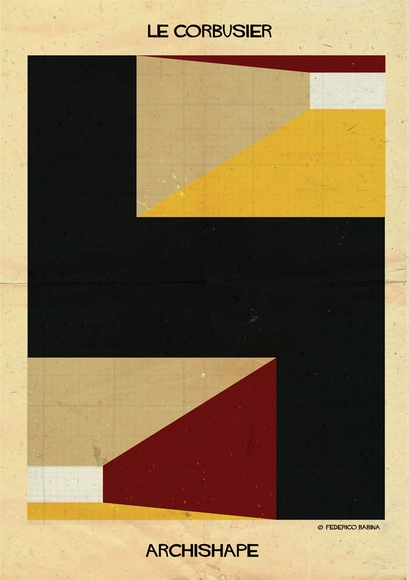
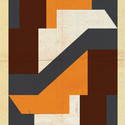
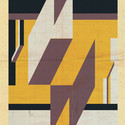
Working in reverse, Italian architect Federico Babina’s latest set of illustrations deconstructs the stylistic forms of 25 famous architects into a series of abstract compositions that embody the essence of each architect's style. This “process,” as Babina says, aims to reveal the “ideal connection between architecture itself as a form of representation and the representation used in its design.”
“The architecture is a set of shapes that draw volumes and voids which sequence generates functions and meanings. These illustrations are one of the possible ways to watch, observe and describe architecture… In these pictures you can read architectural references or simply let your mind get lost between the lines and colors for more imaginative interpretations.”
The narrow, single-story pavilion will stretch between two circular sports fields, connecting it’s inner halls directly to the outdoors. Continue after the break for more images of the project.
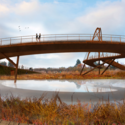
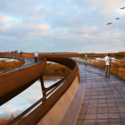
64 North, HNTB Engineering, Bionic Landscape Architecture and sculptor Ned Kahn have been chosen by the City of Palo Alto to realized a new bicycle and pedestrian bridge over the 14-lane Highway 101 at Adobe Creek. Their winning proposal, “Confluence” will connect residential and commercial areas in south Palo Alto to the Baylands Nature Preserve and the regional Bay Trail network.
Read on for more information and a video about the design.
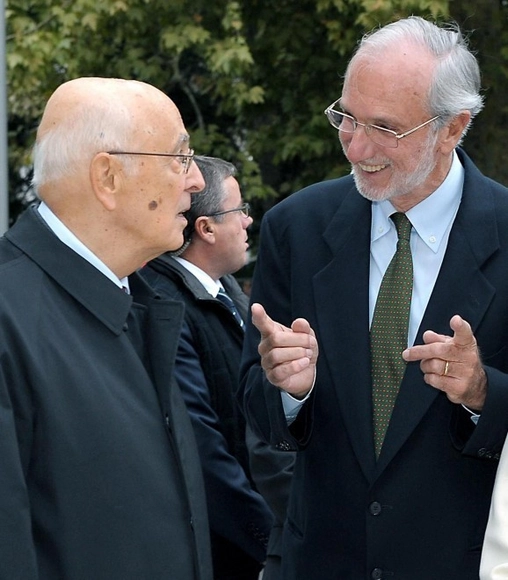
President Giorgio Napolitano and Renzo Piano (2012). Image Courtesy of La Repubblica
In The New Yorker's latest Postcard from Rome Elizabeth Kolbert talks to Renzo Piano in his Senate Office at the Palazzo Giustiniani, just around the corner from the Pantheon. Piano, who was named a Senator for Life by Italian President Giorgio Napolitano in September 2013 (when he was 75 years of age), immediately "handed over the office, along with his government salary, to six much younger architects." He then "asked them to come up with ways to improve the periferie - the often run-down neighborhoods that ring Rome and Italy’s other major cities." Kolbert attests to Piano's belief in the power of museums and libraries and concert halls. For him, "they become places where people share values [and] where they stay together." "This is what I call the civic role of architecture."
Visiting a city as large as Chicago can be overwhelming. For the architect, this is doubly true. The city is a treasure trove of architectural history, perhaps most notable as the birthplace of the skyscraper and the Chicago School. Names like Louis Sullivan, Frank Lloyd Wright, and Daniel Burnham are commonplace in Chicago, their buildings nestled amidst more modern works by the likes of SOM, Jelmut Jahn, and Studio Gang Architects.
Still more works are hidden away in obscure corners of the city, less well known but equally representative of the time and style in which they were built. In the interest of cataloging these buildings, and bringing attention to those that may not be on the typical city tour, blogger John Morris has created Chicago Architecture Data. A near-comprehensive survey of projects built before 1940 organized by neighborhood and architectural style, Chicago Architecture Data is a veritable history book for the architecture of the Windy City.
In the second decade of the twenty-first century, the built environment continues to be redefined on an unprecedented scale by global shifts of culture, economy, and geopolitical structures. Cities and countrysides are transforming differently from country to country; national and local governments continue to define specific legal frameworks impacting building practice; and value systems and social norms remain strongly bound to culture. At the same time, different regions around the world deal with similar changes, from urban sprawl and rapid urbanization to the consequences of an aging population and the lifestyle challenges of the middle class.
https://www.archdaily.com/585676/the-berlage-s-master-of-science-in-architecture-and-urban-design-architectural-education-in-the-age-of-global-practiceSponsored Post
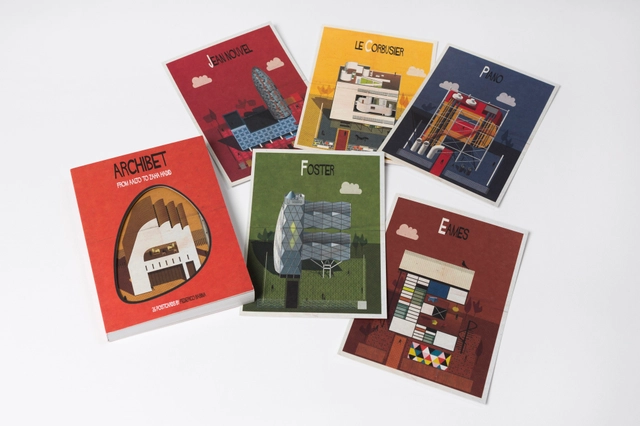
Archibet / Federico Babina. Image Courtesy of Laurence King
UPDATE: Congratulations to winners Robert, Angelo, Nathaniel, Enasaveva, and Avi! We will be contacting you via email.
When Italian architect Federico Babina released his Archibet set this past year, it was an instant hit; no surprise, considering Babina’s illustrations depict the styles of 26 famous architects, from Alvar Aalto to Zaha Hadid, in a clever way unlike anything else. Now, thanks to Babina and publisher Laurence King, five of our readers can win their very own Archibet set.
Official rules: Check out Babina’s complete Archibet set (here) and let us know your favorite “letter” in the comment section below. Five winners will be chosen at random from entries received between Monday, January 12th and Sunday, January 18th 11:59 EST. Anyone in the world is welcome to participate. One entry per person. ArchDaily will enforce verification and remove duplicated ones before choosing the winner.
Bonus: ArchDaily readers can purchase a copy of Archibet by Federico Babina at a discount of 30% when ordering from www.laurenceking.com. Enter the code ARCHIBET30 at the checkout.
“We wanted to offer the local residents an internationally important museum that would help promote the development of China’s creative industries and further progress design in China,” stated China Merchants Group (CMG) vice president Sun Chengming. CMG is collaborating with London’s V&A to realize the project.
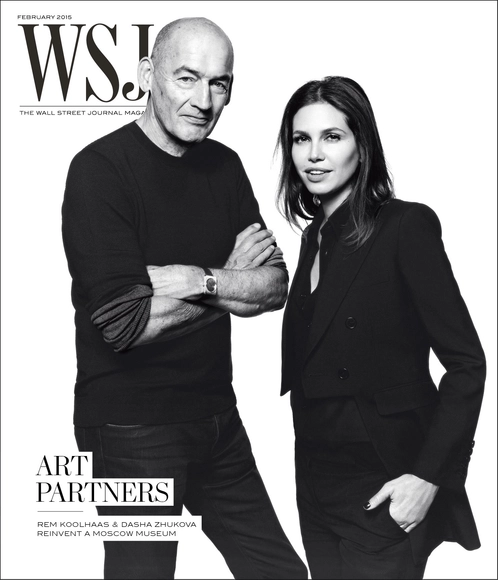
Rem Koolhaas and art philanthropist Dasha Zhukova will be gracing the WSJ. Magazine’s February cover as “art partners” embarking on a transformation that will turn a ruined Brezhnev-era Communist landmark - the Vremena Goda in Moscow’s Gorky Park - into the Garage Museum of Contemporary Art’s new home. “The building is basically a found object,” said Koolhaas, regarding his “raw” design and intent to preserve the structure’s decay. “We are embracing it as it is.”
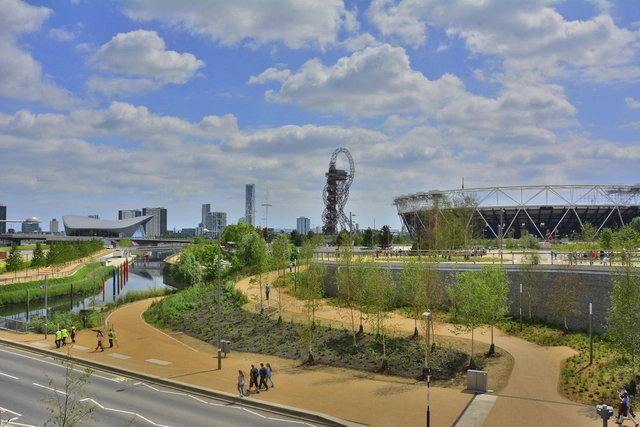
Five consortiums have been shortlisted to envision the University College London’s (UCL) new 125,000-square-meter campus on a key section of London’s Olympicopolis. Planned for the site’s cultural and educational district, nearby the future homes of Victoria & Albert Museum, University of the Arts London and Sadler’s Wells, the campus’ first phase will include the university’s first School of Design, a “Museum of the Future,” and the UCL Center for Experimental Engineering.
The complete shortlist, including Aecom, Gehl Architects and Stanton Williams, after the break.
The 2015 RIBA Norman Foster Travelling Scholarship has launched and is inviting applications from schools of architecture around the world. A £6,000 grant will be awarded to one student by a panel of judges which will include Lord Foster and the current President of the RIBA, Stephen Hodder. First established in 2006, the scholarship is now in its eighth year and is designed to fund international research on a topic related to the survival of our towns and cities in a location of the student’s choice.
Videos
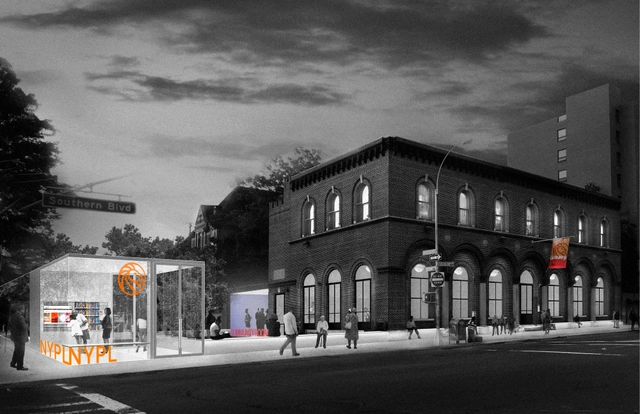
Hunts Point Library concept. Image Courtesy of Andrew Berman Architect, Library Development Solutions, Neil Donnelly, AEA Consulting, Auerbach Pollock Friedlander
There are 207 branch libraries in the city of New York, each providing a number of services to city residents. From the simple lending of books to adult technical literacy classes, these institutions are as vital as they were before the advent of the internet, and their attendance numbers prove it. Between the years of 2002 and 2011, circulation in the city’s library systems increased by 59%. Library program attendance saw an increase of 40%. In spite of this, library funding was cut by 8% within this same timeframe, which has made it difficult to keep many of the system’s buildings in good repair. To spark interest and support from city leaders, The Architectural League, in collaboration with the Center for an Urban Future, instigated the design study Re-Envisioning New York's Branch Libraries.
Sponsored by the Charles H. Revson Foundation, the study is the effort of five design teams chosen by the League. These teams - including MASS Design Group and SITU STUDIO - were charged with proposing exciting new library designs that follow the League’s themes of “integrating libraries into the city’s housing and community development goals, reconfiguring libraries to meet community needs, and developing new ideas for expanding the impact of branch libraries.” The teams presented their work at a January 4th symposium. See each of the proposals, as well as video footage of that symposium, after the break.
Registration is now open for AIA Convention 2015, one of the largest and annual gatherings of architects and design professionals in the US. This year's much-anticipated schedule includes: President Bill Clinton's day one keynote address, 300+ career-changing workshops, seminars, tours, and events led by visionaries, grassroots champions, change agents, and rising stars. A dynamic expo floor turned into a temporary built environment with hundreds of exhibitors, first looks, and surprises. All the details can be found, here. ArchDaily will see you there!
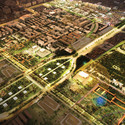
In 2013, Bjarke Ingels Groupcame first in Paris' Europa City competition, an 800,000 square meter cultural and recreational facility on the far North-Eastern outskirts of the city. In an attempt to explain the design of this huge project, filmmakers Squint/Opera have enlisted the help of Bjarke Ingels and a green screen to describe the project - Minority Report style - with a combination of live action and futuristic video effects. In a second video, a detailed walkthrough of the building enlists both 2D and 3D graphics "to capture the excitement and energy of this unique centre." Read on after the break for both videos.
The latest in a series of videos from Louisiana Channel sees Danish architect Bjarke Ingels of BIG dispensing wisdom for a new generation of architects. Speaking with characteristic zeal, Ingels advises young architects "to care, because if you don't care, it doesn't matter." "We're not here to build for other architects," Ingels says, describing architecture as "fundamentally the art and science of accommodating life."
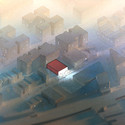
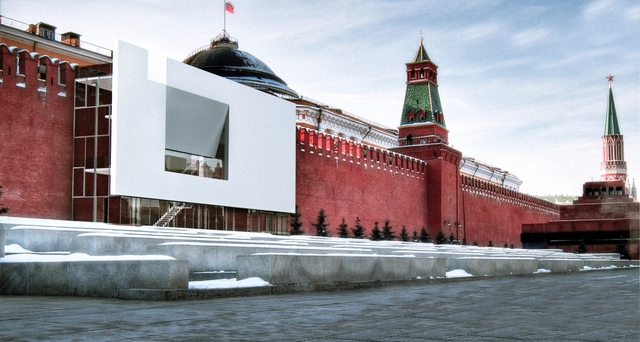
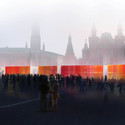
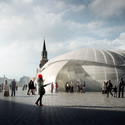
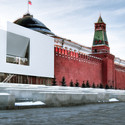
The results of the Red Square Tolerance Pavilion Competition, hosted by Homemade Dessert (HMMD), have been announced. Placed directly in the center of Moscow's Red Square, the competition asked designers to advocate the many facets of tolerance (social, religious, and political) by manifesting them in the form of a temporary pavilion. To further enhance these ideas, the pavilion is not only a symbolic space, but an educational one, with lecture halls and exhibition areas as its program, encouraging entrants to promote tolerance in all aspects of their designs.
The AIA Small Project Practitioners (SPP) invites architects and architecture students to submit design ideas to the 2015 SPP Small Project Design Competition – POP-UP 2015: “A Safe Space.” In this unique design competition, submitters are asked to design a discreet, compact and efficient shelter for the homeless. The fully constructed and completed winning design will be donated to the local non-for-profit partner, The Mad Housers, for use by their clients and program participants.
Four projects have been selected by the American Institute of Architects’ (AIA) for honorably expanding the role of the architect beyond the building and into the realms of urban design, regional and city planning, and community development. These projects will be honored with the AIA’s Institute Honor Awards for Regional and Urban Design at the 2015 National Convention and Design Exposition in Atlanta. See the winners, after the break.
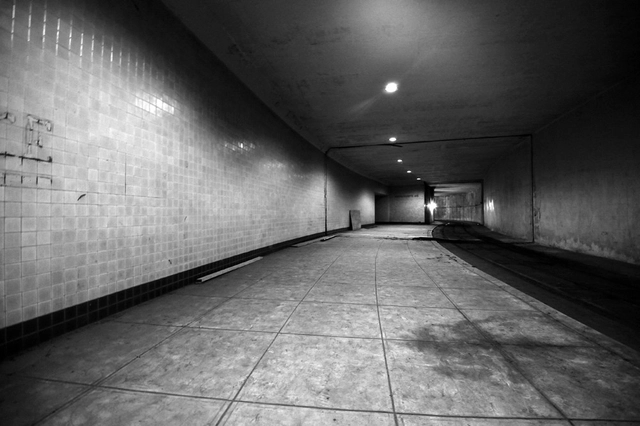
East Platform. Image Courtesy of the Arts Coalition for the Dupont Underground
The Arts Coalition for the Dupont Underground (ACDU) has taken on the task of revitalizing an abandoned trolley station beneath Dupont Circle in the Northwest quadrant of Washington D.C. The nonprofit organization recently signed for a 66-month lease of the property with the District of Columbia’s Office of the Deputy Mayor for Planning and Economic Development. Within that timeframe, the group will transform the space into a permanent cultural hotspot capable of hosting performances, art exhibitions, and other public functions. Learn more, and contribute to the ACDU’s Fundable campaign for this project, after the break.
In a film for the BBC Magazine, Spanish architect Santiago Calatrava talks through his designs for the new St. Nicholas Church - the only non-secular building on the 9/11 Memorial site. The building, which broke ground last year, has been described by Calatrava as a "tiny jewel" for lower Manhattan, comprising of a white Vermont marble shrine sat beneath a translucent central cupola that is illuminated from within. The new church, of Greek Orthodox denomination, replaces a church of the same name which was destroyed during the attacks of 9/11. It is sited close to its original location on 130 Liberty Street, overlooking the National September 11 Memorial park and museum. With the building set to open in early 2016, Calatrava discusses the key conceptual ideas and references behind its unique, controversial design.






PabloBlanco.jpg?1421095092&format=webp&width=640&height=580)




.jpg?1421168496 "© Sutherland Hussey Architects, courtesy of RIBA")















.jpg?1420836447&format=webp&width=640&height=580)

.jpg?1420836358 "© BIG")

.jpg?1420836447)