Following the news of Frank Gehry's passing at age 96, renewed attention has been directed toward a career that significantly shaped architectural discourse from the late 20th century onward. Over more than seven decades, Gehry developed a design language defined by material experimentation, iterative model-making, and an interest in fluid, expressive forms. His work ranges from early residential interventions in Southern California to major cultural institutions that have contributed to the identity of cities around the world. Together, these projects outline a trajectory that intersected with shifts in fabrication technologies, museum typologies, and urban redevelopment strategies.
As Gehry's portfolio expanded, his practice evolved in parallel with advances in digital modeling and construction coordination, shaping new approaches to complexity in architectural design. His adoption of software originally developed for aerospace engineering not only enabled the realization of unconventional geometries but also influenced broader industry standards. Whether applied to museums, performance halls, educational facilities, or civic landscapes, Gehry's methods emphasized the relationship between geometry, structure, and spatial experience. These works form a record of sustained experimentation that illustrates how cultural buildings can serve as catalysts for urban transformation and contribute to long-term architectural narratives.
Read on to explore Frank Gehry's 11 renowned projects, tracing the evolution of his design approach and lasting influence.
Related Article
Spotlight: Frank GehryGehry House, Santa Monica, 1978
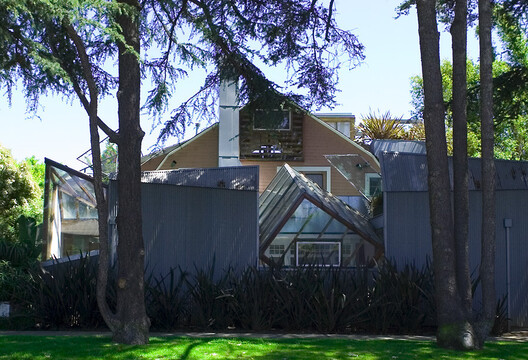
Often cited as a defining early work in Gehry's career, the Gehry House introduced many of the material and spatial strategies that later shaped his larger commissions. Rather than demolishing the existing Dutch Colonial house, Gehry preserved it and wrapped new volumes around three sides, exposing framing and inserting angular geometries that contrasted sharply with the original structure. Materials such as plywood, corrugated metal, glass, and chain-link fencing contributed to a deliberately unfinished appearance that challenged conventional residential aesthetics and stirred local controversy. A later expansion in 1991 responded to the family's needs while maintaining the project's experimental character, reinforcing its significance within California's architectural landscape.
Vitra Design Museum, Weil am Rhein, 1989
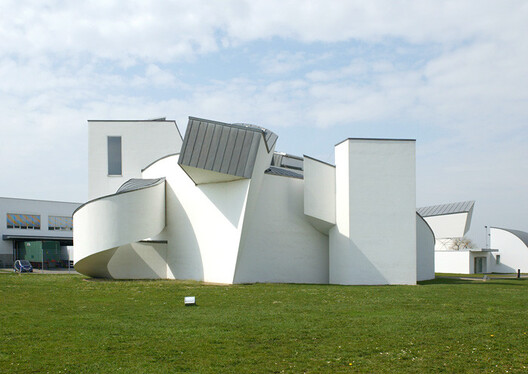
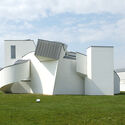
Completed in 1989 as Frank Gehry's first European building, the Vitra Design Museum marks a pivotal shift toward the sculptural forms that would define his later work. Situated on the Vitra Campus in Weil am Rhein, the museum emerged during the company's post-fire reconstruction and transformed an initial brief for a simple storage facility into an independent institution dedicated to design. The building's composition of intersecting curved and angular volumes introduces a dynamic interplay of white plaster surfaces and zinc roofing, signaling Gehry's transition from the angular deconstructivist language of his earlier projects toward more fluid geometries.
Dancing House, Prague, 1996
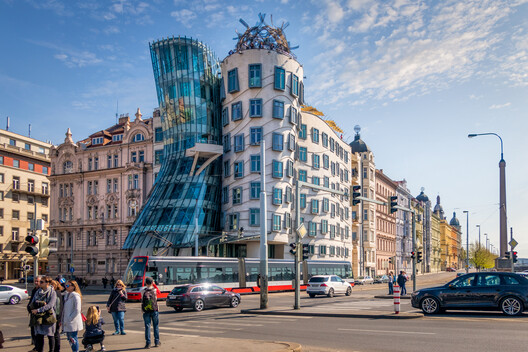
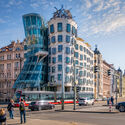
Completed in 1996 and designed with Vlado Milunić, the Dancing House introduced Gehry's emerging formal vocabulary to a prominent site along Prague's riverfront. The design brings together a curved glass tower and a more rectilinear masonry volume, establishing a clear dialogue between dynamic and static forms. Constructed using individually shaped concrete panels and articulated façade elements, the project reflects Gehry's interest in sculptural composition and the interplay of geometry. The building's spatial and material strategies demonstrate his ability to translate expressive form into a civic context, marking an important moment in the progression toward his large-scale cultural projects of the late 1990s.
Guggenheim Museum Bilbao, 1997
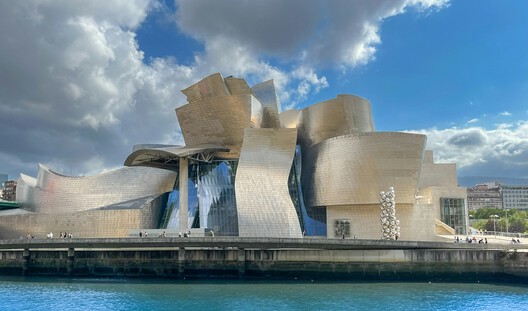
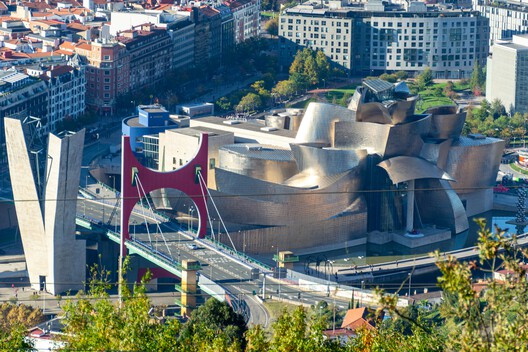
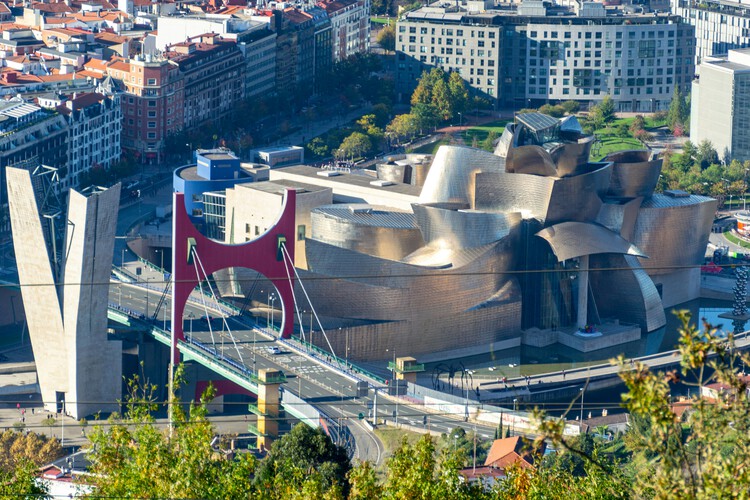
Set along the Nervión River in Bilbao, the Guggenheim Museum integrates complex, swirling forms and a layered material palette to address its industrial setting and multifaceted program. Initiated in 1991 as part of a broader effort to modernize the city's former port district, the museum opened in 1997 and quickly became a major cultural destination, welcoming millions of visitors. Its titanium, limestone, and glass surfaces are shaped through curves designed with CATIA software, allowing Gehry to translate hand-built models into buildable geometries. A light-filled atrium organizes nineteen galleries, articulated on the exterior through orthogonal and organic volumes. The museum's architectural presence and economic impact helped define what later became known as the "Bilbao Effect," highlighting its ongoing influence on the relationship between cultural institutions and urban transformation.
DZ Bank Building, Berlin, 2001
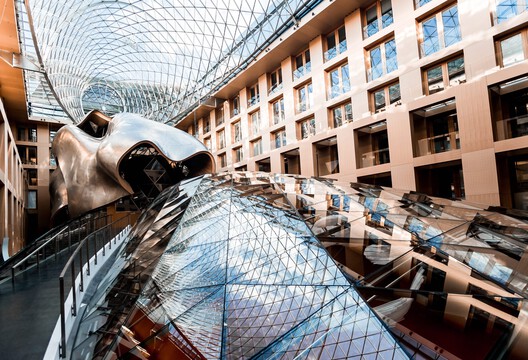
Completed in 2001, the DZ Bank Building in Berlin combines commercial offices and 39 residential units within a single mixed-use complex. The project presents two distinct façades: both clad in buff-colored limestone matching the Brandenburg Gate, yet scaled independently to respond to Pariser Platz and Behrenstrasse. A glass canopy marks the main entrance, leading to a high-volume foyer and a central atrium defined by curving glass ceiling and floor elements. Office spaces are organized around this naturally lit void, while a sculptural stainless-steel-clad conference hall anchors its center. The residential component is arranged around a separate atrium, introducing daylight and views through a reflecting pool and glass elevator system.
Walt Disney Concert Hall, Los Angeles, 2003
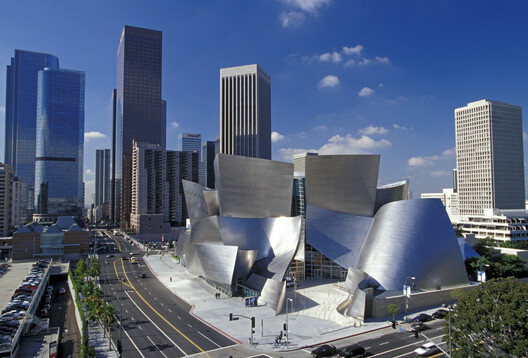
Completed in 2003 as the home of the Los Angeles Philharmonic, the Walt Disney Concert Hall combines sculptural stainless-steel surfaces with a performance space shaped through close collaboration between Gehry and acoustician Yasuhisa Toyota. Initiated by a 1987 donation from Lillian Disney and selected through a design competition, the project developed through extensive model testing, including a 1:10 acoustic mock-up. The hall's single-volume interior brings audience and orchestra into the same space, defined by curving Douglas fir surfaces and a column-free steel structure. Externally, sweeping metal forms evolved from Gehry's paper models, engaging light and movement while framing gardens and public areas intended to enhance the site's civic presence.
Jay Pritzker Pavilion, Chicago, 2004
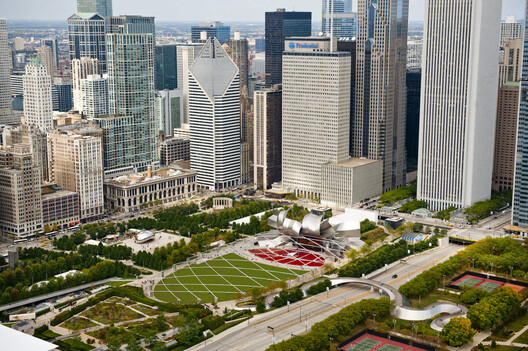
Located in Chicago's Millennium Park, the Jay Pritzker Pavilion is an open-air performance venue designed by Gehry Partners to host the Grant Park Symphony Orchestra and a range of musical programs. The pavilion forms a sculptural focal point within the park, defined by stainless-steel panels that frame the stage, which is clad in Douglas fir. Seating accommodates 4,000 people in fixed seats, with an additional 7,000 on the adjacent lawn. A curving steel trellis spans the length and width of the lawn, supporting a distributed sound system that enhances acoustic quality across the large outdoor space. Back-of-house functions connect to the neighboring Harris Theater, and large glass doors allow the venue to serve community events throughout the year.
Fondation Louis Vuitton, Paris, 2014
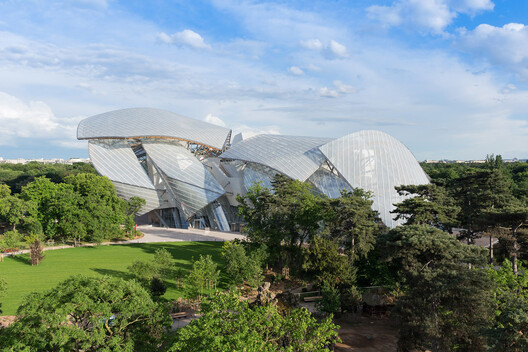
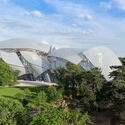
The Fondation Louis Vuitton sits within Paris' Jardin d'Acclimatation and draws on the garden's historic glass pavilions while creating a contemporary museum setting. The building is formed by a series of white "icebergs" clad in fiber-reinforced concrete and wrapped by twelve glass sails supported by timber beams. Positioned along a water garden created for the project, the sails introduce transparency and movement, reflecting the surrounding trees and shifting light. Inside, an active ground-level hall connects the museum to the Jardin, while expansive glazing provides continuous views of the landscape as visitors move through the galleries and circulate toward rooftop terraces.
Biomuseo, Panama City, 2014
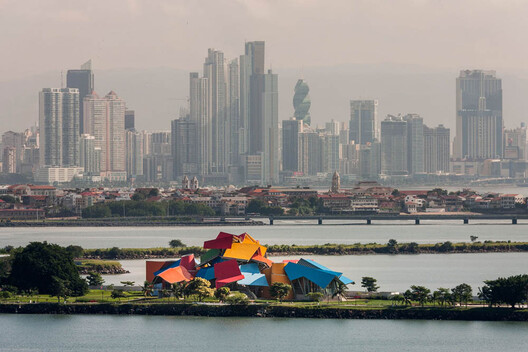
The Biomuseo in Panama combines a museum building, exhibition design, and a surrounding park to create an integrated educational environment. At its center is an open-air atrium sheltered by brightly colored metal canopies that offer protection from wind-driven rain while framing views toward the Canal and city. Public amenities and the two main exhibition wings are organized around this elevated atrium, which also shelters an outdoor exhibition space below. Developed in collaboration with Bruce Mau Design, the museum's eight galleries introduce visitors to the formation of the Isthmus of Panama, its biodiversity, and its ecological significance. The adjacent Park of Biodiversity extends these themes into the landscape through publicly accessible pathways and educational stations.
Dr. Chau Chak Wing Building, Sydney, 2015
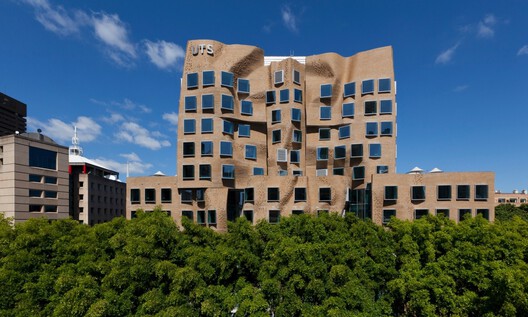
Designed by Gehry Partners as part of the University of Technology Sydney's City Campus Masterplan, the Dr. Chau Chak Wing Building is Frank Gehry's first project in Australia and introduces a distinctive approach to business-school architecture. The building is organized around the idea of a "tree-house," with a central core supporting spaces for collaboration and individual work. Its two contrasting façades, one composed of undulating brick referencing Sydney's masonry heritage, the other formed by angled glass panels that reflect the surrounding context, define its external character.
LUMA Arles Tower, 2021
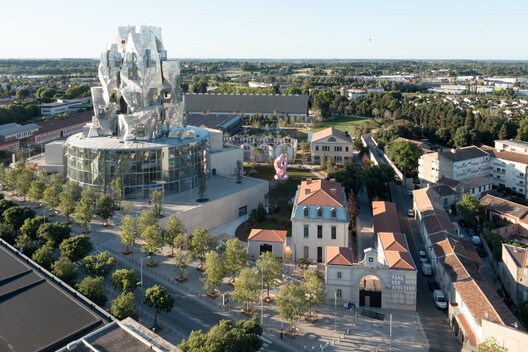
Completed in 2021, the LUMA Arles Tower is the centerpiece of the 27-acre Parc des Ateliers redevelopment, a former industrial site transformed into a creative campus for artists and researchers in France. Designed by Gehry Partners, the building accommodates exhibition galleries, project spaces, research and archive facilities, workshops, seminar rooms, and a café, supporting a wide range of cultural and educational programs. The tower stands alongside six historic industrial structures, five of which were revitalized by architect Annabelle Selldorf for exhibitions and residencies. The entire ensemble is integrated within a public park designed by landscape architect Bas Smets, creating a connected environment for production, display, and community engagement.
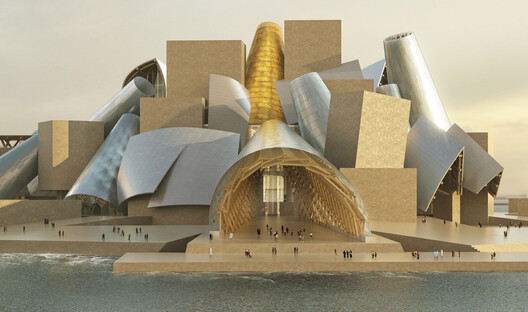
Across varied programs and contexts, Frank Gehry's completed works trace a clear evolution in his handling of form, material, and fabrication. This trajectory extends to the Guggenheim Abu Dhabi, his long-planned museum in the Saadiyat Cultural District scheduled to open in 2026, which carries forward many of the architectural themes that defined his practice. As one of the final major projects to be realized from his studio, it stands as both a continuation of his architectural explorations and a testament to his contribution to cultural institutions worldwide. Even with his passing, Gehry's influence remains embedded in the methods, ambitions, and conversations that continue to define the field.