With its massive, intricate roof and man-made pools and canals, Ateliers Jean Nouvel's astonishingly complex Louvre Abu Dhabi was a project 10-years in the making before finally debuting to the public earlier this month. But even if the project missed it's original completion date, it certainly wasn't for lack of trying – and that's proven in this new video timelapse from EarthCam.
The video captures the 8-year-long construction process from groundbreaking to completion, showing the museum as it came together from a variety of perspectives, including how the roof was assembled in mid-air before being gently lowered into place, and the enormous effort of earth moving to build the unique site.
You may not have guessed that the dystopian state of Los Angeles filmed in Blade Runner 2049 is a real place, just smaller. The scenes, from Los Angeles to the Trash Mesa and Wallace Tower were built to scale in Wellington, New Zealand by Weta Workshop, the massive ‘miniature’ sets were then filmed by cinematographer Alex Funke.
This silent film, ‘The Skyscrapers of New York’ bears rare footage of the construction of a skyscraper from over one hundred years ago, shared by the Library of Congress as part of their ‘Early Films of New York’ collection. The first scenes include real work crews and the early construction methods that made the first skyscrapers possible; the steel framework the men can be seen clinging onto was a technical innovation that provided the strength and stability for buildings to be built over twenty floors high. It is startling to imagine their lack of concern for health and safety as the men are pictured dangling off a crane line in the sky.
Cities are universes in themselves; furiously spawning, spewing, hissing through time and space. They are cudgeled, raked, plastered, worshipped, fought over, set on fire; they are slippery wombs that cradle wars, victories, blood and brilliant storms. The built environment has always been indicative of its inhabitants’ fears, desires, and ideals. As such, it is one of the earliest, most powerful forms of human expression. For World Cities Day 2017, the new BBC Designed section of the BBC Culture website commissioned motion graphics designer Al Boardman to create The Perfect City, an animated video covering a brief history of humankind’s quest for the "ideal" and the "perfect" in urban design. With a voiceover and script by renowned architecture critic and writer Jonathan Glancey, the video is a remarkable 2-minute overview of some prominent examples in city planning, both old and new, successful and unsuccessful.
https://www.archdaily.com/882688/playful-animation-tells-the-story-of-humankinds-quest-for-a-perfect-cityZoya Gul Hasan
Early on in my career I had to decide between honest arrogance and hypocritical humility. I chose honest arrogance and have seen no occasion to change.
Frank Lloyd Wright is the household name of architects in the United States, with stories of his ego as widespread as his prolific work. Watching Frank Lloyd Wright at 83 years old is not your typical history lesson. The interview aired on NBC Chicago in 1958 and captures Frank Lloyd Wright telling stories to Hugh Downs about his education, early career with Louis Sullivan, an inspiration for Taliesin and Taliesin West and his own innovations in architecture (let's just say this question didn't get a humble response).
Architecture has to be organic… we need to create a space for people to connect, to coexist - MAD Architects.
As the demographic of China’s buildings changes, one architect is fighting the “artificial” straight lines and tower blocks that are plaguing the skyline. In the government’s mass urbanization, skyscrapers are having to be built constantly for all the people that are flocking to the cities.
Ma Yansong, the founder of MAD Architects explains “They often deal with efficiency, the function, the structure. There's no nature. People love to go closer to nature and other people, so we need to create environments that let people have these emotional connections."
ODA New York’s design for Bushwick II, a high-end residential complex on the former site of Brooklyn’s Rheingold Brewery, is coming to life in the fast-growing neighborhood of Bushwick, New York. Developed by All Year Management, 123 Melrose is already being clad. Meanwhile, Rabksy Group’s development, 10 Montieth, recently topped out.
Together, the projects will cover three full city blocks, totaling 1.35 million gross square feet. Bushwick II will be the largest housing increase this neighborhood of Brooklyn has ever seen.
For me architecture touches on so much of what it means to be human – it touches on society, on politics, on culture. And we need to negotiate all of those thresholds in order to design.
In this video for CNN Style, architect Amanda Levete, founder of London-based practice AL_A, discusses the importance of identifying and creating thresholds in design, in both the literal and abstract definitions of the term. Working at a wide variety of scales, AL_A strives to react to larger societal issues in their designs, creating points where perceptions and emotions can transform.
In this six-minute-long video, Vox makes the argument that the primary reason behind the recent resurgence of streetcar systems—or proposals for streetcars, at least—in the USA is not because of their contributions to urban mobility, but instead because of the fact that they drive and sustain economic development. As it uncovers the causes for the popular failure of the streetcar systems in cities such as Washington DC, Atlanta, and Salt Lake City (low speed and limited connectivity, mostly) it asks why an increasing number of American city governments are pushing for streetcars in spite of their dismal record at improving transit. Is it solely due to their positively modern aesthetic? Are streetcars destined to function as mere “attractions” in a city’s urban landscape? Or is the real objective something more complex?
The next time you're cursing the price of a city parking meter, think instead about the high cost of free, off-street parking in terms of the urban environment. Urbanists these days agree that cities are at their best when they are walkable—designed for people instead of cars—but the reasons for the car-centric design of cities in the US are complex. In this video, Will Chilton and Paul Mackie of Mobility Lab describe all the problems inherent with parking in US cities and how it got to be this way: namely, off-street parking requirements, or mandatory parking minimums.
Most people know that US cities are dominated by parking, with roughly 8 parking spots per car throughout the country, but this video will give you all the information you need to win any debate about the impacts of mandatory off-street parking. Describe with confidence why cities love mandatory minimums for developers, extoll the virtues of correctly-priced parking meters, and impress your friends and colleagues with your knowledge of the other ways you pay every day for "free" parking.
Videos
Ali Alamedy's miniature worlds. Image via The New York Times
Although trained as a Control and Computer Engineer,Ali Alamedy has since turned his hand to manufacturing scaled, miniature dioramas. After being forced to leave his home in Iraq, he and his family are now based in Turkey – and it is here that he has honed a skill in constructing these tiny, intricate worlds from a broad range of ordinary materials. All scaled at 1:12, these complex and often hyper-realistic models are inspired by the environments around him, complemented by his experiences and, of course, his imagination. In this study of Alamedy's work, ArchDaily asks: how do you do it?
Architect and author of the Architect + Entrepreneur book series Eric Reinholdt recently released a video detailing the results of his research into the best drone for architects and designers. The drone he chose is the Mavic Pro from DJI, which he says balances multiple factors like cost, portability, camera quality, stability, ease of operation, and flight time. The only major negative Reinholdt mentions is the camera’s fixed aperture; he recommends counteracting this by purchasing neutral density filters, which help adjust the camera’s exposure. But why architects? Reinholdt mentions the variety of possible uses for a drone throughout a project, but most importantly, he sees video as the future of telling the story of architecture. Through video, you can simulate a user's movement through spaces and mimic the experience of architecture.
I really believe that the role of the museum is to go beyond the boundaries of the building and to engage in contemporary life, so by creating a new public outdoor space – a new courtyard, a new place – we’ve renegotiated the relationship between street and museum
In this video from CNN Style, director Matthew Donaldson takes us inside the just completed courtyard entrance and extension of London’s V&A Museum, the world's largest museum of decorative arts and design. Designed by AL_A, the newly completed space features 11,840 square feet of flexible gallery space and the world’s first public courtyard constructed entirely of porcelain, paved with 11,000 tiles in 15 different patterns handcrafted by Koninklijke Tichelaar Makkum, the Netherlands' oldest registered company.
Featuring narration by Amanda Levete, founder of AL_A, the video offers an intimate look at the project’s above- and below-ground spaces, including the entry pavilion, sleek new stair and skylight-lit galleries.
The world’s largest indoor waterfall is currently being built in Singapore’s new Jewel Changi Airport extension. Designed by Safdie Architects, the spheroid-shaped dome will be a new luxury lifestyle destination for one of the world’s busiest airports and is a feat of engineering and sustainability. At approximately 134,000 sqm in size, the Jewel offers a range of facilities including airport services, indoor gardens, shopping and leisure attractions – including a canopy park in the upper levels of the dome.The 40m-tall waterfall is designed by water design firm WET, whose commissions include the Bellagio fountains and Burj Khalifa. Dubbed the Rain Vortex, the ambitious cascade will be the centerpiece for the project’s “Forest Valley” urban garden.
A new train station in Cambridge is getting a lot of attention from a surprising audience: mathematicians. Cambridge North Station is clad in aluminum panels with a geometrical cutout design. The architecture firm, Atkins, originally claimed that the pattern was derived from Cambridge alumnus John Conway’s “Game of Life,” but eagle-eyed mathematicians soon realized that was incorrect. As the above video points out, the design is in fact based on a mathematical rule studied by Stephen Wolfram, an Oxford alumnus, much to the dismay of rival university Cambridge. Though the firm’s website still references Conway, a Senior Architectural Designer at Atkins, Quintin Doyle, has since confirmed that it was, in fact, Wolfram’s Rule 30 that they used in the design.
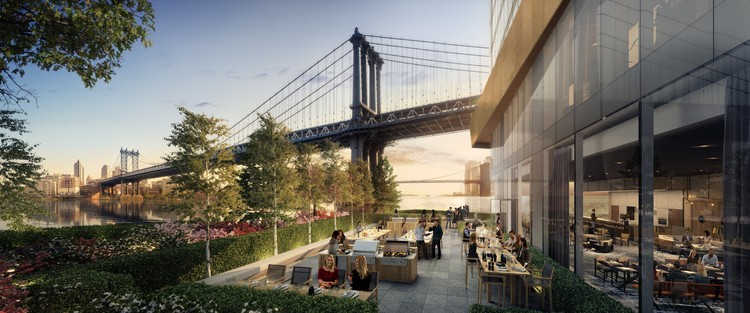
In this video, West 8 co-founder Adriaan Geuze discusses the design process behind New York City’s largest private outdoor gardens, which will be located at One Manhattan Square in the Lower East Side. Currently under construction, the 800-foot-tall glass residential tower will feature more than an acre of exterior garden space designed by West 8 Urban Design and Landscape Architecture.
With 360 camera technology, the ability to transport people into a space through film has become all the more immersive. Viewers are able to turn the viewport in every direction to see the whole scene, or even to put on a headset for a more natural way of viewing a scene. Of course, this has important implications for viewing architecture, which many believe has become too image based, and therefore two-dimensional. 360 videos leave no corners conveniently hidden, as a traditional video or image would, perhaps providing a fuller picture of a place - could this perhaps open up a more human-scale understanding of space?
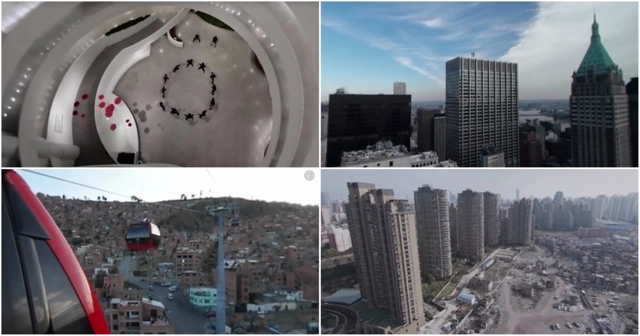
The New York Times have treated their Facebook followers to some great architectural insights through their Daily 360, getting more than their money’s worth out of their 360 camera equipment. Some of these must-see videos include a dance rehearsal taking place in the Guggenheim Museum’s rotunda, as well as an aerial view of La Paz, Bolivia. Read on to take a peek into the richness of earth’s urban spaces:
Serving as a new academic hub at the heart of the Morningside Heights campus, the 128,000-square-foot building will house a “new kind of library that incorporates technologies and learning spaces in an interactive setting and creates an inviting environment that benefits from green spaces.”



_Bloomimages_7.jpg?1505315925 "Courtesy of ODA New York")
_Bloomimages_8.jpg?1505315959 "Courtesy of ODA New York")
_Bloomimages_1.jpg?1505315031 "Courtesy of ODA New York")