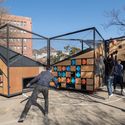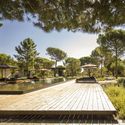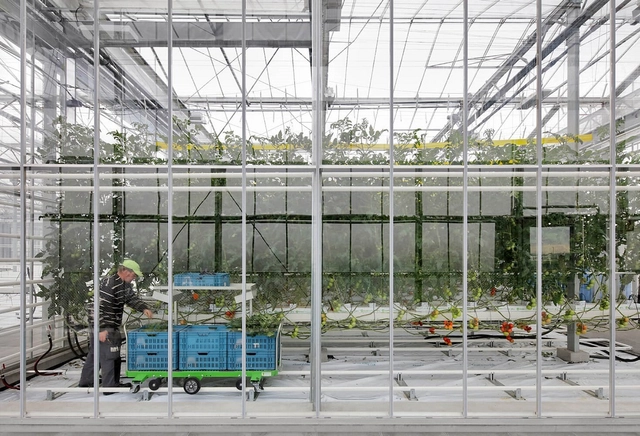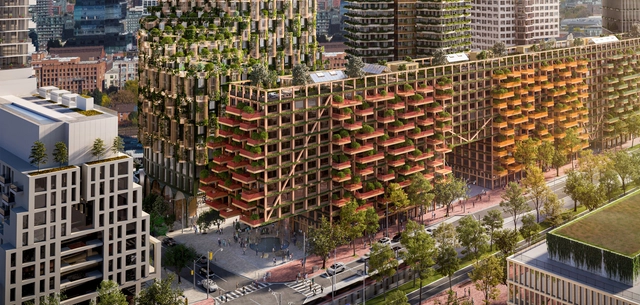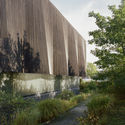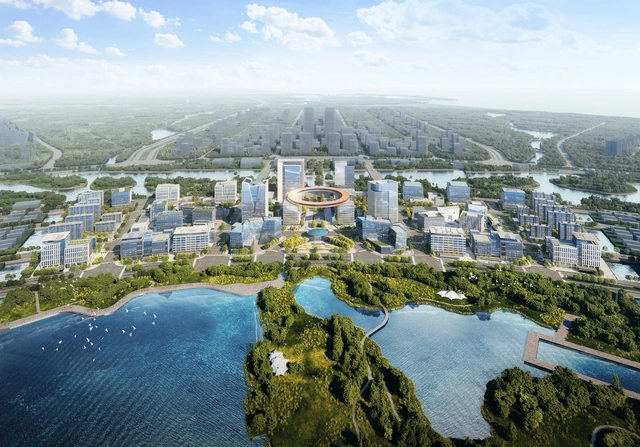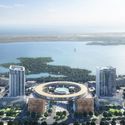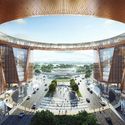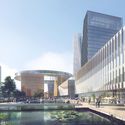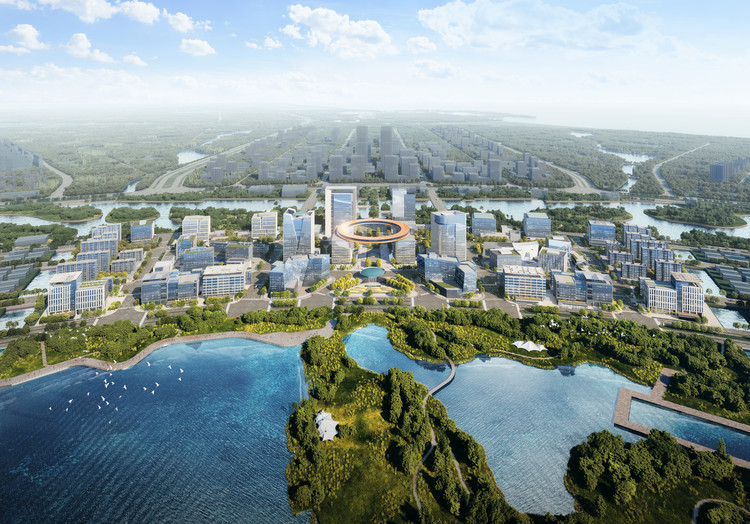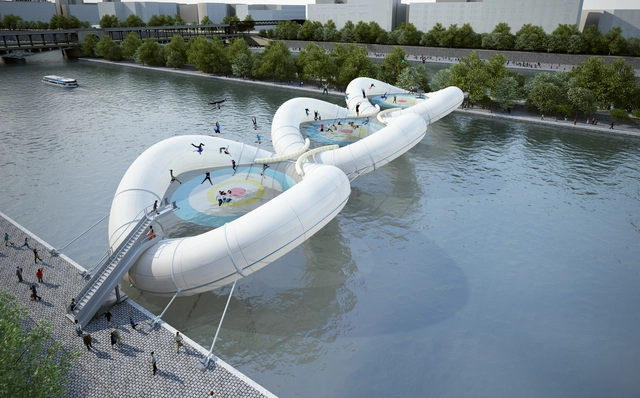
Zbraslav Square . Image Courtesy of Architects for Urbanity
Recognizing the importance of international contests in pushing forward inventive concepts and design, ArchDaily has put together a curated selection of Best Unbuilt Architecture featuring competition entries from around the globe. Submitted by our readers, these projects include winning proposals, honorable mentions, and recognized admissions.
In this week’s article, urban interventions take the lead with multiple square designs and infrastructural elements. On the cultural level, projects underlined include Museums in Iran and Norway, a National Concert hall in Lithuania, and a Mosque in Turkey. For the civic category, the functions highlighted comprise a new city hall for a South Korean district and an Indian community development center for at-risk women. Finally, other programs involve a rural school in Haiti, a tourist center in China, and a housing complex in Prague.
The Un-Habitat or the United Nations agency for human settlements and sustainable urban development, whose primary focus is to deal with the challenges of rapid urbanization, has been developing innovative approaches in the urban design field, centered on the active participation of the community. ArchDaily has teamed up with UN-Habitat to bring you weekly news, article, and interviews that highlight this work, with content straight from the source, developed by our editors.
Associated with crime, waste, and garbage, Dandora in Nairobi’s Eastlands is home to 140,000 or so residents. In an on-going collaboration, between local residents and youth groups, UN-Habitat, Making Cities Together Coalition, and the Dandora Transformation League, the Model Street project has been transforming the garbage-filled community spaces into waste-free, attractive, and engaging places. Focusing on improving the shared courtyard spaces of residential compounds, an annual competition led by the youth of the neighborhood, the Changing Faces Challenge, became an initiative mobilizing citizens across Nairobi.
More than 55% of the world’s population lives in cities, with that number only expected to increase in the coming decades. Despite the rising population in urban areas, local governments continue to raise flags about inadequate infrastructure and the declining quality of life that cities are facing. Perhaps the large scale problems that we typically categorize as urban innovation, inclusion, and infrastructure, can be solved if we get to the root of the smaller troubles, that we may not even know existed. It’s time to take urban issues off the back burner and improve cities not just for today, but for the long term future.
The area surrounding a river, lake, lagoon or sea coast acts as a transition zone between water and land. Therefore, turning the water banks into dynamic and appealing public spaces helps to establish a certain balance between the stiffness of the built environment and the fluidity of water.
Mask Architects has been named one of ten winning teams in the Cool Abu Dhabi a global design competition. Their proposal, The Oasys, is a system where residents of Abu Dhabi can relax and enjoy outdoor spaces without feeling the heat. Selected from more than 1,570 participants across 67 countries, the project aims to tackle the effects of climate change through a localized solution for the urban heat island effect.
Videos
Gary Chang in his Domestic Transformer. Image Courtesy of Edge Design Institute
Compact living units have become the norm in most big cities across the globe. High density and the value of land in urban areas has made it mandatory for most developments to take full advantage of the buildable area. The result is homes that are increasingly smaller. Hong Kong is probably the most extreme case – with roughly three-quarters of the land preserved, the portion left for housing accommodates more than 7 million people in one of the densest urban environments on Earth.
We recently had the opportunity to talk with architect Gary Chang, founder of the Hong Kong-based Edge Design Institute, about his vision of compact living, small-scale architecture, flexibility, and the future of our cities.
Quintain, award-winning developer, used Delve to redesign London’s Wembley Park. Image Courtesy of Quintain
Sidewalk Labs has unveiled Delve, a new generative design tool that aims to help developers, architects and urban designers identify better neighborhood design options. It uses machine learning to reveal optimal design options from a series of core components, including buildings, open spaces, amenities, streets, and energy infrastructure. By applying machine learning, it explores millions of design possibilities for a given project while measuring the impact of design choices.
The Un-Habitat or the United Nations agency for human settlements and sustainable urban development, whose primary focus is to deal with the challenges of rapid urbanization, has been developing innovative approaches in the urban design field, centered on the active participation of the community. ArchDaily has teamed up with UN-Habitat to bring you weekly news, article, and interviews that highlight this work, with content straight from the source, developed by our editors.
“People all over the world are increasingly demanding a say in the way that their cities are planned and designed”.For our third collaboration, discover UN-HABITAT’s guideline on achieving quality public spaces, a site-specific assessment consisting of a series of activities and tools that help understand the quality of the selected area and plan future design and planning solutions on the site through participatory approaches. Focusing on open public space, within a five minutes walking distance, the guide helps users gather and analyze information, creating a logical transition from needs to design.
Design studio Project Room has been announced as the winner of the competition to design and create a new standard streetlight for Los Angeles. Initiated by the City of L.A. and led by the Mayor's Office with the Bureau of Street Lighting, the competition asked designers to create a lighting system that would incorporate new technology, include space for text on each pole, and provide shade to help ease the impacts of the climate crisis.
Trang Keo Park - Vietnam. Image Courtesy of UN-Habitat
The Un-Habitat or the United Nations agency for human settlements and sustainable urban development, whose primary focus is to deal with the challenges of rapid urbanization, has been developing innovative approaches in the urban design field, centered on the active participation of the community. ArchDaily has teamed up with UN-Habitat to bring you weekly news, article, and interviews that highlight this work, with content straight from the source, developed by our editors.
In this second collaboration with UN-Habitat, discover different examples on how to design with and for kids in marginalized areas. In fact, child-responsive planning leads to a vibrant and animated inclusive city. Focusing on spaces for children, this feature highlights cases in Bangladesh, Niger, and Vietnam. These public spaces implementation projects seek to promote environment-friendly livable cities, taking on participatory approaches and involving the youngsters from the beginning of the process. In the end, no one knows the needs of kids, more than the kids themselves.
Approaching the context of widening political divides and growing economic inequalities. A new spatial contract. Learning how will we live together. These thoughts brought by Hashim Sarkis, curator of the 17th International Architecture Exhibition of Venice Biennale 2021, may raise important questions about how architecture crosses and materializes social and political conflicts. To understand a more decentralized point of view, which indicates possibilities other than those dictated by normative mindsets, we interviewed Tainá de Paula, a Brazilian architect and community mobilizer in poor suburban areas.
Nieto Sobejano Arquitectos have unveiled the new design for Cité du Théâtre, a large cultural center promoted by the French government in Paris. They will be working with French office Marin+Trottin Architectes, and the project will be located in the Ateliers Berthier. The winning project is based on the creation of a large elevated garden that establishes a visual continuity with Martin Luther King Park.
MVRDV and The Why Factory (Delft University of Technology) revealed “Le Grand Puzzle”, a book that holds ambitious ideas for Marseille, in the south of France. In fact, the study, made from 2018 to the start of 2020, “proposes a methodology, an agenda, and an analysis to portray today’s Marseille”.
"Landscaping is the only artistic expression that includes all five human senses," says Benedito Abbud in his book Creating Landscapes – a guide to Working in Landscape Architecture. While architecture works mainly with sight and touch, landscaping also embraces smell, hearing and taste, "which provides a rich sensorial experience, by combining the most diverse and full perception experiences. The more a garden can sharpen all the senses, the better it fulfills its role."
Skateboarding is its own urban experience. As interactive public spaces and tactile surfaces, skate parks have slowly begun to shape the way we think about urban design. Beyond the boundary of parks themselves, skaters look at the architecture of the built environment outside of its intended purpose, and in turn, are rethinking how we gather, move around, and reimagine the future of urban life.
Mind the Step - Jardim Nakamura, São Paulo, Brazil. Image Courtesy of UN-Habitat
The Un-Habitat or the United Nations agency for human settlements and sustainable urban development, whose primary focus is to deal with the challenges of rapid urbanization, has been developing innovative approaches in the urban design field, centered on the active participation of the community. ArchDaily has teamed up with UN-Habitat to bring you weekly news, article, and interviews that highlight this work, with content straight from the source, developed by our editors.
Discover in this feature the first lesson to learn from UN-Habitat, on how to design with and for the people. In order to create great public spaces, the only secret is listening to the community. Questioning “how can we design together”, this article presents cases in Ghana, Brazil, and India, focusing on street, market, and open public spaces implementation projects, where interventions took on participatory approaches and involved local residents from the beginning of the process.
Dominique Perrault Architecture - The City of Tomorrow. Image Courtesy of Hangang District Urban Design International Master Competition
Dominique Perrault’s proposal has won “the transformation and revival of industrial heritages” or the Hangang district urban design international competition, in Handan, China. Six teams from world-renowned architectural firms, including Coop Himmelb(l)au and UNStudio Team, were invited to participate in the contest and envision the future of the city, through their creative designs.
CRA - Carlo Ratti Associati has unveiled a major extension for Brazilia, reinterpreting “Lúcio Costa and Oscar Niemeyer’s modernist master plan for Biotic - a high-tech innovation district immersed in nature”. Developed in collaboration with Ernst&Young, the project that started in 2018 reimagines primarily the superblocks.