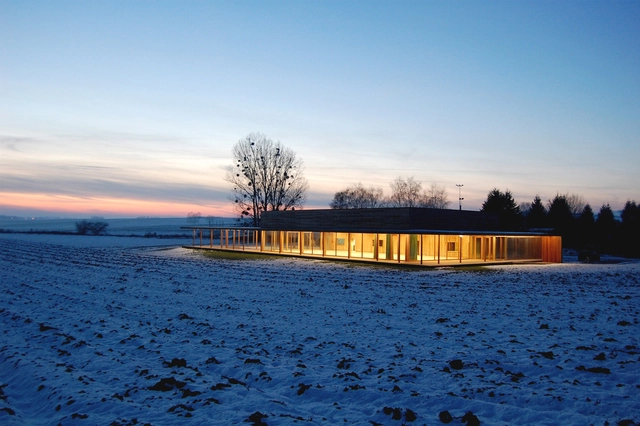
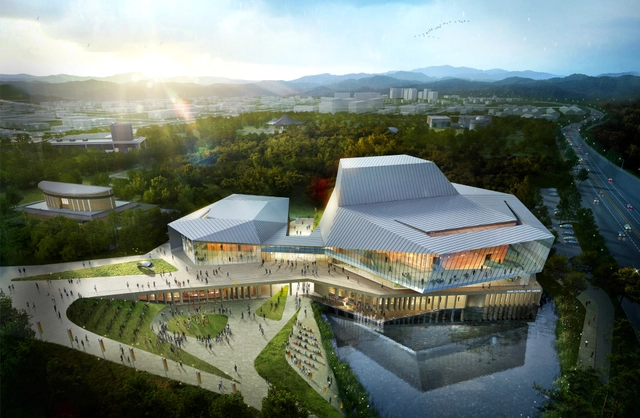
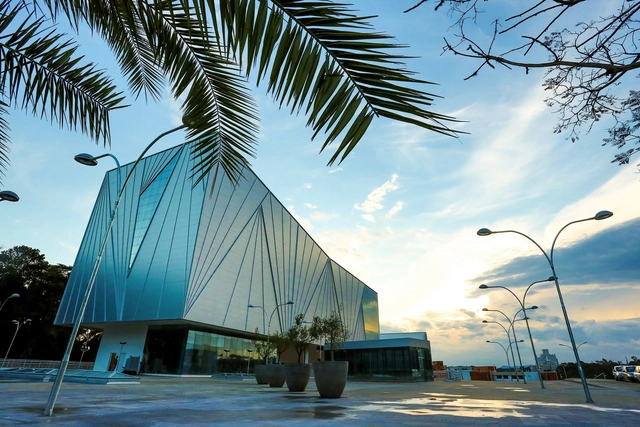
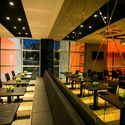
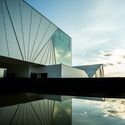
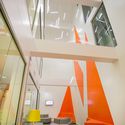
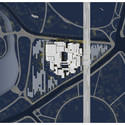
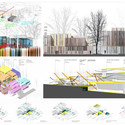
Envisioned as part of a new media park slated for construction in the city, the building's design is playful and contemporary, offering visitors a "series of unique spatial experiences." Learn more about the project and view selected images from the proposal after the break.
designcamp moonpark dmp has won a competition to design the new cultural arts center in Asan, South Korea. The winning proposal, inspired by an "Echoing Sculpture," balances mass and void with two theaters and a cultural arts building that frames a garden and civic waterfront plaza.
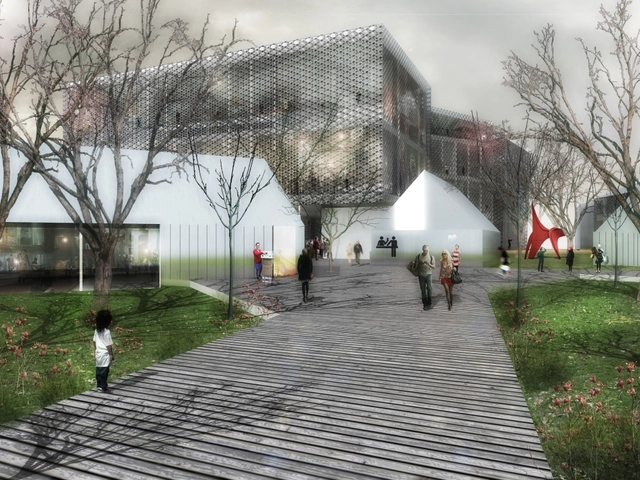
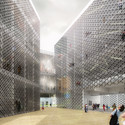
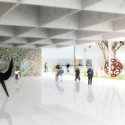
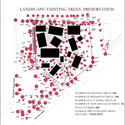
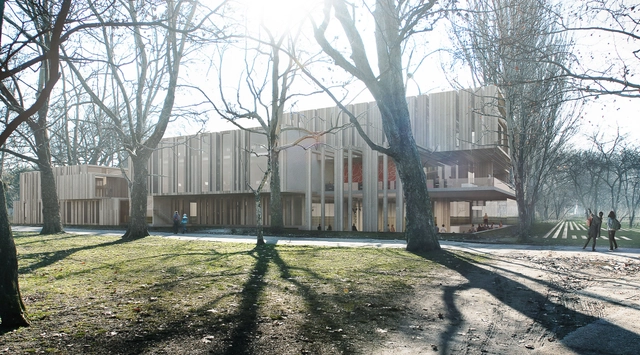
As part of the Liget Budapest Competition, SCStudio has shared their entry for the House of Hungarian Music. A transformation of an existing city park, the project is conceived as a sequence of cultural programs - an “urban archipelago” - connected by a “naturalistic promenade” of pathways and landscape within a preserved forested area.
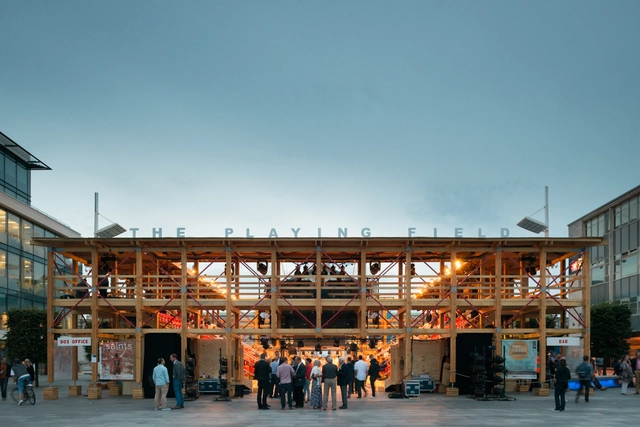
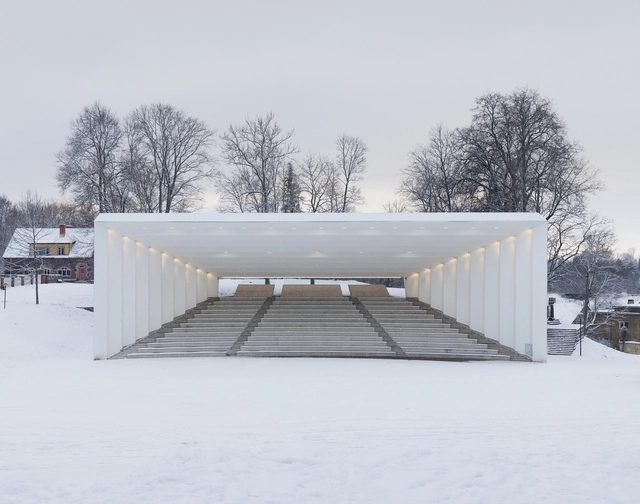
The Playing Field, a 450-seat "high tech Tudor theatre" in the heart of the British city of Southampton, represented a major collaboration between the city’s arts organisations and was realised through a collaborative effort between engineers Structure Workshop and Assemble Studio, the London based practice known for innovative interventions within the public realm. Their Cineroleum, coupled with a bold renovation of a yardhouse, are part of a small canon of cultural buildings designed to temporarily reimagine the urban landscape on a small scale.
Videos
Courtesy of OMA; Photography by Philippe Ruault
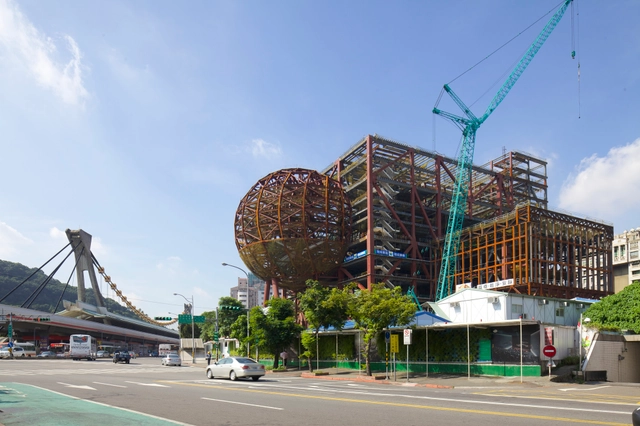
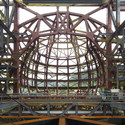
OMA's Taipei Performing Arts Center (TPAC) has topped out in a ceremony including Taipei’s mayor Hau Lung-pin, and OMA's Partners in charge of the project, Rem Koolhaas and David Gianotten. Even in its current skeletal state, the rigidly geometric form is clearly expressed with it's central cube supporting three protruding auditoriums, two cubic and one spherical. The design of the TPAC is in many ways experimental, incorporating a looped public path which shows off the building's backstage areas, and flexible auditoriums which can even be combined, offering extraordinary stage spaces that allow performances which would be impossible in any other theater.
Ahead of the topping out ceremony we spoke to partner in charge David Gianotten, who explained the building's design concepts and the challenges (or rather, surprising lack of challenges) in the construction, and told us "you will only understand it when you have seen it. It's super exciting, we encourage everybody that loves architecture to come and see it because it's spectacular."
Ziya İmren Architects have proposed a "symphonic architectural poem dedicated to Franz Liszt and Béla Viktor János Bartók" as part of the Liget Budapest International Design Competition launched earlier this year. The architects' approach is based on the pioneering compositional methods of Franz Liszt and Bela Bartok. The design proposal brings "thematic inspiration to the fore by restructuring the classical system of a symphonic work into the form of poetry as a gesamtkunstwerk (a 'total work of art')."










-Konior-Studio-Tomasz-Konior-0010.jpg?1418688227&format=webp&width=640&height=580)
-Konior-Studio-Tomasz-Konior-0047.jpg?1418688216 "© Iñigo Bujedo Aguirre")
-Konior-Studio-Tomasz-Konior-0030.jpg?1418688207 "© Iñigo Bujedo Aguirre")
-Konior-Studio-Tomasz-Konior-0015.jpg?1418688195 "© Iñigo Bujedo Aguirre")
-Konior-Studio-Tomasz-Konior-0010.jpg?1418688227)