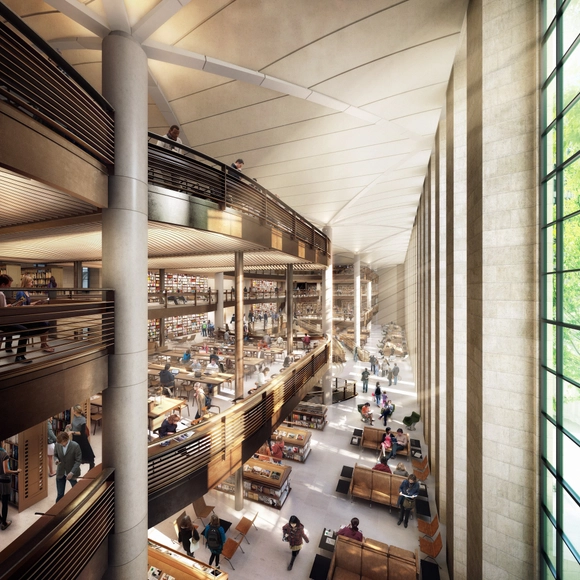
The New York Public Library (NYPL) has abandoned Norman Foster's controversial plans to transform part of its 20th century Carrère and Hastings “masterpiece” into a circulating library. The news doesn’t come as much of a surprise, considering the city’s new mayor, Bill de Blasio expressed skepticism towards the $150 million renovation earlier this year.
According to a report by the New York Times, Blasio does not intend on reducing the NYPL funding, however the money will now be allocated to other purposes.
Several library trustees have stated that in order to keep up with the cultural shift from traditional stacks to online resources, they now intend on completing the renovation of the library's mid-Manhattan branch on Fifth Avenue.
Yes, you read right - the 1960s urban planning battle between Jane Jacobs and Robert Moses will be the central story line for a new opera. Although the premiere is a long way off, its creators promise to bring New York City and the drama to life through song and an elaborate, animated, three-dimensional set. To find out more about the developing project, head on over to Fast Co-Design.
New York Mayor Bill de Blasio has addressed the “crisis of affordability” by implementing a five-borough, ten-year plan that will build and preserve 200,000 affordable units over the coming decade. Believing affordable housing to be part of “the bedrock of what makes New York City work,” Blasio hopes the plan will make New York, once again, “a place where our most vulnerable, our working people and our middle class can all thrive.” Review the plan in detail and check out one of the largest affordable housing projects planned for the city, here.
Not DJ Kool Herc. Not The Sugarhill Gang. Not Crazy Legs. Not even Cornbread. The true father of hip-hop is Moses. The tyrannical, mercilessly efficient head of several New York City public works organizations, Robert Moses, did more in his fifty-year tenure to shape the physical and cultural conditions required for hip-hop’s birth than any other force of man or nature. His grand vision for the city indifferently bulldozed its way through private estates, middle-class neighborhoods, and slums. His legacy: 658 playgrounds, 28,000 apartment units, 2,600,000 acres of public parks, Flushing Meadows, Jones Beach, Lincoln Center, all interconnected by 416 miles of parkways and 13 bridges. Ville Radieuse made manifest, not by Le Corbusier, the visionary architect, but by “the best bill drafter in Albany.”
This new urbanism deepened the rifts within class and culture already present in post-war New York, elevated the rich to midtown penthouses and weekend escapes to the Hamptons or the Hudson Valley, and relegated the poor to crowded subways and public housing towers—a perfect incubator for a fledgling counterculture. One need not know all the lyrics to Grandmaster Flash’s “The Message” or Melle Mel’s “White Lines” to appreciate the incendiary structures built by Moses and his policies. As the Bronx began to burn, hip-hop began to rise.
In January of this year, the latest work by Smiljan Radic, the Chilean architect chosen to design the next Serpentine Pavilion, opened to public acclaim. The Museum of Pre-Columbian Art (Museo de Arte Precolombino), located in Santiago de Chile, is a restoration project that managed to sensitively maintain an original colonial structure - all while increasing the space by about 70%.
What appears here is not strictly a battle between an institution that wants to reflect the spirit of the time vs a building that is inherently specific to its place. It represents a lost design opportunity. What if the American Folk Art Museum had been considered an untouchable civic space in the city of New York, much like the The Museum of Pre-Columbian Art is for the city for Santiago? Then a whole new strategy for adaptive reuse would have emerged.
Unified Urban Field. Image Courtesy of Estate of Lebbeus Woods
This summer, the drawings, theories and works of architect Lebbeus Woods are headed to the city that Lebbeus considered home. After a five-month stay at SFMOMA, the exhibit "Lebbeus Woods - Architect" will be at the Drawing Center in SoHo, Manhattan until mid-June. The following story and overview of the exhibition, by Samuel Medina, originally appeared at Metropolis Magazine as “Coming Home".
It’s all too biblical an irony that Lebbeus Woods—architect of war, catastrophe, and apocalyptic doom—died as strong winds, rain, and waves barreled down on Manhattan, his home for some 40-odd years. Woods passed the morning after Hurricane Sandy flooded Lower Manhattan, almost as if the prophet had succumbed to one of his turbulent visions. But this apocryphal reading is just one way to view Woods’s work, which, as often as it was concerned with annihilation, always dared to build in the bleakest of circumstances.
“Yes, all buildings one day will turn to dust, but this building could have been reused,” Tod Williams. “Unfortunately, the imagination and the will were not there.”
Though MoMA has promised to preserve the building’s iconic copper-bronze facade, Williams is concerned it will forever stay in storage.
Proposals are being suggested on how to resurrect the facade, as the New York Times reported, including a concept from Nina Libeskind, chief operating officer of Studio Daniel Libeskind, and AIA New York executive director Fredric M. Bell that will be presented to MoMA next week. However, Williams expressed disinterest at the idea of installing fragments of the building elsewhere.
A recent article from The New York Times confirms something we've all long-suspected. A Pritzker translates into big bucks. Demand for Shigeru Ban's Manhattan buildings has soared since his awarding of the prize. The New York Times reports that page views of the Metal Shutter Houses, for example, have quadrupled on the listings site Streeteasy.com. Why? The Pritzker name carries weight:
Developers Forest City Ratner Companies (FCRC) and Greenland Group have decided to realize SHoP Architects’ original plan to top Brooklyn’s Barclays Center with a 130,000 square foot green roof. Though the design was first disregarded due to budget cuts, the developers have deemed it necessary to enhance the marketability the Atlantic Yards’ three residential towers - the first is currently underway - and dampen the noise from loud concerts. Little details have been released about the green roof’s design, however rumor has it that it might not be open to the public as it was originally intended.
Skidmore, Owings & Merrill LLP (SOM) has been chosen to design a new teaching and learning facility for Barnard College - Columbia University’s world-renowned liberal arts college for women. The selection committee chose SOM after deeming them the best candidate in three categories: “a history of creative and innovative architecture,” a proven recorded on similar academic projects, and “an internal commitment to woman’s leadership reflected by women holding key roles in the firm.”
Videos
Render for The BIG U, "The Harbor Berm," an elevated path through the park. Image Courtesy of rebuildbydesign.org
Yesterday BIG, along with 9 other teams including OMA and WXY, unveiled their proposals for "Rebuild by Design," a competition which tasks teams with improving the resiliency of waterfront communities through locally-responsive, innovative design. Each proposal was required to be "flexible, easily phased, and able to integrate with existing projects in progress." As Henk Ovink, the Principal of "Rebuild by Design" as well as the Senior Advisor to the U.S. Department of Housing and Urban Development (HUD) Secretary Shaun Donovan, stated: "Rebuild by Design is not about making a plan, but about changing a culture." The winners will be announced later this spring.
BIG's proposal, The BIG U, is rooted in the firm's signature concepts of social infrastructure and hedonistic sustainability. It envisions a 10-mile protective system that encircles Manhattan, protecting the city from floods and storm water while simultaneously providing public realms specific to the needs of the city's diverse communities. Bjarke Ingels states: "We asked ourselves: What if we could envision the resilience infrastructure for Lower Manhattan in a way that wouldn’t be like a wall between the city and the water, but rather a string of pearls of social and environmental amenities tailored to their specific neighborhoods, that also happens to shield their various communities from flooding. Social infrastructure understood as a big overall strategy rooted in the local communities.”
SuralArk Sketch. Image Courtesy of Austin + Mergold
Socrates Sculpture Park and The Architectural League of New Yorkhave announced that Austin+Mergold have won “Folly 2014” – an annual competition among emerging architects to design and build a large-scale project for public exhibition at Socrates Sculpture Park in Long Island City – with their project SuralArk, an installation that is "part ship, part house."
The annual “Folly” program strives to give emerging architects and designers the opportunity to build public projects that explore the boundaries between architecture and sculpture. This year's proposal beat out 171 submissions from 17 countries; it was selected by a jury made up of Chris Doyle, Artist; John Hatfield, Socrates Sculpture Park; Enrique Norten, TEN Arquitectos; Lisa Switkin, James Corner Field Operations; and Ada Tolla, LOT-EK.
SuralArk will open on May 11th through August 3rd. Learn more about the project after the break.
Robert A.M. Stern’s luxury 520 Park Avenue condominium tower, which is set to take its place on Manhattan skyline by 2017, will be topped with a 12,400 square foot triplex priced at $100 million - the city’s priciest unit. The penthouse will be one of 31 expansive residences offered in the limestone-clad building which, according to the a recent press release, will be “evocative of the great New York apartment buildings of the 1920's and 1930's.” Developers William and Arthur Zeckendorf gained approval for the 51-story skyscraper by purchasing $30.4 million in air rights from the neighboring Christ Church.
The construction of Hudson Yards, the biggest private real estate development in the history of the United States and currently the largest development in New York City since the Rockefeller Center, is gaining momentum. The vast infrastructural project in the heart of the city is set to enclose an active rail yard with an expansive platform, paving the way for 28 acres (and 17 million square feet) of commercial and residential space. Housing over 100 commercial units, 5000 residences, 14 acres of open public space, an enormous school and luxury hotel all on top of a working train depot, the project will directly connect to a new subway station and meet with the High Line.
Foster + Partner'scontroversial renovation plans for the New York Public Library (NYPL) are currently in a state of limbo while the city decides their course of action. Foster's proposal for the 20th century Carrère and Hastings "masterpiece" on 5th Avenue is a response to the cultural shift from traditional stacks to online resources, as the library has experienced a 41% decrease in the use of collections over the last 15 years.

Tadao Andohas been commissioned to design his first New York City building. Though little information has been released, the residential development firm Sumaida + Khurana has closed a deal with the Japanese architect to design a 32,000 square foot, eight-unit, luxury condominium building at 152 Elizabeth Street in Nolita. Construction is expected to begin later this year and the building will be completed in 2016.