

“Something I always tell my students is that it’s important to fail on a continuous basis—and I’m not talking about the grade. I mean it’s in the spirit of risk, that you have to be willing to free yourself from a set of preconceptions in order to get to this new place. And if failing constitutes making mistakes in order to learn from these mistakes, then you have achieved an enormous amount. In fact, you’re only able to move forward because of this new-found knowledge.”
Interview: The Latest Architecture and News
Archiculture Interviews: Evan Douglis
https://www.archdaily.com/773534/archiculture-interviews-evan-douglisSabrina Santos
Archiculture Interviews: Michael Monti
“I think one generational shift that’s going on has to do with the interest in architecture students to be involved in the community. Students see architecture not just as a profession, like medicine or law, they see it as a kind of service profession, on the order of social work or social science, where they understand that the work they do affects communities and real people, so they want to involve the communities from the beginning in their design process.”
https://www.archdaily.com/773165/archiculture-interviews-michael-montiSabrina Santos
Archiculture Interviews: Terry Heinlein
“Students who enter schools of architecture today are entering it at a very young age, perhaps when their total world experience and awareness is relatively narrow, and they’re making the decision to become a practicing architect, and putting aside those studies—general ed., liberal arts studies—that might actually, in the end, make them more contributing architects. […] Fewer and fewer people are having that basic liberal arts, general ed. knowledge in the profession. And it’s a serious problem.”
https://www.archdaily.com/773537/archiculture-interviews-terry-heinleinSabrina Santos
Archiculture Interviews: Joe Riley
“What makes a livable city is the place where the resident—the occupant—feels in charge. So, for a child, a neighborhood that’s child-friendly. Or for citizens, a place that is physically beautiful, and handsome, and nourishing, and inspirational—a place where there is [a] substantial [amount] of public realm.”
https://www.archdaily.com/773164/archiculture-interviews-joe-rileySabrina Santos
Archiculture Interviews: Audrey Matlock
“I think that [sustainability education] is a massive responsibility of ours: to go beyond what we’re being asked to do, and to teach our clients what a good building is, and to get them to look at buildings in different ways, and get them to do […] the right thing.”
https://www.archdaily.com/772933/archiculture-interviews-audrey-matlockSabrina Santos
Video: How Stanley Saitowitz Maximizes Freedom of Space
“These are methods to actually create the optimum amount of freedom for the occupant themselves to figure out how they want to use the space and live with the least […] architectural impediments, and the least […] predetermined idea of where things should go and what should happen where.”
In this interview with DDG | DM Development, Stanley Saitowitz discusses the latest Stanley Saitowitz | Natoma Architects project, a residential building called 8 Octavia in San Francisco. Find out more about Saitowitz’s design principles and methods by watching the video above.
https://www.archdaily.com/772560/video-how-stanley-saitowitz-maximizes-freedom-of-spaceSabrina Santos
Calvin Seibert Sculpts Impressive Modernist Sandcastles
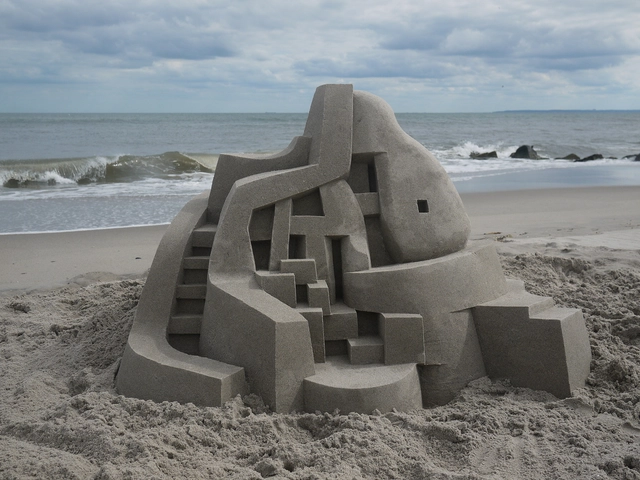
“I always had an affinity for architecture which I attribute to growing up in a neighborhood and town that was constantly under construction. Our house was the first on the block. I think that in a way I was more interested in the abstractness of the foundations and the initial framing then in the completed structures themselves. Things I made back then had that incompleteness about them. As I became more aware of architecture in the wider world Brutalism was one of the styles of the moment. Looking at architecture magazines as a child and seeing hotels in French ski resorts (Marcel Breuer at Flaine) made of concrete suited my sensibility, I was hooked.”
For New York-based Calvin Seibert, sandcastles are more than just a fun summer hobby. Using a paint bucket, homemade plastic trowels, and up to about 150 gallons of water he creates spectacular modernist sandcastles. Read on after the break for an interview with Seibert and to see more photos of his work.



https://www.archdaily.com/770717/calvin-seibert-sculpts-impressive-modernist-sandcastlesSabrina Santos
Archiculture Interviews: Marc Schaut and Dan Bucsescu
In a new segment of the Archiculture extras series, Arbuckle Industries interviews Pratt professors and architects Marc Schaut and Dan Bucsescu, who discuss the extent to which technology has transformed the teaching of architecture, and the necessities of a holistic architecture education. Watch the interview above, and delve into more Archiculture interviews here.
https://www.archdaily.com/769458/archiculture-interviews-marc-schaut-and-dan-bucsescuSabrina Santos
Archiculture Interviews: Bill Hellmuth
“If you look at just carbon emissions, what we do for a living—building buildings, running buildings, all that— is 50 percent of all the carbon emissions in the United States. […] Well that’s both sort of dreadful and wonderful at the same time. […] The opportunity is, because it’s so concentrated, a relatively smaller group of people can do something about it. ”
As a part of its Archiculture series, Arbuckle Industries has interviewed HOK president Bill Hellmuth on his experiences in architecture school and working in a large practice. In the interview, Hellmuth discusses his path in architecture school, how large firms allow for the creation of teams, and issues involving sustainability and livable cities.
https://www.archdaily.com/769625/archiculture-interviews-bill-hellmuthSabrina Santos
Archiculture Interviews: John Cary
"There are far, far more basic things - health, education, housing, and so on - but the thing that we try to communicate [...] is that we need to better articulate how design can improve those truly basic human needs."
https://www.archdaily.com/636410/archiculture-interviews-john-caryHolly Giermann
Archiculture Interviews: John King
"What I love about architecture is it really is the art form that we all encounter, it's larger than life, it's what you can't avoid." In this installment of Arbuckle Industries' Archiculture interviews, author and urban design critic John King dissects the role of the public in architectural practice and the mindset of those who get involved. He goes on to discuss the defining characteristics of successful, seasoned architects, and compares their mentality to that of emerging architects. Additionally, King touches on the subject of architectural criticism and how the profession came about.
https://www.archdaily.com/618276/archiculture-interviews-john-kingHolly Giermann
Archiculture Interviews: Sway Calloway
"I think what you see visually in terms of how you live can definitely make a difference on how you view life."
https://www.archdaily.com/616342/archiculture-interviews-sway-callowayHolly Giermann
The Robot Revolution: Coop Himmelb(l)au Founder Wolf D. Prix on the Future of Construction
With a recently released animation entitled “We Start the Future of Construction,” Coop Himmelb(l)au announced their intention to take digital fabrication to a radical new scale, demonstrating how technology is impacting almost every aspect of the architectural profession. The advent of building information modeling and other modeling software has transformed how architects and engineers navigate the construction process, allowing us to achieve increasingly complex forms that can be modeled with the aid of CNC machining and 3D Printing, but still there remains a wide gap between the technologies available to architects and those employed by builders. When it comes to a building’s actual construction we have been limited by the great costs associated with non-standard components and labor - but now, the automated practices that transformed manufacturing industries could revolutionize how we make buildings.
Last week, ArchDaily sat down with co-founder, Design Principal and CEO of Coop Himmelb(l)au, Wolf D. Prix for his thoughts on the future of construction and the role of the architect in an increasingly technological practice. Read on after the break to find out how robots could impact architectural design, construction, and the future of the profession.





https://www.archdaily.com/604422/the-robot-revolution-coop-himmelb-l-au-founder-wolf-d-prix-on-the-future-of-constructionEvan Rawn
Sergei Tchoban on the Importance of Drawing and Details in Architecture
Berlin Art Link recently sat down with Russian-born, German architect Sergei Tchoban. In the interview above, he discusses his career, including working on the design for the Vostok Tower, Europe’s tallest skyscraper, and the recent opening of the Tchoban Foundation Museum for Architectural Drawing. This building houses his extensive personal works, as well as exhibitions by other artists. “What is very important for me is the quality of all details, so you create a building from outline, from the silhouette, to the door lever. This building brings out a lot of our and my personal ideas about architecture and about details in architecture,” Tchoban said regarding his design for the Museum for Architectural Drawing. The exterior of the building expresses Tchoban’s devotion to draftsmanship-- the facade of the building is etched with a graphic pattern based on sketches from artists Angelo Toseli and Pietro di Gottardo Gonzaga. “I’m very active in drawings, as a draftsman myself. Drawing is a result of our thinking process and our thinking process is not only a thinking process with the head, with the mind, but also the process where you think with the whole body.”
https://www.archdaily.com/589222/sergei-tchoban-on-the-importance-of-drawing-and-details-in-architectureConnor Walker
Archiculture Interviews: David Byrne
“Architecture affects how we see ourselves fitting into a city, and how we relate to one another.” In this latest video from Arbuckle Industries following its release of Archiculture, David Byrne, known for his music, writing, and art, provides his perspective on some of the issues facing architecture today. In the interview, he addresses the need to rethink design practice as an all-encompassing approach, and advocates the tailoring of designs for their specific purposes. Byrne also discusses the problem of the “starchitect” phenomenon, the relationship of people with the built environment, and the resulting atmospheric effects that spatial and acoustic qualities can impart.
https://www.archdaily.com/588685/archiculture-interviews-david-byrneHolly Giermann
Archiculture Interviews: Mary Woods on “Roarkism” and Market-Driven Nature of US Architecture
Cornell University professor and historian Mary Woods is one of over 30 influential practitioners that was interviewed during the filming of Arbuckle Industries’ Archiculture documentary. Beyond her explanation of “Roarkism,” a term inspired by Ayn Rand’s protagonist Howard Roark in The Fountainhead that is used to describe the architect as an “uncompromising individualist,” Woods explains the market-driven nature of the profession and how the US government has historically been reluctant to embrace the arts and architecture.
https://www.archdaily.com/586043/archiculture-interviews-mary-woods-on-roarkism-and-market-driven-nature-of-us-architectureKarissa Rosenfield
Archiculture Interviews: Shigeru Ban
“An earthquake doesn’t kill people, the collapse of a building kills people.” In Arbuckle Industries’ latest interview released following their world premiere of Archiculture, architect humanitarian Shigeru Ban clearly delineates “natural” disasters as a product of mankind, rather than nature. Hear the Pritzker laureate’s thoughts on designing for minorities, disasters, and the importance of travel in the video interview above.
https://www.archdaily.com/583088/archiculture-interviews-shigeru-banKarissa Rosenfield
The Avery Review: Insightful Critical Writing Online
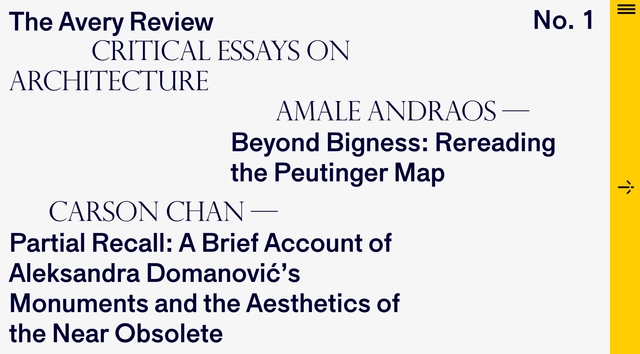
The Avery Review (AR), a new online journal dedicated to thinking about books, buildings and other architectural media, seeks to utilise the potential in the critical essay and repackage it for the digital realm. A project of the Office of Publications at Columbia University's Graduate School of Architecture, Planning and Preservation, the AR's responsive website (designed by Nothing in Common) perfectly matches the exceptional quality of the content. Featuring essays from Owen Hatherley and Amale Andraos, among others, the overarching aim of the review is to "explore the broader implications of a given object of discourse" whether that be "text, film, exhibition, building, project, or urban environment."
Find out more from editors Caitlin Blanchfield and James Graham after the break.
https://www.archdaily.com/552250/the-avery-review-insightful-critical-writing-onlineJames Taylor-Foster