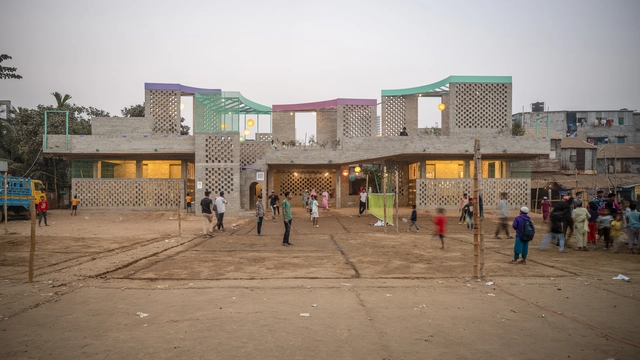
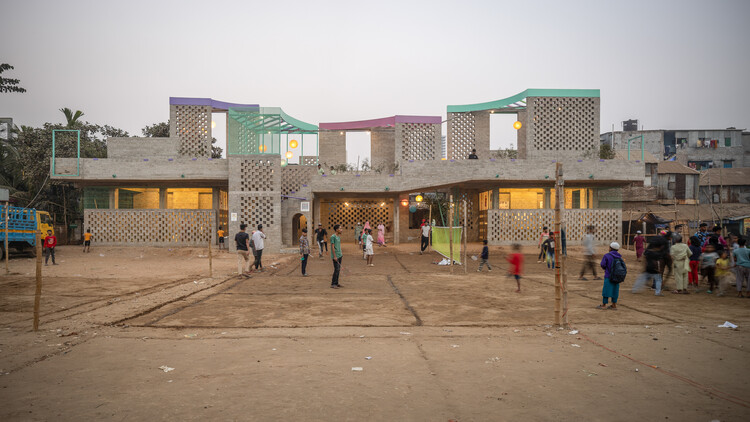
The second edition of the Ammodo Architecture Award has recognized 26 recipients for their contributions to socially and ecologically responsible design. Selected from 168 submissions spanning over 60 countries, the laureates represent a wide range of practices, from established offices to emerging collectives and community-led initiatives. Each recipient receives a grant ranging from €10,000 to €150,000 to support the continued development of their projects. Beyond recognition and financial support, the Ammodo Architecture initiative also functions as a knowledge platform, connecting awardees across regions and facilitating the exchange of ideas on key themes identified by the advisory committee.
Another edition of the conference Architecture Matters will take place on May 15-16 in Munich, Germany, bringing together architects, city officials, developers, and more professionals who care about the built environment (you can read our report of the 20223 edition). Amidst the current state of affairs, the conference is titled “Crisis vs. Crisis”, to reflect on how the interconnected pressing challenges of housing, climate, and geopolitical issues need to be addressed in order to have positive consequences, and not creating yet another crisis.
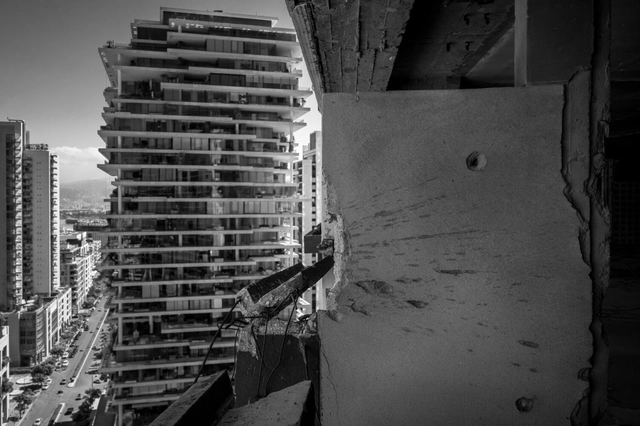
Hosted at the House of Communication, recently refurbished by HENN, the conference starts with a thought provoking talk by Linus Neumann, hacker and spokesperson of the Chaos Computer Club, on the state of Cybersecurity and Infrastructure. Among the speakers this year we find Odile Decq (Studio Odile Decq), Anupama Kundoo (Anupama Kundoo Architects), Kåre Stokholm Poulsgaard, (3XN - GXN), Elisabeth Merk (Planning Director City of Munich), among others, including along with a special photo reportage of Beirut by Sergey Pomonarev, and how its current crisis is reflected on the built environment.
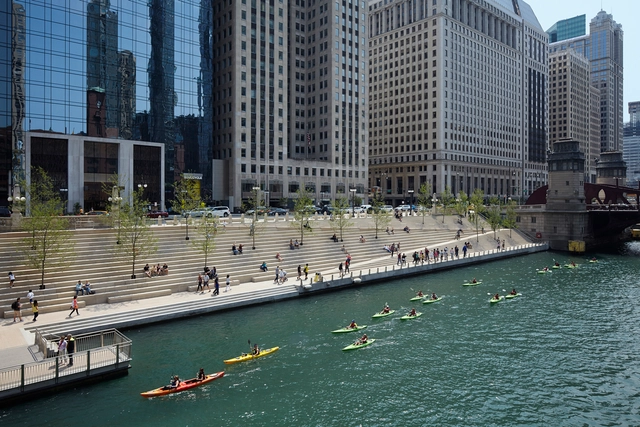
Photo by Kate Joyce, Ross Barney Architects Chicago Riverwalk. Image Courtesy of Chicago Architecture Biennial
The fifth edition of the Chicago Architecture Biennial just announced its list of participants. Under the artistic direction of Floating Museum, a collective of artists, designers, poets, and educators focused on building connections between art, community, architecture, infrastructure, and public institutions, CAB 5 will be presented at multiple sites throughout the city. "This is a Rehearsal" will focus on the community and process-related aspects of architecture, emphasizing how it helps to improve urban life and foster communal responsibility. The participants, chosen by Floating Museum, will look at global environmental, political, and economic challenges while addressing local circumstances. The goal of CAB 5's more than 100 activations, including installations and performances, is to get people to think about how society is impacted by physical infrastructure, societal history, aesthetic, and spatial design.
The Chicago Architecture Biennial is a nonprofit organization that aims to bring together people from around the world to explore innovative ideas and collectively imagine and shape the future of design. The exhibition will open on September 21, 2023, and will be on view until January 2, 2024, spanning various locations across the Chicago metropolitan area. Over 70 creative practitioners, including artists, architects, designers, and performers, will be featured in this citywide exhibition.
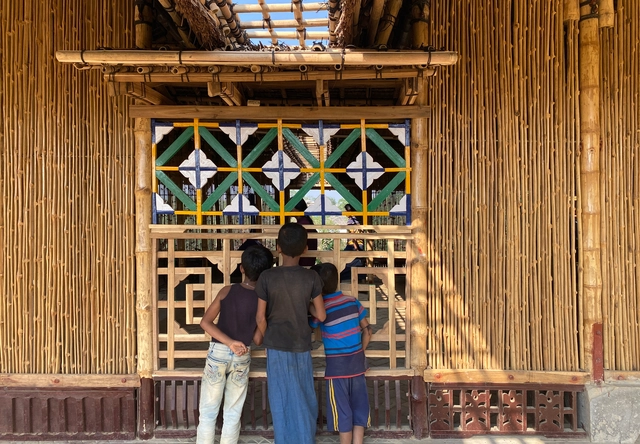
Architecture has been criticized for being a primary elitist indulgence. Most architectural projects are funded by the wealthy and seen as a means of bringing beauty into the surrounding environment. Architecture, however, is a double-sided coin with functionality balancing out aesthetics. With the ability to strategize radical solutions, architects equally find themselves at the forefront of solving complex issues. The context of Southeast Asia offers a demanding challenge with various social problems, giving architects a chance to save the world with humanitarian design.
Hard times bring people together. In recent years we have seen how collective work can be a driving force to help those affected by natural or man-made disasters. After a disaster or displacement, a safe physical environment is often essential. Therefore, the need for coordination becomes a key factor in assisting people in times of need.
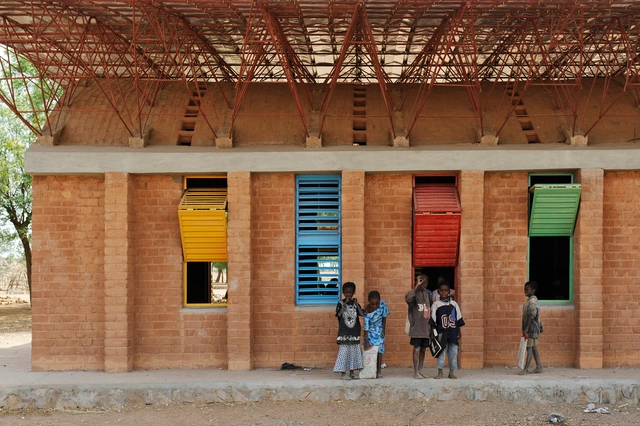
Architects, as "Shelter Specialists", play an important role in creating safe and adequate environments, whether it is individual housing, public buildings, schools, or emergency tent camps. But as architect Diébédo Francis Kéré says, "When you have nothing and you want to convince your community to believe in an idea, it may happen that everybody starts working with you, but you need to keep fighting to convince them."
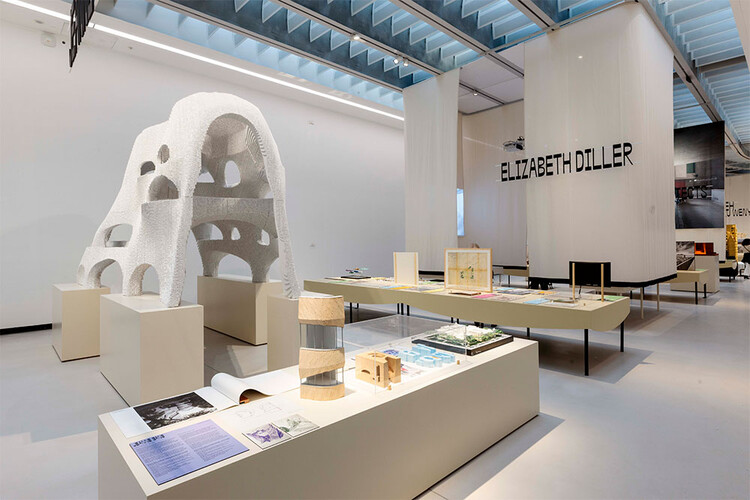
MAXXI Museum celebrates women in architecture in a new exhibition that documents the transformative role of female architects in the profession's evolution over the last century. Curated by Pippo Ciorra, Elena Motisi, Elena Tinacci, and with exhibition design by Matilde Cassani, Good News. Women in Architecture weaves together in four thematic sections the history of women in architecture, with the work of contemporary practitioners and the voices of young collectives, telling the stories of over eighty female architects.
The Royal Institute of British Architects (RIBA) and the Jencks Foundation announced renowned Indian architect Anupama Kundoo as the winner of this year's RIBA Charles Jencks Award. The accolade given in recognition of significant contributions to the theory and practice of architecture acknowledges Kundoo's holistic practice that marries theoretical investigations, material research and sustainable building methods.
The International Union of Architects (UIA) has announced the UIA Gold Medal and Prizes winners. The UIA Gold Medal is awarded to Brazilian architect Paulo Mendes da Rocha, president of the 27th UIA World Congress of Architects — UIA2021RIO Honour Committee. The architect will also participate in a keynote speakers session programmed for July.
Paulo Mendes da Rocha, now 92 years old, has been honored with important awards, such as the Pritzker Prize in 2006, considered to be one of the world's premier architecture prizes, and the Venice Biennale Golden Lion for Lifetime Achievement, in 2016. Mendes da Rocha was the first Brazilian to be awarded this prize.
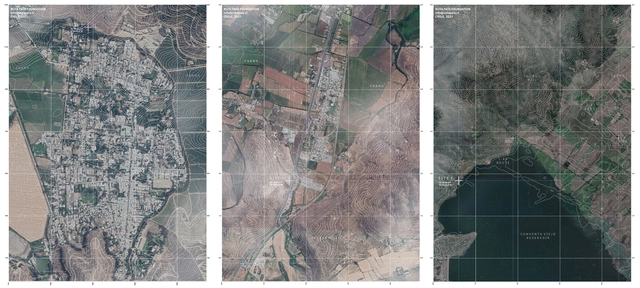
The Chilean organization Ruta Pais Foundation has invited international architects and local artisans to design a series of architectural interventions in order to create 3 artisan routes in the Chilean Central Valley: Wicker Route in Chimbarongo, Clay Route in Pomaire, and Stone Route in Pelequén.
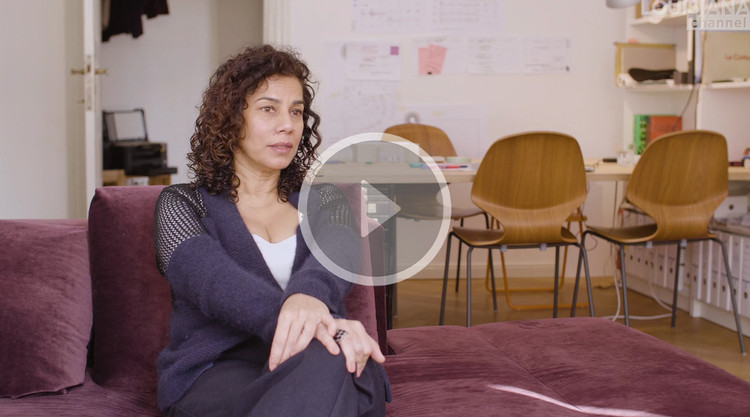
In Louisiana Channel's latest interview, Indian architect Anupama Kundoo shares her thoughts on the importance of balancing between traveling and being in solitude with oneself. "I think travel is important, but if you're not rooted yourself, you will go to a hundred places and not see anything", explained the architect, "traveling helps you step back from what you take for granted".
As a platform for the Louisiana Museum of Modern Art, Louisiana Channel has been stimulating conversations around architecture, art, and the creative world at large. The architecture series provides fascinating insights into the thought process of distinguished architects and their work. Discover seven of the most inspiring interviews created over the past year, discussing a wide array of subjects from exemplary projects, to cities, to architects' design philosophy.
In Louisiana Channel's latest interview, Indian architect Anupama Kundoo shares her thoughts on the importance of observing the surroundings from the perspective of time and its imprint on matter. "Before humans, there was an architecture that life itself creates," says the architect discussing the natural world as a source of inspiration, pointing out that one "can see the same question already solved by nature".
“Time is a resource we are not spending properly. People are eager to save other resources, but they don’t mind spending their time carelessly,” says Anupama Kundoo in this Louisiana ChannelInterview, where she talks about time as a general concept, sharing some of her philosophy of life on the matter. Turning to architecture, Kundoo reflects on the sense of urgency governing the current design process, obstructing any long term thinking about the collective body of work left as a legacy to future generations; therefore she urges architects to take time to rethink their work and refine their designs.
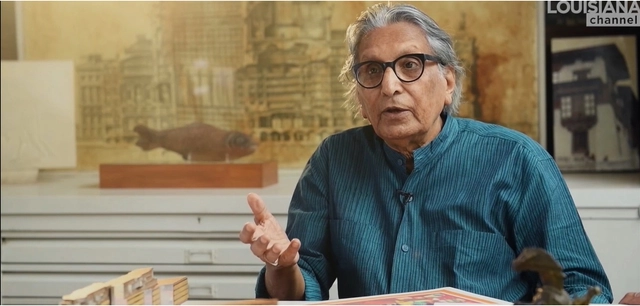
Last Wednesday the world knew the name of the latest Pritzker Prize laureate: Balkrishna Doshi, the first Indian architect to receive architecture’s highest honor. The jury stated that "with an understanding and appreciation of the deep traditions of India’s architecture, Doshi united prefabrication and local craft and developed a vocabulary in harmony with the history, culture, local traditions and the changing times of his home country India".
While architects all in India are rejoicing and celebrating him, Anupama Kundoo, Professor at IE School of Architecture and Design, shared her thoughts on Doshi’s Pritzker Prize. "It is timely that there is recognition of a holistic understanding of the role of the architect, where the design of the built environment is seen as sensitive interventions that retain human scale in the man-made built landscape", stated Kundoo.
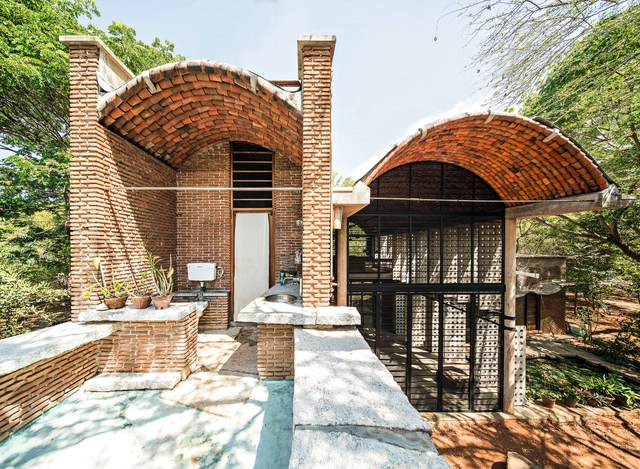
India’s renowned architect Anupama Kundoo has experimented with locally sourced materials to develop Wall House and others for non-profit organizations to minimise impact in the construction process whilst maintaining the connection to the community. She tells us how she integrates hybrid technologies into the building, a response to the growing segregation in India and developing countries.
Every year, citizens of Catalonia commemorate the events of September 11th 1714, a key date in the War of the Spanish Succession that has come to symbolize what Voltaire called "the Barcelonans' extreme love of freedom." With this year marking the 300th anniversary of these events, Barcelona Cultura enlisted the Fundació Enric Miralles to curate 7 public installations around the city as part of its Tricentenari BCN program.
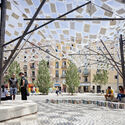
The result is BCN RE.SET, organized by Benedetta Tagliabue of the Fundació Enric Miralles and stage director Àlex Ollé, which invited guest architects from countries all over the world to colloborate with local universities and create installations symbolizing 6 political and ideological concepts: identity, freedom, Europe, diversity, democracy and memory. These installations will be in place until September 11th. Read on after the break for descriptions of all 6 installations.
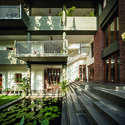
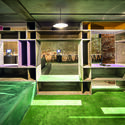
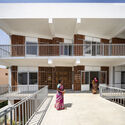
ArchDaily is proud to present images from the 2012 Venice Biennale featuring the reconstruction of Anupama Kundoo’s Wall House. The installation is an opportunity for the architect to reassess intial strategies and continue to explore the experiments of the original construction in Auroville, India. The replica was built by Indian craftspeople and Italian builders. The original design for the house aimed to respond to the environment and culture in which it is situated, taking into consideration construction techniques, material applications, and site strategies. The reconstruction, though absent from a landscape, displays spatial innovation and a collaborative use of materials that evokes an excitement about the integration of culture and structural techniques.
Join us after the break for images from the 2012 Venice Biennale.












.jpg?1618576449 "Wall House. Image © Javier Callejas")
.jpg?1618576436 "Wall House. Image © Javier Callejas")


.jpg?1606397161 "Wall House. Image © Javier Callejas")


.jpg?1585773323&format=webp&width=640&height=580)

.jpg?1506638347&format=webp&width=640&height=580)
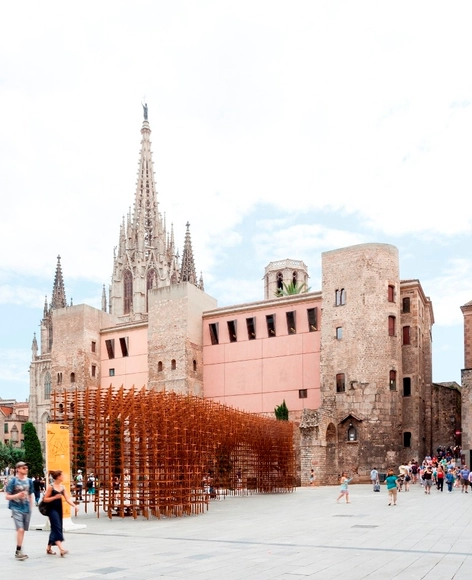

.jpg?1404009231 "Diversity / Yael Reisner + Peter Cook. Image © Marcela Grassi")
.jpg?1404009282 "Freedom / Anupama Kundoo. Image © Marcela Grassi")
.jpg?1404009313 "Memory / Grafton Architects. Image © Marcela Grassi")

