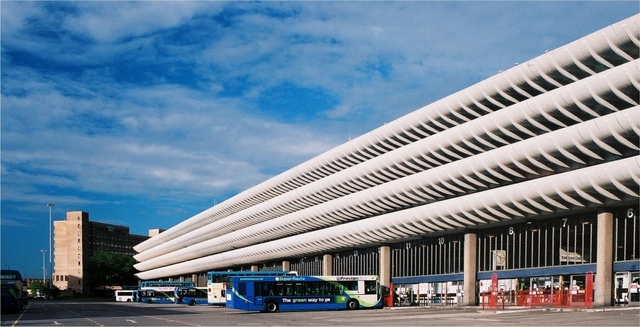
In the UK, the commissioning of buildings is in crisis. The government and the industry as a whole is short-sighted, putting too much emphasis on function and too little thought into what makes for a long-lasting, and in that respect sustainable, building.
What is it that prompts a person to own a classic car or a family to continue to use old silver when both involve so much hard work? Why not buy a new car or use stainless steel cutlery? By convention these possessions have reached the end of their natural life, they require careful maintenance and in many cases they don’t function as well they might - they are obsolete. Their continued use requires a conscious commitment - time and money - on the part of their owner. But then, in time, this responsibility stops being a burden and instead becomes a cause for satisfaction and enjoyment.
It is a question that could be asked of those who commission and use buildings.
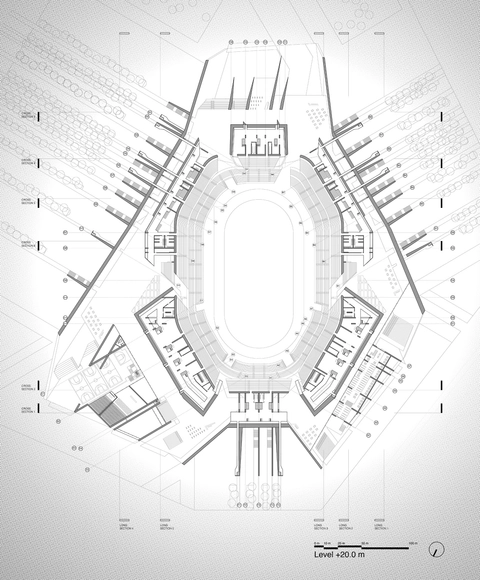
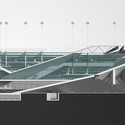
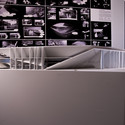
Olympic host cities around the world are increasingly facing issues of post-event sustainability, with many stadiums and arenas falling into disuse and dilapidation mere months after the games. The soaring costs associated with constructing Olympic facilities have plagued organizers for decades, resulting in an all-time low number of bids from host cities for the 2022 Winter Olympics, according to the International Olympic Committee. Yaohua Wang is a recent architecture graduate of the Harvard University Graduate School of Design and a native of China - where facilities constructed for the 2008 Beijing Olympics are slowly being converted to new post-Olympic uses, typified by the transformation of the Watercube into the city's newest waterpark. Wang's thesis project, Salvaged Stadium, delves into the afterlife of Olympic facilities, providing a solution for arena reuse with potential for application worldwide.
Find out how Wang re-evaluated the Olympic development problem after the break
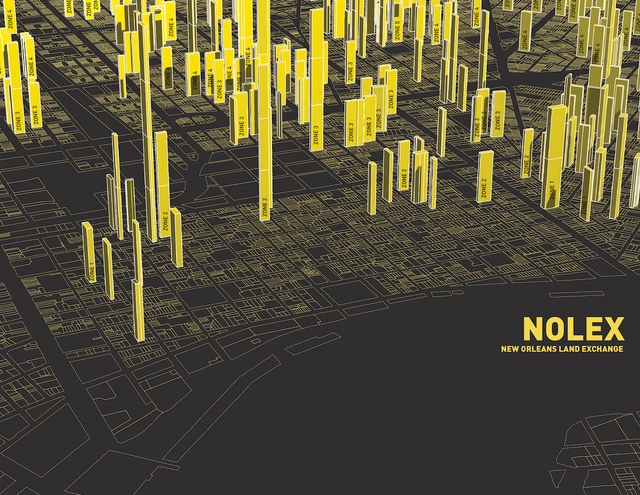
Three finalists have been selected to move forward in the Van Alen Institute (VAI) and New Orleans Redevelopment Authority’s (NORA) “Future Ground” open ideas competition. Each will be provided with a $15,000 stipend to investigate and develop long-term design and policy strategies for vacant land reuse in New Orleans.
“Too often, vacant land has been seen only as a remnant of or absence within the 20th century city,” described the VAI. “Today, with a critical mass of designers, policymakers, scholars, artists, activists, and residents creating pilot projects, thoughtful studies, and new kinds of urbanism on abandoned properties, it is possible to imagine this land as an integral part of the future city.”
Danish firm COBE is transforming the largest industrial building in Nordhavnen - a silo - into an apartment building with both private and public functions. For COBE, who also created the urban development plans for Nordhavnen, this project marks the beginning of the post-industrial area's future. Nordhavnen is a harbor area located only 4km from Copenhagen's city centre.
"The exciting thing about old industrial property is how to preserve their soul and at the same time use them for something else," said Klaus Kastbjerg, the owner of the silo, commenting on the adaptive reuse project. To preserve the soul of the silo, the architects will maintain a raw industrial feeling on the interior. Each of the 40 retrofitted apartments will contain visible historic remnants such as existing concrete columns and walls.
Keep reading after the break for more information and images...
A major competition for reuse has just been announced for the Malagrotta Landfill, one of the European Union's biggest landfill sites. After Malagrotta was closed in August 2013 due to its controversial size and negative impact on the surrounding community, the Municipality of Rome began a process of redevelopment through community engagement. Multi-displinary teams are tasked with a creating a proposal to reinvent the sprawling 240-hectare property while considering its original purpose. The competition is designed to begin a conversation on the long-term vision for the property.
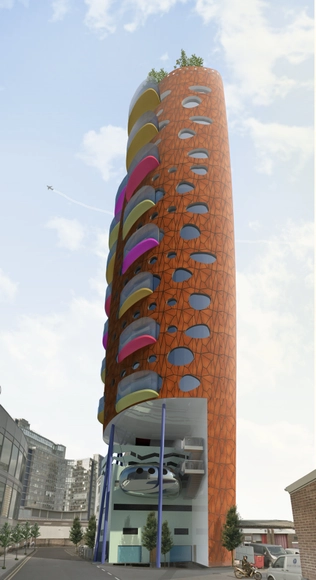
Led by Will Alsop, aLL Design’s funky apartment tower will soon add a whole lot of interest to London’s south bank. The tubular building, which tapers at the bottom and top, will rise above an existing four-storey building on purple stilts and be adorned with corten steel cladding, brightly colored balconies, and irregular rounded windows. Each apartment will include two balconies overlooking the River Thames and the neighboring heliport – bringing about the name “Heliport Heights.” To learn more about the lively design, keep reading after the break.
A mere twenty-five years after its inauguration, the Glass Music Hall at the former Exchange of Berlage in Amsterdam is looking for a new home, where it will be relocated and reassembled for free. The innovative space, originally designed for the Dutch Chamber Music Orchestra, has garnered international attention and multiple awards, but sadly no longer meets the needs of the facility.
Designed by architect Pieter Zaanen and structural designer Mick Eekhout, the Glass Music Hall sits in the center of an existing space, defying stereotypes about what glass can do. Being a hard material, the reverberation time in a blunt glass hall would be approximately 5 seconds. However, this number was brought down to 1 or 2 seconds in this instance, proving glass can be used to create a fantastical acoustical environment.
Mention: ECOLE/AAKAA (Adrien Durrmeyer, Martin Le Bourgeois, Nicolas Simon, Max Turnheim, Nicolas Violette). Image Courtesy of Young Architects Competitions
In our progressively digitized world, factories are often left behind. Outdated and no longer capable of serving their original purpose, these vast spaces become vacant and full of potential. A recent Young Architect Competition (YAC), entitled Space to Culture, recognized this trend and called upon young minds to turn such a factory in Granarolo, Bologna into a center for culture and entertainment. The competition asked entrants to focus on the idea of temporality and ensure the re-purposed factory's longevity through dynamic and flexible spaces. To see the winning entries, continue after the break.
In January of this year, the latest work by Smiljan Radic, the Chilean architect chosen to design the next Serpentine Pavilion, opened to public acclaim. The Museum of Pre-Columbian Art (Museo de Arte Precolombino), located in Santiago de Chile, is a restoration project that managed to sensitively maintain an original colonial structure - all while increasing the space by about 70%.
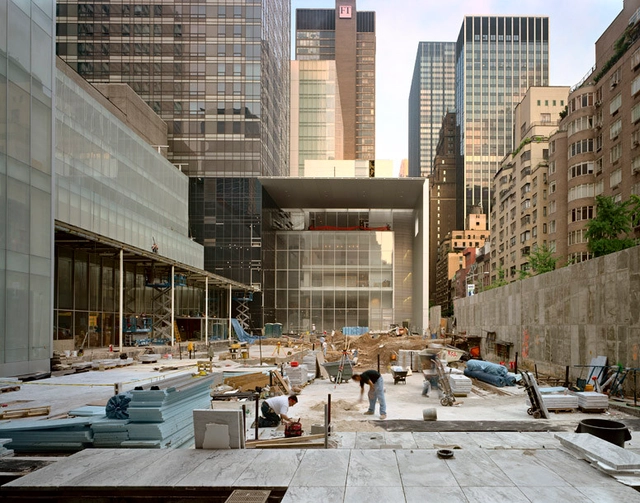
What appears here is not strictly a battle between an institution that wants to reflect the spirit of the time vs a building that is inherently specific to its place. It represents a lost design opportunity. What if the American Folk Art Museum had been considered an untouchable civic space in the city of New York, much like the The Museum of Pre-Columbian Art is for the city for Santiago? Then a whole new strategy for adaptive reuse would have emerged.
In the 1970s, the principal designers at DIALOG, Norm Hotson and Joost Bakker, were commissioned by the Canadian government to redevelop Vancouver's Granville Island, a former industrial site, into a people place. The architects envisioned a radically different type of waterfront characterized - not by beaches or parks - but by varied commercial and cultural programs. Today this iconic destination, popular with both citizens and tourists alike, is recognized as a pioneering precedent for urban development across Canada. In the video above, the DIALOG duo chronicles the success of the mixed-use design, touching on how it has influenced the city of Vancouver as well as the firm’s more recent work.
3rd Prize ($1000): Make It! Grow It! / Song Deng and René Biberstein of Toronto, Canada
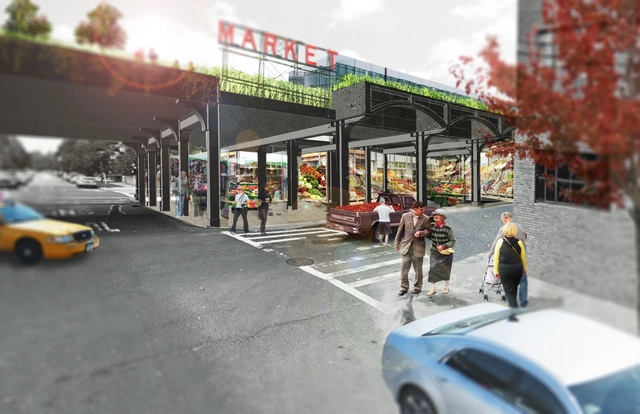
The Emerging New York Architects (ENYA) committee of the AIA New York Chapter has announced the winners of its 2014 biennial design ideas competition, QueensWay Connection: Elevating the Public Realm. In an effort to imagine the ways in which The Trust for Public Land and Friends of the Queensway could transform an abandoned railway in Central Queens into a vibrant urban greenway, entrants were challenged to design a vertical gateway for the elevated viaduct portion of a 3.5 mile stretch along the rail.
Of the 120 submitted proposals from 28 countries, the jury selected the following winners to represent the diverse array of ideas generated:
Videos
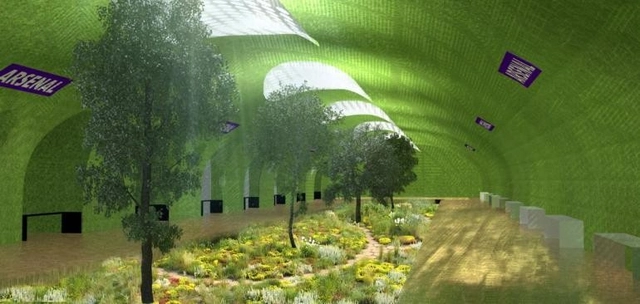
Paris' Arsenal Station as an underground park. Image Courtesy of Manal Rachdi, OXO Architects & Nicolas Laisné, via IBT
We architects know full well the power of renderings to capture the imagination. Apparently - so too do politicians. Capitalizing on the popularity of adaptive reuse projects around the world (a trend instigated by the success of New York's High Line), French politician Nathalie Kosciusko-Morizet has made converting Paris' unused "ghost stations" a major part of her platform, promising that these projects will come to pass should she be elected mayor.
What does the workplace of the future look like? Shawn Gehle, of Gensler, explains in this TEDx Talk that with over 10 billion square feet of existing office space in North America, we may not even need to envision new buildings. Rather, by "hacking" existing buildings, architects can transform them into something completely new. For more on Gensler's "hacker" philosophy, read our article here.
https://www.archdaily.com/466904/saving-north-america-s-office-spaces-by-hacking-themJose Luis Gabriel Cruz
Beloit College has chosen Studio Gang Architects to convert a century old power-plant into a campus recreation and activity center. The project was born out of an ongoing partnership with Alliant Energy Wisconsin, the local utility company that currently holds the space, who has been in talks within the college for over a year.
“The Studio Gang team is very excited to partner with Beloit College,” stated Jeanne Gang. “Together we can transform this historic structure into a new hub for wellness, green power, and great architecture. By reflecting Beloit’s core values in the design, values shared by our team, we will create a model that will bring many benefits to the college, city, and region. This is a project that has the potential to inspire other communities around the globe.”
https://www.archdaily.com/436239/studio-gang-chosen-to-convert-power-plant-to-rec-centerKatherine Allen
The post-war city centre of Rotterdam is ruled by commerce. Only five percent of the city's inhabitants live in the centre, which is almost entirely occupied by highstreet fashion chains, fast food restaurants, and offices. After shop closing time, the shutters go down and the streets are deserted. The municipality would like to lure more inhabitants into the centre – but space for new residential buildings is scarce. So in recent years, a 1960s cinema and church had to make way for a huge new housing complex designed by Alsop Architects, and a residential tower by Wiel Arets was speedily attached to Marcel Breuer's department store, De Bijenkorf. It was not until the municipality suggested forcing new housing high-rises into the green courtyards of the Lijnbaanhoven residential complex, designed in 1954 by Hugh Maaskant, that there were protests and the project had to be cancelled. For the time being, that is.
One densification project, however, tried not to destroy or debase the post-war building originally occupying its site. In many respects, the Karel Doorman residential high-rise could even be called the saviour of the old Ter Meulen department store. It might be rather uncommon for a valiant hero to crouch down on the shoulders of the little old lady he intends to rescue – but that's more or less what happened here.
One thing about a recession is that it accelerates the demise of dying trends and struggling establishments. In this case, it is America’s beloved shopping malls, which have been slowly in decline since its peak popularity in 1990. Now, in the wake of the 2008 economic catastrophe, American cities are riddled with these abandoned shopping meccas, from the mall to big box stores and shopping strips, whose oversize parking lots are equally as useless as the spaces themselves. The question is, how can we effectively repurpose these spaces?
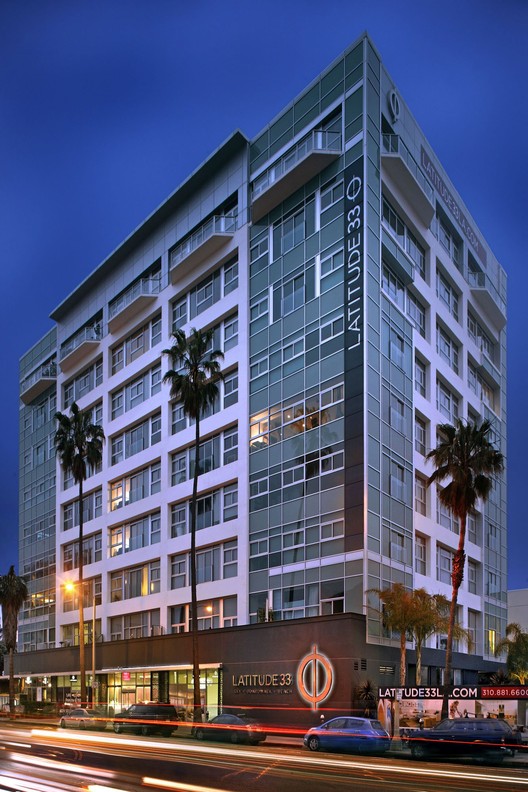
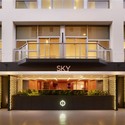
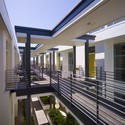
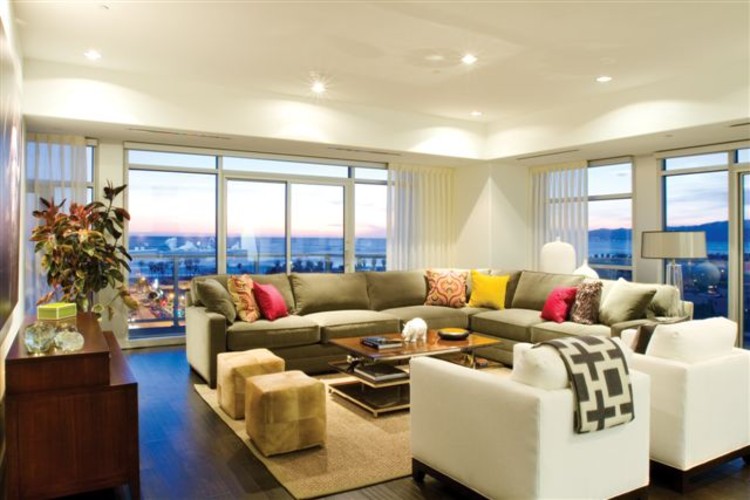
Latitude 33, a luxurious collection of beach-side homes ranging from townhouses, penthouses, and single floor units, was partially designed from a forty year-old, nine-storey “eye sore for the neighborhood” that was once an office building. The mixed use development, designed by KAA Design Group, includes residential and commercial spaces in Marina del Rey in Southern California. The strategic decisions involved with designing these apartments from an early 197os office building earned Latitude 33 two Gold Nugget Merit Awards, one of which was for Best Adaptive Reuse.