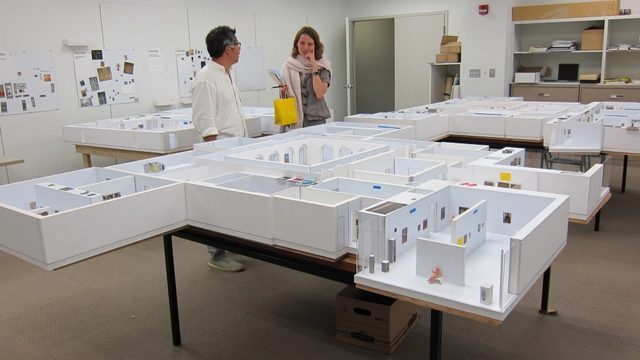
Kulapat Yantrasast at an exhibition design meeting. Image Courtesy of wHY
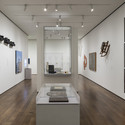
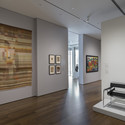
Last month we spoke with Kulapat Yantrasast, Co-Founder and Creative Director of the LA-based design firm wHY. On the heels of the opening of Harvard Art Museums - for which Yantrasast collaborated on the designs of the exhibition spaces - we wanted to learn more about his approach to designing the galleries for Harvard. “One of the things that I'm super sensitive about is the identify of the experience. Harvard, in particular, is a university museum. So first and foremost it's a place for students and faculty to spend time looking at things closely. Because of that, we want to make sure that a group of 15 people can sit or stand around an art object and could really have a discussion,” Yantrasast explained.
wHY has carried out a wide range of museum and gallery projects, including the Grand Rapids Art Museum, the Royal/T project and the renovation of the galleries at the Art Institute of Chicago. Read the full interview with Yantrasast below to learn more about the challenges of gallery design and how technology is affecting museums exhibitions.
In 1954 British sculptor Henry Moore was commissioned to design and install a large wall relief into Joost Boks' new bouwcentrum (Construction Centre) in the Dutch city of Rotterdam. The project, pieced together with approximately 16,000 hand-carved Dutch bricks, stands as the sculptor's only work completed in the humble material. In a short documentary film produced by ARTtube, architectural historian Wouter Vanstiphout narrates the fascinating story behind Wall Relief No.1.
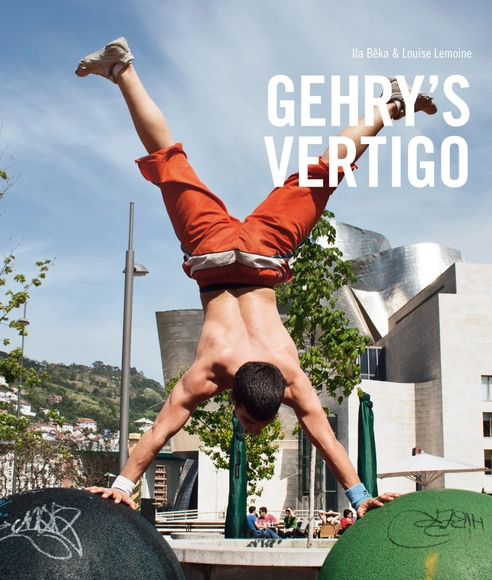
Selected as one of Metropolis Magazine's Game Changers for 2015, Ila Bêka and Louise Lemoine are altering the face of architectural criticism thanks to one simple premise: you don't need to be an expert to have an opinion on the buildings you live with every day. In the following profile, originally published by Metropolis as "Game Changers 2015: Ila Bêka and Louise Lemoine," Veronique Vienne uncovers what it takes to instil such a simple idea with both subtle poignancy and razor-sharp wit.
If walls could talk, what stories would they tell, not only about our intimate selves but also about our cultural assumptions, our social interactions, and the values we cherish most? Short of getting the inside story directly from walls, filmmakers Ila Bêka, 45, and Louise Lemoine, 33, strike up conversations with that other silent cast: the people who sweep the rooms, wash the windows, fix the leaks, and change the light bulbs.
“Our goal is to democratize the highbrow language of architectural criticism,” says Bêka, an architect and filmmaker trained in Italy and France. “Free speech on the topic of architecture is not the exclusive property of experts.”
First Place: William Smith, Hiroshi Kaneko (US, Team 749421). Image Courtesy of matterbetter
The winners of matterbetter’s international Malaysia Airlines Flight 17 (MH17) Memorial and Park ideas competition have been announced. Attracting 293 submissions worldwide, the competition hoped to inspire a new memorial park and public space, free from the political overtone, at the Marine Establissement site in the center of Amsterdam that could be used as a place for remembrance, ceremonies, recreation, and private gatherings in honor of MH17’s victims.
MH17 was a scheduled international passenger flight from Amsterdam to Kuala Lumpur that was shot down near the Ukraine–Russia border on July 17, 2014, killing all 283 passengers and 15 crew members on board. You can view all 10 winning proposals, after the break.
Dublin-based Newenham Mulligan and London-based Grimshaw have been selected by the Royal Dublin Society and Leinster Rugby to redevelop the rugby team’s home arena in Ballsbridge, Ireland. The €20 million redevelopment, announced just before Ireland’s bid to host the 2023 Rugby World Cup, plans to replace the RDS Arena’s old Anglesea stand with one that increases the venue’s capacity to 25,000.
Google Earth Pro has dropped its $399 yearly subscription and is now freely available to all. Beyond providing imagery, detailed maps, terrain and 3D building models of the world, Google Earth’s pro-version is particularly convenient for project planning and research; unlike its standard tools, Pro allows users to print images at 4800x3200, import and pin thousands of addresses onto the map at once, capture HD videos of what’s on screen, and easily measure distances and areas with polygons, circles and more, rather than with just lines and paths. Download it for free and fill out a quick form to unlock its Pro features.
Building Trust has launched their sixth international design competition: Cool School. Seeking an innovative school design proposal that can withstand the extreme Mongolian climate, the competition is challenging architects, designers and engineers to envision a solution which has the chance to shape the future of school buildings across cold regions globally. Contestants should consider environmental conditions, materials, space, comfort, accessibility, adaptability and aesthetics. Building Trust will work alongside competition partners, World Vision, local government and the school community in Khovd, Mongolia to build the winning school design. More information about the competition, here.
We've teamed up with Building Pictures, Filipa Figueira and Tiago Vieira to feature weekly episodes of their video series “Arquitectura à Moda do Porto,” which highlights Porto’s most significant buildings over the last 20 years.
The series is comprised of 10 episodes, each focusing on a different theme: light, stairs, balconies, nature, textures, doors, windows, skylights, pavements and structures.
IconicHouses.org is a database that aims to connect people with the 20th century's most architecturally significant houses, specifically those that have been converted into house museums. The organization aims to not only highlight these incredible structures to make the public more aware of them, but also prevent their demolition through conservation and fundraising efforts.
On show until April 5th at the Grounds for Sculpture in New Jersey, Michael Graves: Past as Prologue celebrates the fifty-year career of one of the United States' best-known and prolific architects. Graves is known for his unapologetic postmodernism which often divides opinion the profession. However in this review of the exhibition, originally published by Metropolis Magazine as "Shape Shifter," Samuel Medina finds that while it is easy to criticize in Graves' design style, it is hard to find fault with the noble intentions underlying his work.
“It’s been fifty years of more is more,” says Karen Nichols, a principal of Michael Graves & Associates, reiterating an aphorism Graves has taken a liking to in recent years. She is standing in front of an exhibition board in the retrospective, Michael Graves: Past as Prologue, which is currently on show at the Grounds for Sculpture in New Jersey. Nichols joined the firm in 1977, precisely the time when her employer made the fateful and rather lucrative pivot towards Postmodernism. The text on the exhibition wall behind her pinpoints The Big Break to the same year, depicting it with two like-minded projects. The first is the built Plocek House (1977), which originated the hide-the-keystone game Graves has been playing ever since. The other, the unrealized scheme for the Fargo-Moorhead Cultural Center Bridge (1977–1978), intended to enlighten the twin midwestern communities with a dose of the Enlightenment architect Claude Nicolas Ledoux’s architecture parlante.
To hear Nichols (and Graves) tell it now, it’s as if Graves were always more Venturian than Venturi, from his earliest neo-Corbusian villas, up through the pedimented temple he built for Disney in 1988. The truth is, Graves—the Cubist, the classicist, and the caricaturist—has always had a hard time saying “No.”
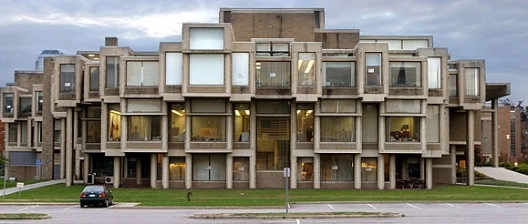
The latest in the debate over Paul Rudolph's controversial Orange County Government Center, Michael Kimmelman of the New York Times stresses the importance of its survival in "A Chance to Salvage a Master's Creation." The much debated plan for the now monumental structure would alter much of its existing character, whether by removal or replacement. Kimmelman argues that despite the criticism the Government Center has garnered from some, Orange County should reconsider architect Gene Kaufman's alternate proposal which would keep the structure intact and would restore it to its former glory.
With structurally unsound bridges, unsafe dams, and derelict roads becoming increasingly common problems, infrastructure has been brought to the forefront of many political agendas. However, limited funding in this area brings to mind the question of economics: how will improvements to North America's major trading channels be made without driving the nation further into debt? This is what Jordan Golson addresses in the article, "It's Time to Fix America's Infrastructure. Here's Where to Start." Although not all of these infrastructural problems can be resolved in the foreseeable future, according to Golson, however some smaller improvements in the next few years can be a manageable starting point. Read the full article, here.
In light of the recent opening of Mons International Congress Xperience (MICX), Daniel Libeskind hosted a private tour through the conference center, explaining his thinking behind the building’s expressive form. The experience was captured on this short film by Spirit of Space with the intention to open the discussion up to a larger audience.
The building, an important new landmark in the Belgium city of Mons, is described by Libeskind as “an expression of contrasting geometric forms.” Aside form providing function and “lively” spaces for auditoria and conference use, the building aims to be “a hinge between the old city and the new.”
A version of this article originally appeared on the Percolate Blog.
In spring of 2009, I graduated from architecture school. At the time, the post-recession economy was rough and not much was happening for architects. With an interest in entrepreneurship and technology, I took a risk and decided to try working at a tech startup. Much to my surprise, I fell in love with the industry and 5 years later, I’m now a Product Designer at Percolate in NYC, a company which produces web and mobile marketing software.
Since my career pivot, I’ve noticed many interesting parallels between architecture and product design. Although the mediums are different, it’s amazing to see how many of the design principles and processes are the same. To some degree, even the tools can be applied to both design industries. In this post, I will discuss hand-drawing, and learn how we apply architecture tools to product design at Percolate.
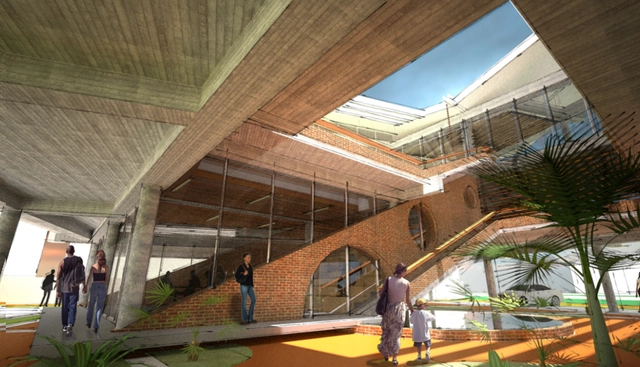
International design firm NLÉ has recently shared its competition-winning design for the financial headquarters of the microfinance bank Credit Direct Limited. Located in Lagos, Nigeria, in the Ikeja district, the bank’s design abandons the forbidding presence of most financial institutions for one that is open and welcoming. This decision not only invites clientele inside, but creates opportunities for adaptation to the tropical weather of Lagos.
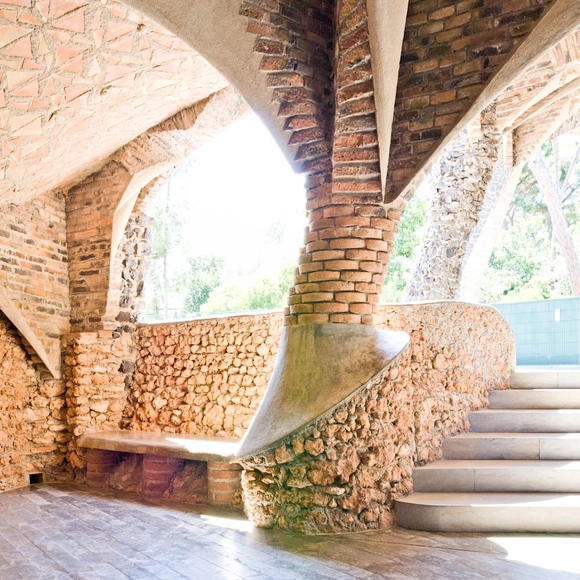
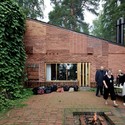
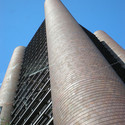
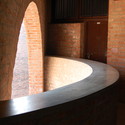
As one of the most ubiquitous forms of construction, it can sometimes be easy to overlook the humble brick. However, this prosaic building method can also be one of the most versatile materials available to architects, thanks to the experimentation of countless architects who, for centuries, have worked to create new forms of expression with the simple material. In this round up, we celebrate architects who, with their architectural classics, have expanded the possibilities of brick craft: Antoni Gaudí's fantastical vaulting at Colònia Güell and Alvar Aalto's experimental brick patterning at his house in Muuratsalo; the powerful brick piers of Kevin Roche and John Dinkeloo's Knights of Columbus Building and the Catalan vaults of Porro, Garatti and Gattardi's National Arts School of Cuba; and finally, what brick round up would be complete without the brick-whisperer himself - Louis Kahn and his all-brick fortress for the Indian Institute of Management.
Combo Competitions'latest ideas challenge asks participants to "rethink refueling" in a competition which seeks to re-imagine the ubiquitous filling station. The historical rise of this 20th century typology, from simple fuel dispensers to palatial rest-stops on the highway, grew with the proliferation of the car and became symbols for societal progression, personal status, and "a bright future." Although the number of vehicles worldwide "surpassed one billion in 2010, there has been a steady decline in filling stations since the end of the last century." As such, perhaps this is the time to start to rethink how these fragments of the international mobility infrastructure operate?
"Your interaction with architecture can either uplift you or depress you." In this latest Archiculture interview from Arbuckle Industries, Maurice Cox discusses the potential of architecture's atmospheric qualities to influence our daily lives. The professor, designer, dean, and former politician expresses his opinions on the intersection of politics and design in both the United States and abroad, arguing the importance of public input on creating inspirational architecture. Additionally, Cox reflects on how the process of transitioning from education to professional practice has changed for today's emerging designers.
This week, the American Institute of Architects (AIA) released the results of its first Consensus Construction Forecast of the year. The forecast is compiled based on predictions of the industry's leading forecasters and is conducted bi-annually to anticipate shifting business conditions in the construction industry. The dominant trend in this forecast (projected for 2015 and 2016) is an overall increase in spending in the construction sector.
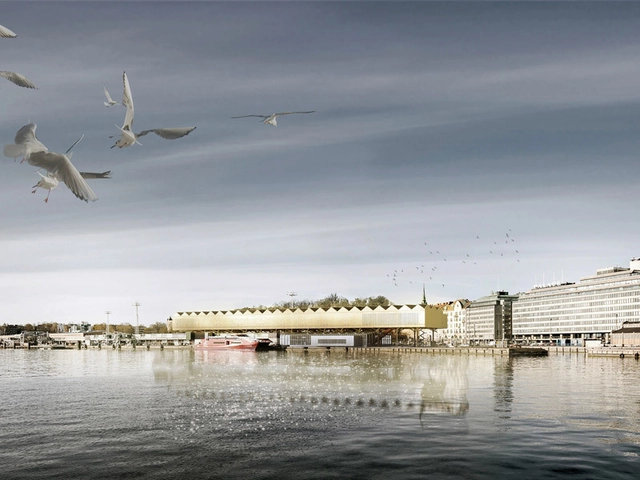
One of the finalists in the Guggenheim Helsinki competition. Image Courtesy of Malcolm Reading Consultants
More than ever, the media shapes architecture. The controversial Helsinki Guggenheim competition is as much about the use and exploitation of contemporary media as it is about design. The competition organisers are hugely proud to have over 1,700 entries to tweet about, but informed critics are less impressed. Has quantity ever guaranteed quality?
The competition has certainly created an impact. Some celebrate this, while others feel it has been detrimental to the profession, with so much unpaid time invested resulting in a low-level contribution to museum design.
Meanwhile, the spectre of Frank Gehry’s Bilbao Guggenheim, an “iconic” building that gave the American foundation so much positive publicity when it opened in 1997, haunts the Helsinki project. Finnish politicians hope for a similar success, a Sydney Opera postcard effect in this remote corner of the earth.
Grimshaw, IDOM, Populous,Feilden Clegg Bradley, White Arkitekter and Wilkinson Eyre are among five international design teams who've been recently shortlisted in a RIBA-organized competition to design the £90 million Bristol Arena, a 12,000-seat indoor entertainment venue set to open by 2017. At this point, the proposals remain anonymous and the public is being asked for their opinion. A judging panel, that includes the Mayor of Bristol, will review the public commentary and designs before selecting a team in March. Take a look at the projects and share your thoughts, after the break.
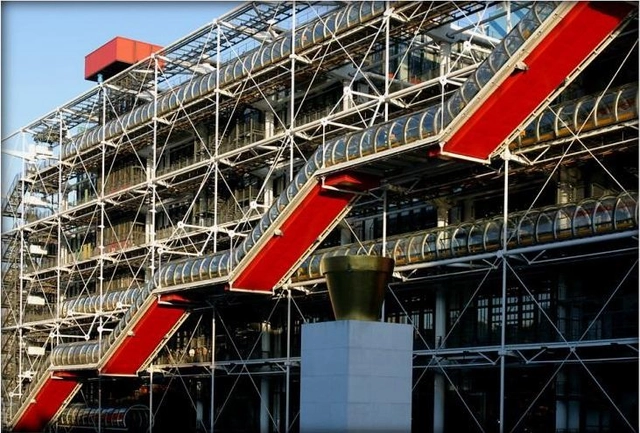
The south west French city of Libourne may soon get its own pop-up Pompidou. Reports indicate that the Libourne satellite outpost would be similar to the one currently underway in Malaga, Spain (soon to open in March 2015). If the deal is passed, the city would host the museum outpost in a former 40,000-square-meter military academy, though renovation costs are excepted run high - nearing €6 million. The city's mayor Philippe Buisson is reaching out to regional and national authorities requesting financial assistance.
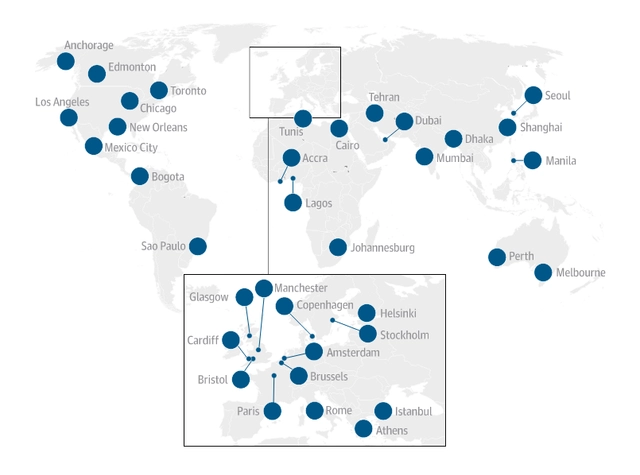
A compilation of all posts in the "Urbanist's Guide to..." series from Guardian Cities, "The Urbanist's Guide to the World" takes readers to cities across the globe. Penned by local bloggers in cities from Manila to Sao Paulo, Tehran to New Orleans, the vignettes are supported by The Rockefeller Foundation and cover everything from "best" and "worst buildings" to cleanliness, soundscapes, and "the best place for a conversation." You can view the interactive guide here.
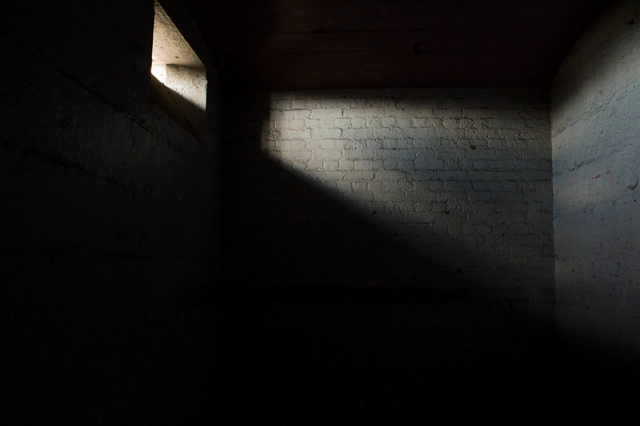
The American Institute of Architects’ (AIA) recent rejection of a proposed amendment to its existing ethics code has sparked debate over the issue of design and human rights violations. The proposed addendum was drawn up late last summer by Architects/Designers/Planners for Social Responsibility (ADPSR), a nonprofit organization advocating social consciousness in the design field. It stipulated that all AIA members would refrain from designing spaces involving human-rights violations, specifically those "intended for execution or for torture or other cruel, inhuman, or degrading treatment or punishment, including prolonged solitary confinement." This would include execution chambers, interrogation rooms intended for torture, and "supermax" security prisons in which prolonged solitary confinement take place.
However, the main controversy arose when considering whether or not the amendment would be an attainable goal for the AIA. Although the content of the amendment was never in question, its clarity and ability to be enforced were.
Read more about the AIA’s decision to reject the ethics amendment, after the break.