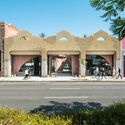
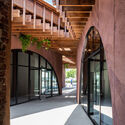
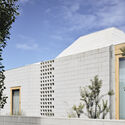
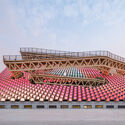
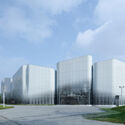
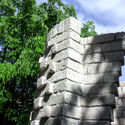
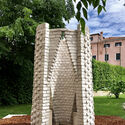
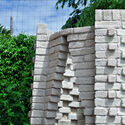
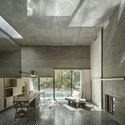
Glass brick facades have emerged as a captivating architectural trend, blending the enduring elegance of glass with the robust strength of bricks. Glass bricks can as well be more thermally resistant than conventional glazing.
These facades add a pixelated effect that plays with light and shadow, perfectly transmitting light, while maintaining privacy. The way glass bricks facades soften and blend the views of the outside can increase calmness and focus. From sleek commercial buildings to avant-garde residential projects, glass brick facades continue to push the boundaries of architectural innovation, captivating both designers and observers alike.
In recent decades, the term "adaptive reuse" has gained tremendous popularity as an eco-friendly construction approach. But what if there was something more poetic about reframing a space and its stories for new users? These architects show that once-deemed disposable facades, walls, and textures can obtain new meaning through bold and clever juxtapositions. These adaptations proudly display their conversions and layers of historical patina under them as a batch of honor and speak to the permanence of buildings and their impermanence in use and interpretation. Through subtle formal moves and daring material choices, they transformed structures that would have been otherwise demolished and reimagined them in new and intriguing ways.
A contemporary building immersed in a built environment. This building is made of (material). An isometric view with realistic textures. Image via DALL.E 2
As AI has become more accessible, we have witnessed examples illustrating its diverse applications. Prominent among these are generative AIs, which excel in their ability to “create” images through prompts, many distinguished by their composition and vividness. These AI systems are neural networks with billions of parameters, trained to create images from natural language, using a dataset of text–image pairs. Thus, although the initial question posed by Turing in the 1950s, “Can machines think?” still recurs today, the generation of images and text is grounded in existing information, limiting their capabilities.
What has surprised many is the increasingly apparent closeness to overcoming the Turing test and the growing similarity, in terms of visualizations, to what an architect with skills in this field can achieve. In this context, while the debate persists in the architectural community about whether AI can process architectural concepts, this article explores how it interprets materials to develop these visual representations. With that in mind, a single prompt was developed for this experiment (with materiality as its variable) to delve into the obtained results.
https://www.archdaily.com/1010723/does-ai-correlate-materiality-with-contemporary-architecture-an-experiment-with-six-building-materialsEnrique Tovar
The term brick is often used as a synonym for common clay solid blocks, but there's more to it. Bricks are perhaps the most elementary of building materials and can be used to design modular, optimized, and most importantly, versatile buildings. This article explores the most popular types of bricks according to their use in construction.
The Brick Industry Association (BIA) has opened entries for the international 2023 Brick in Architecture Awards, featuring a new category for thin brick projects as of last year. Projects will compete for a Best in Class, Gold, Silver, or Bronze award in nine different categories, with only one project earning the Craftsmanship award each year.
From the pre-Columbian period of the Americas –during which cultures such as the Olmec, Maya, Purepecha, and Mexica (Aztec) thrived– to the modern era where architecture has been influenced by social movements and even natural disasters, Mexican architecture showcases a valuable architectural expression, with its own unique voice and distinctive characteristics. Nobel Literature Laureate Octavio Paz argued that architecture is an incorruptible witness to history. Likewise, the materials used to shape it have acted as protagonists of that history, enduring in many cases over time and evolving thanks to the generations of architects who have contributed to it, from different perspectives.
To trace a timeline, it is possible to take as a starting point pre-Hispanic architecture, which exhibited a diversity of nuances due to Mexico's vast territorial extension. This allowed diverse cultures to find their niche and develop their characteristic architectural styles. Subsequently, the era of Spanish colonization, which itself drew influence from Islamic architecture, represented a noteworthy turning point in architectural development. This phase endured until the advent of Mexican Independence in the 19th century. In turn, this marked the initiation of social and cultural movements, both during and after the Mexican Revolution in the early 20th century.
https://www.archdaily.com/1005554/materials-that-define-the-contemporary-mexican-architectural-aestheticEnrique Tovar
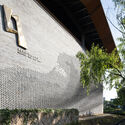
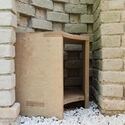
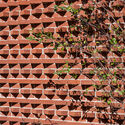
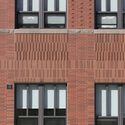
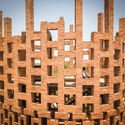
There is no material more diverse and timeless than brick - which can be seen as a staple in both ancient and modern architecture. In many cases, stripping away the drywall of a historical building can reveal beautiful brick walls, which bring a great deal of texture, warmth, and character into a living space. Whether left raw or painted, the look lends itself to a range of styles from rustic to industrial.
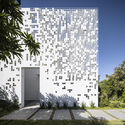
Architects and designers are often looking for ways to make building facades and interior surfaces stand out from the crowd. But sometimes just the smallest change can have the biggest impact once you step back and see the whole picture. By employing an illusionary pattern such as dithering pixels or halftone dots, or by making subtle but intentional changes to the position or orientation of materials, flat surfaces can be transformed into curved, moving forms.
Halftone patterns work by reducing a solid surface of color into dots of decreasing size. As the dots gradually reduce to nothing, they leave nothing behind except a background color. The result is a flat surface with a gradient that mimics the shadows or highlights of a three-dimensional curve. Dithering, meanwhile, is the process of feathering multiple shades of the same color to blend them together. The effect allows designers to, on a large enough scale, create images with depth and curves, while using only a single color. Or even to create the illusion of an intermediary color.
Materiality is a determining factor in shaping the character and experience of a building. Playing with the aesthetic and tactile qualities of materials, the design process encompasses their analysis, selection, and arrangement to create purposeful and sensory-rich spaces. Alongside textures and patterns, exploring materiality also involves the study of color possibilities. The versatile role of color in architectural materials extends beyond mere aesthetics, as it can broaden design opportunities and influence emotional responses, functionality, cultural relevance, and environmental performance.
Even though each material has its distinctive inherent color, the addition of artificial or natural pigments can modify them in favor of the project’s identity. Delving into the debate on maintaining raw aesthetics or changing a material’s natural hues, we showcase various projects to study the differences between using natural versus artificial pigmentation of glass, concrete, brick, stone and wood.
Urban Radicals presented a temporary pavilion “A Brick for Venice” as part of the European Cultural Center’s “Time Space Existence program during the same time as the 2023 Venice Architecture Biennale. The entirety of the brick pavilion was made with mud from the city’s canals. Furthermore, “A Brick for Venice” is the first proof of concept for the team’s novel waste-based construction product.
There are many building materials that have experienced minimal changes since their initial inception in the field of architecture. However, this does not imply that they are outdated, but rather that their qualities and simplicity make them highly versatile materials also demonstrate the resilience and durability of materials that withstand the test of time. An example of this is brick, a timeless material that has been able to adapt over the years, serving functions such as walls, cladding, and flooring, among others. Under this premise, Louis Khan referred to the expressive possibilities of brick, stating, "Even a brick wants to be something. It aspires."
Thanks to the progress of new technologies applied to materials, disruptive proposals have arisen that converge in new construction systems. On many occasions, these new technologies are combined with materials considered "traditional," generating new concepts in which materials such as brick find new applications and possibilities. One of these new concepts is Flexbrick, a ceramic textile with an industrialized system that combines flexible sheets to wrap architectural spaces. This opens up new possibilities for applications at the forefront of the parametric architecture revolution, using a flexible, adaptable, and sustainable material.
https://www.archdaily.com/1003807/algorithm-based-architecture-flexible-bricks-to-wrap-architectural-spacesEnrique Tovar
Water scarcity is one of the most stressful situations that one could ever endure. And yet, in India, a country that holds 18% of the total world population with only 4% of its water resources, this is a recurring struggle with notable numbers of Indian households having to manage water scarcity on a daily basis.
The yearly water cycle is a tough one, ranging from one extreme to another. Harsh monsoons and flood seasons turn into insufferable droughts, making it increasingly difficult to control and retain water resources. While most large-scale actions focus on consequences to agricultural and production sectors, the result is also recognizable at an individual household level. Therefore cumulative small-scale actions are relevant gateways for citizens (? people, designers) to mitigate the issue.
Enlace. Image Courtesy of Brick Industry Association
Since 1989, the Brick Industry Association (BIA) has sponsored one of the most prestigious architectural award programs in the US: the Brick in Architecture Awards. As the only national association to represent both manufacturers and distributors, BIA is an authority in the clay brick industry. Throughout the years, the Brick in Architecture Awards has become a premiere architectural award featuring clay brick.
This year, the award introduced a new Thin Brick category, and 45 winning projects spanning the United States, Australia, Canada, China and Germany. As this video shows, winners include nine Best in Class, 10 Gold, eight Silver, 17 Bronze and an overall Craftsmanship Award.
The Brick Award is an internationally established award that presents outstanding brick architecture from all around the world. Independent architecture critics, experts, architects and developers are invited to submit innovative and creative buildings and other construction works made of clay building materials. The spectrum of applications ranges from building solutions using classic clay blocks, facing bricks and roof tiles to the creative application of clay pavers and ceramic façade panels.
Students at the School of Engineering, RMIT University recently published a study experimenting with a new form of waste management and recycling. As they note in their research, cigarette butts are the most commonly discarded single waste item in the world, with an estimated 5.7 trillion having been consumed around the globe in 2016. However, the materials in cigarette butts—particularly their cellulose acetate filters—can be extremely harmful to the environment due to poor biodegradability. The RMIT study builds on a previous research study by Mohajerani et. al (2016) that experimented with adding discarded cigarette butts to clay bricks for architectural use. In their research, the RMIT students found that such a measure would reduce the energy consumption of the brick production process and lower the thermal conductivity of the bricks, but that other issues including bacterial contamination would have to be addressed prior to successful implementation. Below, we explore this research in more detail, investigating its relevance to the architecture industry and imagining possible futures of application.
https://www.archdaily.com/956164/is-it-possible-to-create-lightweight-bricks-by-recycling-cigarette-buttsLilly Cao
"It's all about attitude and adjusting to the existing circumstances", explains Boonserm Premthada, when asked about his conceptual process. Founder of Bangkok Project Studio, and one of today's most influential Thai figures in architecture, Premthada has been the subject of Bêka & Lemoine's latest documentary, ‘Big Ears Listen With Feet’. The film highlights the personal story of the architect, unveiling all the events and happenings that shaped his unique identity and sensibility. "Deaf from birth", the short movie looks at how the architect's disability led him to listen in a different way, learning from elephants. who "despite their large ears [...] perceive sound mostly through their feet."
ArchDaily had the chance to talk with Boonserm Premthada, during Milan Design Week 2022 at the DAAily bar. Recipient of the Design Prize 2021|22 for social impact curated by designboom, the architect shared insights about his beginnings, his office as well as his creative approach, and his projects.
Largely driven by rural migration to cities and overall population growth, 68% of people worldwide will live in urban areas by 2050. By doing so, many will benefit from greater access to basic services, proximity to public transportation, and better education and employment opportunities. But the pursuit of living urbanized lives also leads to isolation from the outdoors –be it a forest, a meadow or the mountains– that can negatively impact our physical and mental health. Exposure to nature has long been proven to reduce stress levels, boost mood, foster productivity and, above all, enhance well-being. So, considering we typically spend around 93% of our time indoors (and that the pandemic has magnified that statistic), now more than ever we find ourselves seeking a connection with the outdoors and all its inherent benefits. Architects thus face the important challenge of bringing nature in, which is precisely where biophilic design comes into play.
Los Manantiales by Felix Candela. Image Courtesy of Alexander Eisenschmid
Architecture is often an ambitious profession, with many architects hoping to positively contribute to the social life of the communities, create emotional responses, and add moments of delight and solace to our daily experiences. However, market forces have a way of applying constant pressure on this field, often being the deciding factor in many design choices. Costs and economic value are generally a good indicator of how, when, and to what extent certain materials are being used: the standard rule is the cheaper, the better. But materials are only part of the equation. Site labor, management, and design costs are also considered, depicting a complex picture of the balance between the cost of materials and the cost of labor and its effect on the architectural product.