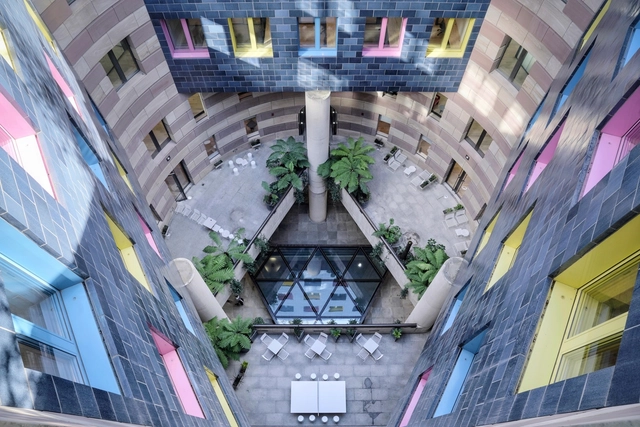
No 1 Poultry, the iconic Grade II* listed landmark in London designed by James Stirling, has opened its doors as WeWork’s 28th London location. The Postmodern masterpiece now serves as a WeWork space for 2300 members, as well as shops, a roof garden, and a restaurant.
This article was originally published on April 22, 2016. To read the stories behind other celebrated architecture projects, visit our AD Classics section.
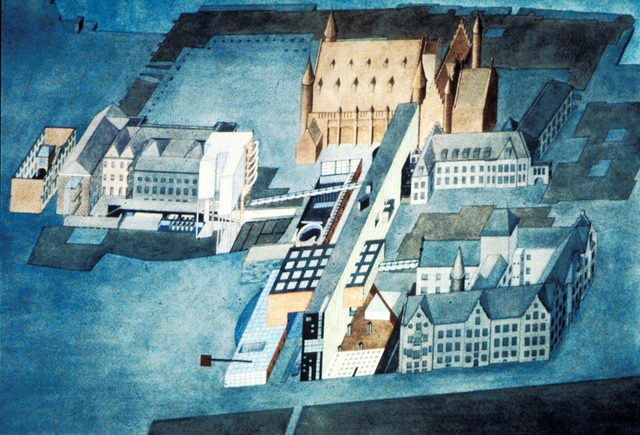
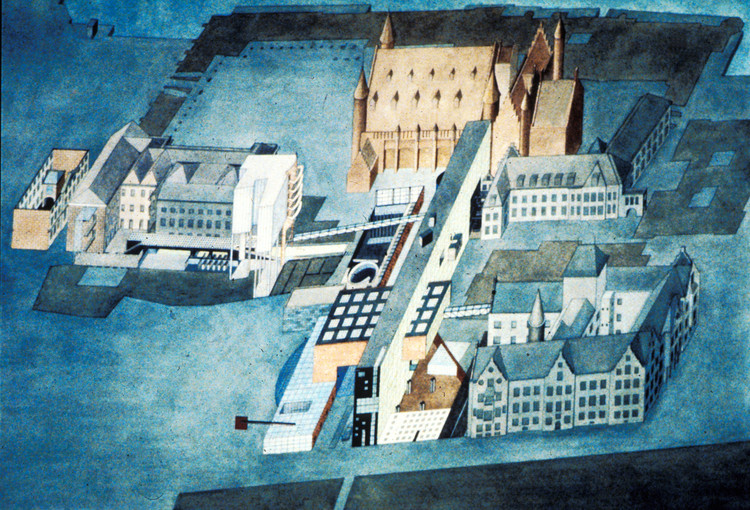
Designed shortly before Zaha Hadid left the Office of Metropolitan Architecture (OMA)—led by Rem Koolhaas—to found her practice, Zaha Hadid Architects, the proposed extension for the Dutch Parliament firmly rejects the notion that imitation is the sincerest form of flattery. Rather than mimic the style of the existing historic buildings, OMA elected to pay tribute to the complex’s accretive construction by inserting a collection of visibly postmodern, geometric elements. These new buildings, unapologetic products of the late 1970s, would have served as unmistakable indicators of the passage of time, creating a graphic reminder of the Parliament’s long history.
Robert Venturi (1925-2018) was the most influential American architect of the last century, though not primarily for his built work, or because of his stature as a designer. He will never stand beside Wright, or Kahn, or even Gehry in that regard. Between 1965 and 1985 he and his collaborator, Denise Scott Brown, changed the way all architects look at buildings, cities, and landscapes, much in the way that Marshall McLuhan, Bob Dylan and Andy Warhol changed our view of art, media, and popular culture during the same period.
I worked with Bob Venturi during my apprenticeship in the 1970s; I also grew up with his books, buildings and paternal influence. He and my father were one year apart; Denise is the same age as my mother.
https://www.archdaily.com/903226/robert-venturi-and-the-difficult-whole-how-architectures-enfant-terrible-changed-design-foreverMark Alan Hewitt
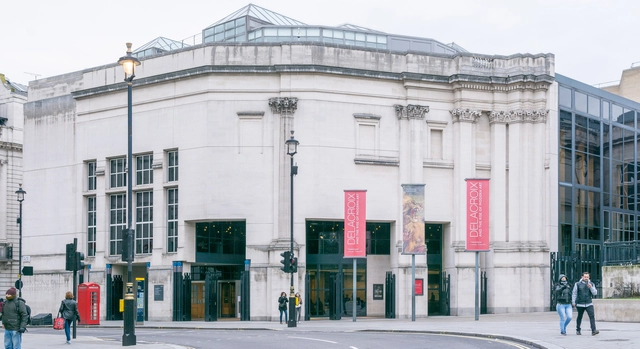
Venturi Scott-Brown’s National Gallery Sainsbury Wing extension (1991) was born into a precarious no-man’s land between the warring camps of neo-Modernists and traditionalists who had been tussling over the direction of Britain’s cities for much of the prior decade. The site of the extension had come to be one of the most symbolic battlefields in British architecture since a campaign to halt its redevelopment with a Hi-Tech scheme by Ahrends Burton Koralek had led to that project’s refusal at planning in 1984.
There are so many complexities and contradictions in life in general and architecture in particular. I am writing this intro to an interview I held in 2004 with Robert Venturi and his life-and-architecture partner Denise Scott Brown, while visiting Beijing’s Tsinghua University where I was invited to teach this fall. Was it simply a coincidence when, at the last moment before leaving my New York City apartment I would, almost by chance, grab a 2001 issue of Architecture magazine with Venturi on its cover and his contradictory quote, “I am not now and never have been a postmodernist.”
I learned of Venturi's passing last week on my first day of teaching at Tsinghua; the news arrived as I and the students discussed their proposals to improve their campus. In yet another strange coincidence, Venturi and Scott Brown had, just prior to our interview, been working on their own proposal for the very same campus. It was a pleasant and bittersweet surprise then to hear my students speak of freeing up the campus in much the same ways as Venturi's Complexity and Contradiction in Architecture attacked then domineering architecture of minimalism and abstraction over 50 years ago.
His and Scott Brown’s ideas for this campus did not materialize but their analytical and often rebellious thinking greatly influenced how students here and architects all over the world approach architecture. It was Venturi who freed our discipline, it was him who set us all free and encouraged to ask our own questions, to get away from all kinds of dogmas and to provoke ideas of hybridization. What follows is an excerpt from my conversation with the architects at their office in Philadelphia 14 years ago.
Robert Venturi - and the postmodernist movement he helped to form - was occasionally a divisive figure. For hardcore modernists, the referencing of prior styles was an affront to the future-facing architecture they had tried to promote. For traditionalists, the ebullient and kitschy take on classicism was an insult to the elegance of the past.
https://www.archdaily.com/902446/this-week-in-architecture-complexity-and-contradictionKatherine Allen
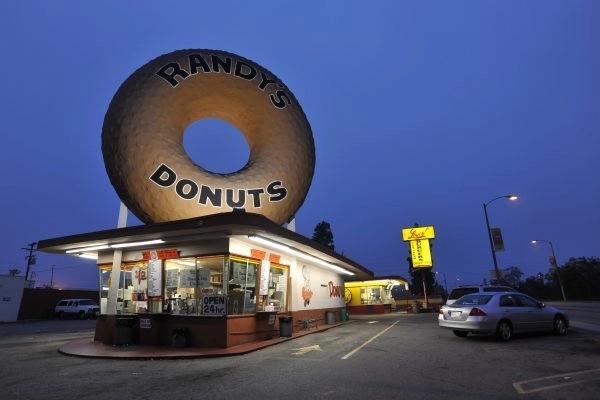
Randy’s Donuts shop and sign (a “decorated shed”) by Extra Medium (CC BY 2.0). Image via 99 Percent Invisible
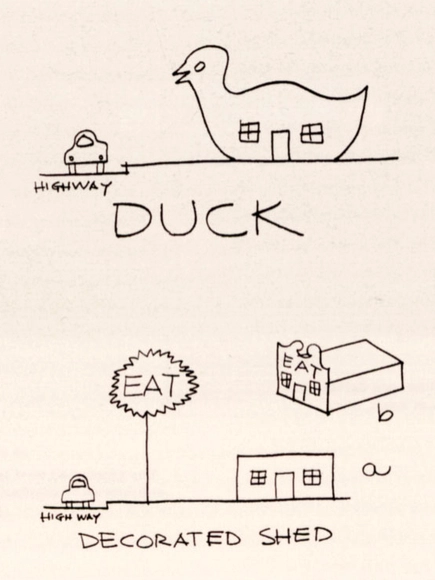
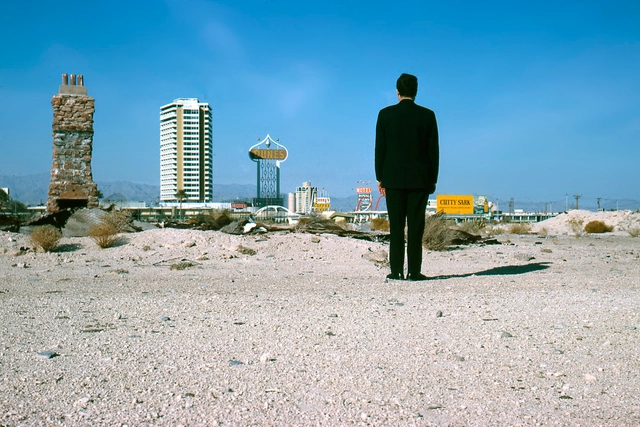
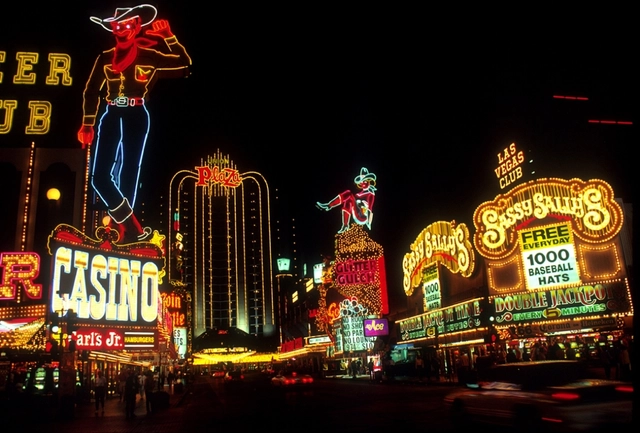
Though the Las Vegas Strip may be garish to some, with its borderline intrusive décor and “pseudo-historical” architecture, some professional architects, most notably Robert Venturi and Denise Scott-Brown, have become captivated by the “ornamental-symbolic elements” the buildings present. The two architects developed the curious design distinction between a “duck” and a “decorated shed”, depending on the building’s decorative form. In his essay for 99% Invisible, Lessons from Sin City: The Architecture of “Ducks” versus “Decorated Sheds”, Kurt Kohlstedt explores how the architects implemented their knowledge of ornamentation in their own works and began an architectural debate still ongoing today.
History has often been taught in a linear way. This way of teaching has often left out grand historical narratives, and focused primarily on the occidental world.
https://www.archdaily.com/899511/controversial-snohetta-renovation-of-philip-johnsons-at-and-t-headquarters-halted-by-individual-landmark-designationNiall Patrick Walsh
Which building is better, the duck or the ornamented shed? More importantly, what kind of architecture does the average American prefer? In their landmark 1972 publication Learning From Las Vegas, Denise Scott Brown and Robert Venturi probed these questions by turning their back on paternalistic modernism in favor of the glowing, overtly kitsch, and symbolic Mecca of the Las Vegas strip. From a chance encounter during a meeting in the Library of Fine Arts at the University of Pennsylvania and shared trips to the strip to critically shaping a new generation of architects, discover the hidden details of the romance and city that defined postmodernism in this latest episode from 99% Invisible.
Historic England has given protection to 17 Post-Modern buildings through their new listing publication. The bold, playful examples of a critical reaction to Modernism, designed between 1970 and 1990, have been listed to stem losses for the valued architectural style, following a recommendation from the UK government’s Department for Digital, Culture, Media, and Sport.
The listed schemes vary in terms of location and use, encompassing culture, housing, education, civic, commercial, and law. From Crown Courts in Cornwall and warehouses in Slough to libraries in Cambridge and housing schemes in London, the listings reflect a revived interest in Post-Modernism, which was spurred by the 2011 “Style and Subversion” exhibition at the V&A in London.
https://www.archdaily.com/894348/historic-england-celebrates-postmodernism-with-17-new-heritage-listingsNiall Patrick Walsh
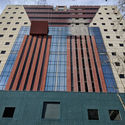
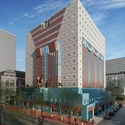
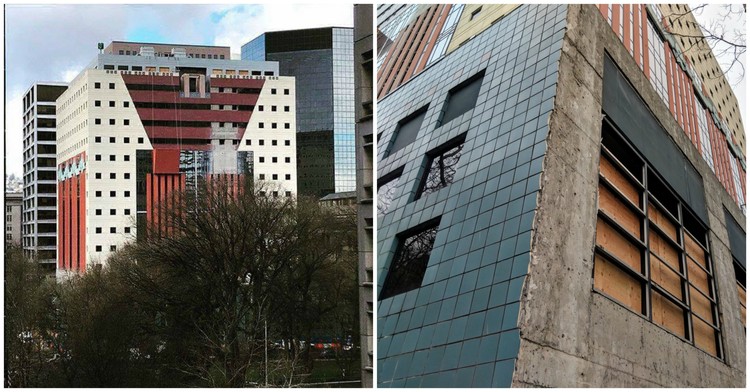
Work has begun on the dismantling of the facade of Michael Graves’ iconic Portland Building, part of a $195 million project that could see the building lose its inclusion on the National Register of Historic Places.
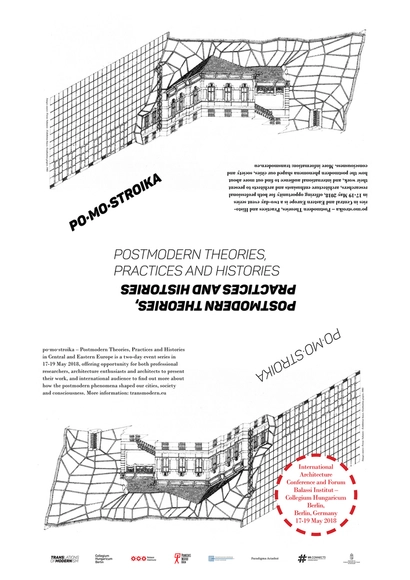
po·mo·stroika – Postmodern Theories, Practices and Histories in Central and Eastern Europe is a two-day event series in 17-19 May 2018, offering opportunity for both professional researchers, architecture enthusiasts and architects to present their work, and international audience to find out more about how the postmodern phenomena shaped our cities, society and consciousness.
The main aim of the program is to create a forum and provide a platform for starting new discussions and breaking the mental barriers behind which the amazing heritage of this era and region is still hidden. Besides the 20-30 minutes long presentations, the event will be enhanced by film screening, workshops and other programmes.
The event is organized by the Budapest-based Translations of Modernism (Transmodern) collective in partnership with the Collegium Hungaricum Berlin.
The argument, made by architectural historian Charles Jencks in the introduction for the recently released book Postmodern Design Complete, that Postmodern styles never truly left the architectural profession is stronger than ever. The movement from the late 70s and 80s which began as a reaction against the utopian canon of modernism has recently been re-entering the architecture scene and defining our present moment of architectural culture.
This brings up an important question: What is the current movement of architecture? And what came directly after postmodernism? If anything, it was an immediate cry of “No more Po-Mo,” followed recently by a wave of “save Po-Mo” perhaps best demonstrated by the rallying to save Philip Johnson’s AT&T Tower from a Snøhetta makeover. Even Norman Foster claimed that although he was never a fan of the postmodern movement, he understood its importance in architectural history. Postmodernism is making its recursive return with Stirling-esque rule-breaking jokes and pictorial appearances.
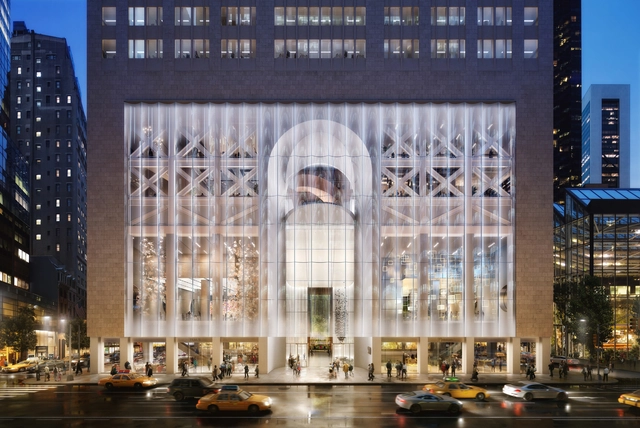
The designs by Snøhetta for the renovation of the building at 550 Madison Avenue have launched the building to the forefront of the debate about the preservation of Postmodern heritage. The plans include replacing the stone facade with undulating glass in order to transform the building's street presence. Should plans progress, the once prominent arched entry will sit behind fritted glass and stone covered columns will be unwrapped to create a hovering datum.
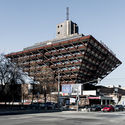
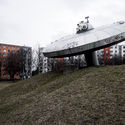
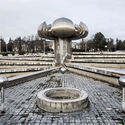
The history of Slovakia is riddled with political unrest and unwanted occupation, with the Slovak people having repeatedly been denied a voice throughout history. In the years following World War I, Slovakia was forced into the common state of Czechoslovakia; the territory was dismembered by the Nazi regime in 1938 and occupied by the Nazis for most of the Second World War, before being eventually liberated by Soviet and Romanian forces in 1945. Over the next four decades of communist rule—first by communists within Czechoslovakia itself and then later by the Soviet Union—the architecture of Slovakia came to develop into a unique form of sci-fi postmodernism that celebrated the shift in industrial influence at the time.
Photographer Stefano Perego has documented the Slovakian architecture from the 1960s–80s and has shared some of his photos with ArchDaily.
People perceive architecture in different ways. “Style” is often an easy classification, traditional or modern. Popular residential work is often categorized dismissively by architects as “vernacular.” The branding of the product of the profession, an oeuvre of work embodied in buildings and their meaning in our culture as celebrated by the American Institute of Architects, has many levels of recognition, from local AIA Chapter Awards, to national Awards.
No AIA Award has more meaning or lustre inside the profession than the “Twenty-five Year Award” for buildings that have “stood the test of time.” The award has been given continuously for the last 56 years. This year, the Design Jury chosen to select a seminal building has opted not to give an award to anything, any building 25-35 years old.
While the exterior of Philip Johnson’s iconic AT&T awaits its fate in an upcoming New York City landmarks designation hearing, demolition of its granite-clad interior lobby has already begun.
Citing the fact that the lobby had already been altered in the 1990s – including the removal of the “Golden Boy” statue – when the building switched tenants from AT&T to the Sony Corporation, the Landmarks Preservation Commission decided last month that the interiors were not deserving of landmark status.








.jpg?1537702346&format=webp&width=640&height=580)
.jpg?1537701733)


.jpg?1537702346)













.jpg?1516086194&format=webp&width=640&height=580)