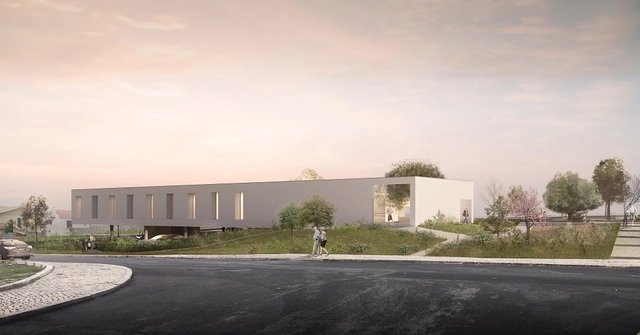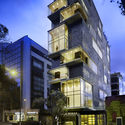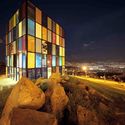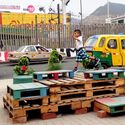
Vista general del memorial sobre el cementerio . Image Cortesía de Fabián Leiva
The "Floating Cemetery of Alto Biobío" project, developed by Universidad de Chile architect Fabián Leiva, proposes a memorial for the Quepuca cemetery—one of 14 flooded following the construction of the Ralco hydroelectric plant. The design features a monomaterial concrete volume positioned over the flooded cemetery to establish a vertical communication between the living and the dead, creating a point of connection between them.
Electric scooters, used in major cities around the world as an urban mobility alternative, have been available to São Paulo residents on the capital's bike lanes since the beginning of this month. On August 11 and 12, two mobility startups presented their service options for the vehicles.
The Bardi Institute has just inaugurated its "Summer Pavilion," a structure built at the foot of the Glass House by Lina Bo Bardi, which will host a schedule of concerts, exhibitions, lectures, and other events. Built amidst the vegetation and featuring an organic shape that evokes Lina's work, the pavilion both blends in and stands out in its context. All proceeds raised during these activities will go toward the maintenance and cultural programming of the Bardi Institute / Glass House in 2019.
Read the project description by Sol Camacho below.
At ArchDaily en Español, we understand the importance of staying in constant contact with architecture students, who will be responsible for designing and building the cities of the future. For this reason, we periodically open a call for applications to join our editorial team through our internship program.
If you currently live in Chile, this could be your opportunity to contribute local content to the world's most visited architecture platform, which inspires and informs hundreds of thousands of architects worldwide. If you are interested, keep reading below.
A few days ago, we welcomed @archdailyco to Instagram. ArchDaily Colombia's dedicated account on the platform serves as a new showcase for local architecture. To mark this milestone, we invited our readers to share their best photos of Colombian architecture using the hashtag #ArchDailyCo.
Today, we present six of the best photos, along with ArchDaily Colombia's featured project of the week on our Instagram account. This inaugural selection spans Bogotá and Medellín, contrasting concrete and brick, while showcasing both bird's-eye cityscapes and architectural details captured by our followers.
Remember to tag your future photos of Colombian architecture on Instagram with the hashtag #ArchDailyCo for a chance to be featured in our next roundup.
Plaza Paz Soldán - tres finalistas. Image Cortesía de Municipalidad de San Isidro
The integration of art and architecture to build a crucial public space at the Paz Soldán roundabout—one of the most iconic and highly trafficked areas in Lima's San Isidro district—was one of the major challenges presented by the Municipality of San Isidro and Grupo Centenario when they launched the Paz Soldán Plaza National Competition. The competition is part of the "2021: Bicentennial Projects" initiative, directed by Gary Leggett.
Among its primary objectives, the competition seeks the transformation of the primarily vehicular roundabout into a freely accessible pedestrian plaza. Additionally, it proposes the spatial integration of the new Paz Soldán Plaza with the monumental area of El Olivar forest, not only establishing this new area as a gateway to the park but also making it a benchmark for other areas of the city. Meanwhile, the anticipated public art proposal offers a reflection on the role of art in public space. It is also worth noting the broad vision of the roundabout as an urban complex, extending beyond the specific area of intervention.
The three finalists and two honorable mentions have already been announced. Out of 160 registered teams, 60 submitted entries. The jury comprised architects Óscar Borasino, Sharif Kahatt, and Michelle Llona, along with art specialists Max Hernández Calvo and Natalia Majluf. The process was advised by specialists including Juan Carlos Dextre, on mobility and traffic impact, and Patricia Dias, on heritage. Finally, the selection of the winner will include a double-weighted vote from the San Isidro Neighborhood Boards.
We spoke with Griselda Balian and Gastón Noriega, members of the Argentine architecture studio BAAG —Buenos Aires Arquitectura Grupal— a team that, through its understanding of the value of collective work, aims to make an exploratory contribution to the discipline.
In the late 19th century, Santa Lucía Hill in Santiago, Chile, underwent a radical transformation, evolving from a rocky outcrop in the center of the capital into a vibrant green space. During the hill's redevelopment, the mayor of Santiago at the time, Benjamín Vicuña Mackenna, converted one of its structures, Hidalgo Fort, into a castle that housed a history museum. Reduced to an administrative warehouse during the 20th century, the fort—originally built in 1816—was converted into an event venue in 1997 and is now preparing for its most significant renovation since its construction.
According to the Chilean newspaper La Tercera, Castillo Hidalgo will be transformed into a cultural center featuring “a convention center and a laboratory.” This will allow the venue to open its doors for more than just private events, especially since Santa Lucía Hill receives over 600,000 tourists annually, according to figures from the Municipality of Santiago.
The website Enterreno is building the first “collaborative time machine” using historical images, allowing thousands of people to travel through time via their mobile devices from anywhere in the country or the world. The platform features over 45,000 photographs revealing what Chile was like in both the distant and recent past, shared by everyday people from their family archives and other sources.
By the end of 2018, at least five cities in Germany could test a model approach to combating pollution. The trial will discourage private vehicle use while offering free public transit—a solution currently adopted in only a few places.
Bonn, Essen, Herrenberg, Reutlingen, and Mannheim are the German cities included in the proposal drafted by the federal government. “We are considering making public transport free of charge to reduce the number of private cars,” German ministers stated in a letter sent to the European Commission. “Fighting air pollution effectively without unnecessary delays is of the highest priority for Germany,” the document adds.
Ponentes del V Congreso Internacional de Arquitectura y Sociedad. Image Cortesía de Fundación Arquitectura y sociedad
On June 14, the second and final day of the 5th International Congress of Architecture and Society took place at the Baluarte Congress Center and Auditorium of Navarre in Pamplona, Spain. The day's sessions focused on topics as diverse as urban development, the political ecology of cities, mobility, and the future of our cities.
Architects Farshid Moussavi and Belinda Tato opened the day's first session, focusing their reflections on the importance of public spaces in cities as “generators of citizenship.” Both experts also highlighted the role of people in shaping cities.
https://www.archdaily.com/1113748/jan-gehl-we-have-lost-the-ability-to-create-neighborhoods-where-it-is-a-pleasure-to-grow-up-and-grow-oldJavier García Librero
Curated by Irish duo Yvonne Farrell and Shelley McNamara, partners at Grafton Architects, this year's theme seeks to reveal "diversity, specificity, and continuity in architecture." According to Paolo Baratta, president of La Biennale di Venezia, FREESPACE aims to promote "desire" in architecture.
A "common, everyday, and collective" space is the goal set by the curatorial team of the upcoming 2019 Chilean Architecture and Urbanism Biennial. This was announced during the official launch last Thursday, November 8, at the headquarters of the Architects Association of Chile (Colegio de Arquitectos) in Santiago.
The first edition of the Biennial to be held in Santiago since 2013—the last two editions took place in Valparaíso—will be located in the traditional Franklin neighborhood of the Santiago commune, a historic sector of the capital currently undergoing urban transformation driven by real estate pressure, commercial reconversion, and historic preservation.
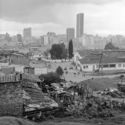
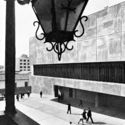
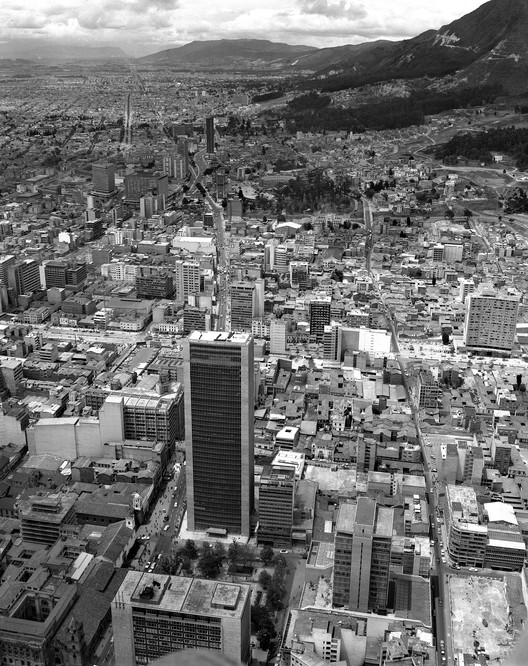
The modernization of Bogotá between 1940 and 1970, captured in urban and architectural photo essays, was documented in various books, magazines, and photobooks of the era, as well as in images from public and private archives across the city. These images reveal an intentional, and even critical, approach to how modern architecture reconfigured city centers, placing new buildings and urban spaces in relation to the existing cityscape.
In analyzing the impact of photojournalism, the work of Sady González, Manuel H. and Daniel Rodríguez is essential. Architecture and the city serve as the backdrop for scenes of urban life, characters, events, and daily activities. Their photographs offer an indispensable visual testament for understanding the city's transformation and its historical context.
The 2018 International Housing Finance Summit, organized by INFONAVIT, brought together experts from various disciplines to discuss the future of cities and the lessons learned to date. Held on May 2 and 3 at the Camino Real Polanco, the event hosted prominent figures who examined urban transformation processes to evaluate models that could guide us toward an integrated urban plan.
As part of a generation of photographers who in recent years have helped place Mexican architecture on the global map, Jaime Navarro is one of the key figures who has navigated the technological transition shaping a new way of seeing and practicing architecture. As one of the country's most recognized photographers, Jaime Navarro's approach aims for photography that can help document the beauty and goodness of specific historical moments, witnessing how we relate, what moves us, and what transcends disciplinary boundaries to build new futures. Below, we present an exclusive interview that showcases his career and the admiration of the ArchDaily team.
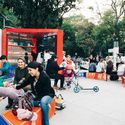
The 2nd Placemaking Latinoamérica Summit—organized by Lugares Públicos A.C.—took place in Mexico City during the first and second weeks of November. It featured various activities, including the rehabilitation of eight public spaces led by Mexican and Latin American participatory urban planning specialists in the boroughs of Cuauhtémoc, Iztacalco, and Miguel Hidalgo.
These interventions were carried out as part of a broader effort to reflect and act on the Placemaking methodology at a Latin American scale, fostering collaboration between organizations from different countries to improve public space. This process is detailed in the "White Paper on Latin American Placemaking: Tactical Urbanism and Innovation in Public Space Program," presented this week by the Alliance for Urban Regeneration (ARU) and Lugares Públicos.
Videos
Libro: Desde la resta. Image Cortesía de n`UNDO
More than six years have passed since n´UNDO launched its manifesto, which, through its 11 points, advocates for and promotes a new way of approaching architectural action based on non-construction and reuse. This approach is grounded in the re-architecture of territory and the city through subtraction and renunciation.
Since November 11, 2011, n`UNDO has built a highly active and compelling track record through urban and territorial intervention plans aimed at the social, cultural, environmental, and physical improvement and recovery of our surroundings. In addition, they have participated in several competitions, earning numerous awards and accolades, and have carried out extensive educational work through workshops, courses, lectures, and conferences. Notable among these was the symposium “Empty Space, Subtraction, and Silence: Subtraction and Renunciation in the Creative Process. An Interdisciplinary Perspective,” held in Madrid in November 2016.
https://www.archdaily.com/1113847/through-subtraction-a-different-and-necessary-way-of-shaping-the-cityJavier García Librero
We must talk about this issue repeatedly until we truly listen: the city of Lima turns its back on the Rímac River, which spoke loudly to us last year with overflows and disasters following the El Niño phenomenon. Meanwhile, calls emerged to improve the reality surrounding this important river and contribute to national reconstruction. In this context, the much-needed idea competition ‘Rímac River Park’, organized by the urban solutions incubator Lima Design Network, promoted various ways to protect the boundaries between nature and appropriation, highlighting the imminent urgency for public space. It will not be built—not for now—but through this publication, we aim to stir the waters once again and move people with these sensitive, ideal projects for the city.
For this International Women's Day, we have partnered with the Colombian print journal de-Arq (Universidad de Los Andes) to showcase the work of five contemporary Colombian architects. They represent distinct, complementary approaches within our discipline: design, research, teaching, and experimentation.
Today, we meet María Paula González Bozzi, founder and director of Fundación Juligón.
The Venice Biennale appointed Irish architects Yvonne Farrell and Shelley McNamara (Grafton Architects) for the 16th International Architecture Exhibition. “Freespace” is the theme, resulting from a series of lectures previously referenced by both architects in publications, exhibitions, and biennales: Architecture and New Geography, Arena for Learning, The Physics of Culture, and Dialogue and Translation. For Farrell and McNamara, “Freespace,” as a compound word, means:
https://www.archdaily.com/1113841/yvonne-farrell-and-shelley-mcnamara-directors-of-the-2018-venice-biennale-define-the-theme-freespaceJuan José Kochen
Edificio Capitol. Eced y Feduchi. Image Cortesía de Open House Madrid
Under the slogan Madrid in October is Architecture, details have been announced for the fourth edition of the Open House Madrid architecture and city festival. Led by architects Paloma Gómez Marín and Pati Núñez, this year's event will feature the most extensive program of any edition to date.
During the weekend of September 29 and 30, more than 120 buildings that are usually closed to the public will open their doors. In addition, over 30 activities have been organized throughout October, making this festival one of the most important cultural events of the year in the Spanish capital.
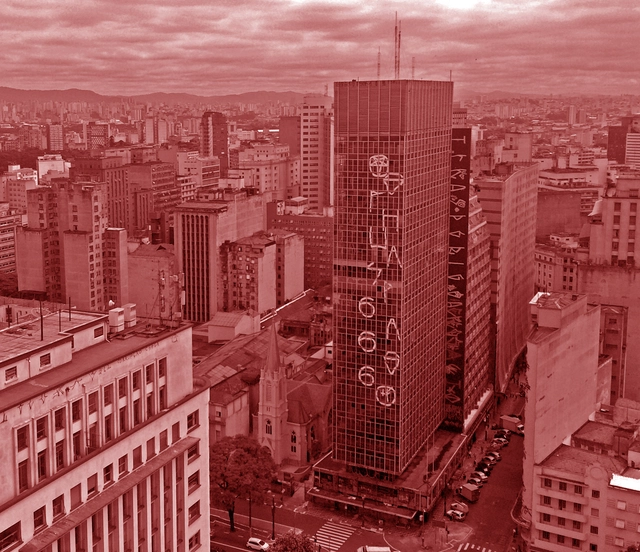
Exactly five months ago, residents of São Paulo witnessed the tragic collapse of the Wilton Paes de Almeida Building. Following a massive fire, the structure of the iconic 24-story modern building came down, leaving dozens dead and injured, and hundreds homeless. Located at the intersection of Rio Branco Avenue and Largo Paissandu, the collapse also affected three other adjacent buildings, including the headquarters of the Lutheran Church of São Paulo.